Kirjojen hintavertailu. Mukana 11 244 527 kirjaa ja 12 kauppaa.

Kirjahaku

Etsi kirjoja tekijän nimen, kirjan nimen tai ISBN:n perusteella.

533 tulosta hakusanalla Jenee M Edwards

Dance and the Music of J. S. Bach, Expanded Edition

Dance and the Music of J. S. Bach, Expanded Edition

Meredith Little; Natalie Jenne

Indiana University Press
2009
pokkari
Stylized dance music and music based on dance rhythms pervade Bach's compositions. Although the music of this very special genre has long been a part of every serious musician's repertoire, little has been written about it. The original edition of this addressed works that bore the names of dances—a considerable corpus. In this expanded version of their practical and insightful study, Meredith Little and Natalie Jenne apply the same principals to the study of a great number of Bach's works that use identifiable dance rhythms but do not bear dance-specific titles. Part I describes French dance practices in the cities and courts most familiar to Bach. The terminology and analytical tools necessary for discussing dance music of Bach's time are laid out. Part II presents the dance forms that Bach used, annotating all of his named dances. Little and Jenne draw on choreographies, harmony, theorists' writings, and the music of many seventeenth- and eighteenth-century composers in order to arrive at a model for each dance type. In Appendix A all of Bach's named dances are listed in convenient tabular form; included are the BWV number for each piece, the date of composition, the larger work in which it appears, the instrumentation, and the meter. Appendix B supplies the same data for pieces recognizable as dance types but not named as such. More than ever, this book will stimulate both the musical scholar and the performer with a new perspective at the rhythmic workings of Bach's remarkable repertoire of dance-based music.
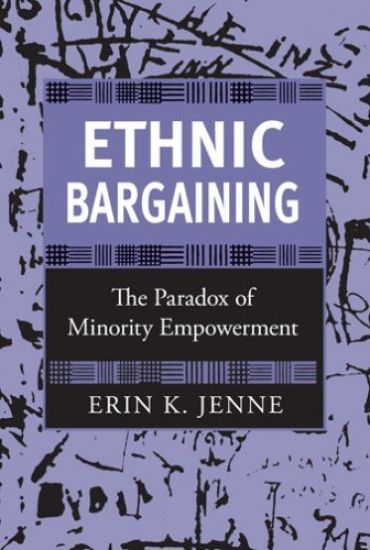
Ethnic Bargaining

Ethnic Bargaining

Erin K. Jenne

Cornell University Press
2006
sidottu
Ethnic Bargaining introduces a theory of minority politics that blends comparative analysis and field research in the postcommunist countries of East Central Europe with insights from rational choice. Erin K. Jenne finds that claims by ethnic minorities have become more frequent since 1945 even though nation-states have been on the whole more responsive to groups than in earlier periods. Minorities that perceive an increase in their bargaining power will tend to radicalize their demands, she argues, from affirmative action to regional autonomy to secession, in an effort to attract ever greater concessions from the central government. The language of self-determination and minority rights originally adopted by the Great Powers to redraw boundaries after World War I was later used to facilitate the process of decolonization. Jenne believes that in the 1960s various ethnic minorities began to use the same discourse to pressure national governments into transfer payments and power-sharing arrangements. Violence against minorities was actually in some cases fueled by this politicization of ethnic difference. Jenne uses a rationalist theory of bargaining to examine the dynamics of ethnic cleavage in the cases of the Sudeten Germans in interwar Czechoslovakia; Slovaks and Moravians in postcommunist Czechoslovakia; the Hungarians in Romania, Slovakia, and Vojvodina; and the Albanians in Kosovo. Throughout, she challenges the conventional wisdom that partisan intervention is an effective mechanism for protecting minorities and preventing or resolving internal conflict.
Nested Security

Nested Security

Erin K. Jenne

Cornell University Press
2015
sidottu
Why does soft power conflict management meet with variable success over the course of a single mediation? In Nested Security, Erin K. Jenne asserts that international conflict management is almost never a straightforward case of success or failure. Instead, external mediators may reduce communal tensions at one point but utterly fail at another point, even if the incentives for conflict remain unchanged. Jenne explains this puzzle using a "nested security" model of conflict management, which holds that protracted ethnic or ideological conflicts are rarely internal affairs, but rather are embedded in wider regional and/or great power disputes. Internal conflict is nested within a regional environment, which in turn is nested in a global environment. Efforts to reduce conflict on the ground are therefore unlikely to succeed without first containing or resolving inter-state or trans-state conflict processes. Nested security is neither irreversible nor static: ethnic relations may easily go from nested security to nested insecurity when the regional or geopolitical structures that support them are destabilized through some exogenous pressure or shocks, including kin state intervention, transborder ethnic ties, refugee flows, or other factors related to regional conflict processes. Jenne argues that regional security regimes are ideally suited to the management of internal conflicts, because neighbors that have a strong incentive to work for stability provide critical hard-power backing to soft-power missions. Jenne tests her theory against two regional security regimes in Central and Eastern Europe: the interwar minorities regime under the League of Nations (German minorities in Central Europe, Hungarian minorities in the Carpathian Basin, and disputes over the Åland Islands, Memel, and Danzig), and the ad hoc security regime of the post–Cold War period (focusing on Russian-speaking minorities in the Baltic States and Albanian minorities in Montenegro, Macedonia, and northern Kosovo).
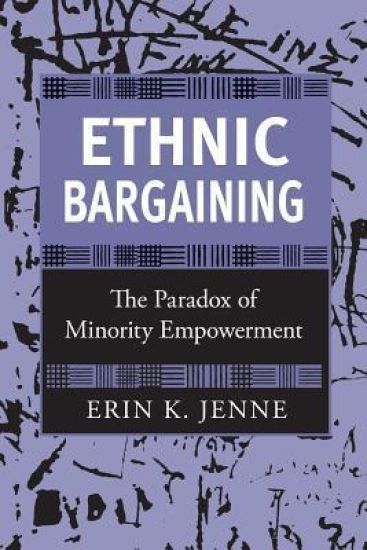
Ethnic Bargaining

Ethnic Bargaining

Erin K. Jenne

Cornell University Press
2014
pokkari
Ethnic Bargaining introduces a theory of minority politics that blends comparative analysis and field research in the postcommunist countries of East Central Europe with insights from rational choice. Erin K. Jenne finds that claims by ethnic minorities have become more frequent since 1945 even though nation-states have been on the whole more responsive to groups than in earlier periods. Minorities that perceive an increase in their bargaining power will tend to radicalize their demands, she argues, from affirmative action to regional autonomy to secession, in an effort to attract ever greater concessions from the central government. The language of self-determination and minority rights originally adopted by the Great Powers to redraw boundaries after World War I was later used to facilitate the process of decolonization. Jenne believes that in the 1960s various ethnic minorities began to use the same discourse to pressure national governments into transfer payments and power-sharing arrangements. Violence against minorities was actually in some cases fueled by this politicization of ethnic difference. Jenne uses a rationalist theory of bargaining to examine the dynamics of ethnic cleavage in the cases of the Sudeten Germans in interwar Czechoslovakia; Slovaks and Moravians in postcommunist Czechoslovakia; the Hungarians in Romania, Slovakia, and Vojvodina; and the Albanians in Kosovo. Throughout, she challenges the conventional wisdom that partisan intervention is an effective mechanism for protecting minorities and preventing or resolving internal conflict.
Food Resources

Food Resources

Teresa Skinner; Irene Jense

All Nations International
2018
pokkari
Food Resources introduces students to the basic elements of agricultural and animal husbandry, and feeding the hungry. Individuals will be able to quickly implement techniques and methods learned in rural and urban settings. Written in simple English, "Food Resources" is perfect for classroom settings or for one-on-one instruction.
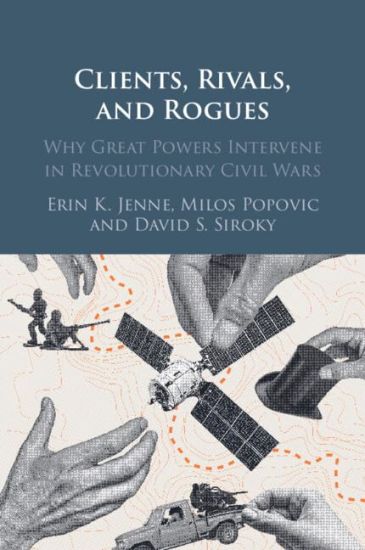
Clients, Rivals, and Rogues

Clients, Rivals, and Rogues

Erin K. Jenne; Milos Popovic; David S. Siroky

Cambridge University Press
2025
pokkari
Why do great powers intervene militarily in revolutionary civil wars? This pivotal question in international relations is answered though a new theory of security hierarchies that emphasizes the role of clients, rivals and rogues in world politics. Employing a mixed-methods approach, integrating statistical analysis with comprehensive case studies of Afghanistan, Libya, and Syria, this book demonstrates that great power interventions are significantly more constrained and predictable than previously assumed. Role theory and frame analysis further exhibit how the status of other states within a great power's security hierarchy influences interventions. The findings provide a lucid account of great power behavior, offering critical insights for scholars and policymakers interested in the international dimensions of intrastate conflicts. Clients, Rivals and Rogues shows that the strategies that underpin great power interventions and provides crucial lessons for the management of regime conflicts, one of the most common and deadly forms of political instability today.
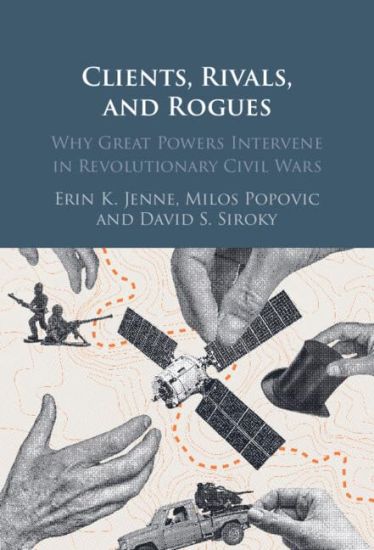
Clients, Rivals, and Rogues

Clients, Rivals, and Rogues

Erin K. Jenne; Milos Popovic; David S. Siroky

Cambridge University Press
2025
sidottu
Why do great powers intervene militarily in revolutionary civil wars? This pivotal question in international relations is answered though a new theory of security hierarchies that emphasizes the role of clients, rivals and rogues in world politics. Employing a mixed-methods approach, integrating statistical analysis with comprehensive case studies of Afghanistan, Libya, and Syria, this book demonstrates that great power interventions are significantly more constrained and predictable than previously assumed. Role theory and frame analysis further exhibit how the status of other states within a great power's security hierarchy influences interventions. The findings provide a lucid account of great power behavior, offering critical insights for scholars and policymakers interested in the international dimensions of intrastate conflicts. Clients, Rivals and Rogues shows that the strategies that underpin great power interventions and provides crucial lessons for the management of regime conflicts, one of the most common and deadly forms of political instability today.
The Complete Book of Sight Words

The Complete Book of Sight Words

Shannon Keeley; Janee (ILT) Trasler; Christy (ILT) Schneider

Spark Notes
2011
pokkari
This title teaches children to recognise common words that don't follow regular spelling rules. It features fun games and puzzles to keep children's interest level high. It is suitable for children aged 4 to 9 years old. Learning to recognise common words that don't follow regular spelling rules and can't be "sounded out" is an important step to becoming a strong reader. The engaging activities in this workbook teach 220 of these essential words in a structured format that encourages independent work. Fun games and puzzles keep children's interest level high, unit tests review and reinforce new vocabulary.
Photoshop Elements 2 Tips and Tricks

Photoshop Elements 2 Tips and Tricks

Gavin Cromhout; Janee Aronoff; Pete Walsh; Dan Caylor; George Kingsnorth

APress
2003
nidottu
An exciting collection of tips and tricks to help you make the most out of this amazing low-cost piece of software. We'll help you uncover some of the secrets hidden in Adobe Photoshop Elements 2, as well as nifty shortcuts - you'll work more effectively and have more time to play! You can learn a lot by experimenting, but it would take you a very long time to pick up the tips and tricks we show you in this book. We've pooled the knowledge of some highly experienced professionals to help provide this handy reference, and ordered them in a clear, logical way - keep this by your side and you'll certainly save time, as well as discover interesting and surprising new ways to manipulate your images. Whether you're just getting to grips with Elements or a more experienced user, this a great addition to your library, that you'll find you want to refer to time and again. From the Publisher We've packed this book full of tips on a wide range of subjects - from making selections to effects and filters - it's all here! Hundreds of hints come thick and fast, from half a page to two pages, every one designed to be used in a variety of situations. Each tip comes with a picture and information about how and when it's likely to be useful, so you'll know when to put it into action!
What Death Do We Part?

What Death Do We Part?

E. Jene Harris

Independently Published
2019
nidottu
Til death do us part. Most of us that have said it don't know how real those words are until we are living it. Until we are living the sex and money that destroys a marriage. Until we are living the backstabbing and revenge that destroys a marriage. Until we are living the struggles that destroy the people in a marriage. It's not until we are living with the dead and dying parts of a marriage that we understand the deaths that do us part. This is a story of just that. The decisions, the hurt...the deaths that do us part.
Get It!

Get It!

Jacqueline Laurita; Jene Luciani

BenBella Books
2016
sidottu
Hey, gorgeous! You know how you're always thinking about getting more organized? More focused? Healthier? Changing up your hair routine? And so many other things? It's time to stop thinking about it and do it! We know getting started seems overwhelming; we've been there. We're both busy professionals and moms, so we know how self-care gets pushed to the side. But that's not the way it should be! We want to help you become your best self--that's why we teamed up to write Get It! And gathered all our favorite tips, tricks, and secrets to help you get whatever "it" you want: Get Centered, Get on Track, Get Organized, Get Healthy, Get Fit, Get Beautiful Hair, Get Flawless Skin, Get Made Up, Get Stylish and Sexy--in just minutes a day. From finding a calm center amidst chaos and dressing for your body type in your 30s, 40s, and beyond, to getting in shape no matter what your schedule looks like and saving time on hair, makeup, and looking and feeling young, Get It! is the ultimate handbook to finding style, beauty, and wellness within yourself while getting exactly what you want out of life. We're so excited to share this book with you. Whatever you want--it's time to get it! XOXO, Jacqueline and Jene
Zählverfahren und Lastannahme in der Betriebsfestigkeit

Zählverfahren und Lastannahme in der Betriebsfestigkeit

Michael Köhler; Sven Jenne; Kurt Pötter; Harald Zenner

Springer-Verlag Berlin and Heidelberg GmbH Co. K
2012
sidottu
Be­triebs­fes­tig­keit be­deu­tet die si­che­re Be­mes­sung von Bau­tei­len un­ter re­a­lis­ti­schen Um­ge­bungs­be­din­gun­gen mit dem Ziel Leicht­bau. Im Mit­tel­punkt steht die Schwing­be­an­spru­chung. Bei der Be­mes­sung wird die zu erwartende Be­an­spru­chung (Be­las­tung) mit der Be­an­spruch­bar­keit (Fes­tig­keit) verglichen, wo­bei die für den An­wen­dungs­fall not­wen­di­ge Si­cher­heit ge­währ­leis­tet wer­den muss. Vo­raus­set­zung für die be­triebs­fes­te Be­mes­sung ist eine zu­ver­läs­si­ge Last­an­nah­me. Die Autoren stellen dar, wie die im Be­trieb ge­mes­se­nen Be­an­spru­chungs­zeit­funk­ti­o­nen durch Zähl­ver­fah­ren in Kol­lek­ti­ve oder Ma­tri­zen trans­for­miert wer­den kön­nen. Aus­führ­lich be­han­delt wird, wel­che As­pek­te zu be­ach­ten sind, um eine zu­ver­läs­si­ge Last­an­nah­me für die Be­mes­sung si­cher­zu­stel­len. Dazu wird ein­mal der the­o­re­ti­sche Hin­ter­grund der Le­bens­dau­er­ab­schät­zung von Bau­tei­len er­läu­tert, zum an­de­ren wer­den die Vor­ge­hens­wei­sen in zahl­rei­chen tech­ni­schen An­wen­dungs­fäl­len dis­ku­tiert. Für die Pra­xis um­setz­ba­re Emp­feh­lun­gen zu ge­ben, ist ein we­sent­li­ches An­lie­gen der Au­to­ren.
Load Assumption for Fatigue Design of Structures and Components

Load Assumption for Fatigue Design of Structures and Components

Michael Köhler; Sven Jenne; Kurt Pötter; Harald Zenner

Springer-Verlag Berlin and Heidelberg GmbH Co. K
2017
sidottu
Understanding the fatigue behaviour of structural components under variable load amplitude is an essential prerequisite for safe and reliable light-weight design.For designing and dimensioning, the expected stress (load) is compared with the capacity to withstand loads (fatigue strength). In this process, the safety necessary for each particular application must be ensured. A prerequisite for ensuring the required fatigue strength is a reliable load assumption.The authors describe the transformation of the stress- and load-time functions which have been measured under operational conditions to spectra or matrices with the application of counting methods. The aspects which must be considered for ensuring a reliable load assumption for designing and dimensioning are discussed in detail. Furthermore, the theoretical background for estimating the fatigue life of structural components is explained, and the procedures are discussed for numerous applications in practice. Oneof the prime intentions of the authors is to provide recommendations which can be implemented in practical applications.
Load Assumption for Fatigue Design of Structures and Components

Load Assumption for Fatigue Design of Structures and Components

Michael Köhler; Sven Jenne; Kurt Pötter; Harald Zenner

Springer-Verlag Berlin and Heidelberg GmbH Co. K
2018
nidottu
Understanding the fatigue behaviour of structural components under variable load amplitude is an essential prerequisite for safe and reliable light-weight design.For designing and dimensioning, the expected stress (load) is compared with the capacity to withstand loads (fatigue strength). In this process, the safety necessary for each particular application must be ensured. A prerequisite for ensuring the required fatigue strength is a reliable load assumption.The authors describe the transformation of the stress- and load-time functions which have been measured under operational conditions to spectra or matrices with the application of counting methods. The aspects which must be considered for ensuring a reliable load assumption for designing and dimensioning are discussed in detail. Furthermore, the theoretical background for estimating the fatigue life of structural components is explained, and the procedures are discussed for numerous applications in practice. Oneof the prime intentions of the authors is to provide recommendations which can be implemented in practical applications.