Kirjahaku
Etsi kirjoja tekijän nimen, kirjan nimen tai ISBN:n perusteella.
1000 tulosta hakusanalla Pamela Cook
It's Manchester 2179 where people are living in floating homes and travel in flying cars.Four children are exploring some Victorian houses, that are to be demolished, when they come across an unusual stone which catapults them back to the nineteenth century.Here they experience the horror of life for Victorian children. They encounter unsavoury body-snatchers, villainous overseers, and murderous gangs. Finding themselves in difficult and dangerous situations they wonder if they can survive.Why are they here and who, or what, is the mysterious force guiding them? And, above all, can they get back to their own time?

Billy is a six-year-old boy who wants nothing more than to stay up past his bedtime. Instead of going to sleep, he imagines all sorts of strange and spooky excuses to stay awake. Through love and reassurance, Billy's parents show him that there is nothing in the dark to be afraid of.Pamela Malcolm has created the perfect tale to read with any child who tries to avoid going to sleep. With memorable illustrations and an important message, Billy Go to Bed is a wonderful bedtime story that will be treasured by children and parents alike.



Heartbreaking and joyous, this memoir is a celebration of life and love. From finding God under her bed to wanting to be a nun, this is also a story of faith that is both faltering and fierce. Finding solace under a lucky bean tree, Pam develops a unique perspective of life. This tumultuous journey spans four continents and includes adventures such as wrestling in Mongolia, camel-riding in the Sahara and leopard-crawling along the Great Wall of China. First loves, marriage, children and family are a messy business. A psychiatrist is needed. Nervous breakdowns, Autism, ADHD, gay outing, trans-racial adoption, bankruptcy and on-line dating are all part of this rich, crazy tapestry. Threaded through the laugh-out-loud moments are the bitterly painful times of loss. Losing her beloved parents and ex-husband was indescribably difficult. Losing her son to cancer was impossible to process. Thankfully, she has faith and Pimms at her side...


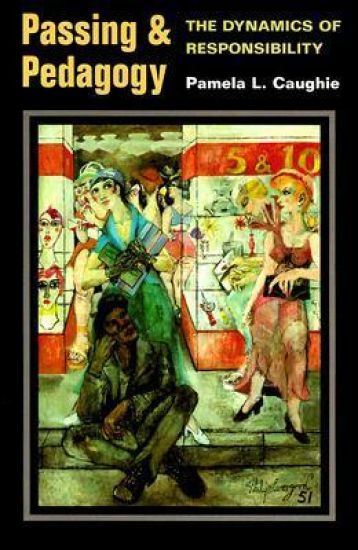
The current academic milieu displays a deep ambivalence about the teaching of Western culture and traditional subject matter. This ambivalence, the product of a unique historical convergence of theory and diversity, opens up new opportunities for what Pamela Caughie calls "passing":recognizing and accounting for the subject positions involved in representing both the material being taught and oneself as a teacher. Caughie's discussion of passing illuminates a recent phenomenon in academic writing and popular culture that revolves around identities and the ways in which they are deployed, both in the arts and in lived experience. Through a wide variety of texts-novels, memoirs, film, drama, theory, museum exhibits, legal cases-she demonstrates the dynamics of passing, presenting it not as the assumption of a fraudulent identity but as the recognition that the assumption of any identity, including for the purposes of teaching, is a form of passing. Astutely addressing the relevance of passing for pedagogy, Caughie presents the possibility of a dynamic ethics responsive to the often polarizing difficulties inherent in today's culture. Challenging and thought-provoking, Passing and Pedagogy offers insight and inspiration for teachers and scholars as they seek to be responsible and effective in a complex, rapidly changing intellectual and cultural environment.
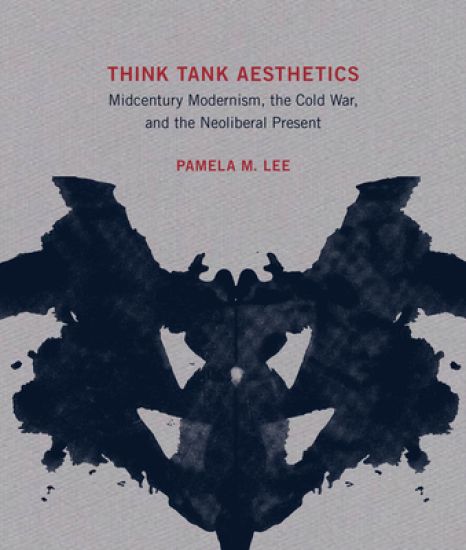
How the approaches and methods of think tanks—including systems theory, operational research, and cybernetics—paved the way for a peculiar genre of midcentury modernism.In Think Tank Aesthetics, Pamela Lee traces the complex encounters between Cold War think tanks and the art of that era. Lee shows how the approaches and methods of think tanks—including systems theory, operations research, and cybernetics—paved the way for a peculiar genre of midcentury modernism and set the terms for contemporary neoliberalism. Lee casts these shadowy institutions as sites of radical creativity and interdisciplinary practice in the service of defense strategy. Describing the distinctive aesthetics that emerged from such institutions as the RAND Corporation, she maps the multiple and overlapping networks that connected nuclear strategists, mathematicians, economists, anthropologists, artists, designers, and art historians.Lee recounts, among other things, the decades-long colloquy between Albert Wohlstetter, a RAND analyst, and his former professor, the famous art historian Meyer Schapiro; the anthropologist Margaret Mead's deployment of innovative visual aids that recall midcentury abstract art; and the combination of cybernetics and modernist design in an “Opsroom” for the short-lived socialist government of Salvador Allende in 1970s Chile (and its restaging many years later as a work of art). Lee suggests that we think of these connections less as disciplinary border crossings than as colonization of the specific interests of arts by the approaches and methods of the sciences. Hearing the echoes of think tank aesthetics in today's pursuit of the interdisciplinary and in academia's science-infused justification of the humanities, Lee wonders what territory has been ceded in a laboratory approach to the arts.
The work of art's mattering and materialization in a globalized world, with close readings of works by Takahashi Murakami, Andreas Gursky, Thomas Hirschhorn, and others.It may be time to forget the art world-or at least to recognize that a certain historical notion of the art world is in eclipse. Today, the art world spins on its axis so quickly that its maps can no longer be read; its borders blur. In Forgetting the Art World, Pamela Lee connects the current state of this world to globalization and its attendant controversies. Contemporary art has responded to globalization with images of movement and migration, borders and multitudes, but Lee looks beyond iconography to view globalization as a world process. Rather than think about the "global art world" as a socioeconomic phenomenon, or in terms of the imagery it stages and sponsors, Lee considers "the work of art's world" as a medium through which globalization takes place. She argues that the work of art is itself both object and agent of globalization.Lee explores the ways that art actualizes, iterates, or enables the processes of globalization, offering close readings of works by artists who have come to prominence in the last two decades. She examines the "just in time" managerial ethos of Takahashi Murakami; the production of ethereal spaces in Andreas Gursky's images of contemporary markets and manufacture; the logic of immanent cause dramatized in Thomas Hirschhorn's mixed-media displays; and the "pseudo-collectivism" in the contemporary practice of the Atlas Group, the Raqs Media Collective, and others.To speak of "the work of art's world," Lee says, is to point to both the work of art's mattering and its materialization, to understand the activity performed by the object as utterly continuous with the world it at once inhabits and creates.
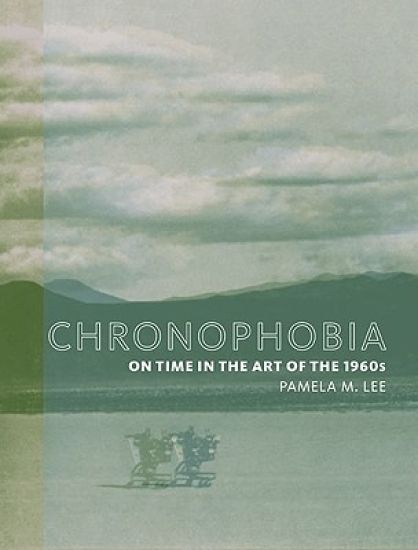
An examination of the pervasive anxiety about and fixation with time seen in 1960s art.In the 1960s art fell out of time; both artists and critics lost their temporal bearings in response to what E. M. Cioran called "not being entitled to time." This anxiety and uneasiness about time, which Pamela Lee calls "chronophobia," cut across movements, media, and genres, and was figured in works ranging from kinetic sculptures to Andy Warhol films. Despite its pervasiveness, the subject of time and 1960s art has gone largely unexamined in historical accounts of the period. Chronophobia is the first critical attempt to define this obsession and analyze it in relation to art and technology.Lee discusses the chronophobia of art relative to the emergence of the Information Age in postwar culture. The accompanying rapid technological transformations, including the advent of computers and automation processes, produced for many an acute sense of historical unknowing; the seemingly accelerated pace of life began to outstrip any attempts to make sense of the present. Lee sees the attitude of 1960s art to time as a historical prelude to our current fixation on time and speed within digital culture. Reflecting upon the 1960s cultural anxiety about temporality, she argues, helps us historicize our current relation to technology and time.After an introductory framing of terms, Lee discusses such topics as "presentness" with repect to the interest in systems theory in 1960s art; kinetic sculpture and new forms of global media; the temporality of the body and the spatialization of the visual image in the paintings of Bridget Riley and the performance art of Carolee Schneemann; Robert Smithson's interest in seriality and futurity, considered in light of his reading of George Kubler's important work The Shape of Time: Remarks on the History of Things and Norbert Wiener's discussion of cybernetics; and the endless belaboring of the present in sixties art, as seen in Warhol's Empire and the work of On Kawara.

Sugar & Spice: Baked With Love
Pamela Yaye; Kat Cantrell; Yahrah St. John
HARPERCOLLINS PUBLISHERS
2024
nidottu
Tantalising treats Jackson Drayson is challenged to launch a patisserie that rivals his cousins' shop. Soon, he’s winning over swarms of customers, including Grace Nicholas. The quiet master baker is also Jack’s top competition – and the one woman immune to his charms. But as passion ignites, Grace is accused of stealing his shop’s secret recipe. Torn between loyalty and love, will Grace decide they have a future together?•Getting the new location of his family’s patisserie off the ground is a full-time job for Chase Drayson. The driven accountant doesn’t have time for pleasure…until he locks eyes with the bakery’s beautiful barista. Amber Bernard is the wrong choice for anything long-term. And she isn’t willing to risk her professional future, no matter how sexy her boss is. But could a leap of faith lead to a lifelong love?•After Mariah Drayson’s marriage ends in heartbreak, the gifted baker is handed the opportunity to run a branch of her family’s legendary patisserie. The competition is stiff, until high-end coffee importer Everett Myers comes up with a tempting proposition. Joining forces with the alluring pastry chef is making the millionaire widower believe in second chances. But will Mariah’s secret cost her a future with Everett?
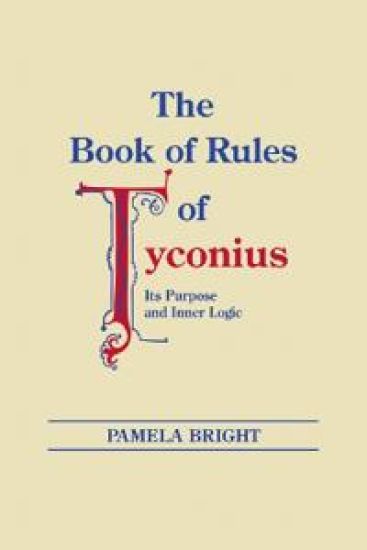
The Book of Rules of Tyconius: Its Purpose and Inner Logic
Pamela Bright
UNIVERSITY OF NOTRE DAME PRESS
2022
sidottu
The Liber Regularum, written by Tyconius in the Fourth Century A.D., was the first system of biblical interpretation proposed by a Latin theologian. Augustine was very interested in this work and included an extraordinary summation of it in his De doctrina christiana. Although this treatment insured the preservation of the work and its lasting fame, Augustine's summary became better known than the original. Pamela Bright's The Book of Rules of Tyconius: Its Purpose and Inner Logic reintroduces this neglected classic of early church literature. Bright asserts that although Augustine was greatly influenced by the Liber Regularum, his philosophical differences caused him to misunderstand its meaning. Bright reexamines the meaning of "prophecy" and "rule" from Tyconius's perspective and reveals that the purpose of the book was not to provide a general guide to scriptural interpretation, but rather a way to interpret apocalyptic texts. She cites Tyconius's intense concern with evil in the church as the genesis of his interest in the apocalypse and subsequently the meaning of the scripture concerning it. Tyconius speaks of the "seven mystical rules" of scripture that with the grace of the Holy Spirit reveal the true meaning of prophecy. If an interpreter follows the "logic" of these rules, the nature of the church as composed by both good and evil membership is revealed. Bright argues that Tyconius was not illogical or incompetent in the work's composition as many critics have claimed but rather that he organized his material in a concentric pattern so that Rule Four, the center of the seven rules, is also the central development of his theory. Of interest to theologians, students of biblical interpretation and of Augustine, The Book of Rules of Tyconius focuses attention upon a work that had great influence on the understanding of the nature of the church, on interpreting scripture, and its meaning for the Church of its day.
With Narrative and the Natural Law Pamela Hall brings Thomistic ethics into conversation with ongoing debates in contemporary moral philosophy, especially virtue theory and moral psychology, and with current trends in narrative theory and the philosophy of history. Pamela M. Hall's study offers a solid, challenging alternative to rigid, legalistic interpretations of the substantial discussion of law in Aquinas's Summa theologiae and defends Aquinas's ethics from charges of excessive legalism. Hall argues that Aquinas's characterization of the content and relationship of natural, human and divine law indicates that his understanding of the quest for the human good is practical, communal, and historical. Hall maintains that natural law, the ongoing inquiry into what is the human good, is narrative both in terms of its internal structure and its being informed by the specific story of Scripture. According to Aquinas the discovery of natural law is enacted historically and progressively within communities and by individuals through a process of practical reasoning. Hall then goes on to show how natural law requires articulation by human law, and how both are connected to divine law (salvation history) as Aquinas understands it. Aquinas represents inquiry into the human good as a kind of historical narrative or story with stages or "chapters"; thus knowledge of natural law requires time and experience, as well as sustained reflection by individuals and by whole communities. Such learning of natural law implies the operation of prudence and the assistance of the moral virtues.
With Narrative and the Natural Law Pamela Hall brings Thomistic ethics into conversation with ongoing debates in contemporary moral philosophy, especially virtue theory and moral psychology, and with current trends in narrative theory and the philosophy of history. Pamela M. Hall's study offers a solid, challenging alternative to rigid, legalistic interpretations of the substantial discussion of law in Aquinas's Summa theologiae and defends Aquinas's ethics from charges of excessive legalism. Hall argues that Aquinas's characterization of the content and relationship of natural, human and divine law indicates that his understanding of the quest for the human good is practical, communal, and historical. Hall maintains that natural law, the ongoing inquiry into what is the human good, is narrative both in terms of its internal structure and its being informed by the specific story of Scripture. According to Aquinas the discovery of natural law is enacted historically and progressively within communities and by individuals through a process of practical reasoning. Hall then goes on to show how natural law requires articulation by human law, and how both are connected to divine law (salvation history) as Aquinas understands it. Aquinas represents inquiry into the human good as a kind of historical narrative or story with stages or "chapters"; thus knowledge of natural law requires time and experience, as well as sustained reflection by individuals and by whole communities. Such learning of natural law implies the operation of prudence and the assistance of the moral virtues.
The Liber Regularum, written by Tyconius in the Fourth Century A.D., was the first system of biblical interpretation proposed by a Latin theologian. Augustine was very interested in this work and included an extraordinary summation of it in his De doctrina christiana. Although this treatment insured the preservation of the work and its lasting fame, Augustine's summary became better known than the original. Pamela Bright's The Book of Rules of Tyconius: Its Purpose and Inner Logic reintroduces this neglected classic of early church literature. Bright asserts that although Augustine was greatly influenced by the Liber Regularum, his philosophical differences caused him to misunderstand its meaning. Bright reexamines the meaning of "prophecy" and "rule" from Tyconius's perspective and reveals that the purpose of the book was not to provide a general guide to scriptural interpretation, but rather a way to interpret apocalyptic texts. She cites Tyconius's intense concern with evil in the church as the genesis of his interest in the apocalypse and subsequently the meaning of the scripture concerning it. Tyconius speaks of the "seven mystical rules" of scripture that with the grace of the Holy Spirit reveal the true meaning of prophecy. If an interpreter follows the "logic" of these rules, the nature of the church as composed by both good and evil membership is revealed. Bright argues that Tyconius was not illogical or incompetent in the work's composition as many critics have claimed but rather that he organized his material in a concentric pattern so that Rule Four, the center of the seven rules, is also the central development of his theory. Of interest to theologians, students of biblical interpretation and of Augustine, The Book of Rules of Tyconius focuses attention upon a work that had great influence on the understanding of the nature of the church, on interpreting scripture, and its meaning for the Church of its day.