The Middle East and Globalization discusses past and contemporary political, societal, economic, and cultural trends in the Middle East against the background of comprehensive theories of globalization. The chapters draw on a shared methodological approach, looking at the fractures and horizons of globalization that are shaping the Middle East.
Taking a glimpse into the impact of Christianity in one of Africa’s largest and fastest-evolving megacities, located in the Gauteng City-Region, this book explores how faith shapes the city and its society. Addressing a scarcity of religious scholarship in the field of urban studies, the book focuses on the Johannesburg-Pretoria corridor and Christian faith expressions in this evolving megacity. Stéphan de Beer highlights how city and faith are in conversation and explores various expressions of Christian faith in an ever-changing urban landscape. Connecting socio-spatial change in post-apartheid South African cities with the changing Christian landscape, the connections and disconnections between Christian faith expressions and urban change are interrogated. Chapters feature wide coverage across both cities, including places like Soweto and Sandton, Sunnyside and Soshanguve, and everything in between. Examining these contexts where global migration and Christian faith increasingly co-exist, the book provides valuable insights to students of religion, sociology and urban studies.
Glimpsing into the impact of Christianity in one of Africa’s largest and fastest-growing megacities, located in the Gauteng City-Region, this book explores how faith shaped the city and its society. Addressing a scarcity of religious scholarship in the field of urban studies, this book focuses on the Johannesburg–Pretoria corridor and Christian faith expressions in the evolving African megacity. Stéphan de Beer highlights how city and faith are in conversation and explores various expressions of Christian faith in this ever-changing urban landscape.Connecting socio-spatial change in post-apartheid South African cities with the changing Christian landscape, this book interrogates the connections and disconnections between Christianity and urban change. Chapters feature wide coverage across both cities, including the areas of Sandton, Tshwane, Woodlane Village and Soshang. Examining the contexts where global migration and Christian faith increasingly co-exist, this book provides valuable insights to students of religion, sociology and urban studies.
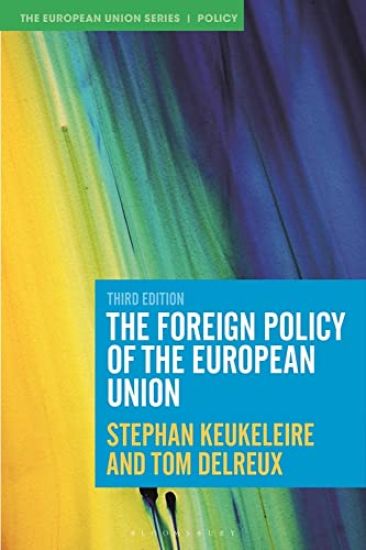
Keukeleire and Delreux demonstrate the scope and diversity of the European Union's foreign policy, showing that EU foreign policy is broader than the Common Foreign and Security Policy and the Common Security and Defence Policy, and that areas such as trade, development, environment and energy are inextricable elements of it. This book offers a comprehensive and critical account of the EU's key foreign relations – with its neighbourhood, with the US, China and Russia, and with emerged powers – and argues that the EU's foreign policy needs to be understood not only as a response to crises and conflicts, but also as a means of shaping international structures and influencing long-term processes.This third edition reflects recent changes and trends in EU foreign policy as well as the international context in which it operates, addressing issues such as the increasingly contested international order, the conflict in Ukraine, the migration and refugee crisis, Brexit and Covid-19. The book not only clarifies the formal procedures in EU foreign policy-making but also elucidates how it works in practice. The third edition includes new sections and boxes on ‘strategic autonomy’, European arms exports, the EU’s external representation, the ‘Brussels Effect’, and decentring and gender approaches to EU foreign policy.Up to date, jargon-free and supported by its own website (eufp.eu), this systematic and innovative appraisal of this key policy area is suitable for undergraduate and postgraduate students, as well as practitioners.
Keukeleire and Delreux demonstrate the scope and diversity of the European Union's foreign policy, showing that EU foreign policy is broader than the Common Foreign and Security Policy and the Common Security and Defence Policy, and that areas such as trade, development, environment and energy are inextricable elements of it. This book offers a comprehensive and critical account of the EU's key foreign relations – with its neighbourhood, with the US, China and Russia, and with emerged powers – and argues that the EU's foreign policy needs to be understood not only as a response to crises and conflicts, but also as a means of shaping international structures and influencing long-term processes.This third edition reflects recent changes and trends in EU foreign policy as well as the international context in which it operates, addressing issues such as the increasingly contested international order, the conflict in Ukraine, the migration and refugee crisis, Brexit and Covid-19. The book not only clarifies the formal procedures in EU foreign policy-making but also elucidates how it works in practice. The third edition includes new sections and boxes on ‘strategic autonomy’, European arms exports, the EU’s external representation, the ‘Brussels Effect’, and decentring and gender approaches to EU foreign policy.Up to date, jargon-free and supported by its own website (eufp.eu), this systematic and innovative appraisal of this key policy area is suitable for undergraduate and postgraduate students, as well as practitioners.
This work has been selected by scholars as being culturally important, and is part of the knowledge base of civilization as we know it. This work was reproduced from the original artifact, and remains as true to the original work as possible. Therefore, you will see the original copyright references, library stamps (as most of these works have been housed in our most important libraries around the world), and other notations in the work.This work is in the public domain in the United States of America, and possibly other nations. Within the United States, you may freely copy and distribute this work, as no entity (individual or corporate) has a copyright on the body of the work.As a reproduction of a historical artifact, this work may contain missing or blurred pages, poor pictures, errant marks, etc. Scholars believe, and we concur, that this work is important enough to be preserved, reproduced, and made generally available to the public. We appreciate your support of the preservation process, and thank you for being an important part of keeping this knowledge alive and relevant.
This work has been selected by scholars as being culturally important, and is part of the knowledge base of civilization as we know it. This work was reproduced from the original artifact, and remains as true to the original work as possible. Therefore, you will see the original copyright references, library stamps (as most of these works have been housed in our most important libraries around the world), and other notations in the work.This work is in the public domain in the United States of America, and possibly other nations. Within the United States, you may freely copy and distribute this work, as no entity (individual or corporate) has a copyright on the body of the work.As a reproduction of a historical artifact, this work may contain missing or blurred pages, poor pictures, errant marks, etc. Scholars believe, and we concur, that this work is important enough to be preserved, reproduced, and made generally available to the public. We appreciate your support of the preservation process, and thank you for being an important part of keeping this knowledge alive and relevant.
The thrilling true story of an Israel spyâ??s epic journey to bring the notorious Butcher of Latvia to justice. A page-turner to rival anything by John le Carre, this real-life tale of espionage will leave readers on the edge of their seats.
Before the Second World War, Herbert Cukurs was a world-famous aviator and a hero in his hometown of Riga, Latvia. During the war he joined the SS, led a militia and was responsible for the genocide of 30,000 Latvian Jews. By the 1960s the man who became known as the Butcher of Riga was living in South America. And Mossad were coming for him. In 1965, a statute of limitations on Nazi war crimes threatened to expire and Germany was seeking to reintegrate concentration camp commanders, pogrom leaders and executioners. The global hunt for Nazi criminals was stepped up, and a target was painted on the back of Cukurs. Yaakov Meidad, the Mossad agent who had kidnapped Adolf Eichmann three years earlier, was called into action once more, leading to an astonishing undercover operation that saw Meidad travel to Brazil in an elaborate disguise before befriending Cukurs and earning his trust. Uncovering a little-known part of Holocaust history and telling the story of one of the most daring operations in the history of the Israeli intelligence community, The Good Assassin is a thrilling story of a forgotten monster and the twenty-year quest to bring him to justice, told by a master of narrative non-fiction.
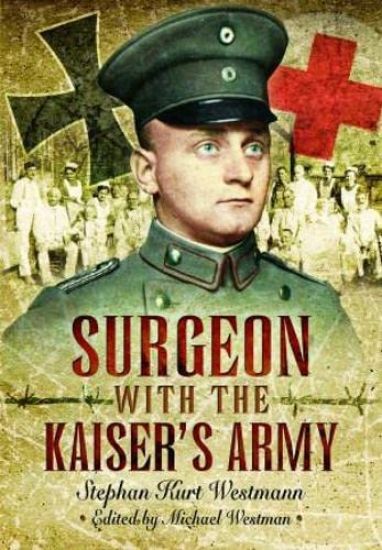
The Author gave up his medical studies at Freiburg University in 1914 to enlist in the German Army. He was soon involved in bloody hand-to-hand fighting against the French before moving to the Russian front. Promoted to medical officer, despite being unqualified and barely into his twenties, he is given command of an ambulance train on the Western Front. He treats and operates on wounded of all nationalities and ranks and rescues British and German soldiers after gas attacks on the trenches of the Somme. As medical officer to the German Air Force (von Richthofen Circus) Westmann sees the dangers and effects of aerial combat at first hand. He witnesses the British tank attacks at Cambrai. His writing graphically illustrates life and death in the front line, the carnage and humour that sustained soldiers of all nationalities. Westmanns insights into the social, political, religious, economic and medical aspects of war time life are particularly revealing. The text is enhanced by contemporary photographs.
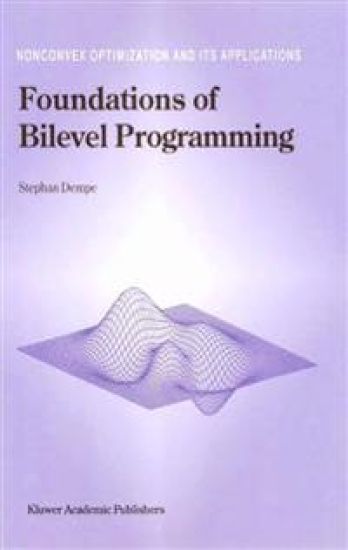
Bilevel programming problems are hierarchical optimization problems where the constraints of one problem (the so-called upper level problem) are defined in part by a second parametric optimization problem (the lower level problem). If the lower level problem has a unique optimal solution for all parameter values, this problem is equivalent to a one-level optimization problem having an implicitly defined objective function. Special emphasize in the book is on problems having non-unique lower level optimal solutions, the optimistic (or weak) and the pessimistic (or strong) approaches are discussed. The book starts with the required results in parametric nonlinear optimization. This is followed by the main theoretical results including necessary and sufficient optimality conditions and solution algorithms for bilevel problems. Stationarity conditions can be applied to the lower level problem to transform the optimistic bilevel programming problem into a one-level problem. Properties of the resulting problem are highlighted and its relation to the bilevel problem is investigated. Stability properties, numerical complexity, and problems having additional integrality conditions on the variables are also discussed. Audience: Applied mathematicians and economists working in optimization, operations research, and economic modelling. Students interested in optimization will also find this book useful.
In the deep sub-micron regime, the power consumption has become one of the most important issues for competitive design of digital circuits. Due to dramatically increasing leakage currents, the power consumption does not take advantage of technology scaling as before. State-of-art power reduction techniques like the use of multiple supply and threshold voltages, transistor stack forcing and power gating are discussed with respect to implementation and power saving capability. Focus is given especially on technology dependencies, process variations and technology scaling. Design and implementation issues are discussed with respect to the trade-off between power reduction, performance degradation, and system level constraints. A complete top-down design flow is demonstrated for power gating techniques introducing new design methodologies for the switch sizing task and circuit blocks for data-retention and block activation. The leakage reduction ratio and the minimum power-down time are introduced as figures of merit to describe the power gating technique on system level and give a relation to physical circuit parameters. Power Management of Digital Circuits in Deep Sub-Micron CMOS Technologies mainly deals with circuit design but also addresses the interface between circuit and system level design on the one side and between circuit and physical design on the other side.