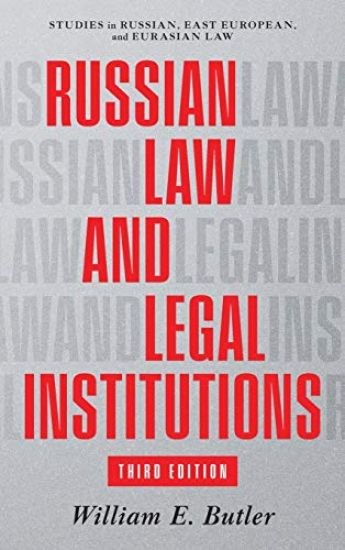
The massive amendments in 2020 to the Russian Constitution are explored in this revised and updated introduction to the historical and contemporary foundations of the Russian legal system set in the larger context of comparative legal studies. This volume retains its basic structure: The Russian Legal System in Context (Russian Law in Comparative Legal Studies; Russian Law and Legal Translation); The Foundations of Russian Law (The Pre-Revolutionary Heritage; Russian Legal Theory; Sources of Law; Legal Profession and Legal Education); The Administration of Russian Legality (ministries of justice, judicial system, procuracy, notariat, registry for acts of civil status, administrative commissions, law enforcement agencies, investigative agencies, arbitration, and the role of non-State entities); and the State Structure of the Russian Federation (Presidency, Federal Assembly, Government, Subjects of the Federation, Local Self-Government). An extensive list of recommended reading is followed by the text of the 1993 Russian Constitution, as amended.viii, 516 pp.
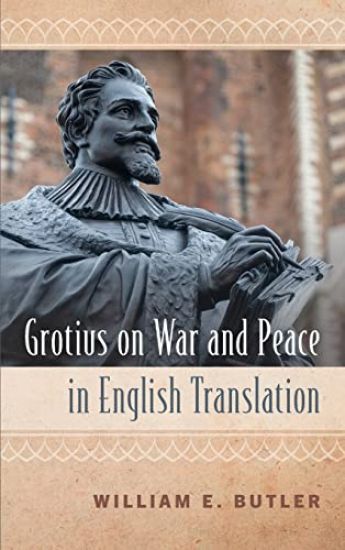
The seven principal English-language versions of Grotius's classic work On the Law of War and Peace (1625) were published between 1654 and 1928. Either by design or serendipity, each of these appeared on the eve of, during, or immediately after a major international conflict. All major achievements in their time, they expressed an overriding conviction that Grotian insights would enlighten present-day readers and help to lessen the incidence and horrors of armed conflict. Drawing upon archival sources never used previously, this study considers the history of these translations and their different approaches to Grotius's complicated text. viii, 162, 8] pp.
Substantially revised and expanded, this edition contains more than 25,000 words and phrases drawn from the legislative acts, international treaties and doctrinal writings of the countries of the Commonwealth of Independent States (CIS). Unlike the great majority of other legal dictionaries, its terminological base is founded on Russian legal practice and usage. The English translations are intended to convey the literal meaning of Russian terms and minimize confusion by ascribing them, insofar as possible, to their sole or principal English equivalents. William E. Butler is the John Edward Fowler Distinguished Professor of Law, Penn State Dickinson Law, and Emeritus Professor of Comparative Law, University College London. The author of numerous works on post-Soviet legal systems, including Russian Law and Legal Institutions (3d ed.; 2021), he has over sixty years of experience as a translator of Soviet and CIS materials ranging from articles, major treatises, codes, legislative acts and treaties to other international and comparative legal materials.xxxii, 172 pp.
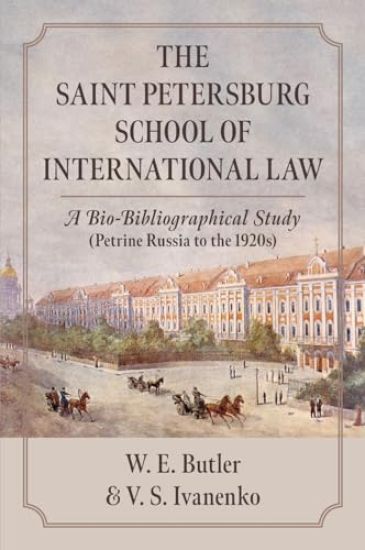
An Encyclopedic Treatise on the St. Petersburg School Based on unprecedented use of archival sources in St. Petersburg and the United States, this encyclopedic treatise is dedicated to the individuals associated with the development of international legal doctrine and state practice for two centuries in the capital of the Russian Empire. Well over four hundred are identified and the contributions of principal figures are summarized or critiqued. St. Petersburg University, which celebrated its 300th anniversary in 2024, is the key institution, but others played a role. The contributions of each are examined. The "St. Petersburg School" is broadly construed to encompass jurists and international legal practitioners whose contact with the capital was brief, but nonetheless documented. The ethnic origins of the St. Petersburg international legal community are impressive in their diversity: Russians, Ukrainians, Belorussians, Georgians, Moldovans, Poles, Estonians, Latvians, Lithuanians, Baltic Germans, Jews, and Hungarians, augmented by individuals from Scandinavian and Western European countries. Extensive bibliographical references, as well as photographs of 60 of the lawyers, enrich the existing corpus of contributions by St. Petersburg to international legal doctrine. William E. Butler has written extensively on the history of international law, including as the editor and translator of V. E. Grabar, The History of International Law in Russia 1647-1917 (Oxford, 1990); the two-volume F. F. Martens, Contemporary International Law of Civilized Peoples (Clark, NJ, 2021-2022); and author of Grotius on War and Peace in English Translation (Clark, NJ, 2021). He is the founding editor of Jus Gentium: Journal of International Legal History (2016-). The John Edward Fowler Distinguished Professor of Law, Penn State Dickinson Law, he is also Professor Emeritus of Comparative Law in the University of London (University College London) and Foreign Member, Russian Academy of Natural Sciences, National Academy of Sciences of Ukraine, and National Academy of Legal Sciences of Ukraine. Vitalii S. Ivanenko has published extensively on the history of international law in Russia with particular reference to St. Petersburg, most especially the monumental Санкт-Петербургская школа международного права St. Petersburg School of International Law] (2019; 2d ed. 2022; 3d ed. 2024) in two volumes. He held positions as senior lecturer, docent, professor, Head of the Chair of International Law, and Pro-Rector for Scientific Work at universities in Baranul and St. Petersburg before, in 1995, becoming Docent at St. Petersburg State University, serving from 1999 to 2011 as Head of the Chair of International Law there. xxiv, 638 pp., 60 b&w illustrations.
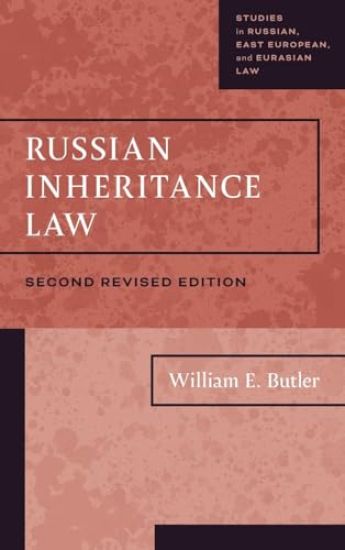
In the decade that has elapsed since the first edition of this work in 2014, major changes have been introduced into the inheritance law of the Russian Federation that collectively strengthen the unobstructed passage of commercial assets from generation to generation while minimizing the likelihood of fractionating family businesses by inadvertently requiring their dispersion among heirs uninterested in such an enterprise or untalented in matters entrepreneurial. These aspirations are collectively addressed through the introduction of the joint will, inheritance contract, and inheritance foundation. No less significant has been the extension of obligatory shares of an inheritance to all females aged 55 or over and all males aged 60 or over.William E. Butler is the John Edward Fowler Distinguished Professor of Law, Penn State Dickinson Law, and Emeritus Professor of Comparative Law, University College London. The author of numerous works on post-Soviet legal systems, including Russian Law and Legal Institutions (3d ed.; 2021), he has over sixty years of experience as a translator of Soviet and CIS materials ranging from articles, major treatises, codes, legislative acts and treaties to other international and comparative legal materials.xv, 365 pp.