The Tragedy of the Korosko (1898) is a novel by Sir Arthur Conan Doyle. It was serialized a year earlier in The Strand magazine between May and December 1897. It was later adapted into a play Fires of Fate by Doyle. The play was in turn twice adapted into film, a 1923 silent film and a 1932 talkie.A group of European tourists are enjoying their trip to Egypt in the year 1895. They are sailing up the River Nile in "a turtle-bottomed, round-bowed stern-wheeler", the Korosko. They intend to travel to Abousir at the southern frontier of Egypt, after which the Dervish country starts. They are attacked and abducted by a marauding band of Dervish warriors. The novel contains a strong defence of British Imperialism and in particular the Imperial project in North Africa. It also reveals the very great suspicion of Islam felt by many Europeans at the time.
The White Company is a historical adventure by Arthur Conan Doyle set during the Hundred Years' War. 1] The story is set in England, France, and Spain, in the years 1366 and 1367, against the background of the campaign of Edward, the Black Prince to restore Peter of Castile to the throne of the Kingdom of Castile. The climax of the book occurs before the Battle of N jera. Doyle became inspired to write the novel after attending a lecture on the Middle Ages in 1889. After extensive research, The White Company was published in serialized form in 1891 in Cornhill Magazine. Additionally, the book is considered a companion to Doyle's later work Sir Nigel, which explores the early campaigns of Sir Nigel Loring and Samkin Aylward. The novel is relatively unknown today, though it was very popular up through the Second World War. In fact, Doyle himself regarded this and his other historical novels more highly than the Sherlock Holmes adventures for which he is mainly remembered.
Vizier Hashin was bored. This time Henry's thumbs had ben dislocated and the parts of Henry's legs that still had live skin on them burned - and he still couldn't break Henry, make him cry for mercy, or even get him to talk. Dihya warned me not to meddle in this business, Henry thought, after he regained consciousness on the cold floor of his pitch-black cell. She thought I was too old to get back into the spy game. I do so hate it when my wife is right...And now she'll try to save me....again. But this time she'll fail. Then the pain surged back over him and he stopped thinking at all. At 55, Henry Doyle has it all: wealth, happiness, a loving wife, a young son, and most important, his life - after a violently successful, 35-year career as a spy, a soldier of fortune, and as needed, a paid assassin. To the men he'd led in battle against Napoleon, he was El Habibka, the legendary Bedouin cavalry general. To the French who hated and feared him, he was more ominous: a shadow - a Sufi ghost - le wraith qui dispara t. When Napoleon escapes captivity on Elba in 1815 to return as Emperor, Henry comes out of retirement, risking all to stop him - and fails, winding up in an Algerian dungeon tortured by his enemy Vizier Hashin. His half-brother Peter Kirkpatrick, a dashing American privateer captain, sails for Algiers in a daring, but utterly foolhardy rescue attempt. Henry's wife Dihya, knowing nothing of Peter's plan, determines to free her husband the only way she can think of: by becoming an odalisque in his captor's harem. Her weapons are sex, her courage, and her razor-sharp shreu dagger. The Most Bold and Daring Act of the Age weaves together three journeys: Peter Kirkpatrick's attempt to fight his way into Algiers to rescue Henry; Dihya's infiltration of Hashin's harem to accomplish the same goal; and Henry's spiritual torment as he confronts what he fears is the loss of everything he has loved in the world.
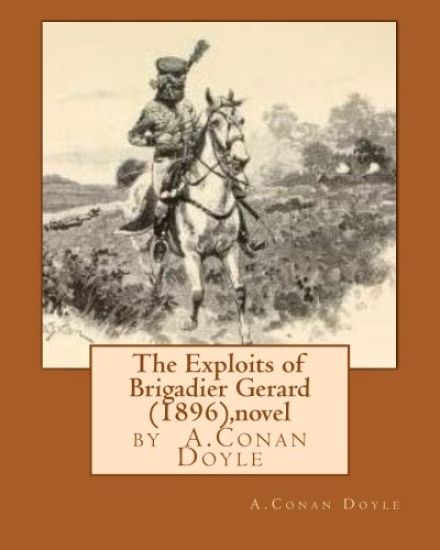
Brigadier Gerard is the hero of a series of historical short stories by the British writer Arthur Conan Doyle. The hero, Etienne Gerard, is a Hussar officer in the French Army during the Napoleonic Wars. Gerard's most notable attribute is his vanity - he is utterly convinced that he is the bravest soldier, greatest swordsman, most accomplished horseman and most gallant lover in all France. Gerard is not entirely wrong, since he displays notable bravery on many occasions, but his self-satisfaction undercuts this quite often. Obsessed with honour and glory, he is always ready with a stirring speech or a gallant remark to a lady. Conan Doyle, in making his hero a vain, and often rather uncomprehending, Frenchman, was able to satirise both the stereotypical English view of the French and - by presenting them from Gerard's baffled point of view - English manners and attitudes.Gerard tells the stories from the point of view of an old man now living in retirement in Paris. We discover that he was born in Gascony in the early 1780s (he is 25 in "How the Brigadier Captured Saragossa"). In "How the Brigadier Rode to Minsk" he attends a review of troops about to depart for the Crimea (1854-5), and this is the last identifiable date in his life, although "The Last Adventure of the Brigadier" has a still later setting, with Gerard about to return to his Gascon homeland. He first joins the 2nd Hussars - the Hussars of Chamberan - around 1799, serving as a lieutenant and junior captain. He first sees action at Marengo in Italy in 1800. He transfers to the 3rd Hussars of Conflans in 1807 as a senior captain. He speaks somewhat idiosyncratic English, having learned it from an officer of the Irish Brigade of the French Army. By 1810 he is colonel of the 2nd Hussars. He serves in Spain, Portugal, Italy, Germany and Russia. He is awarded the Grand-Cross of the L gion d'honneur by Napoleon in 1814. There are various discrepancies in the accounts of his life, not the least that in none of the stories except the last is he married. Conan Doyle enthusiasts have noted that Gerard is modelled on the real-life Baron Jean Baptiste Antoine Marcellin de Marbot, a noted French light cavalry officer during the Napoleonic Wars.Conan Doyle wrote with great affection about Marbot's memoirs in Through the Magic Door. The fictional Gerard is not to be confused with the real Napoleonic officer tienne Maurice G rard (1777-1852), who rose to become a Marshal and later Prime Minister of France.... Sir Arthur Ignatius Conan Doyle KStJ, DL (22 May 1859 - 7 July 1930) was a British writer and physician, most noted for creating the fictional detective Sherlock Holmes and writing stories about him which are generally considered milestones in the field of crime fiction. He is also known for writing the fictional adventures of a second character he invented, Professor Challenger, and for popularising the mystery of the Mary Celeste. He was a prolific writer whose other works include fantasy and science fiction stories, plays, romances, poetry, nonfiction and historical novels.
The Hound of the Baskervilles is the third of the crime novels written by Sir Arthur Conan Doyle featuring the detective Sherlock Holmes. Originally serialised in The Strand Magazine from August 1901 to April 1902, it is set largely on Dartmoor in Devon in England's West Country and tells the story of an attempted murder inspired by the legend of a fearsome, diabolical hound of supernatural origin. Sherlock Holmes and his companion Dr. Watson investigate the case. This was the first appearance of Holmes since his apparent death in "The Final Problem", and the success of The Hound of the Baskervilles led to the character's eventual revival. PLOT: Dr. James Mortimer asks Sherlock Holmes to investigate the death of his friend, Sir Charles Baskerville. Sir Charles was found dead on the grounds of his Devonshire estate, Baskerville Hall, and Mortimer now fears for Sir Charles's nephew and sole heir, Sir Henry Baskerville, who is the new master of Baskerville Hall. The death was attributed to a heart attack, but Mortimer is suspicious, because Sir Charles died with an expression of horror on his face, and Mortimer noticed "the footprints of a gigantic hound" nearby. The Baskerville family has supposedly been under a curse since the era of the English Civil War, when ancestor Hugo Baskerville allegedly offered his soul to the devil for help in abducting a woman and was reportedly killed by a giant spectral hound. Sir Charles believed in the curse and was apparently fleeing from something in fright when he died. Intrigued, Holmes meets with Sir Henry, newly arrived from Canada. Sir Henry has received an anonymous note, cut and pasted from newsprint, warning him away from the Baskerville moors, and one of his new boots is inexplicably missing from his London hotel room. The Baskerville family is discussed: Sir Charles was the eldest of three brothers; the youngest, black sheep Rodger, is believed to have died childless in South America, while Sir Henry is the only child of the middle brother. Sir Henry plans to move into Baskerville Hall, despite the ominous warning message. Holmes and Dr. Watson follow him from Holmes's Baker Street apartment back to his hotel and notice a bearded man following him in a cab; they pursue the man, but he escapes. Mortimer tells them that Mr. Barrymore, the butler at Baskerville Hall, has a beard like the one on the stranger. Sir Henry's boot reappears, but an older one vanishes.Holmes sends for the cab driver who shuttled the bearded man after Sir Henry, and is both astounded and amused to learn that the stranger had made a point of giving his name as 'Sherlock Holmes' to the cabbie. Holmes, now even more interested in the Baskerville affair but held up with other cases, dispatches Watson to accompany Sir Henry to Baskerville Hall with instructions to send him frequent reports about the house, grounds, and neighbors. Upon arrival at the grand but austere Baskerville estate, Watson and Sir Henry learn that an escaped murderer named Selden is believed to be in the area.... Sidney Edward Paget (4 October 1860 - 28 January 1908) was a British illustrator of the Victorian era, best known for his illustrations that accompanied Arthur Conan Doyle's Sherlock Holmes stories in The Strand magazine. Sir Arthur Ignatius Conan Doyle KStJ, DL (22 May 1859 - 7 July 1930) was a British writer and physician, most noted for creating the fictional detective Sherlock Holmes and writing stories about him which are generally considered milestones in the field of crime fiction.