As an adjective, sublime means a subject that is causing deep emotions and feelings of wonder or joy. The noun sublime describes a subject that is without equal, that is supreme or of great moral, artistic or spiritual value. The verb derived from these words describes the capacity of a subject to reach the highest level without going through intermediary steps. To sublimate also means to direct any energy available to something beneficial. More simply, F. Schiller uses the notion of sublime as a tool available to anyone for overcoming all the inconvenient aspects of the experiences we must go through in life. However, for him, the sublime is mostly possible with a determined inclination towards the good and the beautiful. "On Beauty" is one of the early documents with which Frederick Schiller started his long inquiry about Aesthetics in general. The letters are presented, here, in their full content, hence leaving the reader the freedom to assess the scope of his early, rather controversial research about physical and moral Beauty. These letters constitute one of the main documents in understanding the life and works of F. Schiller. "On the sublime" is his famous dissertation about the extent and limits of what it is to be a human being. One trait of the human being is the specific rapport that he or she observes with what he or she perceives as power expressed upon him or her, and the manner how he or she develops a genuinely human culture. "On grace and dignity": Mere submission to power being not a main goal of Humanity, then, one should always show grace when obliging, and dignity when being the one who is obliged. In this essay, F. Schiller presents to us one of his developments in bringing to life the principle of equality in an environment of hierarchy and obedience. It is an interesting text where he also presents to us one of his very own rendition of the tolerance principle. "On the pathetic" specifically deals with our desire not to leave to arbitrariness the care of managing our happiness and sorrow. Therefore, we create these in our own ways; that is pathetically, through destinies, arts and culture in general. But also in the little staging we do when we want to entertain, surprise, frighten or please family and friends. Needless to say, with grace, dignity and the pathetic, Schiller has offered us tools that we can use to chart our lives towards the desired directions. They constitute additional tools for absorbing the unavoidable shocks that we must necessarily face in our life. If Schiller has made any interesting contribution in this field, then it is by pointing to us, that these traits are not inborn, and that anyone of us can tap into them. In "Further comments on the sublime", he extends his inquiry of the sublime to many subjects and objects, and also makes a remarkable assessment of greatness and sublime in the actions of the human being. This writing is slightly more difficult to relate to than the others in this collection, but constitutes nevertheless a very interesting contribution to the debate. "Philosophical letters" exposes in the form of epistolary exchanges various aesthetic matters. Schiller ends this essay with an intriguing form of the sublime: that of creation observed through Freedom and life. "Scattered reflections": In this document, Schiller disserts about the specificity as well as the common ground among the good, the pleasant, the beautiful and the sublime subjects and their applications in gauging various aesthetic subjects. With these essays, one can surely discover a different aspect of the preoccupations of F. Schiller, but certainly, also, personally encompass a greater dimension of what it is to be a human being. Indeed, the sublime is not limited to Schiller's vision, but his thoughts on the matter have interested many people for the past two centuries.
This book is written concerning the importance of walking in obedience to God, for work done in His Kingdom. This story reflects back to only a small contribution of this man of God, who was chosen by God for such a time as this. He was anointed, appointed, and approved by God to teach and lead others in Kingdom business relevant to the "body of Christ". He had great compassion concerning the things of God. Sitting under his wings while being nurtured by him, as he was led by the Holy Spirit, was an experience that many of his disciples were privileged to have. I would liken him to David, "a man after God's own heart". The Word of God tells us that many are called, but few are chosen. He was one chosen and given a special anointing with the ability to reach out, teach, and preach to the masses. He was "a preacher's preacher". Reading this book should encourage you to receive the many lessons shared and advice given. They will help you grow to become the individual God has called you to be. The answers to questions you may have; and the confirmation you seek might just be within your grasp. Become one of the chosen few while God can be found. If you are a leader, this book will help you to grow and press on toward the mark of the higher calling which is in Christ Jesus. This book should enable you to become a trainer of the trainee. It will benefit those coming behind you. More importantly, it should strengthen your walk with Jesus and build you up as you take your place in the vineyard. As the Apostle Paul says in 1 Cor. 2:12-13: "Now we have received, not the spirit of the world, but the Spirit which is of God; that we might know the things that are freely given to us of God. Which things also we speak, not in the words which man's wisdom teacheth, but which the Holy Ghost teacheth: comparing spiritual things with spiritual"(KJV).
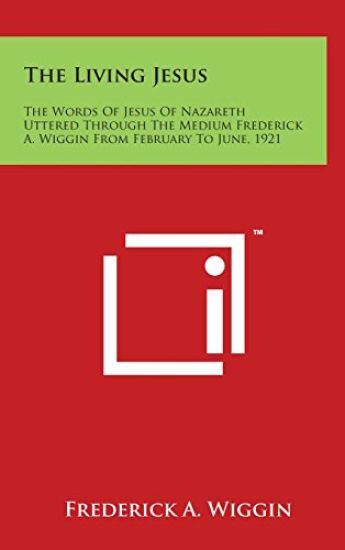
""The Living Jesus: The Words of Jesus of Nazareth Uttered Through the Medium Frederick A. Wiggin from February to June, 1921"" is a book that contains a collection of messages purportedly spoken by Jesus Christ through the mediumship of Frederick A. Wiggin during a series of s�����ances held between February and June of 1921. The messages, which were transcribed by Wiggin and later compiled into this book, cover a wide range of topics, including love, forgiveness, spiritual growth, and the nature of the afterlife. The book offers readers a unique perspective on the teachings of Jesus, as they are presented in a conversational and informal style that is unlike the more formal language found in traditional religious texts. Overall, ""The Living Jesus"" is a fascinating and thought-provoking read for anyone interested in exploring the spiritual teachings of Jesus Christ.This Is A New Release Of The Original 1921 Edition.This scarce antiquarian book is a facsimile reprint of the old original and may contain some imperfections such as library marks and notations. Because we believe this work is culturally important, we have made it available as part of our commitment for protecting, preserving, and promoting the world's literature in affordable, high quality, modern editions, that are true to their original work.