Privatizing Education is a collection of essays written by such luminaries as Martin Carnoy, Christopher Connell, Wendy Connors, Fred Doolittle, Pearl Rock Kane, Frank Kemerer, Christopher Lauricella, Arthur Levine, Ellen Magenheim, Patrick McEwan, Lee D. Mitgang, David Myers, Gary Natriello, Caroline Persell, Mark Schneider, Janelle Scott, Geoffrey Walford, and Amy Stuart Wells who examine the efforts of some educators, reformers, investors, and political groups to move education from the public to the private sector. This is occurring through tuition tax credits, voucher initiatives, and for-profit, educational management organizations. The volume grows out of a conference that took place at Columbia University's Teachers College which launched the National centre for the Study of Privatization in Education.
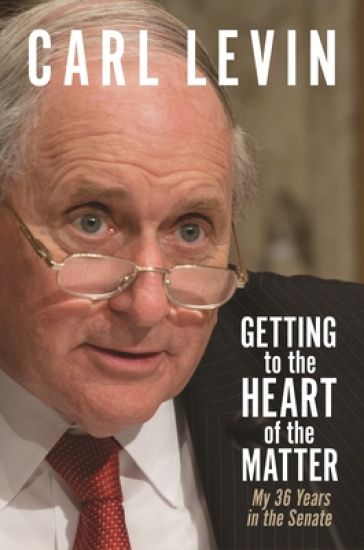
Representing Michigan for thirty-six years in the U.S. Senate, Carl Levin, the longest-serving senator in Michigan history, was known for his dogged pursuit of the truth, his commitment to holding government accountable, and his basic decency. Getting to the Heart of the Matter: My 36 Years in the Senate is his story - from his early days in Detroit as the son of a respected lawyer to the capstone of his career as chair of both the Senate Armed Services Committee and the Senate Permanent Subcommittee on Investigations. Levin's career placed him at the center of some of our nation's most critical points in modern times: from the aftermath of the 1967 Detroit riots, to the Clinton impeachment, through 9/11 and the wars in Iraq and Afghanistan, and the 2008 financial crisis. He met with numerous world leaders, including Egypt's Anwar Sadat and China's Jiang Zemin. Getting to the Heart of the Matter recounts Levin's experiences, thoughts, and actions during these historic moments. Consisting of seventeen chapters, the book takes the reader through Levin's early life in Detroit of the 1940s, 50s, and 60s where he met his wife, started a family, practiced law and served as the first General Counsel for the newly created Michigan Civil Rights Commission and the chief appellate defender for Detroit's Legal Aid Office. Elected to the Detroit City Council in 1969, where Levin served for eight years including four as Council president, the book describes how his fight against the Department of Housing and Urban Development's devastating housing practices in the neighborhoods of Detroit led him to run for the U.S. Senate with a pledge to make government work more effectively. Winning election six times, Levin had an illustrious career in the Senate where he challenged leaders in government and the private sector for the greater good of the nation. Levin describes how, as a Democrat, throughout his time in the Senate, he worked with Republican senators who often held different policy positions in order to find common ground to achieve national goals, and how he and his Senate staff searched for creative solutions to trade issues, support for the auto industry and manufacturing sector, U.S. military action in Iraq and Afghanistan, and efforts to protect the Great Lakes and the environment, among many other issues. Levin's hope in writing this memoir is that by sharing his deeply held beliefs about the responsibility of elected officials, the book will serve as a resource for people beginning a career in, or contemplating running for, public office. Readers with an interest in politics, history, facts, and perseverance will find kinship in this book.
Levin traces the century and a half between the American and French revolutions and the end of the First World War, a key period for public debate over democratization. Examining the writings and ideology of a variety of anti-democratic thinkers, he illustrates how arguments for franchise extention had to contend with a deeply entrenched antipathy to democratic ideas. Only if we resurrect expressions of this opposition, he argues, and recall the dominant values that democracy challenged, are we able to understand the historical and ideological context from which modern western values and institutions emerged.
The late Harry Levin had an international reputation as the world's foremost comparatiste, and he was among the most knowledgeable Shakespeare scholars in the world. Before he died, Harry Levin had planned to publish this essay collection which examines key scenes in a number of Shakespeare's plays.
Successful Drug-Free Psychotherapy for Schizophrenia offers a close examination of how to treat schizophrenic patients using psychotherapy rather than drugs, applying derivatives of psychodynamic principles in treating patients. The author provides real examples throughout of how therapists can resolve patients’ emotional conflicts with better outcomes than by resorting to drugs. She presents methods that allow patients to avoid the neurological damage and obesity that can often result from the use of anti-psychotic drugs. The practical techniques and advice this book offers enable therapists to resolve the chaos of schizophrenia using psychotherapy alone. Theoretically, this book can also be useful for work with depressives.
Successful Drug-Free Psychotherapy for Schizophrenia offers a close examination of how to treat schizophrenic patients using psychotherapy rather than drugs, applying derivatives of psychodynamic principles in treating patients. The author provides real examples throughout of how therapists can resolve patients’ emotional conflicts with better outcomes than by resorting to drugs. She presents methods that allow patients to avoid the neurological damage and obesity that can often result from the use of anti-psychotic drugs. The practical techniques and advice this book offers enable therapists to resolve the chaos of schizophrenia using psychotherapy alone. Theoretically, this book can also be useful for work with depressives.
Fully updated to be aligned with the Project Management Body of Knowledge® (PMBOK® Guide), Sixth Edition, this study guide is structured per the PMP® Examination Content Outline (ECO), 2015 edition, which is the blueprint for the PMP® exam. The study guide has a chapter of 50 questions for each performance domain in the ECO: initiating, planning, executing, monitoring and controlling, and closing. The study guide also provides access to a 200-question on-line test that simulates the experience of taking the actual PMP® examination.
Consider just two of the countless facts about the damage we have done to the Everglades: Half of its original 14,000-square-mile expanse is gone, and saving what is left will cost at least $8.4 billion. Alluding to destruction on a scale we can barely grasp, figures like these can at once stir and immobilize us. In Liquid Land, Ted Levin guides us past the dire headlines and into the magnificent swamp itself, where we come face-to-face with the plants, animals, and landscapes that remain and that will survive only if we protect them.Levin has traveled extensively through the Everglades, often in the company of such dedicated individuals as Archie Jones, the conchologist who for fifty years has been studying and rescuing tree snails, or Frank Mazzotti, with whom Levin spent two weeks in the field monitoring American crocodiles. Through Levin's adventures we come to know intimately a place where water was meant to flow as a broad, shallow "sheet" and where minuscule changes in elevation yield a dramatic change in the diversity of life, from manatees and mangroves on the coast to panthers and orchids in the interior.Throughout, Levin profiles the various parties who have tried to master, protect, or coexist with the Everglades-from the agribusiness concerns known collectively as Big Sugar to Friends of the Everglades to a small community west of Miami, nameless but for the designation "8.5 Square Mile Area." As we float, sometimes slog, alongside Levin through hammocks, keys, and sloughs, we see firsthand how drainage and development have led to water pollution and salinity fluctuations, a disruption of the swamp's wet/dry seasonal cycle, an explosion in the mosquito population, and a weakened response of the ecosystem to drought, fire, hurricanes, and invasive species.Liquid Land captures the Everglades' essential beauty and mystery as it explores ongoing restoration efforts. Our success or failure will have an impact on environmental policy around the world, Levin believes. As the preservationist rallying cry goes, "The Everglades is a test. If we pass, we get to keep the planet.
Using nature and history as her raw materials, Phillis Levin crafts a world alive with ideas. In striking experiments with form, rhyme, and meter, she examines the condition of our species. Levin is a voyager in these poems, cataloging the earthly spectacle, tempering her lines with an irony that strikes an immediate blow at the heart of things. By turns rhaposidist and rhetorician, visionary and witness, she transforms the cycle of love and death into a majestic music:Machines have their own seasons, revolvingAround us, though nature is not their fulcrum.They too move beyond repair to neglect,But cannot die like a diving falconOr repeat, in the end, names that inflectAs the sum of one’s parts stops working.Unconverted by death, they know nothing Of the glory of noise and the daily Trade of the ugly and the beautifulWe have listened to, in stories of manyFor whom engines were passions, and the feelOf life the sense of a great sound building.In language that fuses the discursive and the lyrical, the contemplative and the dramatic, Phillis Levin renews metaphysical inquiry. Temples and Fields becomes finally a study of joy and terror—“the meticulous counting down / Of beginning leaf and scattered petal”—and of the primordial link between the human and the divine.
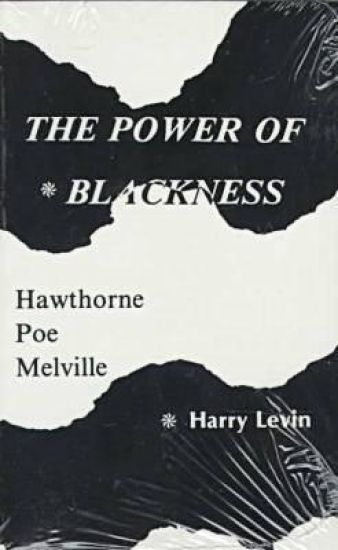
The Power of Blackness is a profound and searching reinterpretation of Hawthorne, Poe and Melville, the three classic American masters of fiction. It is also an experiment in critical method, an exploration of the myth-making process by way of what may come to be known as literary iconology.
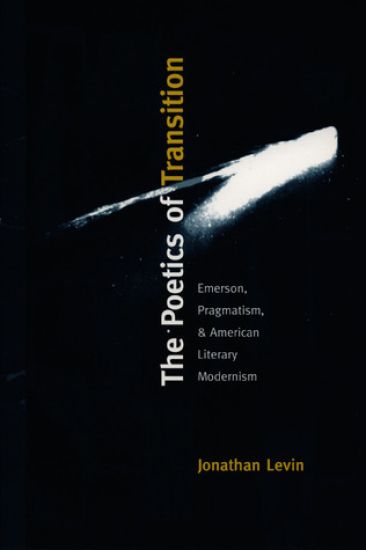
The Poetics of Transition examines the connection between American pragmatism and literary modernism by focusing on the concept of transition as a theme common to both movements. Jonathan Levin begins with the Emersonian notion that transition-the movement from one state or condition to another or, alternately, the figural enactment of that movement-is infused with power. He then offers a revisionary reading of the pragmatists’ view of the permeability of subjective and objective realms and of how American literary modernists stage this permeability in the language and form of their writing.Levin draws on the pragmatist and neopragmatist writings of William James, John Dewey, George Santayana, Richard Rorty, and Cornel West to illuminate the work of modernist literature. In turn, he illuminates the poetic imperatives of pragmatism by tracing the ways in which Henry James, Gertrude Stein, and Wallace Stevens capture the moment of transition-a paradoxical moment that, once it is represented in language or art, requires its own perpetual overcoming. Throughout, he explores how modernist writers, who are masters at recording such “illegible” moments of transition in their poetry and prose, significantly contribute to an expanded understanding of pragmatism and its underlying aesthetics. By linking Emerson with the progressive philosophy of turn-of-the-century pragmatism and the experimentation of American literary modernism, Levin offers new insight into Emerson’s lasting influence on later American philosophers, novelists, and poets.The Poetics of Transition will interest scholars and students in the fields of literary criticism, neopragmatism, literary modernism, and American literature.
The Poetics of Transition examines the connection between American pragmatism and literary modernism by focusing on the concept of transition as a theme common to both movements. Jonathan Levin begins with the Emersonian notion that transition-the movement from one state or condition to another or, alternately, the figural enactment of that movement-is infused with power. He then offers a revisionary reading of the pragmatists’ view of the permeability of subjective and objective realms and of how American literary modernists stage this permeability in the language and form of their writing.Levin draws on the pragmatist and neopragmatist writings of William James, John Dewey, George Santayana, Richard Rorty, and Cornel West to illuminate the work of modernist literature. In turn, he illuminates the poetic imperatives of pragmatism by tracing the ways in which Henry James, Gertrude Stein, and Wallace Stevens capture the moment of transition-a paradoxical moment that, once it is represented in language or art, requires its own perpetual overcoming. Throughout, he explores how modernist writers, who are masters at recording such “illegible” moments of transition in their poetry and prose, significantly contribute to an expanded understanding of pragmatism and its underlying aesthetics. By linking Emerson with the progressive philosophy of turn-of-the-century pragmatism and the experimentation of American literary modernism, Levin offers new insight into Emerson’s lasting influence on later American philosophers, novelists, and poets.The Poetics of Transition will interest scholars and students in the fields of literary criticism, neopragmatism, literary modernism, and American literature.
First published in 1957, The Legacy of German Jewry is a comprehensive rethinking of the German-Jewish experience. Goldschmidt challenges the elegiac view of Gershom Scholem, showing us the German-Jewish legacy in literature, philosophy, and critical thought in a new light. Part One re-examines the breakthrough to modernity, tracing the moves of thinkers like Moses Mendelssohn, building on the legacies of religious figures like the Baal Shem Tov and radical philosophers such as Spinoza. This vision of modernity, Goldschmidt shows, rested upon a belief that "remnants" of the radical past could provide ideas and energy for reconceiving the modern world. Goldschmidt's philosophy of the remnant animates Part Two as well, where his account of the political history of the Jews in modernity and the riches of Jewish culture as recast in German-Jewish thought provide insights into Leo Baeck, Hermann Cohen, and Franz Rosenzweig, among others. Part Three analyzes the post-Auschwitz complex, and uses the Book of Job to break through that trauma. Ahead of his time and biblical in his perspective, Goldschmidt describes the innovative ways that German-Jewish writers and thinkers anticipated what we now call multiculturalism and its concern with the Other. Rather than destined to destruction, the German-Jewish experience is reconceived here as a past whose unfulfilled project remains urgent and contemporary—a dream yet to be realized in practice, and hence a task that still awaits its completion.
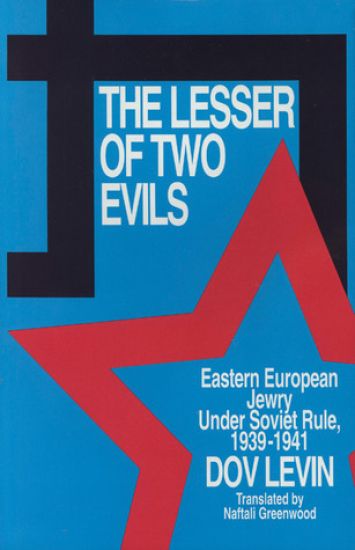
The Lesser of Two Evils describes the quandary and fate of the two million Eastern European Jews following the infamous Ribbentrop-Molotov pact of August 1939, which divided the regions of Eastern Poland, the Baltics, and eastern Rumania between Nazi Germany and the USSR. The Jews in these areas were thus faced with deciding who was the "lesser of two evils"—the Soviets or the Nazis.
With Jerusalem as its epicentre, "The Maltese Dreambook" extends Gabriel Levin's quarter-century-long ramble through the Levant, his adopted homeland. On a Greek island, in the desert wastes of southern Jordan and in Malta, whose Stone Age temples serve as a backdrop to the title poem, this collection abounds in unforeseen encounters that blur the borders between the phantasmal and the real, the modern and the archaic, the rational and the imaginary.