
Kirjahaku
Etsi kirjoja tekijän nimen, kirjan nimen tai ISBN:n perusteella.
1000 tulosta hakusanalla Maple Leaf



Das Buch behandelt die klassischen Themengebiete der Statik der starren K rper, die in den Grundvorlesungen zur Technischen Mechanik angeboten werden: Kr fte und Kr ftesysteme, physikalische Gr en von K rpern und Fl chen, Schnittlasten, Fachwerke sowie die Statik von Seilen und Ketten. Die Besonderheit ist die gleich von Anfang an konsequente Formulierung der anfallenden Grundgleichungen in computergerechter Vektor- und Matrizenschreibweise, was einer Umsetzung in Computer-Algebrasysteme wie Maple sehr entgegenkommt.
Das Buch behandelt die Mechanik der deformierbaren K rper und hat zum Ziel, bei Studierenden der Ingenieurwissenschaften ein vertieftes Verst ndnis mathematischer Methoden bei der Behandlung technischer Systeme zu wecken. Dazu werden die sich immer st rker abzeichnenden Entwicklungstendenzen zum Einsatz von Computeralgebrasystemen in der Lehre und im bungsbetrieb zur Technischen Mechanik aufgegriffen. In zehn Kapiteln werden die wichtigsten Themengebiete der geltenden Vorlesungspl ne der Festigkeitslehre vermittelt, die durch eine Vielzahl von Beispielen begleitet werden. Zu jedem Themengebiet stehen Maple-Prozeduren als Zusatzmaterial zur Verf gung, die eine analytische oder auch numerische Behandlung der im Buch vorgestellten Beispiele durch Computerhilfe erm glichen. Insbesondere gestattet Maple, die erzielten Ergebnisse durch grafische Darstellun-gen einer erweiterten Interpretation zug nglich zu machen. Der Erl uterung des Stoffes dient eine F lle von Abbildungen.
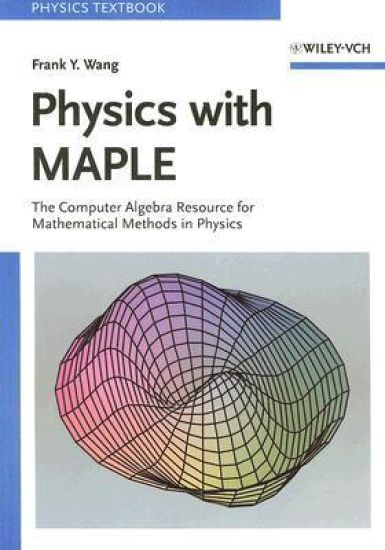
Written by an experienced physicist who is active in applying computer algebra to relativistic astrophysics and education, this is the resource for mathematical methods in physics using MapleTM and MathematicaTM. Through in-depth problems from core courses in the physics curriculum, the author guides students to apply analytical and numerical techniques in mathematical physics, and present the results in interactive graphics. Around 180 simulating exercises are included to facilitate learning by examples. This book is a must-have for students of physics, electrical and mechanical engineering, materials scientists, lecturers in physics, and university libraries. * Free online MapleTM material at http://www.wiley-vch.de/templates/pdf/maplephysics.zip * Free online MathematicaTM material at http://www.wiley-vch.de/templates/pdf/physicswithmathematica.zip * Solutions manual for lecturers available at www.wiley-vch.de/supplements/
Der vorliegende Ubungsband besteht aus den beiden Hauptteilen Analysis im )Rl und Analysis im)Rn und beschiiftigt sich mit der Differential- und Integralrechnung fur Funktionen von einer und von mehreren Veriinderlichen. In der Integralrechnung wird der Rie mannsche Integralbegriff zugrunde gelegt. Der erste Teil des Buches dient dem Auf- und Ausbau der Grundlagen der Analysis. Compu teralgebrasysteme erleichtem Routinerechnungen, dienen aber auch wesentlich dem begrifflichen und inhaltlichen Verstiindnis. Mathe matica und Maple sind die Computeralgebrasysteme mit der groBten Verbreitung. Man hiitte die Rechnungen natiirlich auch mit einem anderen geeigneten System machen konnen. Das Buch besteht aus drei Komponenten. Repetitorium: Jeder Abschnitt beginnt mit einem kurzen AbriB der Theo rie. Hierbei werden Definitionen und Siitze nicht besonders gekennzeichnet. Es solI ein Leitfaden fiir die Wiederholung gegeben werden und Werkzeuge fiir konkrete Aufgaben be reitgestellt werden. Die eingefiihrten Begriffe werden zur Er leichterung der Orientierung auf der RandspaJte hervorgeho ben. (ca. 20% des Buchumfangs)."
Elementare Differentialgeometrie mit Maple
Helmut Reckziegel; Markus Kriener; Knut Pawel
Vieweg+teubner Verlag
1998
sidottu
In dem Buch wird die Kurven- und Flächentheorie im 3-dimensionalen euklidischen Raum behandelt und ein Maple-Programmpaket auf einer CD zum konkreten Arbeiten geliefert. Mit einer neuen Programmerweiterung und dem theoretischen Hintergrund unter www.mi.uni-koeln.de/mi/Forschung/Reckziegel/diffgeo_ext/index.html.
Maple is a computer algebraic system with a fast-growing number of users in schools, universities, and other institutions. Intended for anyone who is encountering Maple for the first time, First Steps in Maple provides a detailed step-by-step introduction, teaching by way of examples taken from many areas of mathematics. It is particularly suitable for undergraduates, and has self-test problems (with solutions) for each chapter.
Mathematik für Ingenieure mit Maple
Thomas Westermann
Springer-Verlag Berlin and Heidelberg GmbH Co. K
2001
nidottu
Dieses zweibändige Werk deckt den üblichen Mathematikstoff für sämtliche Ingenieurstudiengänge an Fachhochschulen ab. Werkzeuge der Computeralgebra werden mit durchgerechneten Beispielen kombiniert, abstrakte mathematische Begriffe anschaulich erklärt. Für die numerische Bearbeitung von Problemstellungen dienen die angegebenen Algorithmen und Pascalprogramme. Auf der beiliegenden CD-ROM befinden sich neben Animationen auch die im Buch abgedruckten Maple-Worksheets, mit denen der Stoff direkt beim Lernen aus dem Buch interaktiv eingeübt werden kann. In der 2. Auflage wurden die Maple-Ausarbeitungen umfassend ergänzt, viele Visualisierungen mathematischer Begriffe neu erstellt, die ektronischen Arbeitsblätter an die neue Maple-Version angepasst und Textverbesserungen vorgenommen. Die CD-ROM wurde völlig neu und benutzerfreundlicher gestaltet und die interaktive Nutzung der elektronischen Arbeitsblätter weiter erleichtert.
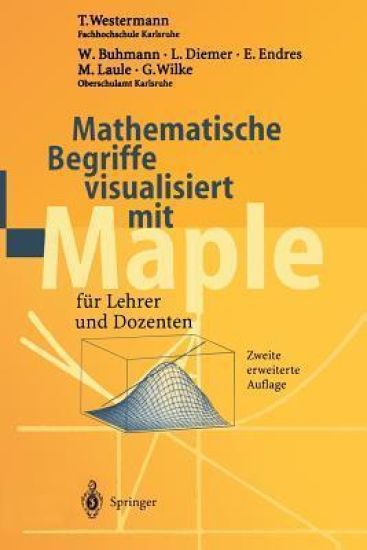
Mathematische Begriffe visualisiert mit Maple
T. Westermann; W. Buhmann; L. Diemer; E. Endres; M. Laule; G. Wilke
Springer-Verlag Berlin and Heidelberg GmbH Co. K
2001
muu
Im Buch und auf der CD-ROM werden 49 Unterrichts-/ Vorlesungsthemen dargestellt. Die elektronischen Maple-Arbeitsblätter auf der CD-ROM liefern für Lehrer und Dozenten an Schulen und Hochschulen ein Medium mit dessen Hilfe grundlegende mathematische Begriffe veranschaulicht werden können. Dies erfolgt sowohl in Schaubildern, 3D-Darstellungen als auch in Animationen, die in Form von kleinen Filmen abstrakte mathematische Begriffe greifbarer und damit begreifbarer machen.Gegenüber der ersten Auflage wurden folgende Themen neu aufgenommen: Ungleichungen, Fraktale und Chaos, Schwingungen, Richtungsfelder bei DG, Kegelschnitte und Winkelvariationen, Laufende Wellen, Normalenverteilungen, algebraische Kurven, Ortskurven, Affine Abbildungen.
Finite Elements Using Maple
Artur Portela; A. Charafi
Springer-Verlag Berlin and Heidelberg GmbH Co. K
2002
sidottu
Almost all physical phenomena can be mathematically described in terms of differential equations. The finite element method is a tool for the appro- mate solution of differential equations. However, despite the extensive use of the finite element method by engineers in the industry, understanding the principles involved in its formulation is often lacking in the common user. As an approximation process, the finite ele~ent method can be for- lated with the general technique of weighted residuals. This technique has the advantage of enhancing the essential unity of all processes of approxi- tion used in the solution of differential equations, such as finite differences, finite elements and boundary elements. The mathematics used in this text, though reasonably rigorous, is easily understood by the user with only a basic knowledge of Calculus. A common problem to the courses of Engineering is to decide about the best form to incorporate the use of computers in education. Traditional c- pilers, and even integrated programming environments such as Turbo Pascal, are not the most appropriate, since the student has to invest much time in developing an executable program that, in the best of cases, will be able to solve only one definitive type of problems. Moreover, the student ends up learning more about programming than about the problem that he/she wants to solve with the developed executable program.
Experiments In Mathematics Using Maple
Christopher T.J. Dodson; Elizabeth A. Gonzalez
Springer-Verlag Berlin and Heidelberg GmbH Co. K
1995
nidottu
We believe that to understand and be comfortable with mathematical con cepts and methods, it is necessary to do mathematics and, traditionally, doing meant with a pencil and paper. Now, a modest home computer can provide a platform for a computer algebra package like Maple, which can perform all of the operations encountered in secondary school mathematics and beyond, and pro vide graphical representations of functions, including animations. The capability of rendering accurate graphics for mathematical functions greatly enhances the learning experience, and helps intuition work in new situations, before beginning to do the algebra and calculus needed to solve a problem. For example, if you can see that a function has a clear minimum from its graph, then you are more likely to be able to identify its location precisely by analysis. This book is designed to support the interactive Maple worksheets that we have developed for the two senior secondary school years and made available via the Internet at the anonymous ftp site ftp. ut irc. utoronto . ca (/pub/ednet/maths/maple). This takes you from basic algebra, functions and sequences, to calculus and its applications. Thus, the book is a hardcopy version of the worksheets, with additional explanatory text, cross-referencing, appen dices containing worked solutions to all exercises, and indexing.

Erste Schritte mit Maple
Werner Burkhardt
Springer-Verlag Berlin and Heidelberg GmbH Co. K
1996
nidottu
Dieser Titel bildet einen sicheren Einstieg in das Computeralgebrasystem Maple für Anwender zum Selbststudium, für Kurse an Schulen und Hochschulen sowie für den mathematisch-naturwissenschaftlichen Unterricht in der Sekundarstufe II. Die vorliegende Neuauflage berücksichtigt Maple V Release 4. Der Autor beschreibt auf verständliche Art anhand einzelner Problemfelder der Mathematik und ihrer Anwendungsgebiete den Umgang mit Maple sowie die Lösung mathematischer Probleme. Der Leser kann selbst bestimmen, wie er das Buch durcharbeitet, da die einzelnen Kapitel in sich geschlossen und voneinander unabhängig sind. Die erworbenen Kenntnisse können sofort am Bildschirm umgesetzt werden. Zur Vertiefung der einzelnen Kapitel befinden sich jeweils am Ende Kontrollaufgaben mit Lösungen.
An Introduction to Maple V
Jack-Michel Cornil; Philippe Testud
Springer-Verlag Berlin and Heidelberg GmbH Co. K
2001
nidottu
The authors take up standard topics of college mathematics, and show how the computer algebra tool Maple can be used to compute and experiment so that students get a better understanding of mathematics.
Funktionentheorie erkunden mit Maple
Wilhelm Forst; Dieter Hoffmann
Springer-Verlag Berlin and Heidelberg GmbH Co. K
2012
nidottu
Bei dieser Einführung in die Funktionentheorie handelt es sich um eine neue Lehrform, nicht um eine klassische Darstellung. Das Buch schlägt eine Brücke zur Computeranwendung und zu Maple. Dies beeinflusst die Struktur der einzelnen Kapitel. In einem Textteil wird - teils nur skizzenartig - die zugrundeliegende Theorie dargestellt und mit sorgfältig ausgewählten Beispielen illustriert. Hieran schließt sich der "Worksheet"-Teil an, in dem der vorangehende Stoff - mit Hilfe von Maple 15 - diskutiert wird. Auf diese Weise können auch anspruchsvollere Beispiele als üblich behandelt und eindrucksvolle Graphiken erstellt werden. Anhand ausgefeilter Worksheets mit "Maple vom Feinsten" wird gezeigt, wie man mit einem Computeralgebrasystem gestalten und Ideen umsetzen kann. Da die Funktionentheorie in vielen Fächern benötigt wird, spannen zahlreiche Beispiele - etwa zur Potentialströmung, Kutta-Joukowski-Transformation und Netzgenerierung mit Hilfe konformer Abbildungen - den Bogen zu Anwendungen.
Introduction to Cryptography with Maple
José Luis Gómez Pardo
Springer-Verlag Berlin and Heidelberg GmbH Co. K
2012
sidottu
This introduction to cryptography employs a programming-oriented approach to study the most important cryptographic schemes in current use and the main cryptanalytic attacks against them. Discussion of the theoretical aspects, emphasizing precise security definitions based on methodological tools such as complexity and randomness, and of the mathematical aspects, with emphasis on number-theoretic algorithms and their applications to cryptography and cryptanalysis, is integrated with the programming approach, thus providing implementations of the algorithms and schemes as well as examples of realistic size. A distinctive feature of the author's approach is the use of Maple as a programming environment in which not just the cryptographic primitives but also the most important cryptographic schemes are implemented following the recommendations of standards bodies such as NIST, with many of the known cryptanalytic attacks implemented as well. The purpose of the Maple implementations is to let the reader experiment and learn, and for this reason the author includes numerous examples. The book discusses important recent subjects such as homomorphic encryption, identity-based cryptography and elliptic curve cryptography. The algorithms and schemes which are treated in detail and implemented in Maple include AES and modes of operation, CMAC, GCM/GMAC, SHA-256, HMAC, RSA, Rabin, Elgamal, Paillier, Cocks IBE, DSA and ECDSA. In addition, some recently introduced schemes enjoying strong security properties, such as RSA-OAEP, Rabin-SAEP, Cramer--Shoup, and PSS, are also discussed and implemented. On the cryptanalysis side, Maple implementations and examples are used to discuss many important algorithms, including birthday and man-in-the-middle attacks, integer factorization algorithms such as Pollard's rho and the quadratic sieve, and discrete log algorithms such as baby-step giant-step, Pollard's rho, Pohlig--Hellman and the index calculus method.This textbookis suitable for advanced undergraduate and graduate students of computer science, engineering and mathematics, satisfying the requirements of various types of courses: a basic introductory course; a theoretically oriented course whose focus is on the precise definition of security concepts and on cryptographic schemes with reductionist security proofs; a practice-oriented course requiring little mathematical background and with an emphasis on applications; or a mathematically advanced course addressed to students with a stronger mathematical background. The main prerequisite is a basic knowledge of linear algebra and elementary calculus, and while some knowledge of probability and abstract algebra would be helpful, it is not essential because the book includes the necessary background from these subjects and, furthermore, explores the number-theoretic material in detail. The book is also a comprehensive reference and is suitable for self-study by practitioners and programmers.
Introduction to Cryptography with Maple
José Luis Gómez Pardo
Springer-Verlag Berlin and Heidelberg GmbH Co. K
2015
nidottu
This introduction to cryptography employs a programming-oriented approach to study the most important cryptographic schemes in current use and the main cryptanalytic attacks against them. Discussion of the theoretical aspects, emphasizing precise security definitions based on methodological tools such as complexity and randomness, and of the mathematical aspects, with emphasis on number-theoretic algorithms and their applications to cryptography and cryptanalysis, is integrated with the programming approach, thus providing implementations of the algorithms and schemes as well as examples of realistic size. A distinctive feature of the author's approach is the use of Maple as a programming environment in which not just the cryptographic primitives but also the most important cryptographic schemes are implemented following the recommendations of standards bodies such as NIST, with many of the known cryptanalytic attacks implemented as well. The purpose of the Maple implementations is to let the reader experiment and learn, and for this reason the author includes numerous examples. The book discusses important recent subjects such as homomorphic encryption, identity-based cryptography and elliptic curve cryptography. The algorithms and schemes which are treated in detail and implemented in Maple include AES and modes of operation, CMAC, GCM/GMAC, SHA-256, HMAC, RSA, Rabin, Elgamal, Paillier, Cocks IBE, DSA and ECDSA. In addition, some recently introduced schemes enjoying strong security properties, such as RSA-OAEP, Rabin-SAEP, Cramer--Shoup, and PSS, are also discussed and implemented. On the cryptanalysis side, Maple implementations and examples are used to discuss many important algorithms, including birthday and man-in-the-middle attacks, integer factorization algorithms such as Pollard's rho and the quadratic sieve, and discrete log algorithms such as baby-step giant-step, Pollard's rho, Pohlig--Hellman and the index calculus method.This textbookis suitable for advanced undergraduate and graduate students of computer science, engineering and mathematics, satisfying the requirements of various types of courses: a basic introductory course; a theoretically oriented course whose focus is on the precise definition of security concepts and on cryptographic schemes with reductionist security proofs; a practice-oriented course requiring little mathematical background and with an emphasis on applications; or a mathematically advanced course addressed to students with a stronger mathematical background. The main prerequisite is a basic knowledge of linear algebra and elementary calculus, and while some knowledge of probability and abstract algebra would be helpful, it is not essential because the book includes the necessary background from these subjects and, furthermore, explores the number-theoretic material in detail. The book is also a comprehensive reference and is suitable for self-study by practitioners and programmers.
Finite Elements Using Maple
Artur Portela; A. Charafi
Springer-Verlag Berlin and Heidelberg GmbH Co. K
2012
nidottu
Almost all physical phenomena can be mathematically described in terms of differential equations. The finite element method is a tool for the appro- mate solution of differential equations. However, despite the extensive use of the finite element method by engineers in the industry, understanding the principles involved in its formulation is often lacking in the common user. As an approximation process, the finite ele~ent method can be for- lated with the general technique of weighted residuals. This technique has the advantage of enhancing the essential unity of all processes of approxi- tion used in the solution of differential equations, such as finite differences, finite elements and boundary elements. The mathematics used in this text, though reasonably rigorous, is easily understood by the user with only a basic knowledge of Calculus. A common problem to the courses of Engineering is to decide about the best form to incorporate the use of computers in education. Traditional c- pilers, and even integrated programming environments such as Turbo Pascal, are not the most appropriate, since the student has to invest much time in developing an executable program that, in the best of cases, will be able to solve only one definitive type of problems. Moreover, the student ends up learning more about programming than about the problem that he/she wants to solve with the developed executable program.