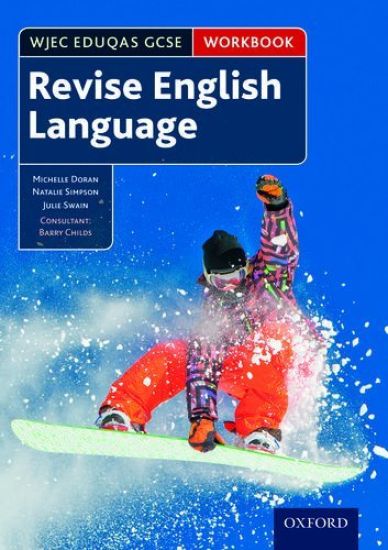
Please note this title is suitable for any student studying: Exam Board: Eduqas Level: GCSE and English Language First teaching: 2015 First exams: 2017 Matched to the requirements of the WJEC Eduqas GCSE English Language specification, this workbook provides an active and structured approach to revision. This full colour write-in workbook helps prepare students for the exams and provides extensive practice opportunities, sample student answers, revision tips and sample exam papers. With a focus on self-evaluation, this workbook, written by an experienced and trusted author team, aims to help students take control of their revision through an active and motivational approach.
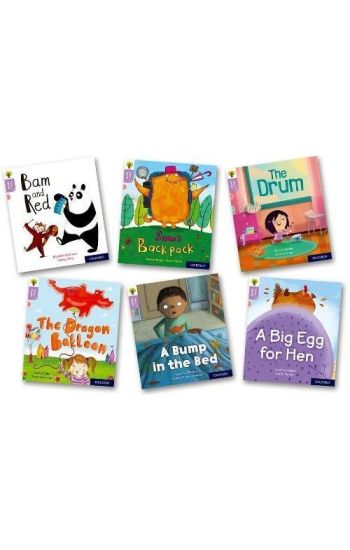
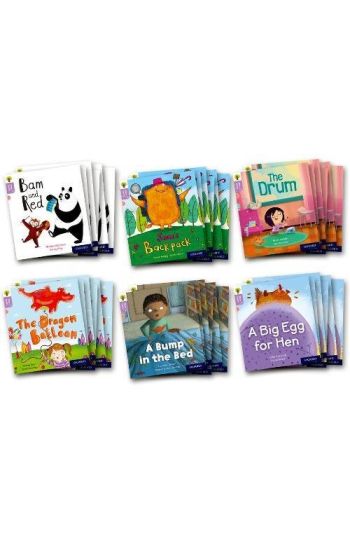
Oxford Reading Tree Story Sparks is an emotionally-engaging fiction series that will fire children's imaginations and develop their comprehension skills. The variety of authors and illustrators broadens children's reading experience, with something to appeal to every child. The titles at Oxford Levels 1+ to 5 are phonically decodable with some extra high-interest words to expand children's vocabularies and enrich the stories. All the books in the series are carefully levelled, making it easy to match every reader to the right book. This pack contains six books, one of each of the following titles: Bam and Red, Sam's Backpack, The Drum, The Dragon Balloon, A Bump in the Bed and A Big Egg for Hen.
Oxford Reading Tree Story Sparks is an emotionally-engaging fiction series that will fire children's imaginations and develop their comprehension skills. The variety of authors and illustrators broadens children's reading experience, with something to appeal to every child. The titles at Oxford Levels 1+ to 5 are phonically decodable with some extra high-interest words to expand children's vocabularies and enrich the stories. All the books in the series are carefully levelled, making it easy to match every reader to the right book. This pack contains 36 books, six of each of the following titles: Bam and Red, Sam's Backpack, The Drum, The Dragon Balloon, A Bump in the Bed and A Big Egg for Hen.
When Bam the panda accidentally breaks Red's drum, he needs to think of a way to make it up to Red! Oxford Reading Tree Story Sparks is an emotionally-engaging fiction series that will fire children's imaginations and develop their comprehension skills. The variety of authors and illustrators broadens children's reading experience, with something to appeal to every child. This story is one of six titles at Oxford Level 1+, which are phonically decodable with some extra high-interest words to expand children's vocabularies and enrich the stories. All the books in the series are carefully levelled, making it easy to match every reader to the right book.
Numerical analysis explains why numerical computations work, or fail. This book is divided into four parts. Part I starts with a guided tour of floating number systems and machine arithmetic. The exponential and the logarithm are constructed from scratch to present a new point of view on questions well-known to the reader, and the needed knowledge of linear algebra is summarized. Part II starts with polynomial approximation (polynomial interpolation, mean-square approximation, splines). It then deals with Fourier series, providing the trigonometric version of least square approximations, and one of the most important numerical algorithms, the fast Fourier transform. Any scientific computation program spends most of its time solving linear systems or approximating the solution of linear systems, even when trying to solve non-linear systems. Part III is therefore about numerical linear algebra, while Part IV treats a selection of non-linear or complex problems: resolution of linear equations and systems, ordinary differential equations, single step and multi-step schemes, and an introduction to partial differential equations. The book has been written having in mind the advanced undergraduate students in mathematics who are interested in the spice and spirit of numerical analysis. The book does not assume previous knowledge of numerical methods. It will also be useful to scientists and engineers wishing to learn what mathematics has to say about the reason why their numerical methods work - or fail.
Numerical analysis explains why numerical computations work, or fail. This book is divided into four parts. Part I starts Part I starts with a guided tour of floating number systems and machine arithmetic. The exponential and the logarithm are constructed from scratch to present a new point of view on questions well-known to the reader, and the needed knowledge of linear algebra is summarized. Part II starts with polynomial approximation (polynomial interpolation, mean-square approximation, splines). It then deals with Fourier series, providing the trigonometric version of least square approximations, and one of the most important numerical algorithms, the fast Fourier transform. Any scientific computation program spends most of its time solving linear systems or approximating the solution of linear systems, even when trying to solve non-linear systems. Part III is therefore about numerical linear algebra, while Part IV treats a selection of non-linear or complex problems: resolution of linear equations and systems, ordinary differential equations, single step and multi-step schemes, and an introduction to partial differential equations. The book has been written having in mind the advanced undergraduate students in mathematics who are interested in the spice and spirit of numerical analysis. The book does not assume previous knowledge of numerical methods. It will also be useful to scientists and engineers wishing to learn what mathematics has to say about the reason why their numerical methods work - or fail.
What is given to us in conscious experience? The Given is an attempt to answer this question and in this way contribute to a general theory of mental content. The content of conscious experience is understood to be absolutely everything that is given to one, experientially, in the having of an experience. Michelle Montague focuses on the analysis of conscious perception, conscious emotion, and conscious thought, and deploys three fundamental notions in addition to the fundamental notion of content: the notions of intentionality, phenomenology, and consciousness. She argues that all experience essentially involves all four things, and that the key to an adequate general theory of what is given in experience--of 'the given'--lies in giving a correct specification of the nature of these four things and the relations between them. Montague argues that conscious perception, conscious thought, and conscious emotion each have a distinctive, irreducible kind of phenomenology--what she calls 'sensory phenomenology', 'cognitive phenomenology', and 'evaluative phenomenology' respectively--and that these kinds of phenomenology are essential in accounting for the intentionality of these mental phenomena.
Traditionally economists have based their economic predictions on the assumption that humans are super-rational creatures, using the information we are given efficiently and generally making selfish decisions that work well for us as individuals. Economists also assume that we're doing the very best we can possibly do - not only for today, but over our whole lifetimes too. But increasingly the study of behavioural economics is revealing that our lives are not that simple. Instead, our decisions are complicated by our own psychology. Each of us makes mistakes every day. We don't always know what's best for us and, even if we do, we might not have the self-control to deliver on our best intentions. We struggle to stay on diets, to get enough exercise and to manage our money. We misjudge risky situations. We are prone to herding: sometimes peer pressure leads us blindly to copy others around us; other times copying others helps us to learn quickly about new, unfamiliar situations. This Very Short Introduction explores the reasons why we make irrational decisions; how we decide quickly; why we make mistakes in risky situations; our tendency to procrastination; and how we are affected by social influences, personality, mood and emotions. The implications of understanding the rationale for our own financial behaviour are huge. Behavioural economics could help policy-makers to understand the people behind their policies, enabling them to design more effective policies, while at the same time we could find ourselves assaulted by increasingly savvy marketing. Michelle Baddeley concludes by looking forward, to see what the future of behavioural economics holds for us. ABOUT THE SERIES: The Very Short Introductions series from Oxford University Press contains hundreds of titles in almost every subject area. These pocket-sized books are the perfect way to get ahead in a new subject quickly. Our expert authors combine facts, analysis, perspective, new ideas, and enthusiasm to make interesting and challenging topics highly readable.
International Refugee Law and the Protection of Stateless Persons examines the extent to which the 1951 Convention relating to the Status of Refugees protectsde jure stateless persons. While de jure stateless persons are clearly protected by the 1954 Convention relating to the Status of Stateless Persons, this book seeks to explore the extent to which such persons are also entitled to refugee status. The questions addressed include the following: When is a person 'without a nationality' for the purpose of the 1951 Refugee Convention? What constitutes one's country of former habitual residence as a proxy to one's country of nationality? When does being stateless give rise to a well-founded fear of persecution for reasons specified in the 1951 Refugee Convention and/or UNHCR mandate? What are the circumstances under which statelessness constitutes persecution or inhuman or degrading treatment? How are courts assessing individual risk or threat to stateless persons? The book draws on historical and contemporary interpretation of international law based on the travaux préparatoires to the 1951 Refugee Convention and its antecedents, academic writing, UNHCR policy and legal documents, UN Human Rights Council resolutions, UN Human Rights Committee general comments, UN Secretary General reports, and UN General Assembly resolutions. It is also based on original comparative analysis of existing jurisprudence worldwide relating to claims to refugee status based on or around statelessness. By examining statelessness through the prism of international refugee law, this book fills a critical gap in existing scholarship.
One of Fichte's most important ideas - that nature can place limits on our ability to govern ourselves, and that anyone who values autonomy is thereby committed to the value of basic research and of the development of autonomy-enhancing technologies - has received little attention in the interpretative literature on Fichte, and has little currency in contemporary ethics. This volume aims to address both deficits. Beginning from a reconstruction of Fichte's theory of rational agency, Kosch examines his arguments for the thesis that rational agency must have two constitutive ends: substantive and formal independence. It argues for a novel interpretation of Fichte's conception of substantive independence, and shows how Fichte's account of moral duties is derived from the end of substantive independence on that conception. It also argues for a new interpretation of Fichte's conception of formal independence, and explains why the usual understanding of this end as providing direct guidance for action must be mistaken. It encompasses a systematic reconstruction of Fichte's first-order claims in normative ethics and political philosophy.
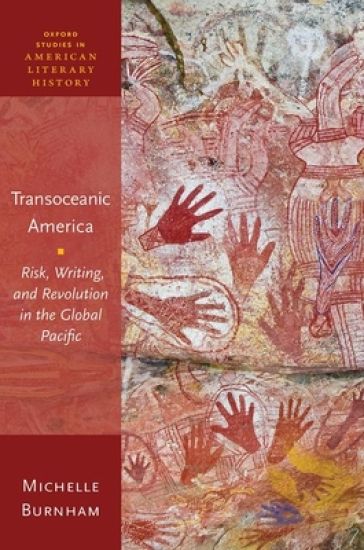
Transoceanic America offers a new approach to American literature by emphasizing the material and conceptual interconnectedness of the Atlantic and Pacific worlds. These oceans were tied together economically, textually, and politically, through such genres as maritime travel writing, mathematical and navigational schoolbooks, and the relatively new genre of the novel. Especially during the age of revolutions in the late eighteenth and early nineteenth centuries, long-distance transoceanic travel required calculating and managing risk in the interest of profit. The result was the emergence of a newly suspenseful form of narrative that came to characterize capitalist investment, political revolution, and novelistic plot. The calculus of risk that drove this expectationist narrative also concealed violence against vulnerable bodies on ships and shorelines around the world. A transoceanic American literary and cultural history requires new non-linear narratives to tell the story of this global context and to recognize its often forgotten textual archive.
One of Fichte's most important ideas - that nature can place limits on our ability to govern ourselves, and that anyone who values autonomy is thereby committed to the value of basic research and of the development of autonomy-enhancing technologies - has received little attention in the interpretative literature on Fichte, and has little currency in contemporary ethics. This volume aims to address both deficits. Beginning from a reconstruction of Fichte's theory of rational agency, this volume examines his arguments for the thesis that rational agency must have two constitutive ends: substantive and formal independence. It argues for a novel interpretation of Fichte's conception of substantive independence, and shows how Fichte's account of moral duties is derived from the end of substantive independence on that conception. It also argues for a new interpretation of Fichte's conception of formal independence, and explains why the usual understanding of this end as providing direct guidance for action must be mistaken. It encompasses a systematic reconstruction of Fichte's first-order claims in normative ethics and the philosophy of right.
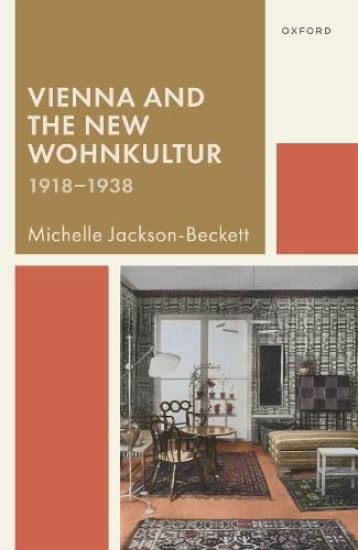
While the domestic sphere might seem tangential to the dire political situation and humanitarian crises of interwar Europe, it was nevertheless at the forefront of debates about cultural identity and economic policy in the Viennese press, culture, and arts. Vienna and the New Wohnkultur, 1918-1938 explores why and how the Viennese design landscape was set apart--aesthetically and theoretically--from other European explorations of modern design. Jackson-Beckett examines interior design exhibitions, press, and debates about modern living in interwar Vienna, an overlooked area of modern European architecture and design history, arguing for a reconsideration of the contours of European modernism. The text analyses varied interpretations of modern domestic culture (Wohnkultur) in Vienna, and explores why these interpretations were distinct from other strands of European modernism. Vienna and the New Wohnkultur introduces new research and translation of primary sources on flexible, adaptable, and affordable design by architects, designers, and retailers. Vienna's design discourse also prefigured important postmodern and contemporary discussions on historicism, eclecticism, empathy, and user experience. Through extensive new research in archival and period sources, Jackson-Beckett illustrates how design ideas, taste, and portrayals of domestic culture of fin-de-siècle Viennese Modernism (Wiener Moderne) were also deployed as forms of cultural and national identity both during the early years of the Social Democratic government in Vienna (1918-1934) and later under the fascist state (1934-1938).
The non-use of biological weapons has been described as the 'great mystery of biological warfare.' The Biological Weapons Taboo solves that mystery by analysing the bioweapons taboo, in the first comprehensive study of the concept. Bentley explains precisely why bioweapons are perceived as repulsive and how this sentiment is consequently expressed in the form of political behaviours, including the refusal to engage in biological aggression. Drawing on extensive archival evidence, this volume looks back on United States' foreign policy decision-making (particularly in relation to the Geneva Protocol and the Biological Weapons Convention) to demonstrate how and why the taboo has comprised a decisive factor in shaping both biowarfare strategy and political rhetoric - and why the taboo needs to be recognised as a necessary consideration in the study of bioweapons. In analysing a taboo, the volume also takes the debate on international norms forward by questioning and challenging the wider analytic comprehension of 'taboo' itself. Rejecting current definitions of the concept as inadequate, Bentley proposes a new and original model of understanding based on the normative characteristics of disgust, stigmatization, and fetishization.
What did work mean to Shakespeare? And what does it mean to work in Shakespeare's plays? Work was a quintessential part of early modern society, as it is today. But the meanings attached to different forms of work were changing in important ways during the sixteenth and seventeenth centuries in England. Developments such as the enclosure movement, the growth of venture capitalism, and the diversification of the wage-labour market transformed England's labour economy and helped reshape the everyday lives of men and women in both rural and urban communities. These socio-economic shifts had a direct effect on the professional theatres of Shakespeare's day. The world of work, including the people at all social levels who performed it, was vital to Shakespeare's drama, both because the theatre was a highly successful business enterprise in its own right and because work significantly influences the plots, language, and structures of Shakespeare's plays throughout his career. Shakespeare and Work introduces readers to the rich working world of Shakespeare's plays. Opening chapters provide an overview of working conditions in Shakespeare's England and in the theatre and discuss Shakespeare's own practices as a working playwright. Subsequent chapters examine a range of plays from multiple genres, including Twelfth Night, Othello, The Tempest, Titus Andronicus, Love's Labour's Lost, Macbeth, The Winter's Tale, 2 Henry VI, and A Midsummer Night's Dream, and consider several types of work that are either staged directly (such as service) or, more frequently, alluded to (such as agricultural work). Offering an accessible and wide-ranging account of how Shakespeare engaged with the working world around him, Shakespeare and Work demonstrates that we can come to a richer understanding of Shakespeare's dramatic output and cultural legacy if we attend to how the everyday world of work shapes both the action and the language of his plays.
Written by experts, this is the most complete, issues-led textbook on European Union politics. With contemporary issues and debates presented alongside thorough coverage of the theory, institutions, policies, and history of the EU, European Union Politics effortlessly guides students to a clear understanding of this complex area. Key Features: - With its comprehensive exploration of the EU's history, theories, institutions, policies, and ongoing debates, European Union Politics is appropriate for a wide range of Politics and International Relations modules. - Straightforward writing style and useful learning tools in European Union Politics make it the perfect introduction for students new to the subject. - New contributors to this edition add to the already established pool of contributors of European Union Politics, consisting of leading academics and scholars in EU politics, offering readers an authoritative perspective on key debates. - Divided into sections like "Issues and Debates" and "Policies and Policy-making", the book's structure helps students critically engage with EU studies and simplifies complex themes. - Case and example boxes throughout the text demonstrate the relevance of EU theories, institutions, and policies, and help students to understand the workings of the EU in practice. New to this Edition: - A thorough and extensive empirical updating of content, which takes account of recent developments in the European Union. - Three brand new chapters cover gender and sexuality in the European Union, digital policy in the EU, and the war in Ukraine. - Two newly authored and completely rewritten chapters cover trade and the EU, and the future of the EU. Digital Formats and Resources: The eighth edition is available for students and institutions to purchase in a variety of formats: The e-book and Politics Trove offer a mobile experience and convenient access, along with multiple-choice questions, answer guidance, a flashcard glossary, functionality tools, navigation features, and links that offer extra learning support. For more information about e-books, please visit: www.oxfordtextbooks.co.uk/ebooks.
In the decades either side of 1700, England witnessed a major public debate about the immortality of the soul. At its centre were two unlikely figures: the lawyer Henry Layton and the physician William Coward. Across numerous publications, both argued that the soul's immortality was a pagan invention absent from early scripture and only later absorbed into Christianity. Their detailed histories of the soul aimed to recast it as an inescapably human creation, rather than a natural and revealed truth. Though often seen as the product of radical freethinking circles, Layton and Coward's histories drew directly on scholarly commonplaces that they simply reassembled and repurposed. Economic, social, and cultural shifts across the seventeenth century had made academic scholarship more accessible than ever, enabling a growing number of non-specialists to participate in scholarly debates that were now more firmly in the public sphere. The derivative nature of their work should not see writers like Layton and Coward dismissed as mere hacks. Technical proficiency does not automatically confer historical significance, nor does its absence preclude it. Layton and Coward's contributions to the debate about the soul were amateurish and, to specialist scholars at the time, unsurprising. Yet they helped push scholarship in new directions. The impact of ideas depends as much on the context of their circulation as on their originality and rigour. Rather than portraying the heterodox publications of the period c.1700 as the 'unintended consequences' of scholarship, this book presents a more dynamic model: a feedback loop between lay and specialist knowledge, in which amateur contributions actively shaped scholarly debates. The early Enlightenment, this book suggests, may be best understood less in terms of substantive new ideas, and more in the repackaging of older ones, with different targets, by different sorts of people, for different audiences.
The Oxford Studies in Postcolonial Literatures series offers stimulating and accessible introductions to definitive topics and key genres and regions within the rapidly diversifying field of postcolonial literary studies in English. The first book of its kind, Pacific Islands Writing offers a broad-ranging introduction to the postcolonial literatures of the Pacific region. Drawing upon metaphors of oceanic voyaging, Michelle Keown takes the reader on a discursive journey through a variety of literary and cultural contexts in the Pacific, exploring the Indigenous literatures of Polynesia, Melanesia, and Micronesia, and also investigating a range of European or Western writing about the Pacific, from the adventure fictions of Herman Melville, R. L. Stevenson, and Jack London to the Päkehä (European) settler literatures of Aotearoa/New Zealand. The book explores the relevance of 'international' postcolonial theoretical paradigms to a reading of Pacific literatures, but it also offers a region-specific analysis of key authors and texts, drawing upon Indigenous Pacific literary theories, and sketching in some of the key socio-historical trajectories that have inflected Pacific writing. Well-established Indigenous Pacific authors such as Albert Wendt, Witi Ihimaera, Alan Duff, and Patricia Grace are considered alongside emerging writers such as Sia Figiel, Caroline Sinavaiana-Gabbard, and Dan Taulapapa McMullin. The book focuses primarily upon Pacific literature in English - the language used by the majority of Pacific writers - but also breaks new ground in examining the growing corpus of francophone and hispanophone writing in French Polynesia, New Caledonia, and Easter Island/Rapa Nui.
An analysis of the policies and institutions used by the EU to create a single market. Drawing upon literature from several disciplines, this book develops an account of the regulatory strategies and institutional arrangements adopted, providing an evaluation of the process involved.