This book provides an informative account of the design of instruments used in rockets and spacecraft. The volume begins with a chapter introducing the basic principles of designing for the space environment. Following chapters discuss mechanical, structural, thermal and electronic design including the problems that are frequently encountered in the testing and verification of spacecraft subsystems. Important topics are described, including stress analysis, multilayer insulation, two-dimensional sensor systems, mechanisms, the structure of space optics, and project management and control. A final chapter looks towards future developments of space instrument design and addresses issues arising from financial constraints. The book contains lists of symbols, acronyms and units and a comprehensive reference list. Worked examples are found throughout the text. This volume is suitable for researchers and engineers in spacecraft and space instrument design. It will also be valuable to graduate students of physics, space science, spacecraft engineering and astronautics.
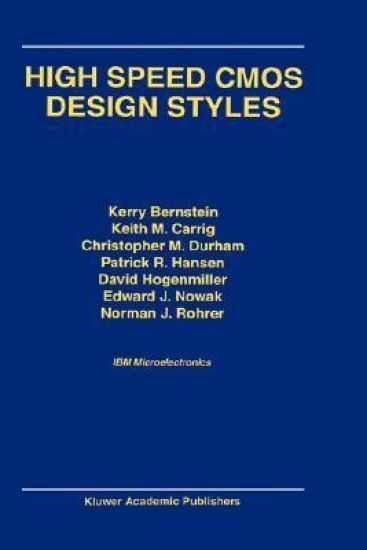
High Speed CMOS Design Styles is written for the graduate-level student or practicing engineer who is primarily interested in circuit design. It is intended to provide practical reference, or `horse-sense', to mechanisms typically described with a more academic slant. This book is organized so that it can be used as a textbook or as a reference book. High Speed CMOS Design Styles provides a survey of design styles in use in industry, specifically in the high speed microprocessor design community. Logic circuit structures, I/O and interface, clocking, and timing schemes are reviewed and described. Characteristics, sensitivities and idiosyncrasies of each are highlighted. High Speed CMOS Design Styles also pulls together and explains contributors to performance variability that are associated with process, applications conditions and design. Rules of thumb and practical references are offered. Each of the general circuit families is then analyzed for its sensitivity and response to this variability. High Speed CMOS Design Styles is an excellent source of ideas and a compilation of observations that highlight how different approaches trade off critical parameters in design and process space.
Stephen Watts; Patrick B Johnston; Jennifer Kavanagh; Sean M Zeigler; Bryan Frederick; Trevor Johnston; Karl P Mueller; Astrid Stuth Cevallos; Nathan Chandler; Meagan L Smith; Alexander Stephenson; Julia A Thompson
The foreign policy and defense communities have intensively debated the efficacy of low-cost and small-footprint military options for crises such as those in Afghanistan, Iraq, Libya, Somalia, Syria, and Yemen. This report provides a statistical analysis of hundreds of cases, supplemented by case studies, to evaluate the strategic effects of each option across a range of irregular warfare operations and in a range of operational environments.
High Speed CMOS Design Styles is written for the graduate-level student or practicing engineer who is primarily interested in circuit design. It is intended to provide practical reference, or `horse-sense', to mechanisms typically described with a more academic slant. This book is organized so that it can be used as a textbook or as a reference book. High Speed CMOS Design Styles provides a survey of design styles in use in industry, specifically in the high speed microprocessor design community. Logic circuit structures, I/O and interface, clocking, and timing schemes are reviewed and described. Characteristics, sensitivities and idiosyncrasies of each are highlighted. High Speed CMOS Design Styles also pulls together and explains contributors to performance variability that are associated with process, applications conditions and design. Rules of thumb and practical references are offered. Each of the general circuit families is then analyzed for its sensitivity and response to this variability. High Speed CMOS Design Styles is an excellent source of ideas and a compilation of observations that highlight how different approaches trade off critical parameters in design and process space.
The Center for Theoretical Studies of the University of Miami has been the host of annual winter conferences whose content has expanded from the particular topic of symmetry principles in high energy physics to encompass the bases and relationships of many branches of know ledge. The scope of the Tenth Coral Gables Conference on Fundamental Interactions included astrophysics, atomic and molecular physics, fundamental theories of gravi tation, of electromagnetism, and of hadrons, gauge theories of weak and electromagnetic interactions, high energy physics, liquid helium physics, and theoretical biology. The range of topics is partially represented by the scientific talks which form this book. The tangible fruits of the conference are these papers; the intangible ones are the changes of outlook which the participants experienced and the new appreciation they gained of the basic unity of all knowledge. Historically, the early Coral Gables Conferences witnessed the introduction of the concept of the quark and the attempts to formulate a unification of the in ternal and space-time symmetries of the elementary particles, while later ones were the initial forums for new unified theories of interactions and for the ideas of scaling, light-cone dominance, and partons.
Captivating and inspiring, readers traverse stunning survival and loss, spanningcontinents and cultures. Maiming, death, divorce, disease, and a global pandemic provide the backdrop for an unlikely merger of stories and reflections shared by Paul Templer and Rebecca Simons.This unexpected duo provides insight, illuminating the path to discovering themagnificence and resilience that resides within us all.
Captivating and inspiring, readers traverse stunning survival and loss, spanningcontinents and cultures. Maiming, death, divorce, disease, and a global pandemic provide the backdrop for an unlikely merger of stories and reflections shared by Paul Templer and Rebecca Simons.This unexpected duo provides insight, illuminating the path to discovering themagnificence and resilience that resides within us all.
Viability theory designs and develops mathematical and algorithmic methods for investigating the adaptation to viability constraints of evolutions governed by complex systems under uncertainty that are found in many domains involving living beings, from biological evolution to economics, from environmental sciences to financial markets, from control theory and robotics to cognitive sciences. It involves interdisciplinary investigations spanning fields that have traditionally developed in isolation. The purpose of this book is to present an initiation to applications of viability theory, explaining and motivating the main concepts and illustrating them with numerous numerical examples taken from various fields.
Viability theory designs and develops mathematical and algorithmic methods for investigating the adaptation to viability constraints of evolutions governed by complex systems under uncertainty that are found in many domains involving living beings, from biological evolution to economics, from environmental sciences to financial markets, from control theory and robotics to cognitive sciences. It involves interdisciplinary investigations spanning fields that have traditionally developed in isolation. The purpose of this book is to present an initiation to applications of viability theory, explaining and motivating the main concepts and illustrating them with numerous numerical examples taken from various fields.
Smart and Flexible Digital-to-Analog Converters proposes new concepts and implementations for flexibility and self-correction of current-steering digital-to-analog converters (DACs) which allow the attainment of a wide range of functional and performance specifications, with a much reduced dependence on the fabrication process. DAC linearity is analysed with respect to the accuracy of the DAC unit elements. A classification is proposed of the many different current-steering DAC correction methods. The classification reveals methods that do not yet exist in the open literature. Further, this book systematically analyses self-calibration correction methods for the various DAC mismatch errors. For instance, efficient calibration of DAC binary currents is identified as an important missing method. This book goes on to propose a new methodology for correcting mismatch errors of both nominally identical unary as well as scaled binary DAC currents. A new concept for DAC flexibility is presented. The associated architecture is based on a modular design approach that uses parallel sub-DAC units to realize flexible design, functionality and performance. Two main concepts, self-calibration and flexibility, are demonstrated in practice using three DAC testchips in 250nm, 180nm and 40nm standard CMOS. Smart and Flexible Digital-to-Analog Converters will be useful to both advanced professionals and newcomers in the field. Advanced professionals will find new methods that are fully elaborated from analysis at conceptual level to measurement results at test-chip level. New comers in the field will find structured knowledge of fully referenced state-of-the art methods with many fully explained novelties.DAC linearity is analysed with respect to the accuracy of the DAC unit elements. A classification is proposed of the many different current-steering DAC correction methods. The classification reveals methods that do not yet exist in the open literature. Further, this book systematically analyses self-calibration correction methods for the various DAC mismatch errors. For instance, efficient calibration of DAC binary currents is identified as an important missing method. This book goes on to propose a new methodology for correcting mismatch errors of both nominally identical unary as well as scaled binary DAC currents. A new concept for DAC flexibility is presented. The associated architecture is based on a modular design approach that uses parallel sub-DAC units to realize flexible design, functionality and performance. Two main concepts, self-calibration and flexibility, are demonstrated in practice using three DAC testchips in 250nm, 180nm and 40nm standard CMOS. Smart and Flexible Digital-to-Analog Converters will be useful to both advanced professionals and newcomers in the field. Advanced professionals will find new methods that are fully elaborated from analysis at conceptual level to measurement results at test-chip level. New comers in the field will find structured knowledge of fully referenced state-of-the art methods with many fully explained novelties.This book goes on to propose a new methodology for correcting mismatch errors of both nominally identical unary as well as scaled binary DAC currents. A new concept for DAC flexibility is presented. The associated architecture is based on a modular design approach that uses parallel sub-DAC units to realize flexible design, functionality and performance. Two main concepts, self-calibration and flexibility, are demonstrated in practice using three DAC testchips in 250nm, 180nm and 40nm standard CMOS. Smart and Flexible Digital-to-Analog Converters will be useful to both advanced professionals and newcomers in the field. Advanced professionals will find new methods that are fully elaborated from analysis at conceptual level to measurement results at test-chip level. New comers in the field will find structured knowledge of fully referenced state-of-the art methods with many fully explained novelties.Two main concepts, self-calibration and flexibility, are demonstrated in practice using three DAC testchips in 250nm, 180nm and 40nm standard CMOS. Smart and Flexible Digital-to-Analog Converters will be useful to both advanced professionals and newcomers in the field. Advanced professionals will find new methods that are fully elaborated from analysis at conceptual level to measurement results at test-chip level. New comers in the field will find structured knowledge of fully referenced state-of-the art methods with many fully explained novelties.
Smart and Flexible Digital-to-Analog Converters proposes new concepts and implementations for flexibility and self-correction of current-steering digital-to-analog converters (DACs) which allow the attainment of a wide range of functional and performance specifications, with a much reduced dependence on the fabrication process. DAC linearity is analysed with respect to the accuracy of the DAC unit elements. A classification is proposed of the many different current-steering DAC correction methods. The classification reveals methods that do not yet exist in the open literature. Further, this book systematically analyses self-calibration correction methods for the various DAC mismatch errors. For instance, efficient calibration of DAC binary currents is identified as an important missing method. This book goes on to propose a new methodology for correcting mismatch errors of both nominally identical unary as well as scaled binary DAC currents. A new concept for DAC flexibility is presented. The associated architecture is based on a modular design approach that uses parallel sub-DAC units to realize flexible design, functionality and performance. Two main concepts, self-calibration and flexibility, are demonstrated in practice using three DAC testchips in 250nm, 180nm and 40nm standard CMOS. Smart and Flexible Digital-to-Analog Converters will be useful to both advanced professionals and newcomers in the field. Advanced professionals will find new methods that are fully elaborated from analysis at conceptual level to measurement results at test-chip level. New comers in the field will find structured knowledge of fully referenced state-of-the art methods with many fully explained novelties.DAC linearity is analysed with respect to the accuracy of the DAC unit elements. A classification is proposed of the many different current-steering DAC correction methods. The classification reveals methods that do not yet exist in the open literature. Further, this book systematically analyses self-calibration correction methods for the various DAC mismatch errors. For instance, efficient calibration of DAC binary currents is identified as an important missing method. This book goes on to propose a new methodology for correcting mismatch errors of both nominally identical unary as well as scaled binary DAC currents. A new concept for DAC flexibility is presented. The associated architecture is based on a modular design approach that uses parallel sub-DAC units to realize flexible design, functionality and performance. Two main concepts, self-calibration and flexibility, are demonstrated in practice using three DAC testchips in 250nm, 180nm and 40nm standard CMOS. Smart and Flexible Digital-to-Analog Converters will be useful to both advanced professionals and newcomers in the field. Advanced professionals will find new methods that are fully elaborated from analysis at conceptual level to measurement results at test-chip level. New comers in the field will find structured knowledge of fully referenced state-of-the art methods with many fully explained novelties.This book goes on to propose a new methodology for correcting mismatch errors of both nominally identical unary as well as scaled binary DAC currents. A new concept for DAC flexibility is presented. The associated architecture is based on a modular design approach that uses parallel sub-DAC units to realize flexible design, functionality and performance. Two main concepts, self-calibration and flexibility, are demonstrated in practice using three DAC testchips in 250nm, 180nm and 40nm standard CMOS. Smart and Flexible Digital-to-Analog Converters will be useful to both advanced professionals and newcomers in the field. Advanced professionals will find new methods that are fully elaborated from analysis at conceptual level to measurement results at test-chip level. New comers in the field will find structured knowledge of fully referenced state-of-the art methods with many fully explained novelties.Two main concepts, self-calibration and flexibility, are demonstrated in practice using three DAC testchips in 250nm, 180nm and 40nm standard CMOS. Smart and Flexible Digital-to-Analog Converters will be useful to both advanced professionals and newcomers in the field. Advanced professionals will find new methods that are fully elaborated from analysis at conceptual level to measurement results at test-chip level. New comers in the field will find structured knowledge of fully referenced state-of-the art methods with many fully explained novelties.
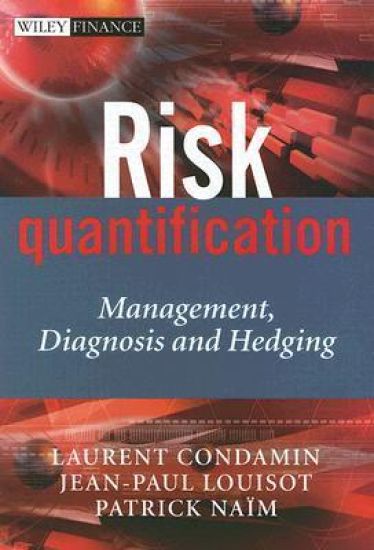
This book offers a practical answer for the non-mathematician to all the questions any businessman always wanted to ask about risk quantification, and never dare to ask. Enterprise-wide risk management (ERM) is a key issue for board of directors worldwide. Its proper implementation ensures transparent governance with all stakeholders’ interests integrated into the strategic equation. Furthermore, Risk quantification is the cornerstone of effective risk management,at the strategic and tactical level, covering finance as well as ethics considerations. Both downside and upside risks (threats & opportunities) must be assessed to select the most efficient risk control measures and to set up efficient risk financing mechanisms. Only thus will an optimum return on capital and a reliable protection against bankruptcy be ensured, i.e. long term sustainable development. Within the ERM framework, each individual operational entity is called upon to control its own risks, within the guidelines set up by the board of directors, whereas the risk financing strategy is developed and implemented at the corporate level to optimise the balance between threats and opportunities, systematic and non systematic risks. This book is designed to equip each board member, each executives and each field manager, with the tool box enabling them to quantify the risks within his/her jurisdiction to all the extend possible and thus make sound, rational and justifiable decisions, while recognising the limits of the exercise. Beyond traditional probability analysis, used since the 18th Century by the insurance community, it offers insight into new developments like Bayesian expert networks, Monte-Carlo simulation, etc. with practical illustrations on how to implement them within the three steps of risk management, diagnostic, treatment and audit. With a foreword by Catherine Veret and an introduction by Kevin Knight.
In today's competitive business environment, a well thought out business plan is more important than ever before. Not only can it assist you in raising the money needed to start or expand a business-by attracting the interest of potential investors-but it can also help you keep tabs on your progress once the business is up and running. Completely revised and updated to reflect today's dynamic business environment, The Ernst & Young Business Plan Guide, Third Edition leads you carefully through every aspect involved in researching, writing, and presenting a winning business plan. Illustrating each step of this process with realistic examples, this book goes far beyond simply discussing what a business plan is. It explains why certain information is required, how it may best be presented, and what you should be aware of as both a preparer and reviewer of such a proposal. Divided into three comprehensive parts, The Ernst & Young Business Plan Guide, Third Edition outlines the essential elements of this discipline in a straightforward and accessible manner. Whether you're considering starting, expanding, or acquiring a business, the information found within these pages will enhance your chances of success. * Advice on how to write and develop business plans * A realistic sample plan * All new sections on funding and financing methodswith provisions for restructuring and bankruptcy * Tips for tailoring plans to the decision makers
Perhaps not since Ralph Tyler's (1949) Basic Principles of Curriculum and Instruction has a book communicated the field as completely as Understanding Curriculum. From historical discourses to breaking developments in feminist, poststructuralist, and racial theory, including chapters on political theory, phenomenology, aesthetics, theology, international developments, and a lengthy chapter on institutional concerns, the American curriculum field is here. It will be an indispensable textbook for undergraduate and graduate courses alike.
A century of publishing and bookselling; over 700 books published in the field of Americana, many of them quite scarce and collectible; an international reputation for academic excellence and the publication of source works in American history. For three generations the company has been a leader in its field, and has received numerous awards for its work, including the Pulitzer Prize for American History.This new bibliography and history contains a complete listing of all works produced by the firm through the past one hundred years, with full annotations on each book. Additionally, a history of the company provides insights into the firm's founding, publishing efforts, relocations, rare book business, staff members, and achievements.Much revised and expanded: This new work completely supercedes the 1993 bibliography which was produced in a limited edition of 500 copies and was sold out prior to publication. This new work contains added data, revisions and corrections, new publications issued in the past decade, and new topical sections. The historical introduction has been revised and contains new illustrations.Complete bibliographic entries: Each entry includes the usual author/editor and title listings with publication place and date. A physical description of the book is given, including the number of copies produced. Data on reprints by the company and others is added, plus a short summation of the contents, an appraisal of importance, and comments of interest regarding the publication or reception of the work.New and enlarged sections: Bibliography of publications: The complete list of books published under the company imprint has been expanded, revised and corrected.Contract publications: A detailed listing of all books produced for other individuals, organizations and publishers on a contract basis is added.Promotional materials: A section on catalogs and promotional ephemera is provided.Mis-identified books: An enlarged list of books mistaken for Clark publications is included.Series list: A separate section lists all volumes published in each of the many completed and ongoing series published by the company.The book is bound in linen cloth. Embellished with photographs and facsimiles. Printed on acid-free paper with foil stamped spine and front cover. The trade edition is issued in an edition of 1000 copies.
The United States and the world were unprepared for the COVID-19 pandemic, despite decades of warnings highlighting the inevitability of global pandemics and the need for international coordination. The failure to prioritize and adequately fund preparedness and effectively implement response plans has exacted a heavy human and economic price, and the crisis is not yet over. Emerging and reemerging infectious diseases are a threat to global and national security that neither the United States nor the world can afford to ignore. This Task Force proposes a comprehensive strategy that includes institutional reforms and policy innovations to help the United States and the multilateral system perform better in this crisis and when the next one emerges. Without increased U.S. leadership on and adequate investment in pandemic preparedness and response, the United States and the world will remain unnecessarily vulnerable to epidemic threats. The Council on Foreign Relations sponsors Independent Task Forces to assess issues of current and critical importance to U.S. foreign policy and provide policymakers with concrete judgments and recommendations. Diverse in backgrounds and perspectives, Task Force members aim to reach a meaningful consensus on policy through private deliberations. Once launched, Task Forces are independent of CFR and are solely responsible for the content of their reports. Task Force members are asked to join a consensus signifying that they endorse the general policy thrust and judgments reached by the group, though not necessarily every finding and recommendation. Each Task Force member also has the option of putting forward an additional or a dissenting view.
The archaeological site at Killarney Bay, on the northeast side of Georgian Bay in Ontario, Canada, has attracted and mystified archaeologists for decades. The quantities of copper artifacts, exotic cherts, and long-distance trade goods all highlight the importance of the site during its time of occupation. Yet researchers have struggled to date the site or assign it to a particular cultural tradition, since the artifacts and mortuary components do not precisely match those of other sites and assemblages in the Upper Great Lakes. The history of archaeological investigation at Killarney Bay stretches across parts of three centuries and involves field schools from universities in two countries (Laurentian University in Canada and the University of Michigan in the United States). This volume pulls together the results from all prior research at the site and represents the first comprehensive report ever published on the excavations and finds at Killarney Bay. Heavily illustrated.
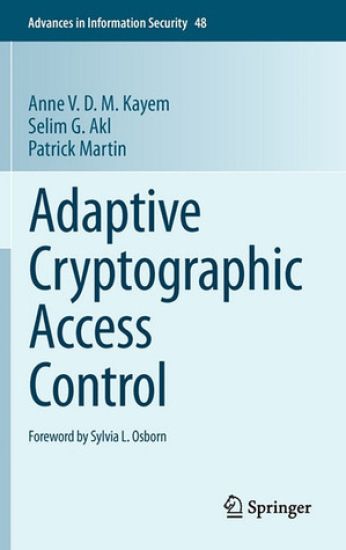
Cryptographic access control (CAC) is an approach to securing data by encrypting it with a key, so that only the users in possession of the correct key are able to decrypt the data and/or perform further encryptions. Applications of cryptographic access control will benefit companies, governments and the military where structured access to information is essential. The purpose of this book is to highlight the need for adaptability in cryptographic access control schemes that are geared for dynamic environments, such as the Internet. Adaptive Cryptographic Access Control presents the challenges of designing hierarchical cryptographic key management algorithms to implement Adaptive Access Control in dynamic environments and suggest solutions that will overcome these challenges. Adaptive Cryptographic Access Control is a cutting-edge book focusing specifically on this topic in relation to security and cryptographic access control. Both the theoretical and practical aspects and approaches of cryptographic access control are introduced in this book. Case studies and examples are provided throughout this book.
Cryptographic access control (CAC) is an approach to securing data by encrypting it with a key, so that only the users in possession of the correct key are able to decrypt the data and/or perform further encryptions. Applications of cryptographic access control will benefit companies, governments and the military where structured access to information is essential. The purpose of this book is to highlight the need for adaptability in cryptographic access control schemes that are geared for dynamic environments, such as the Internet. Adaptive Cryptographic Access Control presents the challenges of designing hierarchical cryptographic key management algorithms to implement Adaptive Access Control in dynamic environments and suggest solutions that will overcome these challenges. Adaptive Cryptographic Access Control is a cutting-edge book focusing specifically on this topic in relation to security and cryptographic access control. Both the theoretical and practical aspects and approaches of cryptographic access control are introduced in this book. Case studies and examples are provided throughout this book.