Kirjojen hintavertailu. Mukana 11 244 527 kirjaa ja 12 kauppaa.

Kirjahaku

Etsi kirjoja tekijän nimen, kirjan nimen tai ISBN:n perusteella.

1000 tulosta hakusanalla Random House

Random Families

Random Families

Rosanna Hertz; Margaret K. Nelson

Oxford University Press Inc
2018
sidottu
The ready availability of donated sperm and eggs has made possible an entirely new form of family. Children of the same donor and their families, with the help of the internet, can now locate each other and make contact. Sometimes this network of families form meaningful connections that blossom into longstanding groups, and close friendships. This book is about unprecedented families that have grown up at the intersection of new reproductive technologies, social media and the human desire for belonging. Random Families asks: Do shared genes make you a family? What do couples do when they discover that their children shares half their DNA with a dozen or more other offspring from the same sperm donor? What do kids find in common with their donor siblings? What becomes of these chance networks once parents and donor siblings find one another? Based on over 350 interviews with children (ages 10-28) and their parents from all over the U.S., Random Families chronicles the chain of choices that couples and single mothers make from what donor to use to how to participate (or not) in donor sibling networks. Children reveal their understanding of a donor, the donor's spot on the family tree and the meaning of their donor siblings. Through rich first-person accounts of network membership, the book illustrates how these extraordinary relationships--woven from bits of online information and shared genetic ties-- are transformed into new possibilities for kinship. Random Families offers down-to-earth stories from real families to highlight just how truly distinctive these contemporary new forms of family are.

Random Families

Random Families

Rosanna Hertz; Margaret K. Nelson

Oxford University Press Inc
2020
nidottu
Random Families is about the unprecedented families that have grown up at the intersection of new reproductive technologies, social media, and the human desire for belonging. Children of the same donor and their families, with the help of the internet, can now locate each other and make contact. Based on over 350 interviews with children (ages 10-28), their parents and related donors from all over the U.S., Random Families chronicles the chain of choices that couples and single mothers make from what donor to use to how to participate (or not) in donor sibling networks. Children reveal their understanding of a donor, the donor's spot on the family tree and the meaning of their donor siblings. Through rich first-person accounts of network membership, the book illustrates how these extraordinary relationships-woven from bits of online information and shared genetic ties-are transformed into new possibilities for kinship. Random Families offers down-to-earth stories from real families to highlight just how truly distinctive these contemporary new forms of family are.
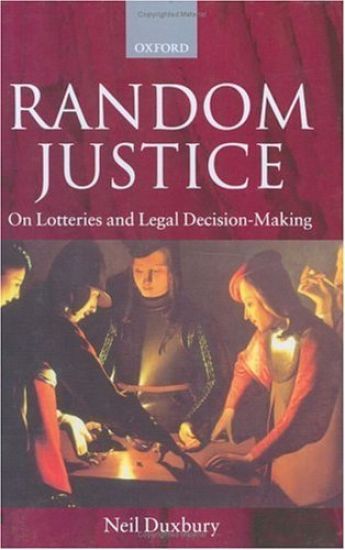
Random Justice

Random Justice

Duxbury Neil

Oxford University Press
1999
sidottu
Chance inevitably plays a role in law but it is not often that we consciously try to import an element of randomness into a legal process. Random Justice: On Lotteries and Legal Decision-Making explores the potential for the use of lotteries in social, and particularly legal, decision-making contexts. Utilizing a variety of disciplines and materials, Neil Duxbury considers in detail the history, advantages, and drawbacks of deciding issues of social significance by lot and argues that the value of the lottery as a legal decision-making device has generally been underestimated. The very fact that there exists widespread resistance to the use of lotteries for legal decision-making purposes betrays a commonly held belief that legal processes are generally more important than are legal outcomes. Where, owing to the existence of indeterminacy, the process of reasoning is likely to be excessively protracted and the reasons provided strongly contestable, the most cost-efficient and impartial decision-making strategy may well be recourse to lot. Aversion to this strategy, while generally understandable, is not necessarily rational. Yet in law, as Professor Duxbury demonstrates, reason is generally valued more highly than is rationality. The lottery is often conceived to be a decision-making device that operates in isolation. Yet lotteries can frequently and profitably be incorporated into other decision-frameworks. The book concludes by controversially considering how lotteries might be so incorporated and also advances the thesis that it may sometimes be sensible to require that adjudication takes place in the shadow of a lottery.
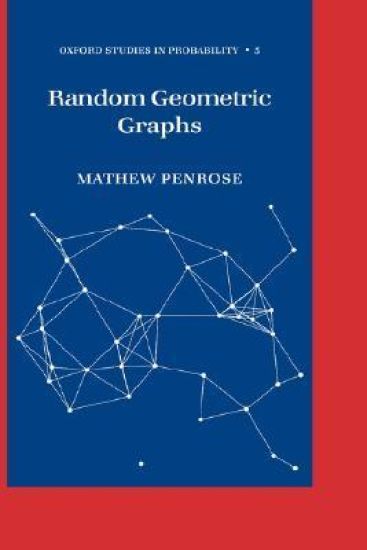
Random Geometric Graphs

Random Geometric Graphs

Mathew Penrose

Oxford University Press
2003
sidottu
This monograph sets out a body of mathematical theory for finite graphs with nodes placed randomly in Euclidean space and edges added to connect points that are close to each other. As an alternative to classical random graph models, these geometric graphs are relevant to the modelling of real-world networks having spatial content, arising in numerous applications such as wireless communications, parallel processing, classification, epidemiology, astronomy, and the internet. Aimed at graduate students and researchers in probability, combinatorics, statistics, and theoretical computer science, it covers topics such as edge and component counts, vertex degrees, cliques, colourings, connectivity, giant component phenomena, vertex ordering and partitioning problems. It also illustrates and extends the application to geometric probability of modern techniques including Stein's method, martingale methods and continuum percolation.
Random Coefficient Models

Random Coefficient Models

Nicholas T. Longford

Clarendon Press
1994
sidottu
The principal aim of the book is an exposition of methods for the analysis of clustered observations; the secondary one is to provide substantive interest as a measure of uncertainty, quality, equity, or generally, as a summary of differences among experimental or observational units. Another goal is to make a balanced presentation of the advantages and limitations of these methods The examples used for illustration of methods are not drawn exclusively from the social sciences. Although models are motivated mainly by social science problems, they are applicable in a variety of situations involving (imperfect) replication, such as repeated measurements, repeated experiments, logitudinal analysis, and analysis of covariance structures in general.
Random Walks and Random Environments: Volume 1: Random Walks
This is the first volume of a two-volume work devoted to probability theory in physics, physical chemistry and engineering. This volume provides an introduction to the problem of "random walk" and its applications. In its simplest form, the random walk describes the motion of an idealized drunkard and is a discrete analogue of the diffusion through a medium with traps, laser speckle and the conformations of polymers in dilute solution. Prior knowledge of probability theory is helpful, but not assumed.
Random Walks and Random Environments: Volume 2: Random Environments
This is the second volume of a two-volume work devoted to probability theory in physical chemistry, and engineering. Rather than dealing explicitly with the idea of an ongoing random walk, each chaotic step taking place at fixed time intervals, this volume addresses models in which the disorder is frozen in space-random environments. The volume begins with a largely self-contained introduction to the geometry of random environments, emphasizing Bernoulli percolation models. The scope of the investigation then widens as we ask how structural disorder affects the transport process. The final chapters confront the interplay of two different forms of randomness; spatial randomness frozen into the environment and temporal randomness associated with the choices for next steps made by a random walker. The book ends with a discussion of "the ant in the labyrinth" problems. It is supported by an extensive bibliography and very little prior knowledge is assumed.
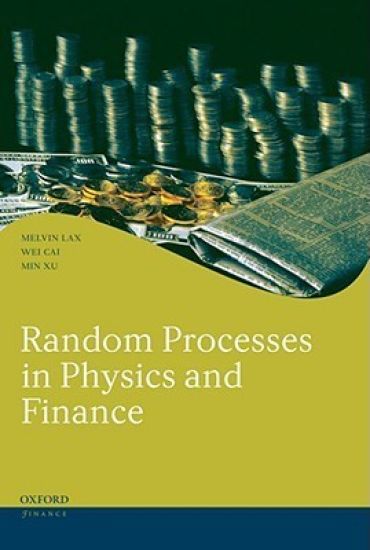
Random Processes in Physics and Finance

Random Processes in Physics and Finance

Melvin Lax; Wei Cai; Min Xu

Oxford University Press
2006
sidottu
This respected high-level text is aimed at students and professionals working on random processes in various areas, including physics and finance. The first author, Melvin Lax (1922-2002) was a distinguished Professor of Physics at City College of New York and a member of the U. S. National Academy of Sciences, and is widely known for his contributions to our understanding of random processes in physics. Most chapters of this book are outcomes of the class notes which Lax taught at the City University of New York from 1985 to 2001. The material is unique as it presents the theoretical framework of Lax's treatment of random processes, from basic probability theory to Fokker-Planck and Langevin Processes, and includes diverse applications, such as explanations of very narrow laser width, analytical solutions of the elastic Boltzmann transport equation, and a critical viewpoint of mathematics currently used in the world of finance.
Random Tensors

Random Tensors

Razvan Gheorghe Gurau

Oxford University Press
2016
sidottu
Written by the creator of the modern theory of random tensors, this book is the first self-contained introductory text to this rapidly developing theory. Starting from notions familiar to the average researcher or PhD student in mathematical or theoretical physics, the book presents in detail the theory and its applications to physics. The recent detections of the Higgs boson at the LHC and gravitational waves at LIGO mark new milestones in Physics confirming long standing predictions of Quantum Field Theory and General Relativity. These two experimental results only reinforce today the need to find an underlying common framework of the two: the elusive theory of Quantum Gravity. Over the past thirty years, several alternatives have been proposed as theories of Quantum Gravity, chief among them String Theory. While these theories are yet to be tested experimentally, key lessons have already been learned. Whatever the theory of Quantum Gravity may be, it must incorporate random geometry in one form or another. This book introduces a framework for studying random geometries in any dimensions. Building on the resounding success of random matrices as theories of random two dimensional surfaces, random tensors are their natural generalization to theories of random geometry in arbitrary dimension. This book shows that many of the celebrated results in random matrices, most notably 't Hooft's 1/N expansion, can be generalized to higher dimensions. It provides a complete and self-contained derivation of the key results on random tensors.
Random Process Analysis With R

Random Process Analysis With R

Marco Bittelli; Roberto Olmi; Rodolfo Rosa

Oxford University Press
2022
sidottu
Random process analysis (RPA) is used as a mathematical model in physics, chemistry, biology, computer science, information theory, economics, environmental science, and many other disciplines. Over time, it has become more and more important for the provision of computer code and data sets. This book presents the key concepts, theory, and computer code written in R, helping readers with limited initial knowledge of random processes to become confident in their understanding and application of these principles in their own research. Consistent with modern trends in university education, the authors make readers active learners with hands-on computer experiments in R code directing them through RPA methods and helping them understand the underlying logic. Each subject is illustrated with real data collected in experiments performed by the authors or taken from key literature. As a result, the reader can promptly apply the analysis to their own data, making this book an invaluable resource for undergraduate and graduate students, as well as professionals, in physics, engineering, biophysical and environmental sciences, economics, and social sciences.
Random Process Analysis With R

Random Process Analysis With R

Marco Bittelli; Roberto Olmi; Rodolfo Rosa

Oxford University Press
2022
nidottu
Random process analysis (RPA) is used as a mathematical model in physics, chemistry, biology, computer science, information theory, economics, environmental science, and many other disciplines. Over time, it has become more and more important for the provision of computer code and data sets. This book presents the key concepts, theory, and computer code written in R, helping readers with limited initial knowledge of random processes to become confident in their understanding and application of these principles in their own research. Consistent with modern trends in university education, the authors make readers active learners with hands-on computer experiments in R code directing them through RPA methods and helping them understand the underlying logic. Each subject is illustrated with real data collected in experiments performed by the authors or taken from key literature. As a result, the reader can promptly apply the analysis to their own data, making this book an invaluable resource for undergraduate and graduate students, as well as professionals, in physics, engineering, biophysical and environmental sciences, economics, and social sciences.
Random Justice

Random Justice

Neil Duxbury

Oxford University Press
2002
nidottu
Chance inevitably plays a role in law but it is not often that we consciously try to import an element of randomness into a legal process. Random Justice: On Lotteries and Legal Decision-Making explores the potential for the use of lotteries in social, and particularly legal, decision-making contexts. Utilizing a variety of disciplines and materials, Neil Duxbury considers in detail the history, advantages, and drawbacks of deciding issues of social significance by lot and argues that the value of the lottery as a legal decision-making device has generally been underestimated. The very fact that there exists widespread resistance to the use of lotteries for legal decision-making purposes betrays a commonly held belief that legal processes are generally more important than are legal outcomes. Where, owing to the existence of indeterminacy, the process of reasoning is likely to be excessively protracted and the reasons provided strongly contestable, the most cost-efficient and impartial decision-making strategy may well be recourse to lot. Aversion to this strategy, while generally understandable, is not necessarily rational. Yet in law, as Professor Duxbury demonstrates, reason is generally valued more highly than is rationality. The lottery is often conceived to be a decision-making device that operates in isolation. Yet lotteries can frequently and profitably be incorporated into other decision-frameworks. The book concludes by controversially considering how lotteries might be so incorporated and also advances the thesis that it may sometimes be sensible to require that adjudication takes place in the shadow of a lottery.
Random Processes in Physics and Finance

Random Processes in Physics and Finance

Melvin Lax; Wei Cai; Min Xu

Oxford University Press
2013
nidottu
This text is aimed at professionals and students working on random processes in various areas, including physics and finance. The first author, Melvin Lax (1922-2002), was a distinguished Professor of Physics at City College of New York and a member of the U. S. National Academy of Sciences, widely known for his contribution on random processes in physics. Most chapters of this book are the outcome of the class notes which Lax taught at the City University of New York from 1985 to 2001. The material is unique as it presents the theoretical framework of Lax's treatment of random processes, starting from basic probability theory, to Fokker-Planck and Langevin Processes, and includes diverse applications, such as explanation of very narrow laser width and analytical solution of the elastic Boltzmann transport equation. Lax's critical viewpoint on mathematics currently used in the financial world is also presented in this book.
Random Notes From A World Gone Wrong
"The idea for the book came initially from my research notes/ internal blog ... which] deals mainly with the changing nature of investment strategy of major global funds, the aftermath of the global financial crisis, the impact of Brexit, the global position of London, the increasingly political nature of global capital flows into the sector and the industry's default position which is one of delusion and a hope against hope for soft landings... These issues are set against a background of just how the real estate capital market has evolved ... from a local and rather dozy industry to one of increasing sophistication. However, the underlying argument is that this apparent shift is superficial despite the hope that, somehow, bankers have learnt from the lessons of the past, that rating agencies and regulators do more than tick boxes, or investors cease their natural tendency to stray from the world they know best." Joe Valente, June 2018 All profits from this book will be donated to Bloodwise.
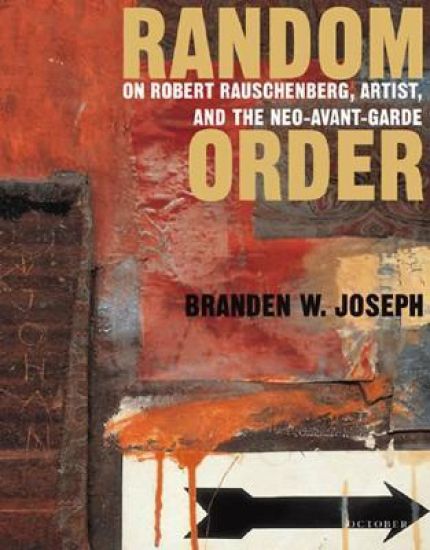
Random Order

Random Order

Branden W. Joseph

MIT Press
2007
pokkari
An examination of the artistic development of Robert Rauschenberg, focusing on his relationship with John Cage and his role in the making of the American neo-avant-garde.Robert Rauschenberg is one of the most important visual artists of the second half of the twentieth century. In Random Order, Branden Joseph examines Rauschenberg's work in the context of the American neo-avant-garde. One of the foundations of his study is Rauschenberg's professional relationship with experimental composer John Cage. From the moment of their encounter at Black Mountain College in 1952, Joseph argues, Rauschenberg and Cage initiated a new avant-garde project, one that approached the idea of difference not in terms of negation but as a positive force. Claiming that Rauschenberg's work cannot be understood solely from the standpoint of the Frankfurt School-whose theories have dominated discussions of avant-garde and neo-avant-garde aesthetics-Joseph turns to the theoretical positions of Gilles Deleuze and Jacques Derrida. Rauschenberg's neo-avant-garde was not a simple repetition of earlier avant-garde movements, Joseph shows, but a series of practices that opposed the rise of postwar spectacle, commodification, and mass conformity.Beginning with the White Paintings, Joseph examines Rauschenberg's artistic development from 1951 to 1971. He looks at the black paintings, Red Paintings, Elemental Paintings and Elemental Sculptures, Combines and Combine paintings, transfer drawings and silkscreens, performances, and explorations in art and technology. Joseph's study not only offers new interpretations of Rauschenberg's work, but also deepens our understanding of the entire neo-avant-garde project.
Random Fields

Random Fields

Erik Vanmarcke

MIT Press
1983
pokkari
Random variation over space and time is one of the few attributes that might safely be predicted as characterizing almost any given complex system. Random fields or "distributed disorder systems" confront astronomers, physicists, geologists, meteorologists, biologists, and other natural scientists. They appear in the artifacts developed by electrical, mechanical, civil, and other engineers. They even underlie the processes of social and economic change. The purpose of this book is to bring together existing and new methodologies of random field theory and indicate how they can be applied to these diverse areas where a "deterministic treatment is inefficient and conventional statistics insufficient." Many new results and methods are included.After outlining the extent and characteristics of the random field approach, the book reviews the classical theory of multidimensional random processes and introduces basic probability concepts and methods in the random field context. It next gives a concise amount of the second-order analysis of homogeneous random fields, in both the space-time domain and the wave number-frequency domain. This is followed by a chapter on spectral moments and related measures of disorder and on level excursions and extremes of Gaussian and related random fields. After developing a new framework of analysis based on local averages of one-, two-, and n-dimensional processes, the book concludes with a chapter discussing ramifications in the important areas of estimation, prediction, and control. The mathematical prerequisite has been held to basic college-level calculus.
Random Selection in Politics

Random Selection in Politics

Lyn Carson; Brian Martin

Praeger Publishers Inc
1999
sidottu
How might the entire citizenry of a country make the decisions that affect them? Carson and Martin provide the first accessible and comprehensive overview of random selection as a possible process for transforming our modern political systems. Building on the theoretical work of the likes of John Burnheim and Fred Emery and drawing on their own work with social action groups, they outline a set of methods that go beyond the mere tapping of community opinion to reveal not only preferences but a more active role in creating the community.Random selection, as Carson and Martin show, has been used in community participation in short-term decision making and long-term planning. It can be a powerful tool in the development of local, federal, and international policy. An important and innovative look at government decision making, this will be of primary interest to scholars and researchers in political theory and electoral systems, as well as political activists and reformers.
Random Surfaces and Quantum Gravity

Random Surfaces and Quantum Gravity

Kluwer Academic / Plenum Publishers
1991
sidottu
Methods on the random triangulations of surfaces provide a description of non-critical string theory or equivalently of the coupling of matter fields to quantum gravity in two dimensions. Among the papers presented at the Cargese meeting are detailed reviews that make the volume useful for the non-s"