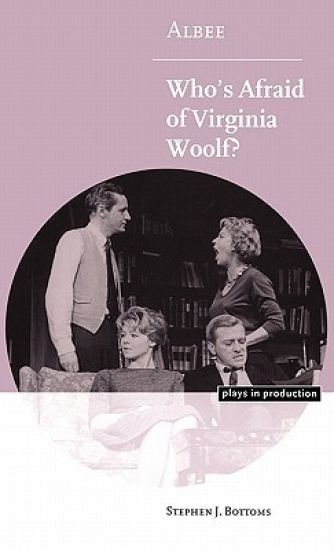
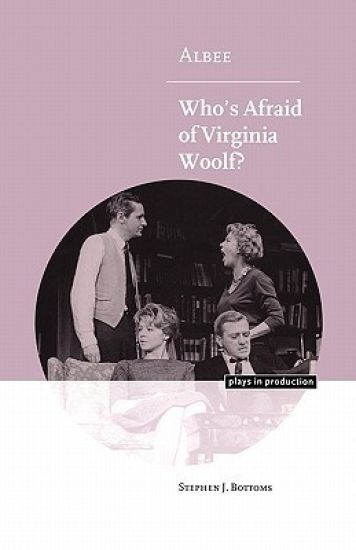
This is a detailed study of one of the most important plays in contemporary theatre, Who's Afraid of Virginia Woolf?, by Edward Albee. In this fascinating look at the modern stage, Stephen Bottoms draws on original archival material and sources including an exclusive interview with Edward Albee. The Introduction considers the text of the play itself; part one provides a survey of the major productions from 1962 to 1999, with special attention paid to the premiere and the 1966 film version. Part two examines shifting critical responses to the play, demonstrating how changing times and attitudes have altered audience perception of performances. The third and final part offers a detailed examination of five different performances, comparing and contrasting directorial, design and acting approaches to demonstrate how our understanding of the play alters considerably according to its interpretation on stage.
This is the first detailed study of one of the most important plays in contemporary theatre, Who’s Afraid of Virginia Woolf?, by Edward Albee. In this fascinating look at the modern stage, Stephen Bottoms draws on original archival material and sources including an exclusive interview with Edward Albee. The Introduction considers the text of the play itself; part one provides a survey of the major productions from 1962 to 1999, with special attention paid to the premiere and the 1966 film version. Part two examines shifting critical responses to the play, demonstrating how changing times and attitudes have altered audience perception of performances. The third and final part offers a detailed examination of five different performances, comparing and contrasting directorial, design and acting approaches to demonstrate how our understanding of the play alters considerably according to its interpretation on stage.
In March 1941, Virginia Woolf filled her pockets with stones and drowned herself in England's River Ouse. Her body was found three weeks later. What seemed like a tragic ending at the time was, in fact, just the beginning of a mystery. . . . Six decades after Virginia Woolf's death, landscape designer Jo Bellamy has come to Sissinghurst Castle for two reasons: to study the celebrated White Garden created by Woolf's lover Vita Sackville-West and to recover from the terrible wound of her grandfather's unexplained suicide. In the shadow of one of England's most famous castles, Jo makes a shocking find: Woolf's last diary, its first entry dated the day after she allegedly killed herself. If authenticated, Jo's discovery could shatter everything historians believe about Woolf's final hours. But when the Woolf diary is suddenly stolen, Jo's quest to uncover the truth will lead her on a perilous journey into the tumultuous inner life of a literary icon whose connection to the White Garden ultimately proved devastating. Rich with historical detail, The White Garden is an enthralling novel of literary suspense that explores the many ways the past haunts the present-and the dark secrets that lurk beneath the surface of the most carefully tended garden.
Rachel Bowlby's acclaimed book on Virginia Woolf now appears with five new essays which look at Woolf in a number of new frames - as a woman essayist; as a city writer and critic of modern culture; and as a writer on love. Rachel Bowlby shows, with inimitable critical panache, how it is that Woolf's writing, in its many forms and fashions, continues to provide rich matter for thinking about the histories and futures of women, writing and culture.
As a representation of the Woolfs' personal library, the Leonard and Virginia Woolf Collection at Washington State University reveals valuable biographical information about the Woolfs and about writers and artists associated with the Bloomsbury Group. The Library of Leonard and Virginia Woolf: A Short-title Catalog consists of brief citations that reflect the circa 6,000 volumes within this WSU collection. Arranged in alphabetical order by author or title, the entries include an edition statement, printing or impression statement, publisher, and publication date and location. Initials are provided for annotators, inscribers, illustrators, and binders.
Copublished with Pace University Press, this book is a valuable addition to scholarship on Bloomsbury, the history of women in Britain, and the work of Leonard and Virginia Woolf. It portrays an era and illuminates the work of a number of famous writers by examining less well-known lives and works that were part of the adaptive complex, or milieu. Several essays and appendices contribute significantly to our understanding of the extent that the Woolfs collaborated with each other and with others. Beside the literary histories of S.P. Rosenbaum, this collection of original essays will be essential reading for students of Bloomsbury and women's history. Illustrated.
The argument of this book is a simple one: that criticism after theory is a single movement of thought defined by synthesis and continuity rather than by conflict and change. The most influential figures in criticism since Saussure—Bakhtin, Derrida, and Foucault—are wholly consistent with Saussure's foundational Course in General Linguistics (1916) no matter the traditions of complaint that have followed in Saussure's wake from Bakhtin forward. These complaints vitiate—despite themselves and often hilariously so—the misconceptions that have made cottage industries out of quarrels with Saussurean semiology that are based on notions of Saussure that are incorrect. The materialist criticism dominant today is actually dependent upon on the legacy of a presumably formalist structuralism rather than a step beyond it. New Historicism, postcolonialism, gender studies, environmental criticism, archive studies, even shared and surface reading are, like deconstruction, the by-products of Saussure's structuralism, not its foils. Saussure's sign is sensory and concrete. Language and materiality are not distinct but one and the same—history, society, the psychological subject, even the environment are systems of signs, material archives read and reread by futures that produce the past after the fact. Without Saussure, contemporary criticism would have no identifiable or effective source. The book begins with chapters on Saussure and Derrida, Bakhtin and Shakespeare, and Freud and Foucault followed by chapters on Victorian and American fiction, D.H. Lawrence and modern poetry, Virginia Woolf and Melanie Klein, and the historicist tropology of psychoanalysis. It concludes with a coda in life writing on the author's epileptic disability.
The argument of this book is a simple one: that criticism after theory is a single movement of thought defined by synthesis and continuity rather than by conflict and change. The most influential figures in criticism since Saussure—Bakhtin, Derrida, and Foucault—are wholly consistent with Saussure's foundational Course in General Linguistics (1916) no matter the traditions of complaint that have followed in Saussure's wake from Bakhtin forward. These complaints vitiate—despite themselves and often hilariously so—the misconceptions that have made cottage industries out of quarrels with Saussurean semiology that are based on notions of Saussure that are incorrect. The materialist criticism dominant today is actually dependent upon on the legacy of a presumably formalist structuralism rather than a step beyond it. New Historicism, postcolonialism, gender studies, environmental criticism, archive studies, even shared and surface reading are, like deconstruction, the by-products of Saussure's structuralism, not its foils. Saussure's sign is sensory and concrete. Language and materiality are not distinct but one and the same—history, society, the psychological subject, even the environment are systems of signs, material archives read and reread by futures that produce the past after the fact. Without Saussure, contemporary criticism would have no identifiable or effective source. The book begins with chapters on Saussure and Derrida, Bakhtin and Shakespeare, and Freud and Foucault followed by chapters on Victorian and American fiction, D.H. Lawrence and modern poetry, Virginia Woolf and Melanie Klein, and the historicist tropology of psychoanalysis. It concludes with a coda in life writing on the author's epileptic disability.
Edward Albee’s Who’s Afraid of Virginia Woolf? shocked audiences and critics alike with its assault on decorum. At base though, the play is simply a love story: an examination of a long-wedded life, filled with the hopes, dreams, disappointments, and pain that accompany the passing of many years together. While the ethos of the play is tragicomic, it is the anachronistic, melodramatic secret object—the nonexistent "son"—that upends the audience’s sense of theatrical normalcy. The mean and vulgar bile spewed among the characters hides these elements, making it feel like something entirely "new."As Michael Y. Bennett reveals, the play is the same emperor, just wearing new clothes. In short, it is straight out of the grand tradition of living room drama: Ibsen, Chekhov, Glaspell, Hellmann, O’Neill, Wilder, Miller, Williams, and Albee.
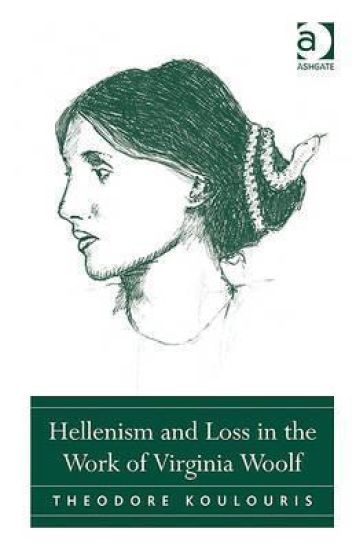
Taking up Virginia Woolf's fascination with Greek literature and culture, this book explores her engagement with the nineteenth-century phenomenon of British Hellenism and her transformation of that multifaceted socio-cultural and political reality into a particular textual aesthetic, which Theodore Koulouris defines as 'Greekness.' Woolf was a lifelong student of Greek, but from 1907 to1909 she kept notes on her Greek readings in the Greek Notebook, an obscure and largely unexamined manuscript that contains her analyses of a number of canonical Greek texts, including Plato's Symposium, Homer's Odyssey, and Euripides' Ion. Koulouris's examination of this manuscript uncovers crucial insights into the early development of Woolf's narrative styles and helps establish the link between Greekness and loss. Woolf's 'Greekness,' Koulouris argues, enabled her to navigate male and female appropriations of British Hellenism and provided her with a means of articulating loss, whether it be loss of a great Hellenic past, women's vocality, immediate family members, or human civilization during the formative decades of the twentieth century. In drawing attention to the centrality of Woolf's early Greek studies for the elegiac quality of her writing, Koulouris maps a new theoretical terrain that involves reassessing long-established views on Woolf and the Greeks.
Taking up Virginia Woolf's fascination with Greek literature and culture, this book explores her engagement with the nineteenth-century phenomenon of British Hellenism and her transformation of that multifaceted socio-cultural and political reality into a particular textual aesthetic, which Theodore Koulouris defines as 'Greekness.' Woolf was a lifelong student of Greek, but from 1907 to1909 she kept notes on her Greek readings in the Greek Notebook, an obscure and largely unexamined manuscript that contains her analyses of a number of canonical Greek texts, including Plato's Symposium, Homer's Odyssey, and Euripides' Ion. Koulouris's examination of this manuscript uncovers crucial insights into the early development of Woolf's narrative styles and helps establish the link between Greekness and loss. Woolf's 'Greekness,' Koulouris argues, enabled her to navigate male and female appropriations of British Hellenism and provided her with a means of articulating loss, whether it be loss of a great Hellenic past, women's vocality, immediate family members, or human civilization during the formative decades of the twentieth century. In drawing attention to the centrality of Woolf's early Greek studies for the elegiac quality of her writing, Koulouris maps a new theoretical terrain that involves reassessing long-established views on Woolf and the Greeks.
The Servants of Desire in Virginia Woolf’s Shorter Fiction proposes an insight into the ways in which Virginia Woolf engaged with the questions of how class influences working women’s occupation of private and public space and how material privilege or economic distress inhibits or encourages their likelihood of obtaining their intellectual, spiritual, and physical desires. This groundbreaking book uses class as the determining factor to assess how servants and working class women occupy private and public space and articulate or fail to realize their desires. Drawing upon published and unpublished holograph and typescript drafts of the shorter fiction in The Monks House Papers as well as the Berg Collection, this book examines Woolf’s oscillating patterns of elision, idealization, and contempt for the voices and desires of female servants, lesbians, gypsies, and other disenfranchised women. The Servants of Desire in Virginia Woolf’s Shorter Fiction also assesses how the portrayal of working class women in the shorter fiction becomes a vital template for the representation of working class women in Woolf’s novels and essays. This study of the cumulative portrayal of the working class woman in all of Virginia Woolf’s shorter fiction will also be compelling for anyone interested in social justice, especially for advocates of equality in gender/race/class/sexuality conflicts.
This is an exhibition catalogue at the Grolier Club, September 16 - November 22, 2008. The theme of loss is expressed or implied in much of Virginia Woolf's fiction and non-fiction, and one that resonates with the story of her own life, from her childhood, through her loss of family, and of friends, and of security in two World Wars, to her struggles with mental illness and her eventual suicide. And yet Virginia Woolf was, by all accounts, a lively and engaging woman, full of warmth, humor, maternal feeling (for her sister's children, as she had none of her own), passion, and exultation. She had a prodigiously active career, and she stood at the center of a large group of notable, engaged figures, many of them public intellectuals at the forefront of their generation, who were connected to her (and to each other) by bonds of family, affinity, shared artistic and social enterprise and, above all, affection. This group, and their friends, produced mountains of books, hundreds of square feet of paintings, and reams of press. The selection of material in this recent Grolier Club exhibition and its accompanyning catalogue documents the mutual enrichment of their life and work, and the resonance of Virginia Woolf's greatest literary work with the story of her life and the lives of those who were dear to her. Much of the material is reproduced here for the first time. Items from William Beekman's collection of Virginia Woolf and Bloomsbury span her life and career, and include photographs, letters, association copies, artwork, and ephemera. From Barbara Dobkin's collection of feminist history are a number of items from Virginia's adolescent library as well as material documenting her relationship with Vita Sackville-West. The Mortimer Rare Book Room at Smith College provided many early images - drawn from Leslie Stephen's photo albums - as well as copiously annotated proof material and samples from Virginia's important correspondence with Lytton Strachey. It is designed by Jerry Kelly, and printed in an edition of 1500 copies.
A comprehensive study guide offering in-depth explanation, essay, and test prep for selected works by Edward Albee, well renowned American dramatist and theatrical producer. Titles in this study guide include Who's Afraid of Virginia Woolf?, The Zoo Story, and Tiny Alice. As a major playwright of the twentieth century, Albee's work established him as a sharp critic of American values. Moreover, he expertly displayed slashing insight and witty dialogue in the gruesome portrayal of marriage, family life, and self revelation. This Bright Notes Study Guide explores the context and history of Albee's classic work, helping students to thoroughly explore the reasons they have stood the literary test of time. Each Bright Notes Study Guide contains: - Introductions to the Author and the Work - Character Summaries - Plot Guides - Section and Chapter Overviews - Test Essay and Study Q&As The Bright Notes Study Guide series offers an in-depth tour of more than 275 classic works of literature, exploring characters, critical commentary, historical background, plots, and themes. This set of study guides encourages readers to dig deeper in their understanding by including essay questions and answers as well as topics for further research.