This is a guide for anyone in the academy – faculty member, administrator or professional staff – at whatever point she or he may be along the career path. Whether you are a newly-minted Ph.D. landing your first job, at mid career, or even already retired and concerned about how long your money might last, Ed Bridges offers you a straightforward, easy-to-grasp, and structured way to think about money, learn how it works, understand the priorities for your stage in life, determine your objectives, and develop a personal plan most likely to achieve them.Why a book specifically for those who work in higher education? The chances are that your retirement funds are mostly invested in TIAA-CREF funds, and that the plans created by the different institutions where you have worked, or will work, impose sometimes conflicting limitations of how you can manage your retirement money. This is potentially complex terrain with which many professional financial advisors are unfamiliar. This book provides ample guidance for you to manage your retirement funds, but if you do prefer to seek professional advice, it sets out the criteria for choosing a reliable advisor, and may even be a book from which your advisor can benefit if he or she is not fully conversant with TIAA-CREF’s offerings, and the quirks of academic retirement plans.What makes this book unique is that Ed Bridges shares with you his self-education about the risky business of investing and retirement planning. As he writes, “In schooling myself, I adopted the mind-set that I had used as a social scientist for the past forty-six years. I distinguished between fact and opinion and scrutinized the evidence behind every author’s claims; moreover, I searched for research that might corroborate or refute these claims. In the process, I learned a great deal about the route I should have taken to retirement from the time I accepted my first academic appointment to the time I submitted my intention to retire. Join me as I relive my long journey so that you may avoid my wrong turns and succeed in reaching your ultimate destination, a worry-free retirement, despite the risks and uncertainties you will surely face when you retire.”The book includes simple questionnaires and worksheets to help you determine where you stand, and think through your options.
This is a guide for anyone in the academy – faculty member, administrator or professional staff – at whatever point she or he may be along the career path. Whether you are a newly-minted Ph.D. landing your first job, at mid career, or even already retired and concerned about how long your money might last, Ed Bridges offers you a straightforward, easy-to-grasp, and structured way to think about money, learn how it works, understand the priorities for your stage in life, determine your objectives, and develop a personal plan most likely to achieve them.Why a book specifically for those who work in higher education? The chances are that your retirement funds are mostly invested in TIAA-CREF funds, and that the plans created by the different institutions where you have worked, or will work, impose sometimes conflicting limitations of how you can manage your retirement money. This is potentially complex terrain with which many professional financial advisors are unfamiliar. This book provides ample guidance for you to manage your retirement funds, but if you do prefer to seek professional advice, it sets out the criteria for choosing a reliable advisor, and may even be a book from which your advisor can benefit if he or she is not fully conversant with TIAA-CREF’s offerings, and the quirks of academic retirement plans.What makes this book unique is that Ed Bridges shares with you his self-education about the risky business of investing and retirement planning. As he writes, “In schooling myself, I adopted the mind-set that I had used as a social scientist for the past forty-six years. I distinguished between fact and opinion and scrutinized the evidence behind every author’s claims; moreover, I searched for research that might corroborate or refute these claims. In the process, I learned a great deal about the route I should have taken to retirement from the time I accepted my first academic appointment to the time I submitted my intention to retire. Join me as I relive my long journey so that you may avoid my wrong turns and succeed in reaching your ultimate destination, a worry-free retirement, despite the risks and uncertainties you will surely face when you retire.”The book includes simple questionnaires and worksheets to help you determine where you stand, and think through your options.
A typical classroom includes students of considerable behavioral diversity, and maintaining classroom focus is often dependent upon successfully managing disruptive moments. In Power Struggles: Successful Techniques for Educators (Second Edition), authors Allen N. Mendler and Brian D. Mendler provide many different strategies to deal with all levels of difficult and resistant students. Drawing from years of experience, they help teachers understand the root causes of misbehavior and offer practical, step-by-step instructions on how to defuse situations in a way that protects the dignity of all involved and keeps the lesson on track. Chapters Introduction to the Second Edition When Kids Push Our Buttons Prevention Strategies Intervention Strategies Defusing Strategies Challenge Strategies Power Struggle Scenarios Benefits This second edition includes: Activities throughout to provide guidance Easy-to-learn methods of effective intervention Real-world stories of these strategies in action
What should the church look like today? What should be the focus of its message? How should I present that message? We live in as pivotal and defining an age as the Great Depression or the Sixties–a period whose definition, say some cultural observers, includes a warning of the church’s influence. The result? A society measurably less religious but decidedly more spiritual. Less influenced by authority than by experience. More attuned to images than to words. How does the church adapt to such a culture? Or should it, in fact, eschew adapting for maintaining a course it has followed these last two millennia? Or something in between? These are exactly the questions asked in The Church In Emerging Culture by five Christian thinker-speaker-writers, each who advocate unique stances regarding what the church’s message should be (and what methods should be used to present it) as it journeys through this evolving, postmodern era. The authors are: Andy Crouch–Re:Generation Quarterly editor-in-chief Michael Horton–professor and reformed theologian Frederica Mathewes-Green–author, commentator, and Orthodox Christian Brian D. McLaren–postmodernist, author, pastor, and Emergent senior fellow Erwin Raphael McManus–author and pastor of the innovative and interethnic L.A.-based church, Mosaic Most unique about their individual positions is that they’re presented not as singular essays but as lively discussions in which the other four authors freely (and frequently) comment, critique, and concur. That element, coupled with a unique photographic design that reinforces the depth of their at-once congenial and feisty conversation, gives you all-access entrée into this groundbreaking discourse. What’s more, general editor Leonard Sweet (author of SoulTsunami and AquaChurch, among several other acclaimed texts) frames the thought-provoking dialogue with a profoundly insightful, erudite introductory essay–practically a book within a book. The Church In Emerging Culture is foundational reading for leaders and serious students of all denominations and church styles.
An introduction to MATLAB for engineering students, complete with practice problems Written as a complement to Engineering Mechanics Dynamics, this book provides students with an introduction to MATLAB as well as example problems that correspond to the aforementioned text. The book covers numerical calculations, defining functions, graphics, symbolic calculations, differentiation and integration, and solving equations with MATLAB and then presents problems in seven subsequent chapters. These cover kinematics of particles, kinetics of particles, kinetics of systems of particles; plane kinematics of rigid bodies; plane kinetics of rigid bodies, three-dimensional dynamics of rigid bodies, and vibration and response time.
Learn MATLAB to help you understand mechanics MATLAB is a powerful tool for mathematical modeling, and is becoming essential to many engineering fields. Solving Statics Problems in MATLAB is designed to both introduce students to MATLAB, and provide them with a useful tool for understanding static mechanics. The book begins with MATLAB basics, including scripts, functions, graphics, calculations, and equations, then moves into physics with targeted guidance on solving force systems, equilibriums, structures, friction, and more. The problems presented are taken from Engineering Mechanics Statics, 6th Edition, but the clear guidance and comprehensive instruction can be applied to any course.
In this study assessing black civic participation after the civil rights movement, Fredrick C. Harris, Valeria Sinclair-Chapman and Brian D. McKenzie demonstrate that the changes in black activism since the civil rights movement is characterized by a tug-of-war between black political power on one side and economic conditions in black communities on the other. As blacks gain greater access and influence within the political system, black participation in political activities increases while downward turns in the economic conditions of black communities produce less civic involvement in black communities. Examining changes in black activism from the early 1970s to the 1990s, this tug-of-war demonstrates that the quest for black political empowerment and the realities of economic and social life act as countervailing forces, in which negative economic and social conditions in black communities weaken the capacity of blacks to organize so that their political voices can be heard.
In this study assessing black civic participation after the civil rights movement, Fredrick C. Harris, Valeria Sinclair-Chapman and Brian D. McKenzie demonstrate that the changes in black activism since the civil rights movement is characterized by a tug-of-war between black political power on one side and economic conditions in black communities on the other. As blacks gain greater access and influence within the political system, black participation in political activities increases while downward turns in the economic conditions of black communities produce less civic involvement in black communities. Examining changes in black activism from the early 1970s to the 1990s, this tug-of-war demonstrates that the quest for black political empowerment and the realities of economic and social life act as countervailing forces, in which negative economic and social conditions in black communities weaken the capacity of blacks to organize so that their political voices can be heard.
Game theory, particularly the use of repeated games, N-person games, and incomplete information games have been popular research techniques in political science, sociology, and managementùbut difficult for new social researchers to useùuntil now. Aimed at making these topics accessible to all social scientist, Game Theory Topics shows how game theory can be productively applied to problems in the social sciences. Using a common social science gameùChickenùto illustrate game theory concepts, the authors introduce readers to games of incomplete information; how to build uncertainty into game theoretic models; the concept of Bayesian Nash equilibrium; and the role of repetition in game theory, including how game theoretic models can easily accommodate many players. Throughout the book, the authors use applications to social science problems to illustrate the points being developed in each chapter.
An increasing proportion of parents in the United States are turning to home-based education for their children. If this trend continues, as much as two per cent of school-age children may be taught in this way by the end of the century. Home Schooling presents an overview of home education which reflects its multidimensional nature. The volume also enhances the possibility of cooperative relations between professional and home educators. Parents, teachers, school board members and researchers will find this invaluable reading.
Combines current data and taxonomic classifications for tiger beetles in the Southeast with stunning close-up photographs, flight season charts, and distribution maps.Tiger beetles are brightly colored and metallic beetles, often with ivory or cream-colored markings. They are most abundant and diverse in habitats near bodies of water with sandy or clay soils and can be found along rivers, on sea and lake shores, on sand dunes, around dry lakebeds, on clay banks, or on woodland paths. Conservatively estimated, the group comprises more than 2,600 species worldwide.Tiger Beetles of the Southeastern United States identifies and describes 52 taxa (42 species and 10 additional subspecies) of tiger beetles that occur in Alabama, Florida, Georgia, Mississippi, North Carolina, South Carolina, and Tennessee. Stunning close-up photographs accompany current taxonomic and biological information in a volume designed for a growing audience of enthusiastic amateurs and professionals alike.The authors provide an in-depth description of the anatomy, life cycle, and behavior of tiger beetles; an overview of the various southeastern habitats in which they occur; instructions for finding, identifying, and photographing them in the wild; and the conservation status of various species. The individual species accounts include stunning, detailed images, flight season charts, county-level regional distribution maps, and discussion of identifying features, habitat, similar species, and subspecies when applicable. The appendix includes two species previously found in Florida but no longer known to exist there.The result is the most complete field guide to date on tiger beetles in the region. With more than 230 images of beetles and their habitats, as well as life history and distribution data, this book is essential for tiger beetle enthusiasts, naturalists of all kinds, photographers, biologists, and teachers throughout the region.
Roger Koppl; Roberto Cazzolla Gatti; Abigail Devereaux; Brian D. Fath; James Herriot; Wim Hordijk; Stuart Kauffman; Robert E. Ulanowicz; Sergi Valverde
A long tradition explains technological change as recombination. Within this tradition, this Element develops an innovative combinatorial model of technological change and tests it with 2,000 years of global GDP data and with data from US patents filed between 1835 and 2010. The model explains 1) the pace of technological change for a least the past two millennia, 2) patent citations and 3) the increasing complexity of tools over time. It shows that combining and modifying pre-existing goods to produce new goods generates the observed historical pattern of technological change. A long period of stasis was followed by sudden super-exponential growth in the number of goods. In this model, the sudden explosion of about 250 years ago is a combinatorial explosion that was a long time in coming, but inevitable once the process began at least two thousand years ago. This Element models the Industrial Revolution as a combinatorial explosion.
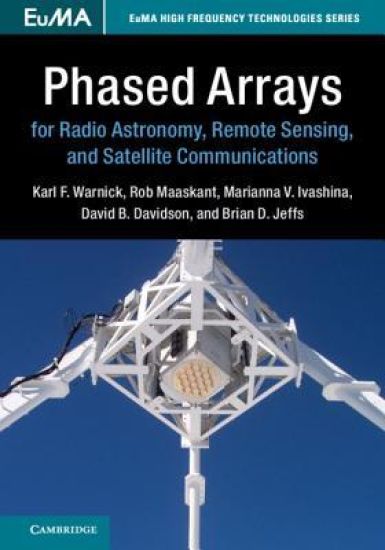
Discover a modern approach to the analysis, modeling and design of high sensitivity phased arrays. Network theory, numerical methods and computational electromagnetic simulation techniques are uniquely combined to enable full system analysis and design optimization. Beamforming and array signal processing theory are integrated into the treatment from the start. Digital signal processing methods such as polyphase filtering and RFI mitigation are described, along with technologies for real-time hardware implementation. Key concepts from interferometric imaging used in radio telescopes are also considered. A basic development of theory and modeling techniques is accompanied by problem sets that guide readers in developing modeling codes that retain the simplicity of the classical array factor method while incorporating mutual coupling effects and interactions between elements. Combining current research trends with pedagogical material suitable for a first-year graduate course, this is an invaluable resource for students, teachers, researchers, and practicing RF/microwave and antenna design engineers.
Racial disparities in health and life expectancy are public health problems that have existed since before the US became a country and affect all American's lives. On average, Black Americans have poorer overall health than White Americans and receive lower quality healthcare. This volume presents research from a broad range of academic disciplines, personal narratives, and historical sources to explain the origins of anti-Black racism and describe specific ways in which it threatens both Black Americans' health and the quality of their medical care. Using their own research and public policy expertise, the authors analyze the critical roles of individual and systemic racial bias in these racial health disparities and their consequence for all Americans. They also identify current viable interventions that can reduce current racial health disparities. Unequal Health is invaluable to professionals who study health disparities and lay people who are concerned about them.
In this revised and updated 4th edition, Discipline with Dignity provides in-depth guidance for implementing a proven approach to classroom management that can help students make better choices and teachers be more effective. Emphasizing the importance of mutual respect and self-control, the authors offer specific strategies and techniques for building strong relationships with disruptive students and countering the toxic social circumstances that affect many of them, including dysfunctional families, gangs, and poverty. Educators at all levels can learn:The difference between formal and informal discipline systems and when to use each.The role of values, rules, and consequences. How to address the underlying causes of discipline problems that occur both in and out of school. What teachers can do to defuse or prevent classroom disruptions and disrespectful behavior without removing students from the classroom. Why traditional approaches such as threats, punishments, and rewards are ineffective—and what to do instead. How to use relevance, teacher enthusiasm, choice, and other elements of curriculum and instruction to motivate students. How to reduce both teacher and student stress that can trigger power struggles. With dozens of specific examples of student-teacher interactions, Discipline with Dignity illustrates what you can do—and not do—to make the classroom a place where students learn and teachers maintain control in a nonconfrontational way. The goal is success for all, in schools that thrive.
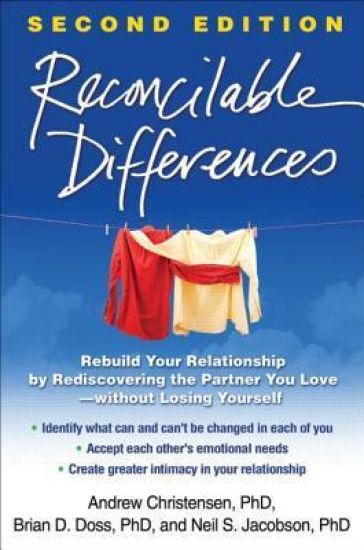
Every couple has disagreements, but what happens when recurring conflicts start to pull your relationship apart? Do you lie awake hoping that your spouse will eventually see things your way, or rehashing the evidence that you're right? Demand some immediate changes--or else? This popular, science-based guide offers powerful solutions for couples frustrated by continual attempts to make each other change. True acceptance may seem difficult to accomplish, but the clear-cut steps and thought-provoking exercises in this book can make it a reality. You'll learn why you keep having the same fights again and again; how to keep small incompatibilities from causing big problems; what communication strategies really work to resolve conflicts; and how to problem-solve and make positive changes--together. Updated throughout with new research, practical tools, and examples, the second edition features a new chapter on mindfulness. Mental health professionals: visit http://ibct.psych.ucla.edu to learn about using this self-help guide as an adjunct to therapy.