Kirjahaku
Etsi kirjoja tekijän nimen, kirjan nimen tai ISBN:n perusteella.
1000 tulosta hakusanalla Adam Dailey

How far will you go for love? Kevin Spivey murdered New Orleans' coke king, laundered $4 million in dirty assets, and set plans in motion to disappear. He's pulled the perfect crime, but Kevin has some more obstacles in his way. All flights out of Washington, D.C., are grounded under the heaviest storm to hit in close to a decade. Mykal Odadjian, his one and only love might be on the way. Of course, Mykal might not forgive Kevin, and the FBI might be en route. He's also got the Chicago cartel to worry about; he made his fortune selling them hot credit cards, and they'd be more than willing to turn his staged fatality into a reality. Kevin, faced with all the possible crises that would snap most men in half, faces this possibility: is he losing his mind, or has his late best friend been using him as a puppet for even darker purposes? As he waits for his future to unfold, Kevin has to face the demons of his past, demons that pushed him away from the straight and narrow, demons that could take his soul.
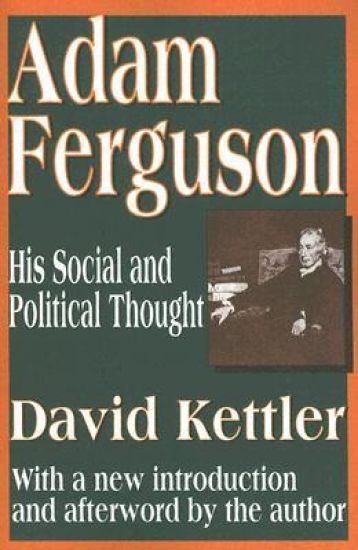
The thought of Adam Ferguson generated great excitement among many of his philosophic contemporaries in the late eighteenth century, and it continues to inspire the modern reader. This major study by David Kettler is an ideal introduction to Ferguson's life and thought. The new introduction to this first paperback edition discusses Ferguson's work in relation to his better-known contemporaries David Hume and Adam Smith, while the afterword offers an in-depth reconsideration of Ferguson's most renowned work, An Essay on the History of Civil Society, with emphasis on present-day disputes about the concept of civil society. Ferguson welcomed the advent of critical and analytical philosophy as an ally against superstitious credulity and confused obscurantism, but he was afraid that it might also dissolve into incomprehensible technical complexity and ethical relativism. He was attracted by the manifest practical accomplishments of modern science, as well as by its masterful ordering of natural phenomena into a unified theoretical structure, but he feared that its adherents would debase the notion of man to that of a machine at the mercy of mechanical forces. Ferguson thought well of ambition, but he also believed that a frenzy of ambition and frustration might tear at man's self-respect and peace of mind. The decisive phenomenon manifested by Ferguson's writing is the emergence of an intellectual's point of view toward the conditions of modern society. Many of the questions that he posed have been restated in more profound ways, some of the questions and most of the answers have been eliminated or transformed beyond recognition; and all of the issues he raises are now expressed by others in harsh, new words. But, however formulated, Ferguson's concerns clearly foreshadow the problems of over-rationalization, dehumanization, atomization, alienation, and bureaucratization that have been repeatedly canvassed by intellectuals in our time.

Synopsis coming soon.......


Adam Johnstone's Son and A Rose of Yesterday
F. Marion Crawford
KESSINGER PUBLISHING CO
2004
pokkari

The History of the Progress and Termination of the Roman Republic. by Adam Ferguson.
Adam Ferguson
University of Michigan Library
2001
sidottu

After reading this stunning nonfiction book, which was featured in Allure Magazines December 22, 2006 issue, you will realize that lies are the deadliest sins in our lives. To believe the words of these Evangelists, will surely cause you to die; it is astonishing how much they lie to us about God. The Churches deceived the whole world, and are now responsible for teaching us Eve ate the "Apple," although this was never written in the Bible. Believing in lies about God caused Adam, Eve and all of us to become "naked" (unprotected), and exposed to death. Death entered into our world, because Eve ate (believed) the words of someone who lied to her about God; they called him "Satan". Would you trust another liar to teach you about God? The story Garden of Eden is a parable that teaches us not to (eat) believe in forbidden words like the preachers who constantly lie to us about God. Christ was Not a Jew Again the author Delroy Marshall did a remarkable job proving Christ was not a Jew. The Bible makes us understand that Christ died because he opposed Jewish laws. According to the Bible, God sent his Son to free his chosen people, the Israelites from the teaching of Jewish religion and their tradition. We still allow these so called Evangelists to teach us Christ was a Jew. King of the Jews was only a sign nailed to the cross by law to show people the charge that was brought against him. In other words, many false witnesses testified against Christ but none of their charges could hold up against him. He preached so much about the coming of his father's Kingdom, that it was the only thing they could use against him. If any King opposed Caesar, it was the law for them to be put to death. Mark 15v26, the written notice of the false charge brought against this innocent man was "King of the Jews" which was not a title given to him but a criminal charge brought against him, which is "treason" and he had be crucified for it. The Jews knew that he was not a member of their religion and asked Pilate to remove the sign, "King of the Jews" from the cross but he refused. Judaism is a religious organization and not a nationality. The only way to become a Jew is to follow Jewish customs. According to the Bible, Christ was not a part of Judaism and fought against their religious laws and practices, that enslaved and misled the people of Israel physically and mentally, he spent his entire ministry preaching to the people of Israel "not" to believe in Judaism the religious organization that killed him. How then could Jesus be a Jew? The Bible teaches us that Christ is the Son of God; and was not a member of the Jewish religion; it is impossible for him to be related to any of us, he is from heaven. His Kingdom is the one that was promised to come. Although the author doesn't have a PhD or study theology many who have these credentials have read his book and have agreed that what he wrote is true.



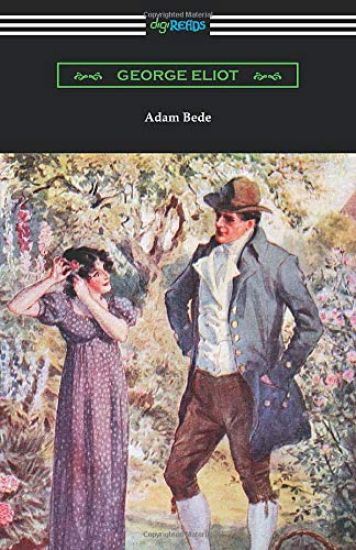
Originally published in 1859, "Adam Bede" is the first novel by George Eliot, which was the pen name of Mary Ann Evans. Eliot was one of the leading British writers of the Victorian era, as well as a noted journalist, poet, and translator. "Adam Bede" concerns a small, tight-knit, and fictional rural community called Hayslope and the romantic drama that develops between four of its young residents: the title character Adam, a young carpenter, the beautiful young Hetty Sorrel, Captain Arthur Donnithorne, a young squire, and Hetty's cousin, the virtuous Methodist lay preacher, Dinah Morris. Adam, respected for his intelligence and integrity, has fallen in love with Hetty, who in turn has fallen in love with Arthur, the local squire's charismatic grandson and heir. Adam discovers that Hetty and Arthur have been meeting in secret and uses this knowledge to force his rival to leave town. However, before Hetty and Adam can wed, Hetty discovers herself to be pregnant and a series of bad decisions results in tragic consequences. A classic of 19th century literature, "Adam Bede", a popular choice in English literature courses, remains a classic tale of love, desperation, and redemption. This edition is printed on premium acid-free paper.

Although the idea that all human beings are descended from Adam is a long-standing conviction in the West, another version of this narrative exists: human beings inhabited the Earth before, or alongside, Adam, and their descendants still occupy the planet. In this engaging and provocative work, David N. Livingstone traces the history of the idea of non-adamic humanity, and the debates surrounding it, from the Middle Ages to the present day. From a multidisciplinary perspective, Livingstone examines how this alternative idea has been used for cultural, religious, and political purposes. He reveals how what began as biblical criticism became a theological apologetic to reconcile religion with science-evolution in particular-and was later used to support arguments for white supremacy and segregation. From heresy to orthodoxy, from radicalism to conservatism, from humanitarianism to racism, Adam's Ancestors tells an intriguing tale of twists and turns in the cultural politics surrounding the age-old question, "Where did we come from?"