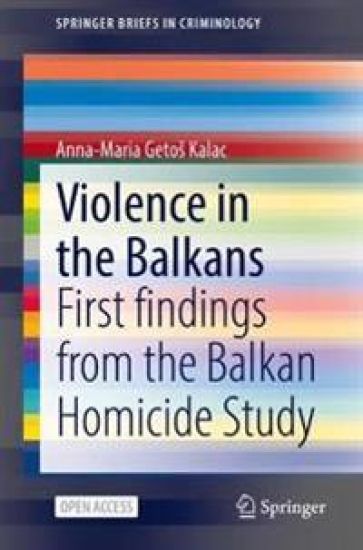
This is the first volume to offer an in-depth look at (lethal) violence in the Balkans. The Balkans Homicide Study analyses 3,000 (attempted) homicide cases from Croatia, Hungary, Kosovo, Macedonia, Romania and Slovenia. Shedding light on a region long neglected in terms of empirical violence research, the study at hand asks:- What types of homicides occur in the Balkans?- Who are the perpetrators and what motivates them?- Who are the victims and what potential protective factors are on their side?- Why do prosecutors dismiss homicide investigations? Amongst other questions and considerations, this brief discusses regional commonalities throughout the Balkans in view of their cultural,historical and normative context. Dismantling negative stereotypes of a growing and thriving Balkan society, this volume will be of interest to researchers in the Balkans, researchers of post-conflict regions, and those interested in the nature of homicide and its motivation, prevention, and various criminal justice approaches.
Anhand umfangreicher Quellenstudien analysiert diese Untersuchung wissenschaftliche Verlage, die w hrend der deutschen Teilung namensgleich in Ost und West existierten: Akademische Verlagsgesellschaft, J.A. Barth, Gustav Fischer, S. Hirzel, Carl Marhold, Theodor/Dr. Dietrich Steinkopff, B. G. Teubner und Georg Thieme. Das Buch leistet damit einen Beitrag zur Erforschung des deutsch-deutschen Verh ltnisses nach 1945, das sich in den Beziehungen der Parallelverlage und der Branchenverb nde in DDR und Bundesrepublik spiegelt. Es werden differenzierte Einblicke in die Verflechtungen politischer, kultureller und konomischer Motive und Interessen der Akteure gegeben.
Die Kapitel Esr 1-3 bilden den Auftakt einer Rückkehr-Tempelbau-Erzählung, die die Restauration der judäischen Gemeinde in nachexilischer Zeit schildert. Besonders die Herkunft und Authentizität der im Zentrum dieses Prologs stehenden Rückkehrerliste Esr 2 sowie ihr Charakter als sekundäre Einfügung sind dabei in der bisherigen Forschung immer wieder kontrovers diskutiert worden. Die vorliegende Studie bietet nun eine umfassende Untersuchung dieser Liste sowohl im Hinblick auf Form und Inhalt als auch auf ihre Einbettung und Funktion für den Erzählkontext Esr 1-3. Dabei zeigt sich, dass die Rückkehrerliste nicht aus ihrem Kontext herauszulösen ist, sondern mit diesem gemeinsam einen Motivkomplex bildet, der an den ersten Exodus gemahnt. Dabei lässt gerade die Liste selbst Rückschlüsse auf die Konstruktion nachexilisch-jüdischer Identität im Spannungsfeld von Kontinuität und Diskontinuität zu.
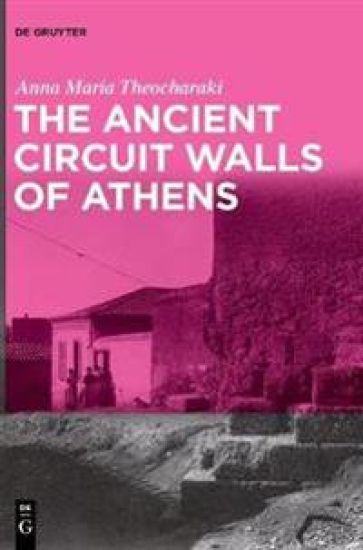
In Athens, most remains of the ancient city-wall were revealed during rescue excavations; as a result, documentation is scattered and fragmented. This book systematically investigates all published data, revealing the history and the nature of the surviving remains of this significant monument. The book provides an analysis of the ancient literary sources, the western travellers’ accounts, and the history of archaeological research on the circuit walls of ancient Athens. It collects, records, and maps all archaeological data from systematic and rescue excavations of the physical remains of the wall as it evolved over eleven centuries and through more than a dozen construction phases. It reviews issues relating to structure, chronology and topography of the ancient city wall, as well as to the management of its remains by the state authorities. The enormous amount of primary evidence makes the book essential reading for scholars of the topography of ancient Athens. This monograph also aspires to increase community awareness of cultural heritage in everyday urban contexts, as the wall has been preserved in a number of ways: in basements of buildings, reburied in situ, in the open air or beneath glass floors.
As of yet, the remarkable and highly influential textual form of Euclidean mathematics has not been considered from a literary-aesthetic perspective. By its extreme standardization and seeming non-literariness it appears to defy such an approach. This book nonetheless attempts precisely a literary-aesthetic study of the language and style of Euclid’s Elements, focusing on book I. It aims to find out what is literary about the form and what motivates this form as form. In doing so, it employs the concept of clarity, asking: How is the textual form related to logical and communicative clarity? That is, how far is the omnipresent standardization necessary for the accomplishment and successful communication of the proofs? Based on a close analysis of the standardization at all levels of the text (lexicon, grammar, structure, and especially diagram), it argues that the textual form of the Elements is standardized beyond logical-communicative purposes, and that it is in this sense ‘aesthetic’. The book exposes the unexpected literary dimension of Euclid’s Elements, provides a new interpretation of the peculiar form of the work, and offers a model for determining the role of clarity (not only) in Greek theoretical mathematics.
Anhand umfangreicher Quellenstudien analysiert diese Untersuchung wissenschaftliche Verlage, die w hrend der deutschen Teilung namensgleich in Ost und West existierten: Akademische Verlagsgesellschaft, J.A. Barth, Gustav Fischer, S. Hirzel, Carl Marhold, Theodor/Dr. Dietrich Steinkopff, B. G. Teubner und Georg Thieme. Das Buch leistet damit einen Beitrag zur Erforschung des deutsch-deutschen Verh ltnisses nach 1945, das sich in den Beziehungen der Parallelverlage und der Branchenverb nde in DDR und Bundesrepublik spiegelt. Es werden differenzierte Einblicke in die Verflechtungen politischer, kultureller und konomischer Motive und Interessen der Akteure gegeben.
The book provides an encyclopaedic overview of the language contact between Slavic languages and Romani in Eastern, South-Eastern and East-Central Europe. It is based on Yaron Matras’ pragmatic-functional approach to language contact and follows a new direction in Romani linguistics that conceives Romani as a subgroup of closely related languages rather than a single language. The central topics discussed in the book are: Slavic impact on Romani phonetics and phonology, morphology and syntax; forms and functions of Slavic verbal prefixes in Romani; Slavic impact on the Romani lexicon; Romani elements in the nonstandard lexicon of the Slavic languages; writing Romani with ‘Slavic’ alphabets.
The book provides an encyclopaedic overview of the language contact between Slavic languages and Romani in Eastern, South-Eastern and East-Central Europe. It is based on Yaron Matras’ pragmatic-functional approach to language contact and follows a new direction in Romani linguistics that conceives Romani as a subgroup of closely related languages rather than a single language. The central topics discussed in the book are: Slavic impact on Romani phonetics and phonology, morphology and syntax; forms and functions of Slavic verbal prefixes in Romani; Slavic impact on the Romani lexicon; Romani elements in the nonstandard lexicon of the Slavic languages; writing Romani with ‘Slavic’ alphabets.
Die Berücksichtigung des Zivilrechts bei der Anwendung strafrechtlicher Tatbestände ist etwa beim Diebstahl nach § 242 StGB anerkannt. Diesen kann nur begehen, wer eine Sache wegnimmt, die nach zivilrechtlichen Vorschriften im Eigentum eines anderen steht und auf deren Übereignung er keinen fälligen und einredefreien Anspruch hat. Weist ein Sachverhalt Bezugspunkte nicht allein zur Rechtsordnung des strafenden Staates auf, stellt sich die Frage, inwieweit und nach welchem Maßstab das (Internationale) Privatrecht einer ebenfalls berührten ausländischen Rechtsordnung über diese Schnittstelle Eingang in seine strafrechtliche Beurteilung finden darf und soll. Anna-Maria Brutscher diskutiert hierzu unterschiedliche Lösungsansätze, deren praktische Konsequenzen an einem Beispielsfall aufgezeigt und die unter Berücksichtigung verfassungsrechtlicher und strafrechtlicher Grundsätze gegeneinander abgewogen werden. Diese legen den Rückgriff auf ausländisches Privatrecht nahe und setzen ihm zugleich Grenzen.
Emanuel Hirschs theologischer Ansatz zeichnet sich durch das Bestreben aus, evangeliumsgemäß und zugleich den Bedingungen der Moderne verpflichtet zu sein. Anna-Maria Klassen entfaltet seine an diesem Maßstab ausgerichtete Transformation der Eschatologie, deren Thema das Verhältnis des Einzelnen zu seinem Tod ist. Hirschs Todesdeutung überzeugt, weil sie die Negativität des Todes mit dem christlichen Gottesbild verbindet. Auch der Glaubende kann sich über das Jenseits des Todes nicht sicher sein. Er steht in der unauflöslichen Spannung zwischen Vollendungsgewissheit und Todesangst. Gott wird zugleich als der Gnädige und der Richtende erfahren. Hirsch liefert mit verschiedenen Formen der Todesangst eine Phänomenologie der modernen Gerichtserfahrung. Diese ist, wie die Autorin in drei exemplarischen Skizzen zeigt, auch für die Reflexion über gegenwärtige glaubenspraktische Fragen hilfreich.
This book identifies the main challenges to confronting global health (in)securities at three levels. First, at the level of zoonosis, to which HIV and Ebola, as well as H1Nn, MERS-CoV, and SARS belong, and which promise to continue to emerge. Second, at the level of the spread of these across bio-, ecological and political boundaries and borders, particularly nationally. These present challenges not only in terms of immunities, but also in terms of rights – who is eligible for treatment under whose responsibility? Finally, at the international level of global administration, presenting a challenge in terms of coordinated public health, legal, political, and economic response. The book develops coordinated policy recommendations for meeting these challenges in a globalized world, and examines the unique opportunities and challenges associated with the co-administration of the good of public health by both nation states and non-state actors. This book will be valuable read for students of Public Policy, Health Policy and Management, International Relations and Global Governance.
This book integrates current advances in biology, economics of information and linguistics research through applications using agent-based modeling and social network analysis to develop scenarios of communication and language emergence in the social aspects of biological communications. The book presents a model of communication emergence that can be applied both to human and non-human living organism networks. The model is based on economic concepts and individual behavior fundamental for the study of trust and reputation networks in social science, particularly in economics; it is also based on the theory of the emergence of norms and historical path dependence that has been influential in institutional economics. Also included are mathematical models and code for agent-based models to explore various scenarios of language evolution, as well as a computer application that explores language and communication in biological versus social organisms, and the emergence of various meanings and grammars in human networks.Emergence of Communication in Socio-Biological Networks offers both a completely novel approach to communication emergence and language evolution and provides a path for the reader to explore various scenarios of language and communication that are not constrained to the human networks alone. By illustrating how computational social science and the complex systems approach can incorporate multiple disciplines and offer an integrated theory-model approach to the evolution of language, the book will be of interest to researchers working with computational linguistics, mathematical linguistics, and complex systems.
This book delves into the diffuse relationship between states, citizens, and non-citizens. It explores the theoretical heritage of human security and identifies practical responses to the (re)negotiated relationships between states and citizens, responsibility and accountability. It argues that the changes to global order since the 1990s have resulted in a divergence from the understanding of the State as the arbiter within its territory, and as the guarantor of (human) security within its borders. In addition, while interventionist actions of various non-state actors to implement material guarantees of (human) security reaching both citizens and non-citizens (including refugees) have solved some immediate problems, they have not answered the question of where accountability ultimately lies.
This book explores the in-depth relationship between historic-cultural heritage and landscape, urban, and regional planning. It analyzes recent cultural and discipline positions and addresses research to interpret legacy values and the necessity for conservation within the urban setting. It also presents a method that helps urban planners to implement the suggestions, based on extensive knowledge of topographic methods and urban archaeology, to enhance the shaping and planning of the historic and present-day city.A rapid evolution of techniques and methods that provide innovative planning instruments and contribute to conservation projects involving cities and territories is now being witnessed in urban planning. Actors involved in the planning process use an organic and multidisciplinary vision of techniques and methods to understand the relation between the historic-cultural goods and their settlement context. Through urban archaeology it is now possible to orient—in a systematic way—interventions in the historic centers of European cities and document the origin and evolution of the urban shape, to reconcile renewal demand and preservation of ancient heritage.
This book identifies the main challenges to confronting global health (in)securities at three levels. First, at the level of zoonosis, to which HIV and Ebola, as well as H1Nn, MERS-CoV, and SARS belong, and which promise to continue to emerge. Second, at the level of the spread of these across bio-, ecological and political boundaries and borders, particularly nationally. These present challenges not only in terms of immunities, but also in terms of rights – who is eligible for treatment under whose responsibility? Finally, at the international level of global administration, presenting a challenge in terms of coordinated public health, legal, political, and economic response. The book develops coordinated policy recommendations for meeting these challenges in a globalized world, and examines the unique opportunities and challenges associated with the co-administration of the good of public health by both nation states and non-state actors. This book will be valuable read for students of Public Policy, Health Policy and Management, International Relations and Global Governance.
This book integrates current advances in biology, economics of information and linguistics research through applications using agent-based modeling and social network analysis to develop scenarios of communication and language emergence in the social aspects of biological communications. The book presents a model of communication emergence that can be applied both to human and non-human living organism networks. The model is based on economic concepts and individual behavior fundamental for the study of trust and reputation networks in social science, particularly in economics; it is also based on the theory of the emergence of norms and historical path dependence that has been influential in institutional economics. Also included are mathematical models and code for agent-based models to explore various scenarios of language evolution, as well as a computer application that explores language and communication in biological versus social organisms, and the emergence of various meanings and grammars in human networks.Emergence of Communication in Socio-Biological Networks offers both a completely novel approach to communication emergence and language evolution and provides a path for the reader to explore various scenarios of language and communication that are not constrained to the human networks alone. By illustrating how computational social science and the complex systems approach can incorporate multiple disciplines and offer an integrated theory-model approach to the evolution of language, the book will be of interest to researchers working with computational linguistics, mathematical linguistics, and complex systems.