For any undergraduate/graduate-level course in Music Education. Unique in both content and approach, this text offers a single-volume authoritative comparison of the four most popular music education methods used in North America-Jacques-Dalcroze, Kodaly, Orff, and Comprehensive Musicianship. Its in-depth examination of the methods and underlying philosophies of each method-and its suggested lessons for each method at each grade level-will help students make educated curricular choices among methods.
The 18th century was a wealth of knowledge, exploration and rapidly growing technology and expanding record-keeping made possible by advances in the printing press. In its determination to preserve the century of revolution, Gale initiated a revolution of its own: digitization of epic proportions to preserve these invaluable works in the largest archive of its kind. Now for the first time these high-quality digital copies of original 18th century manuscripts are available in print, making them highly accessible to libraries, undergraduate students, and independent scholars.Western literary study flows out of eighteenth-century works by Alexander Pope, Daniel Defoe, Henry Fielding, Frances Burney, Denis Diderot, Johann Gottfried Herder, Johann Wolfgang von Goethe, and others. Experience the birth of the modern novel, or compare the development of language using dictionaries and grammar discourses. ++++The below data was compiled from various identification fields in the bibliographic record of this title. This data is provided as an additional tool in helping to insure edition identification: ++++British LibraryT049920The adaptation probably by David Garrick. With a half-title.London: printed for J. and R. Tonson, 1756. 8],47, 1]p.; 8
The 18th century was a wealth of knowledge, exploration and rapidly growing technology and expanding record-keeping made possible by advances in the printing press. In its determination to preserve the century of revolution, Gale initiated a revolution of its own: digitization of epic proportions to preserve these invaluable works in the largest archive of its kind. Now for the first time these high-quality digital copies of original 18th century manuscripts are available in print, making them highly accessible to libraries, undergraduate students, and independent scholars.Western literary study flows out of eighteenth-century works by Alexander Pope, Daniel Defoe, Henry Fielding, Frances Burney, Denis Diderot, Johann Gottfried Herder, Johann Wolfgang von Goethe, and others. Experience the birth of the modern novel, or compare the development of language using dictionaries and grammar discourses. ++++The below data was compiled from various identification fields in the bibliographic record of this title. This data is provided as an additional tool in helping to insure edition identification: ++++Huntington LibraryN000302The adaptation probably by David Garrick, with some contribution from J.C. Smith. With an errata slip for p. 41 containing an extra song, "Come pride, ..", to cancel "Farewell ungrateful traitor ..".London: printed for J. and R. Tonson and S. Draper, 1755. 2],47, 1]p.; 8
The most popular schools song and hymn book ever! Combines Come and Praise 1 and 2, giving you the words and music for 149 traditional and contemporary hymns and songs in one volume.
This is the 19th book from author and popular music historian Harvey Kubernik. His comprehensive compilation of interviews and conversations with rock, blues, folk, soul, reggae musicians, singers, songwriters, and recording engineers, photographers, cinematographers, documentary movie makers and distributors whose creative works matter, and who share their insider stories, techniques and inspiration with readers and viewers. This is the definitive volume for fans, collectors, music and film students to cherish and share anyone who follows rock 'n' roll facts and stax of wax from the fifties into our current century. For the ever-growing audience of people who love to see and hear their favorite stars performing live in arenas, concert halls, outdoor concert venues, and now on screen in theaters, on TV and in productions and formats designed for home entertainment, here is the real-to-reel backstory behind many of the music DVD's and movies you have on your shelves and in rotation on your home library. This book includes dialogues with acclaimed Oscar winners D. A. Pennebaker, Murray Lerner, Albert Maysles, Morgan Neville, John Ridley, and Curtis Hanson alongside commentary about noted directors Michael Lindsay-Hogg, Allan Arkush, Colin Hanks, Quentin Tarentino and Martin Scorsese. You'll also learn about filmmakers and screenwriters David Leaf, Leslie Ann Coles, and Travis Edward Pike, plus the often-overlooked rock 'n' roll contributions of native Americans. You'll be reminded again of the pioneering television efforts of Ed Sullivan and Dick Clark with photography displayed in the pages by Henry Diltz and Heather Harris. This 508 page book, illustrated with a total of 220 photos, documents and artifacts, is mandatory for anyone who loves music and available screen productions with the Rolling Stones, the Beatles, the Doors, Otis Redding, Bob Marley, the music of Motown, Bob Dylan, Elvis Presley, Johnny Cash, Brian Wilson, James Brown, the Bee Gees, John Lennon, the Supremes, Ike and Tina Turner, the Jimi Hendrix Experience, The Band, Paul Butterfield, and the sounds of Laurel Canyon, including the Mamas and the Papas, the Byrds, Crosby, Stills and Nash, and the famed studio recording musicians, the Wrecking Crew. Harvey examines seminal music television shows and the ongoing influence and impact of "American Bandstand," " Shindig " " Shebang " and "Upbeat." There's even a whole chapter on the sacred music George Harrison and Ravi Shankar presented in their Concert for Bangladesh charity event that will celebrate a 50th anniversary in 2021.This is the one you've been waiting for Harvey Kubernik is your tour guide on this journey through the past that you can still see, hear and own in 2020.
This book is a survey and analysis of how deep learning can be used to generate musical content. The authors offer a comprehensive presentation of the foundations of deep learning techniques for music generation. They also develop a conceptual framework used to classify and analyze various types of architecture, encoding models, generation strategies, and ways to control the generation. The five dimensions of this framework are: objective (the kind of musical content to be generated, e.g., melody, accompaniment); representation (the musical elements to be considered and how to encode them, e.g., chord, silence, piano roll, one-hot encoding); architecture (the structure organizing neurons, their connexions, and the flow of their activations, e.g., feedforward, recurrent, variational autoencoder); challenge (the desired properties and issues, e.g., variability, incrementality, adaptability); and strategy (the way to model and control the process of generation, e.g., single-step feedforward, iterative feedforward, decoder feedforward, sampling). To illustrate the possible design decisions and to allow comparison and correlation analysis they analyze and classify more than 40 systems, and they discuss important open challenges such as interactivity, originality, and structure. The authors have extensive knowledge and experience in all related research, technical, performance, and business aspects. The book is suitable for students, practitioners, and researchers in the artificial intelligence, machine learning, and music creation domains. The reader does not require any prior knowledge about artificial neural networks, deep learning, or computer music. The text is fully supported with a comprehensive table of acronyms, bibliography, glossary, and index, and supplementary material is available from the authors' website.
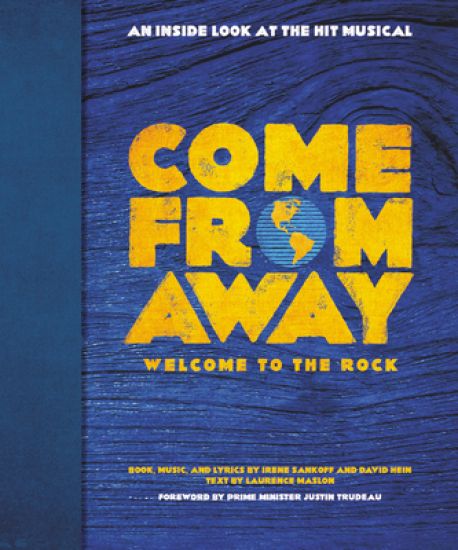
Come From Away: Welcome to the Rock - a fully illustrated companion volume to the hit Tony Award-winning Broadway musical, featuring the book and lyrics for the first time in print, backstage stories and the real history behind the show's events, character design sketches, and songs that ended up on the cutting room floor. The Tony Award-winning Broadway musical Come From Away tells the remarkable true story of a small town that welcomed the world. On September 11, 2001, 38 planes and 6,579 passengers were forced to land in the provincial town of Gander, Newfoundland. The local residents opened their arms to the displaced visitors, offering food, shelter, and friendship. In the days that followed, cultures clashed and nerves ran high, but uneasiness turned into trust, music soared into the night, and gratitude grew into enduring friendships. Come From Away: Welcome to the Rock is the ultimate companion piece to Irene Sankoff and David Hein's smash-hit musical based on that extraordinary experience. Featuring the complete book and lyrics for the first time in print, a foreword by Canadian Prime Minister Justin Trudeau, and exclusive photos of the company and physical production, this essential companion also includes original interviews with passengers, Gander residents, and the actors who portray them. The narrative by theater historian Laurence Maslon details the events of that memorable and challenging week and also traces the musical's development from the ten-year reunion of residents and airline passengers in Gander, where the idea for the musical was born, to the global phenomenon it is today. Come From Away: Welcome to the Rock gives an unprecedented look behind the curtain and demonstrates why the story has touched so many so deeply: Because we come from everywhere, we all come from away.
This book contains over four hundred fifty tuning scales, tracker scales and key frame layouts for player and reproducing pianos, coin pianos and orchestrions, music boxes, table-top organettes, reed, pipe, and electronic organs, barrel organs and various other miscellaneous mechanical musical instruments. In addition to the six hundred fifty pictures and illustrations, there are capsule histories of many of the companies which produced these instruments on both sides of the Atlantic Ocean. There are numerous informative articles on such subjects as arranging piano rolls, how to decode an unknown scale, how nickelodeon rolls were originally made, selecting the type of roll to be used for a new orchestrion, arranging music for barrel organs, tuning antique instruments, how rolls are perforated and detailed pictorial tours of both the QRS and Play-Rite Music Roll factories as they manufactured rolls in the early 1980s. There's a good bit of information on player pipe organs, and for the carousel buffs, a fascinating collection of pictures of Charles Looff, the carousel builder, and many of the fine machines he made--all of which were fitted with beautiful mechanical organs.
The source readings in Hymnology are primary documents illustrating the philosophy and practice of congregational singing during various historical periods of the Christian church. They are drawn from a wide variety of sources including letters, diaries, periodicals, hymnal and tunebook prefaces, theological treatises, certain controversial books and pamphlets, and deliberations of church councils. The material ranges in date from the beginning of the second century to the 1960s. All the major streams of Christian song are covered, including early Greek and Latin hymnody, pre-Reformation vernacular hymnody, the Lutheran chorale, Reformed psalmody, and English and American hymnody from the sixteenth to the twentieth century. The book is suitable for use as a text or supplementary text for courses in hymnology, a professional reference work for ministers and church musicians, and a book for laymen interested in the history of church music.
First Published in 1998. This series presents the music of early American composers of sacred music—psalmody, as it was called—in collected critical editions. Each volume has been prepared by a scholar who has studied the musical history of the period and the stylistic qualities of the composer. The purpose of the series is to present the music of important early American composers in accurate editions for both performance and study. This volume presents selected music by one of the best known and most prolific composers of New England psalmody during the late eighteenth and early nineteenth centuries. Oliver Holden was a native and life-long resident of Massachusetts.
Baptist Hymnody in America is a collection of primary documents on congregational singing among Baptists in the United States from the eighteenth through the early twenty-first centuries. These documents—many of which are not readily available and are gathered here for the first time—record the struggles and triumphs of Baptists as they have sought to provide acceptable sung forms of worship, suggest how certain types of song became identified particularly as "Baptist," demonstrate the varying philosophies of hymnody expressed among Baptists for the past four hundred years, and reveal the historic diversity of Baptist worship practices.The introduction describes the purpose, format, and organization of the collection. Subsequent discussions take up the British Baptist background in the seventeenth and eighteenth centuries; the beginnings of Baptist hymnody in America; the earliest Baptist hymnals; local and regional collections in the early nineteenth century; sectional, national, and denominational collections in the mid-nineteenth century; the Sunday school song and revival hymnody; hymnals of the late nineteenth century; hymnals of denominational identity; and new currents in Baptist congregational song. Each chapter is prefaced by a general introduction, and each document or group of documents is provided with a commentary that contains biographical information on the author, the context and a summary of the writing, and a description of the source. The documents included are not only of intrinsic interest but also provide a foundation for engaging current and future issues regarding congregational song within Baptist life.
Baptist Hymnody in America is a collection of primary documents on congregational singing among Baptists in the United States from the eighteenth through the early twenty-first centuries. These documents—many of which are not readily available and are gathered here for the first time—record the struggles and triumphs of Baptists as they have sought to provide acceptable sung forms of worship, suggest how certain types of song became identified particularly as "Baptist," demonstrate the varying philosophies of hymnody expressed among Baptists for the past four hundred years, and reveal the historic diversity of Baptist worship practices.The introduction describes the purpose, format, and organization of the collection. Subsequent discussions take up the British Baptist background in the seventeenth and eighteenth centuries; the beginnings of Baptist hymnody in America; the earliest Baptist hymnals; local and regional collections in the early nineteenth century; sectional, national, and denominational collections in the mid-nineteenth century; the Sunday school song and revival hymnody; hymnals of the late nineteenth century; hymnals of denominational identity; and new currents in Baptist congregational song. Each chapter is prefaced by a general introduction, and each document or group of documents is provided with a commentary that contains biographical information on the author, the context and a summary of the writing, and a description of the source. The documents included are not only of intrinsic interest but also provide a foundation for engaging current and future issues regarding congregational song within Baptist life.