Kirjojen hintavertailu. Mukana 12 016 292 kirjaa ja 12 kauppaa.

Kirjahaku

Etsi kirjoja tekijän nimen, kirjan nimen tai ISBN:n perusteella.

1000 tulosta hakusanalla Deborah Cook

Flawed Convictions

Flawed Convictions

Deborah Tuerkheimer

Oxford University Press Inc
2015
nidottu
The emergence of Shaken Baby Syndrome (SBS) presents an object lesson in the dangers that lie at the intersection of science and criminal law. As often occurs in the context of scientific knowledge, understandings of SBS have evolved. We now know that the diagnostic triad alone does not prove beyond a reasonable doubt that an infant was abused, or that the last person with the baby was responsible for the baby's condition. Nevertheless, our legal system has failed to absorb this new consensus. As a result, innocent parents and caregivers remain incarcerated and, perhaps more perplexingly, triad-only prosecutions continue even to this day. Flawed Convictions: "Shaken Baby Syndrome" and the Inertia of Injustice is the first book to survey the scientific, cultural, and legal history of Shaken Baby Syndrome from inception to formal dissolution. It exposes extraordinary failings in the criminal justice system's treatment of what is, in essence, a medical diagnosis of murder. The story of SBS highlights fundamental inadequacies in the legal response to "science dependent prosecution." A proposed restructuring of the law contends with the uncertainty of scientific knowledge.

The Well-Ordered Universe

The Well-Ordered Universe

Deborah Boyle

Oxford University Press Inc
2017
sidottu
The prolific Margaret Cavendish (1623-1673) published books on natural philosophy as well as stories, plays, poems, orations, allegories, and letters. Her mature philosophical system offered a unique panpsychist theory of Nature as composed of a continuous, non-atomistic, perceiving, knowing matter. In contrast to the dominant philosophical thinking of her day, Cavendish argued that all matter has free will and can choose whether or not to follow Nature's rules. The Well-Ordered Universe explores the development of Cavendish's natural philosophy from the atomism of her 1653 poems to the panpsychist materialism of her 1668 Grounds of Natural Philosophy. Deborah Boyle argues that her natural philosophy, her medical theories, and her social and political philosophy are all informed by an underlying concern with order, regularity, and rule-following. This focus on order reveals interesting connections among apparently disparate elements of Cavendish's philosophical program, including her views on gender, on animals and the environment, and on sickness and health. Focusing on the role of order in Cavendish's philosophy also helps reveal key differences between her natural philosophy and her more conservative social and political philosophy. Cavendish believed that humans' special desire for public recognition often leads to an unruly ambition, causing humans to disrupt society in ways not seen in the rest of Nature. Thus, The Well-Ordered Universe defends Cavendish as a royalist who endorsed absolute monarchy and a rigid social hierarchy for maintaining order in human society.
Women and Leadership

Women and Leadership

Deborah L. Rhode

Oxford University Press Inc
2016
sidottu
For most of recorded history, men have held nearly all of the most powerful leadership positions. Today, although women occupy an increasing percentage of leadership positions, in America they hold less than a fifth of positions in both the public and private sectors. The United States ranks 78th in the world for women's representation in political office. In politics, although women constitute a majority of the electorate, they account for only 18 percent of Congress, 10 percent of governors, and 12 percent of mayors of the nation's 100 largest cities. In academia, women account for a majority of college graduates, but only about a quarter of full professors and university presidents. In law, women are almost half of law school graduates, but only 17 percent of the equity partners of major firms, and 22 percent of Fortune 500 general counsels. In business, women constitute a third of MBA graduates, but only 5 percent of Fortune 500 CEOs. In Women and Leadership, the eminent legal scholar Deborah L. Rhode focuses on women's underrepresentation in leadership roles and asks why it persists and what we can do about it. Although organizations generally stand to gain from increasing gender equity in leadership, women's underrepresentation is persistent and pervasive. Rhode explores the reasons, including women's family roles, unconscious gender bias, and exclusion from professional development networks. She stresses that we cannot address the problem at the individual level; instead, she argues that we need broad-based strategies that address the deep-seated structural and cultural conditions facing women. She surveys a range of professions-politics, management, law, and academia-and draws from a survey of prominent women to develop solutions that can successfully chip away at the imbalance. These include developing robust women-to-women networks, enacting laws and policies that address work/life imbalances, and training programs that start at an earlier age. Rhode's clear exploration of the leadership gap and her compelling policy prescriptions will make this an essential book for anyone interested in leveling the playing field for women leaders in America.
What Women Want

What Women Want

Deborah L. Rhode

Oxford University Press Inc
2017
nidottu
What Women Want is a trenchant examination of the struggle for women's equality, and a prescription for what to focus on next in order to ensure maximum success. Feminism today is a movement that lacks leadership, unity, and definition, and it has gotten stuck in a boom and bust cycle when it comes to public opinion and action. Despite significant progress over the last fifty years, equality is still a distant goal in the political, social, and economic spheres. Only by identifying the barriers (both internal and external) that remain, Deborah Rhode argues, can we begin to identify solutions. A rigorously researched and well-written answer to the glut of gender-related books that have come onto the market recently, What Women Want comprehensively analyzes the challenges the feminist movement faces today. Combining sharp academic analysis and interviews with notable figures such as Sheryl Sandberg, Rhode focuses on five main topics: employment issues such as pay discrimination, work-life balance and the government's pitiful response, the assault on women's reproductive rights and the limits it places on their economic mobility, sexual harassment and violence, and the detrimental effect that the unfashionable label "feminist" can have, especially in attracting young women to the movement. Despite these formidable obstacles, the goals and principles of feminism are widely accepted by the American mainstream, and Rhode, herself a pathbreaker in the fields of law and education, offers effective strategies for redefining and advancing the feminist agenda, thereby creating a movement that truly recognizes, and is responsive to, what all women want.
Strategic Brand Management: Lessons for Winning Brands in Globalized Markets

Strategic Brand Management: Lessons for Winning Brands in Globalized Markets

Deborah Roedder John; Carlos J. Torelli

Oxford University Press
2017
nidottu
Strategic Brand Management provides a concise, flexible, and modern take on global brand management, with cutting-edge research and mini-cases and activities to engage students. The book provides readers with an innovative framework that explains the four key aspects of strategic brand management: identifying and measuring, building, leveraging, and protecting brands.
Cheating

Cheating

Deborah L. Rhode

Oxford University Press Inc
2018
sidottu
Cheating is deeply embedded in everyday life. The costs of the most common forms of cheating total close to a trillion dollars annually. Part of the problem is that many individuals fail to see such behavior as a serious problem. "Everyone does it" is a common rationalization, and one that comes uncomfortably close to the truth. That perception is also self-perpetuating. The more that individuals believe that cheating is widespread, the easier it becomes to justify. Yet what is most notable about analysis of the problem is how little there is of it. Whether or not Americans are cheating more, they appear to be worrying about it less. In Cheating, eminent legal scholar Deborah Rhode offers the only recent comprehensive account of cheating in everyday life and the strategies necessary to address it. Because cheating is highly situational, Rhode drills down on its most common forms in sports, organizations, taxes, academia, copyright infringement, marriage, and insurance and mortgages. Cheating also reviews strategies necessary to address the pervasiveness and persistence of cheating in these contexts. We clearly need more cultural reinforcement of ethical conduct. Efforts need to begin early, with values education by parents, teachers, and other role models who can display and reinforce moral behaviors. Organizations need to create ethical cultures, in which informal norms, formal policies, and reward structures all promote integrity. People also need more moral triggers that remind them of their own values. Equally important are more effective enforcement structures, including additional resources and stiffer sanctions. Finally, all of us need to take more responsibility for combatting cheating. We need not only to subject our own conduct to more demanding standards, but also to assume a greater obligation to prevent and report misconduct. Sustaining a culture that actively discourages cheating is a collective responsibility, and one in which we all have a substantial stake.
Family Secrets: Shame & Privacy in Modern Britain

Family Secrets: Shame & Privacy in Modern Britain

Deborah Cohen

Oxford University Press
2017
nidottu
We live today in a culture of full disclosure, where tell-all memoirs top the best-seller lists, transparency is lauded, and privacy seems imperiled. But how did we get here? Exploring scores of previously sealed records, Family Secrets offers a sweeping account of how shame--and the relationship between secrecy and openness--has changed over the last two centuries in Britain. Deborah Cohen uses detailed sketches of individual families as the basis for comparing different sorts of social stigma. She takes readers inside an Edinburgh town house, where a genteel maiden frets with her brother over their niece's downy upper lip, a darkening shadow that might betray the girl's Eurasian heritage; to a Liverpool railway platform, where a heartbroken mother hands over her eight-year old illegitimate son for adoption; to a town in the Cotswolds, where a queer vicar brings to his bank vault a diary--sewed up in calico, wrapped in parchment--that chronicles his sexual longings. Cohen explores what families in the past chose to keep secret and why. She excavates the tangled history of privacy and secrecy to explain why privacy is now viewed as a hallowed right while secrets are condemned as destructive. In delving into the dynamics of shame and guilt, Family Secrets explores the part that families, so often regarded as the agents of repression, have played in the transformation of social mores from the Victorian era to the present day. Written with compassion and keen insight, this is a bold new argument about the sea-changes that took place behind closed doors.
Lawyers as Leaders

Lawyers as Leaders

Deborah L. Rhode

Oxford University Press Inc
2018
nidottu
No occupation in America supplies a greater proportion of leaders than law. They obviously lead law firms, but they also sit at the helm of a vast and diverse array of businesses across America, including 10 percent of S & P 500 firms. And of course, a strikingly large percentage of our political leaders are attorneys, including half the members of Congress. This raises two obvious questions: why do we look to lawyers to lead, and why do so many of them prove to be so untrustworthy and unprepared? In Lawyers as Leaders, eminent law professor Deborah Rhode not only answers these questions but crafts an essential manual for attorneys who need to develop better leadership skills. She contends that the legal profession attracts a large number of individuals with the ambition and analytic capabilities to be leaders, but often fails to develop other qualities that are essential to their effectiveness. The focus of legal education and the reward structure of legal practice undervalue the interpersonal skills and ethical commitments necessary for successful leadership. Although some lawyers are sufficiently gifted to need little reinforcement, Rhode shows that the vast majority of law school graduates need to develop the leadership characteristics that she profiles. They know it too. According to one survey, almost 90 percent of attorneys stated that their law schools did not teach them leadership skills. Given the importance of the topic, it is surprising how little the profession has done to develop leadership skills. The first serious treatment of the subject, Lawyers as Leaders will be essential to law school instructors who teach leadership courses (a growing field) and any attorney who finds him or herself in a management position.
Methods of Argument: An Anthology of Readings

Methods of Argument: An Anthology of Readings

Deborah H. Holdstein; Danielle Aquiline

Oxford University Press
2018
nidottu
Countering the current climate of "fake news" and "alternative facts," Methods of Argument: An Anthology of Readings showcases well-reasoned and well-supported arguments. The anthology's selections model an array of critical-thinking and writing techniques, covering both simple single-point and complex multi-point arguments.
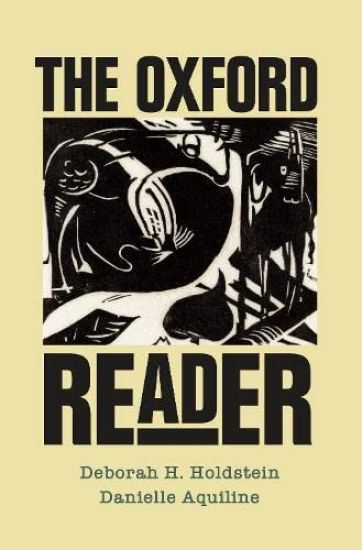
The Oxford Reader

The Oxford Reader

Deborah H. Holdstein; Danielle Aquiline

OXFORD UNIVERSITY PRESS INC
2022
nidottu
The Oxford Reader offers a renewed emphasis on more traditional forms of literacy—sustained reading, writing, and thinking—which comes at a particularly urgent moment. In a world of alternative facts and fake news, the importance of a well and deeply educated citizenry is reinvigorated. Even within the multimodal classroom, many instructors have continued to introduce (or reintroduce) the modes to employ readings that direct students to read carefully, to respond and argue cogently and accountably, and to become nimble and ready writers, no matter what they're writing. The Oxford Reader distinguishes itself by offering not only an expected mix of classic and contemporary selections, but also a variety of genres to emphasize nonfiction, without excluding some literary works and prominent pieces from blogs and other online sources. This spectrum of voices, genres, and time periods illustrate that what is considered contemporary thinking often has its roots elsewhere.
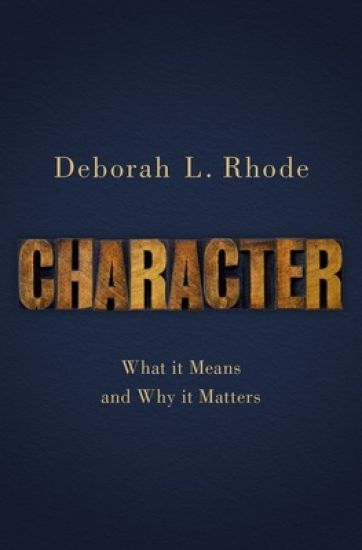
Character

Character

Deborah L. Rhode

Oxford University Press Inc
2019
sidottu
Americans claim to care about character. Over four fifths want it taught in public schools, and 95 percent think that a president's character is important. And historically, philosophers, educators, politicians, religious leaders, judges, and the general public have agreed that character should be valued and reinforced. Yet in the United States, the institutions charged with that mission have consistently fallen short. Simply put, too little effort has been made to understand the importance of character and the strategies that can best develop and support it. After first exploring the history of the concept over time, Deborah Rhode turns her focus to the institutions that have traditionally fostered good character: families, schools, youth organizations, civic groups, and political organizations. However, as we have increasingly de-emphasized the subject-a trend that is most evident in our politics-our awareness of its shaping influence has waned. Indeed, we often focus on the wrong things when it comes to fostering good character. For instance, almost a third of the workforce is covered by licensing laws requiring good moral character, even occupations where the need for screening is not self-evident: florist, fortune teller, and frog farmers. Character also plays a pivotal role in the criminal justice system, in defining guilt, punishment, and eligibility for parole. All too often, these legal requirements are idiosyncratic, inequitable, and subject to race and class bias. Millions of Americans who have convictions for minor offenses are excluded from a vast range of occupations and benefits without evidence that such exclusion serves the public interest. We can do better, she stresses, and outlines a powerful program for reform. Rhode punctuates the book through a series of portraits of exemplary individuals whose good character made them who they were: Ida B. Wells, Jane Addams, Martin Luther King, Mother Teresa, Nelson Mandela, Albert Schweitzer, and Thurgood Marshall. All of these individuals had flaws, but through their commitments to both social justice and helping the less fortunate, they all demonstrate the power and importance of strong character.
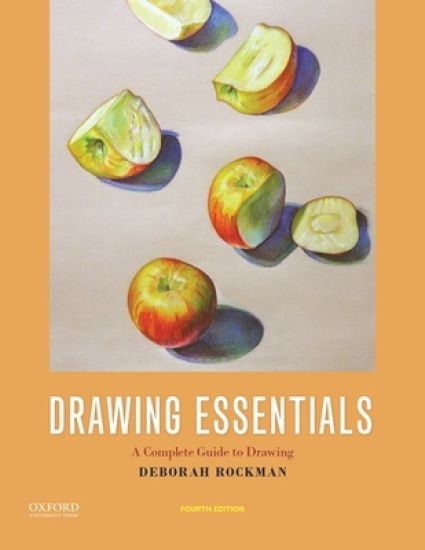
Drawing Essentials: A Complete Guide to Drawing

Drawing Essentials: A Complete Guide to Drawing

Deborah Rockman

Oxford University Press
2020
nidottu
With unparalleled clarity, Drawing Essentials: A Complete Guide to Drawing, Fourth Edition, explains in depth the essentials of depicting form and space on a two-dimensional surface, focusing on the cultivation of observational skills, increased sensitivity, critical thinking, technical refinement, and knowledge of materials. This richly illustrated text is appropriate for use in all levels of drawing classes, from introductory to advanced levels, as well as for figure and life drawing classes.
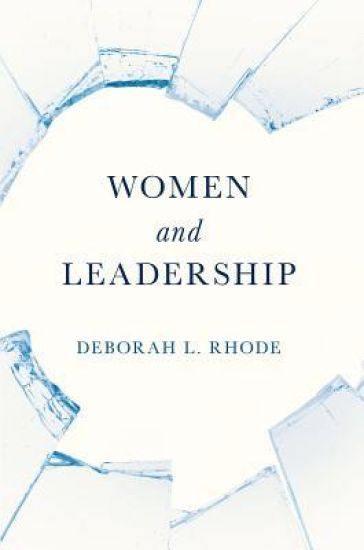
Women and Leadership

Women and Leadership

Deborah L. Rhode

Oxford University Press Inc
2019
nidottu
For most of recorded history, men have held nearly all of the most powerful leadership positions. Today, although women occupy an increasing percentage of leadership positions, in America they hold less than a fifth of positions in both the public and private sectors. The United States ranks 78th in the world for women's representation in political office. In politics, although women constitute a majority of the electorate, they account for only 18 percent of Congress, 10 percent of governors, and 12 percent of mayors of the nation's 100 largest cities. In academia, women account for a majority of college graduates, but only about a quarter of full professors and university presidents. In law, women are almost half of law school graduates, but only 17 percent of the equity partners of major firms, and 22 percent of Fortune 500 general counsels. In business, women constitute a third of MBA graduates, but only 5 percent of Fortune 500 CEOs. In Women and Leadership, the eminent legal scholar Deborah L. Rhode focuses on women's underrepresentation in leadership roles and asks why it persists and what we can do about it. Although organizations generally stand to gain from increasing gender equity in leadership, women's underrepresentation is persistent and pervasive. Rhode explores the reasons, including women's family roles, unconscious gender bias, and exclusion from professional development networks. She stresses that we cannot address the problem at the individual level; instead, she argues that we need broad-based strategies that address the deep-seated structural and cultural conditions facing women. She surveys a range of professions in politics, management, law, and academia and draws from a survey of prominent women to develop solutions that can successfully chip away at the imbalance. These include developing robust women-to-women networks, enacting laws and policies that address work/life imbalances, and training programs that start at an earlier age. Rhode's clear exploration of the leadership gap and her compelling policy prescriptions will make this an essential book for anyone interested in leveling the playing field for women leaders in America.
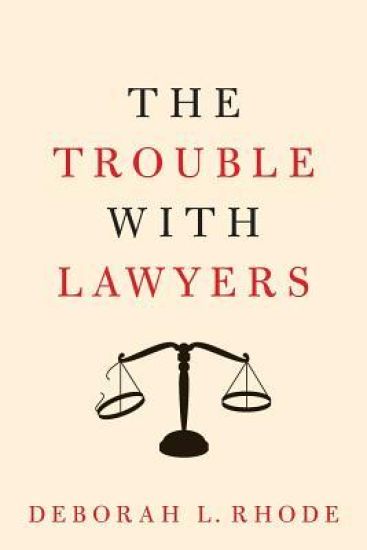
The Trouble with Lawyers

The Trouble with Lawyers

Deborah L. Rhode

Oxford University Press Inc
2019
nidottu
By any measure, the law as a profession is in serious trouble. Americans' trust in lawyers is at a low, and many members of the profession wish they had chosen a different path. Law schools, with their endlessly rising tuitions, are churning out too many graduates for the jobs available. Yet despite the glut of lawyers, the United States ranks 67th (tied with Uganda) of 97 countries in access to justice and affordability of legal services. The upper echelons of the legal establishment remain heavily white and male. Most problematic of all, the professional organizations that could help remedy these concerns instead jealously protect their prerogatives, stifling necessary innovation and failing to hold practitioners accountable. In light of these circumstances, it is unsurprising that law ranked the lowest of ten occupations in a 2013 Pew survey of which profession or occupation contributes the most to society's well being. Deborah Rhode's The Trouble with Lawyers is a comprehensive account of the challenges facing the American bar. She examines how the problems have affected (and originated within) law schools, firms, and governance institutions like bar associations; the impact on the justice system and access to lawyers for the poor; and the profession's underlying difficulties with diversity. She uncovers the structural problems, from the tyranny of law school rankings and billable hours to the legal profession's almost entirely reactive response to claims of misconduct-all of which do a disservice to lawyers, their clients, and the public. A clear and pointed account of a profession that has gone badly off the rails, The Trouble with Lawyers is both an essential guide to America's legal crisis and a tool that can help fix it.
The Heaven Shop

The Heaven Shop

Deborah Ellis

Oxford University Press
2005
nidottu
Binti's father is dying from AIDS, a disease that nobody in their town in Malawi dares name aloud. As Binti and her brother and sister slowly begin to understand what this means, they begin to realise too that not only is this what killed their mother, but that they could all be infected. But Binti's a fighter. She fought to become the child star in Malawi's most popular radio show and she's going to fight to overcome the fear and prejudice all around her. When the family are split up and sent to live with various scared and cruel relatives, Binti knows that it is up to her to reunite them. But her fight to do so means coming to a new understanding not only of herself but of human nature and realising that people are not always as they seem.
The Prison Runner

The Prison Runner

Deborah Ellis

Oxford University Press
2008
nidottu
'Diego had never been in the jungle before. He'd lived with his family high in the hills, and then he was a prison kid, a city kid. His nights were bare light bulbs burning, women and children crying, guards yelling and keys clanging. He hated it, but it was what he was used to . . .' A simple error of judgement hurls Diego into a nightmare. He's been living in prison with his mother and sister, looking after them and earning money whenever he can. Until the day he accidentally breaks the rules. Suddenly the family are in trouble, and Diego needs money to save them. So when one of his friends tells Diego that he knows a job that will make them both rich, Diego gives into temptation. But the job is far different from the one he'd imagined, and Diego soon finds himself in the heart of the Bolivian jungle and the clutches of men who produce drugs for a living . . .
The Breadwinner Graphic Novel

The Breadwinner Graphic Novel

Deborah Ellis

Oxford University Press
2018
nidottu
This beautiful graphic-novel adaptation of The Breadwinner animated film tells the story of eleven-year-old Parvana who must disguise herself as a boy to support her family during the Taliban's rule in Afghanistan. Parvana lives with her family in one room of a bombed-out apartment building in Kabul, Afghanistan's capital city. Parvana's father -- a history teacher until his school was bombed and his health destroyed -- works from a blanket on the ground in the marketplace, reading letters for people who cannot read or write. One day, he is arrested for having forbidden books, and the family is left without someone who can earn money or even shop for food. As conditions for the family grow desperate, only one solution emerges. Forbidden to earn money as a girl, Parvana must transform herself into a boy, and become the breadwinner. Deborah Ellis's beloved novel has been adapted for film by Aircraft Pictures, Cartoon Saloon and Melusine Productions in association with Angelina Jolie's production company, jolie pas productions. The animated feature film, directed by Nora Twomey, will launch in the UK in 2018.
One More Mountain

One More Mountain

Deborah Ellis

Oxford University Press
2023
pokkari
It's 2021 and Parvana and Shauzia, the brave protagonists of The Breadwinner, must now flee to escape new dangers from an old enemy. These days, Parvana runs a school for girls, but when the Taliban regains power everything changes in an instant and Parvana and Shauzia must lead the girls to safety.
Mud City

Mud City

Deborah Ellis

Oxford University Press
2023
pokkari
Shauzia, Parvana's best friend from The Breadwinner, has fled war-torn Afghanistan and is living in a refugee camp in Afghanistan. Determined to take control of her destiny, she escapes the camp, with no money, no food and only her dog Jasper for company.
My Name is Parvana

My Name is Parvana

Deborah Ellis

Oxford University Press
2023
pokkari
Fifteen-year-old Parvana has rebuilt her life after being reunited with her mother and sisters. But suspicion and fear towards the education of women have put them all in danger. When Parvana is held at an American army base in Afghanistan, suspected of being a terrorist, she must protect her family at all costs.