Kirjojen hintavertailu. Mukana 12 016 292 kirjaa ja 12 kauppaa.

Kirjahaku

Etsi kirjoja tekijän nimen, kirjan nimen tai ISBN:n perusteella.

1000 tulosta hakusanalla Joyce Rodgers

James Joyce's Finnegans Wake Illustrated

James Joyce's Finnegans Wake Illustrated

John H. Boose

Createspace Independent Publishing Platform
2014
nidottu
Some scholars see James Joyce's Finnegans Wake as a work of satire and irony; others see it as a playground for the English language. I love the book, and its release into the public domain in many parts of the world enabled me to produce this illustrated Volume. Finnegans Wake endures the reputation of being one of the most challenging works of fiction in the English language. When asked what he made of it, Ezra Pound contended, "Nothing so far as I make out, nothing short of divine vision or a new cure for the clap can possibly be worth all the circumambient peripherization." Oliver Gogarty believed it was "the most colossal leg pull in literature since Macpherson's Ossian." But if a picture can clarify a thousand words, then perhaps pictures can help illuminate Joyce's masterpiece. My copy of Finnegans Wake includes 219,035 words. At one picture per one thousand words, it would take only 220 pictures to explain the entire text. This illustrated book, Volume 1, contains Finnegans Wake Book 1, Chapters 1 and 2, at 15,751 words. I have incorporated over 300 illustrations, so you can see that these two chapters are explained awfully thoroughly. At this rate, the final set of illustrated Volumes will contain over 4,170 images, an over-explanation ratio of more than 19:1. So quickly can confusing things come to brightness. All the illustrations are authentic and promote the tradition of prickly debate started with the publication of Joyce's original book. As critic Omar Gosh says, "It is a real piece of work." "I can't wait to see the movie." - Dick Tator, The Banana Republican. "We hope to carry on the tradition for this work of many initially negative reviews, ranging from bafflement to open hostility: It's a real piece of work." - Segovia Carpet, The Unterrified English Major News. "If Boose isn't America's leading classic literature illustrator, I can see why." - Isabelle Ringing. "Where's Finnegan? Where's the wake?" - Ginger Vitas, The Typesetter Tabloid. "This is the best e-book I've ever seen." - Abraham Lincoln. "Here Comes - Pictures of - Everybody." - Vito Powers. "Even more dense and obscure than the original." - Stephen Dedalus, The Fowlmouth Forum. "Clearly, the author's mind is not polluted with a single idea." - Ira Gurgitate, The Emma Wroyd Journal of Paid Endorsements. "...truly... a book... Joyce... pictures... lunchtime..." - Felix Cited. "The author continues to erode the literary value of Finnegans Wake, now infesting it with dubious illustrations." - Daryl Lickt, The Cellar Door Shower "Boose is an unbelievable illustrator." - F. Stop Fitzgerald. "O june of eves the jenniest, thou who fleeest flicklesome the fond fervid frondeur to thickly thyself attach..." - J. Joyce, Finnegans Wake.
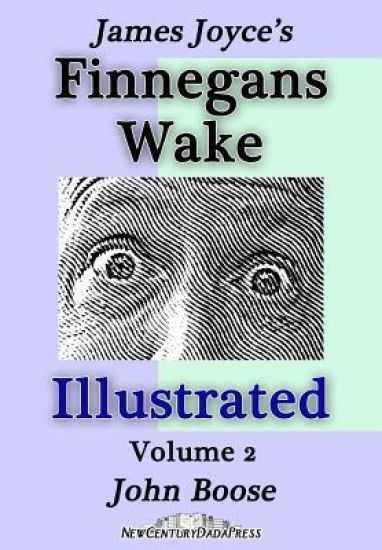
James Joyce's Finnegans Wake Illustrated: Volume 2

James Joyce's Finnegans Wake Illustrated: Volume 2

John H. Boose

Createspace Independent Publishing Platform
2014
nidottu
Some scholars see James Joyce's Finnegans Wake as a work of satire and irony; others see it as a playground for the English language. Its release into the public domain in many parts of the world enabled the production of this illustrated Volume. Finnegans Wake endures the reputation of being one of the most challenging works of fiction in the English language. When asked what he made of it, Ezra Pound contended, "Nothing so far as I make out, nothing short of divine vision or a new cure for the clap can possibly be worth all the circumambient peripherization." Oliver Gogarty believed it was "the most colossal leg pull in literature since Macpherson's Ossian." But if a picture can clarify a thousand words, then perhaps pictures can help illuminate Joyce's masterpiece. Finnegans Wake includes 219,035 words. At one picture per one thousand words, it would take only 220 pictures to fully explain the entire text. This illustrated book, Volume 2, contains Finnegans Wake Book 1, Chapters 3 through 7, with 53,565 words. With the addition of 295 illustrations, you can see that these five chapters are explained awfully thoroughly, with an over-explanation ratio of more than 5:1. So quickly can confusing things come to brightness. All the illustrations are authentic and promote the tradition of prickly debate started with the publication of Joyce's original book. As critic Ira Gurgitate proclaims, "It's a real piece of work." What They're Saying About Finnegans Wake Illustrated: "These illustrations look like I need a drink." - Rhoda Booke, Loose Change Quaarterly. "This is the best e-book I've ever read." - Benjamin Franklin, Poor Gomer's Almanac. "This is the perfect mixture of an unreadable book and 21st Century Dada." - Sheila Takya, The Paid Endorser. "So many pictures, so little art." - Amelia Barfup, The Hourly World News. "Even the worst book has an end." - Ira Gurgitate, The Pittsburgh Drifter. "What have I done to deserve this? Why was I born? Why am I living?" - Trudy Ages, The Trivial Messenger. "Even worse than I expected, which is saying something." - Rhoda Mule, KRUD Radio. "...Jeeves... Wooster... pictures... classic... cocktail time..." - Mike Easter, The Hard Times. "This book made me physically ill, even worse than Boose's other illustrated classics." - Myra Mains "If Boose isn't America's leading classics illustrator, I can see why." - Isabelle Ringing, The Illiterary Journal. "It's like attending a wake for someone who died decades ago, then being served Champagne that's been sitting open all that time." - Lucinda Head. "Boose is an unbelievable illustrator." - F. Stop Fitzgerald, Dept. of Fine Arts, Florida University. "Finnegans Wake Illustrated has the look and pacing of a two-camera sitcom filmed by a bunch of eighth graders and conceived by their less bright classmates." - Helen Wheels. "I'd rather be drinking." - Tyrone Shoelaces, The Daily Bungle. "Finnegans Wake Illustrated is rated PG-13 (Parents strongly cautioned). It will make your children stupid." - Curt Reply, The Hard Times. "...so indescribably bad that I do not intend to waste anyone's time by describing it." - Segovia Carpet. "This Dada book is truly a modern surreal experience." - Salvador Doily. "With the addition of all the pictures, it's now much funnier than any of my plays." - William Shakespeare, Spinning in his grave. "It is very strange. This Mr. Bunbury seems to suffer from curiously bad health." - Oscar Wilde. "...your pristopher polombos, hence our Kat Kresbyterians; the curt witty wotty dashes never quite just right at the trim trite truth letter... look at this prepronominal funferal, engraved and retouched and edgewiped and puddenpadded, very like a whale's egg farced with pemmican..." - James Joyce.
James Joyce - Collected Poems

James Joyce - Collected Poems

James Joyce

READ BOOKS
2016
sidottu
This book contains the collected poetry of James Joyce. It includes 'Chamber Music', 'Pomes Penyeach', and 'Ecce Puer'. James Joyce was born in Dublin, Ireland in 1882 and is considered to be one of the most influential writers in the modernist avant-garde of the early 20th century. He published his first short story in 1904 and wrote many poems and novels including A Portrait of the Artist as a Young Man (1914), Ulysses (1922), and Finnegans Wake in 1939. This book is a perfect addition to the bookshelf of those who admire James Joyce and collect his works.
A Portrait of the Artist as a Young Man James Joyce

A Portrait of the Artist as a Young Man James Joyce

James Joyce

Createspace Independent Publishing Platform
2017
nidottu
A Portrait of the Artist as a Young Man is a semi-autobiographical novel by James Joyce, first serialized in The Egoist from 1914 to 1915 and published in book form in 1916. It depicts the formative years in the life of Stephen Dedalus, a fictional alter ego of Joyce and a pointed allusion to the consummate craftsman of Greek mythology, Daedalus. A Portrait is a key example of the K nstlerroman (an artist's bildungsroman) in English literature. Joyce's novel traces the intellectual and religio-philosophical awakening of young Stephen Dedalus as he begins to question and rebel against the Catholic and Irish conventions he has been brought up in. He finally leaves for Paris to pursue his calling as an artist. The work pioneers some of Joyce's modernist techniques that would later come to fruition in Ulysses and Finnegans Wake. The Modern Library ranked Portrait as the third greatest English-language novel of the twentieth century.
A Portrait of the Artist as a Young Man (1916). By: James Joyce: "A Portrait of the Artist as a Young Man is a coming of age tale by James Joyce, firs
A Portrait of the Artist as a Young Man is the first novel of Irish writer James Joyce. A K nstlerroman in a modernist style, it traces the religious and intellectual awakening of young Stephen Dedalus, a fictional alter ego of Joyce and an allusion to Daedalus, the consummate craftsman of Greek mythology. Stephen questions and rebels against the Catholic and Irish conventions under which he has grown, culminating in his self-exile from Ireland to Europe. The work uses techniques that Joyce developed more fully in Ulysses (1922) and Finnegans Wake (1939). A Portrait began life in 1903 as Stephen Hero-a projected 63-chapter autobiographical novel in a realistic style. After 25 chapters, Joyce abandoned Stephen Hero in 1907 and set to reworking its themes and protagonist into a condensed five-chapter novel, dispensing with strict realism and making extensive use of free indirect speech that allows the reader to peer into Stephen's developing consciousness. American modernist poet Ezra Pound had the novel serialised in the English literary magazine The Egoist in 1914 and 1915, and published as a book in 1916 by B. W. Huebsch of New York. The publication of A Portrait and the short story collection Dubliners (1914) earned Joyce a place at the forefront of literary modernism.In 1998, the Modern Library named the novel third on its list of the 100 best English-language novels of the 20th century.Stephen Dedalus - The main character of A Portrait of the Artist as a Young Man. Growing up, Stephen goes through long phases of hedonism and deep religiosity. He eventually adopts a philosophy of aestheticism, greatly valuing beauty and art. Stephen is essentially Joyce's alter ego, and many of the events of Stephen's life mirror events from Joyce's own youth.His surname is taken from the ancient Greek mythical figure Daedalus, who also engaged in a struggle for autonomy. Simon Dedalus - Stephen's father, an impoverished former medical student with a strong sense of Irish nationalism. Sentimental about his past, Simon Dedalus frequently reminisces about his youth.Loosely based on Joyce's own father and their relationship. Mary Dedalus - Stephen's mother who is very religious and often argues with Stephen about attending services. Emma Clery - Stephen's beloved, the young girl to whom he is fiercely attracted over the course of many years. Stephen constructs Emma as an ideal of femininity, even though (or because) he does not know her well. Charles Stewart Parnell - An Irish political leader who is not an actual character in the novel, but whose death influences many of its characters. Parnell had powerfully led the Irish Parliamentary Party until he was driven out of public life after his affair with a married woman was exposed. Cranly - Stephen's best friend at university, in whom he confides some of his thoughts and feelings. In this sense Cranly represents a secular confessor for Stephen. Eventually Cranly begins to encourage Stephen to conform to the wishes of his family and to try harder to fit in with his peers, advice that Stephen fiercely resents. Towards the conclusion of the novel he bears witness to Stephen's exposition of his aesthetic philosophy. It is partly due to Cranly that Stephen decides to leave, after witnessing Cranly's budding (and reciprocated) romantic interest in Emma. Dante (Mrs. Riordan) - The governess of the Dedalus children. She is very intense and a dedicated Catholic. Lynch - Stephen's friend from university who has a rather dry personality...... James Augustine Aloysius Joyce (2 February 1882 - 13 January 1941) was an Irish novelist, short story writer, and poet. He contributed to the modernist avant-garde and is regarded as one of the most influential and important authors of the 20th century.....
Exiles: a play in three acts. By: James Joyce: Exiles is James Joyce's only extant play and draws on the story of "The Dead",
Exiles is James Joyce's only extant play and draws on the story of "The Dead", the final short story in Joyce's story collection Dubliners. The play was rejected by W. B. Yeats for production by the Abbey Theatre. Its first major London performance was in 1970, when Harold Pinter directed it at the Mermaid Theatre. In terms of both its critical and popular reception, Exiles has proven the least successful of all of Joyce's published works. In making his case for the defence of the play, Padraic Colum conceded: "...critics have recorded their feeling that Exiles] has not the enchantment of Portrait of the Artist nor the richness of Ulysses]... They have noted that Exiles has the shape of an Ibsen play and have discounted it as being the derivative work of a young admirer of the great Scandinavian dramatist."Summary: Joyce himself described the structure of the play as "three cat and mouse acts". The play follows four players and two couples, Richard Rowan, a writer and his "common-law wife"Bertha, and Robert Hand with his cousin and previous lover Beatrice, both old friends of the previous couple. "The plot is deceptively simple: Richard, a writer, returns to Ireland from Rome with Bertha, the mother of his illegitimate son, Archie. While there, he meets his former lover and correspondent Beatrice Justice and former drinking partner and now successful journalist Robert Hand. Robert was also Beatrice's lover, and here the complications begin." 2] As jealousy develops throughout the relationships the action meditates mostly in a budding relationship between Hand and Bertha and thus in Hand's attempts at seduction with the lover of his friend. The first act takes place at Rowan's house where Hand makes his first advance at Bertha. After kissing her "with passion" several times Hand requests she join him in his home for a second meeting later that evening. Bertha in turn confides in Rowan and questions whether or not to accept his invitation. To this, Rowan retorts she must do whatever she pleases. In the second act, Hand waits, expecting Bertha at the appointed hour but instead is surprised when Rowan appears. Calmly, Rowan explains his knowledge of Hand's attempts at wooing Bertha but is interrupted when Bertha herself knocks at the door. Rowan returns home, leaving his wife alone with Hand who continues his advances toward Bertha. The act ends inconclusively, with Hand asking if Bertha loves him, and Bertha explaining: "I like you, Robert. I think you are good... Are you satisfied?" The third act returns to Rowan's home at seven o'clock the following morning. Bertha's maid informs her of Rowan's departure from the home an hour earlier, as he left for a walk on the strand. Printed in the morning newspapers is a favourable article written about Rowan, written the previous evening by Hand himself. The events of the previous night between Bertha and Hand are unclear, as both parties agree it was a "dream." But appearances demonstrate Hand and Bertha shared "a sacred night of love." Hand reports to Rowan, assuring him Bertha in fact did not stay the night but instead Hand spent the night alone. Claiming to have visited the Vice-Chancellor's lodge, returned home to write the newspaper article, then gone to a nightclub where he picked up a divorc e and had sex with her ("what the subtle Duns Scotus calls a death of the spirit took place") in the cab on the way home. Following this conversation, Hand leaves his cousin's house in Surrey while Rowan and Bertha are reconciled. Bertha admits that she longs to meet her lover, but asserts that the lover is Rowan himself.The resolution of the play lies precisely in the sense of doubt about what occurred between Hand and Bertha between Acts Two and Three. Rowan is wounded by the sense of doubt that he admits he longed for.... James Augustine Aloysius Joyce (2 February 1882 - 13 January 1941) was an Irish novelist, short story writer, and poet.
James Joyce in 90 Minutes

James Joyce in 90 Minutes

Paul Strathern

Ivan R Dee, Inc
2005
sidottu
Building on his enormously successful series of Philosophers in 90 Minutes, Paul Strathern now applies his witty and incisive prose to brief biographical studies of the world's great writers. He brings their lives and ideas to life in entertaining and accessible fashion. Far from being a novelty, each book is a highly refined appraisal of the writer and his work, authoritative and clearly presented.
James Joyce

James Joyce

Alfonso Zapico

Arcade Publishing
2016
sidottu
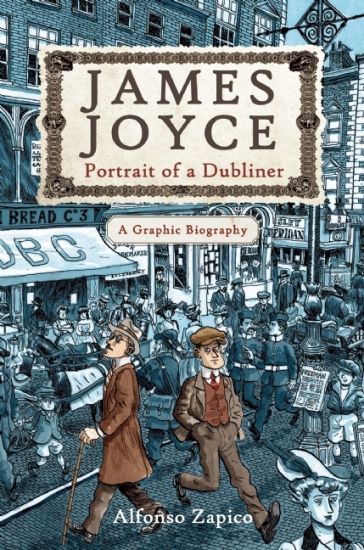
A dazzling, prize-winning graphic biography of one of the world's most revered writers. Winner of Spain's National Comic Prize and published to acclaim in Ireland, here is an extraordinary graphic biography of James Joyce that offers a fresh take on his tumultuous life. With evocative anecdotes and hundreds of ink-wash drawings, Alfonso Zapico invites the reader to share Joyce's journey, from his earliest days in Dublin to his life with his great love, Nora Barnacle, and their children, and his struggles and triumphs as an artist. Joyce experienced poverty, rejection, censorship, charges of blasphemy and obscenity, war, and crippling ill-health. A rebel and nonconformist in Dublin and a harsh critic of Irish society, he left Ireland in self-imposed exile with Nora, moving to Paris, Pola, Trieste, Rome, London, and finally Zurich. He overcame monumental challenges in creating and publishing Dubliners, Portrait of an Artist as a Young Man, Ulysses, and Finnegan's Wake. Along the way, he encountered a colorful cast of characters, from the Irish nationalists Charles Parnell and Michael Collins to literary greats Yeats, Proust, Hemingway, and Beckett, and the likes of Carl Jung and Vladimir Lenin.
From Joyce to Grace

From Joyce to Grace

Grace Neils Woodbridge

Writers Apex
2021
pokkari
God can transform a life from nothing and make something beautiful out of it. My childhood life was hopeless. I didn't stand a chance to survive life and be an adult. I had no hope. I didn't know what it was like to have hope. I was tossed back and forth living from one family member to another. Then I grew to be a teenager, and at fifteen years old, I was raped, and my future was taken from me by rape, and I got pregnant and gave birth to a child. I was a mother before I became an adult. I had no experience about life, and there seem to be no future. Then I had a relationship and lived in a battered relationship. One day, I was told by my abuser, "You think you're Jesus Christ? You're so goody-goody." I don't know why he said that. I retaliate back verbally but not physically. We were married by this time, and there were three children in the marriage, and although he didn't beat the children, they were there to witness the abuse. I stayed in the marital abuse to protect my children from not having a home with a mom and dad. Because I wasn't raised in a home with a mom and dad, I wanted that for my children. Then it came a time because of the beatings, I could no longer stay in the marriage. The beating became severe, and I had to make a choice. If I stayed in the marriage to protect my children so that they can have a home with a mom and dad like I didn't have, there would have been only a dad because I wanted to die. I didn't want to live anymore. My life was being beaten out of me.One day, after I was beaten so badly, my eyes swollen and my head swollen, I lay on the floor, and I cried out to God, "If this is what life is, I don't want to live anymore take me. I want to die " Then quietly within me, I heard, "It doesn't have to be that way. Leave." I didn't think before that I could leave permanently because I left once with the children, and he came and took us back, but God gave me the strength that I needed, and He directed me how to escape, and I was set free from marital abuse, and through God's grace, He made something beautiful out of me, and my life was transformed from nothing to something good. I will always give God the praise for His goodness, His mercy, and His grace to (me) Grace all the days of my life