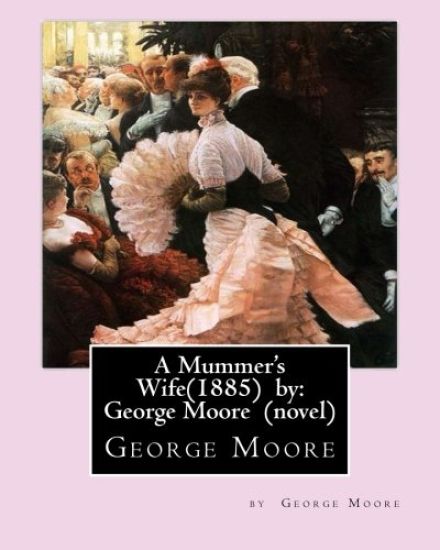
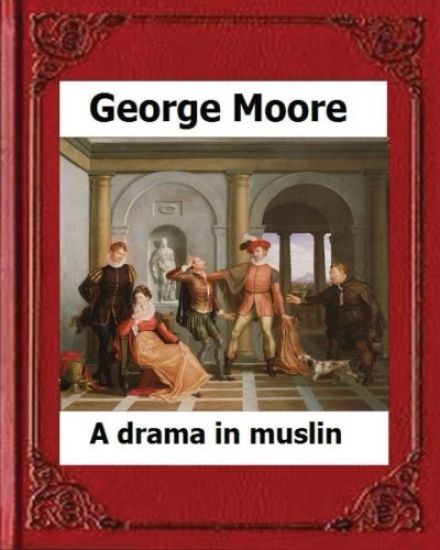
George Augustus Moore (24 February 1852 - 21 January 1933) was an Irish novelist, short-story writer, poet, art critic, memoirist and dramatist. Moore came from a Roman Catholic landed family who lived at Moore Hall in Carra, County Mayo. He originally wanted to be a painter, and studied art in Paris during the 1870s. There, he befriended many of the leading French artists and writers of the day. A Mummer's Wife London is a novel George Moore was born in Moore Hall in 1852. As a child, Moore enjoyed the novels of Walter Scott, which his father read to him. 10] He spent a good deal of time outdoors with his brother, Maurice George Moore, and also became friendly with the young Willie and Oscar Wilde, who spent their summer holidays at nearby Moytura. Oscar was to later quip of Moore: "He conducts his education in public". His father had again turned his attention to horse breeding and in 1861 brought his champion horse, Croagh Patrick, to England for a successful racing season, together with his wife and nine-year-old son. For a while George was left at Cliff's stables until his father decided to send George to his alma mater facilitated by his winnings. Moore's formal education started at St. Mary's College, Oscott, a Catholic boarding school near Birmingham where he was the youngest of 150 boys. He spent all of 1864 at home, having contracted a lung infection brought about by a breakdown in his health. His academic performance was poor while he was hungry and unhappy. In January 1865, he returned to St. Mary's College with his brother Maurice, where he refused to study as instructed and spent time reading novels and poems.That December the principal, Spencer Northcote, wrote a report that: "he hardly knew what to say about George." By the summer of 1867 he was expelled, for (in his own words) 'idleness and general worthlessness', and returned to Mayo. His father once remarked, about George and his brother Maurice: "I fear those two redheaded boys are stupid", an observation which proved untrue for all four boys
The Battle of Corunna (or A Coru a, La Corunna, La Coru a, Elvi a or La Corogne) took place on 16 January 1809, when a French corps under Marshal of the Empire Nicolas Jean de Dieu Soult attacked a British army under Lieutenant-General Sir John Moore. The battle took place amidst the Peninsular War, which was a part of the wider Napoleonic Wars. It was a result of a French campaign, led by Napoleon, which had defeated the Spanish armies and caused the British army to withdraw to the coast following an unsuccessful attempt by Moore to attack Soult's corps and divert the French army. Doggedly pursued by the French under Soult, the British made a retreat across northern Spain while their rearguard fought off repeated French attacks. Both armies suffered extremely from the harsh winter conditions. Much of the British army, excluding the elite Light Brigade under Robert Craufurd, suffered from a loss of order and discipline during the retreat. When the British eventually reached the port of Corunna on the northern coast of Galicia in Spain a few days ahead of the French they found their transport ships had not arrived. The fleet arrived after a couple of days and the British were in the midst of embarking when the French forces marched up and forced the British to fight a battle before they could depart for England.In the resulting action, the British repulsed the French assault and completed their embarkation, saving their army from destruction but leaving the port cities of Corunna and Ferrol, as well as northern Spain, to be captured and occupied by the French. During the battle, Sir John Moore, the British commander, was mortally wounded, dying after hearing all the French attacks had been repulsed.... Walter Stanley Paget (1863-1935), the youngest and perhaps the least artistically talented of the three Paget brothers, held a gold medal from the Royal Academy of Art, and, like his brothers, illustrated books and magazines in late nineteenth-century and early twentieth-century London, signing himself as "Wal Paget": ...... George Alfred Henty (8 December 1832 - 16 November 1902) was a prolific English novelist and war correspondent.He is best known for his historical adventure stories that were popular in the late 19th century. His works include The Dragon & The Raven (1886), For The Temple (1888), Under Drake's Flag (1883) and In Freedom's Cause (1885).Biography--G.A.Henty was born in Trumpington, near Cambridge. He was a sickly child who had to spend long periods in bed. During his frequent illnesses he became an avid reader and developed a wide range of interests which he carried into adulthood. He attended Westminster School, London, and later Gonville and Caius College, Cambridge, where he was a keen sportsman. He left the university early without completing his degree to volunteer for the Army Hospital Commissariat when the Crimean War began. He was sent to the Crimea and while there he witnessed the appalling conditions under which the British soldier had to fight. His letters home were filled with vivid descriptions of what he saw. His father was impressed by his letters and sent them to The Morning Advertiser newspaper which printed them. This initial writing success was a factor in Henty's later decision to accept the offer to become a special correspondent, the early name for journalists now better known as war correspondents. Shortly before resigning from the army as a captain in 1859 he married Elizabeth Finucane. The couple had four children. Elizabeth died in 1865 after a long illness and shortly after her death Henty began writing articles for the Standard newspaper. In 1866 the newspaper sent him as their special correspondent to report on the Austro-Italian War where he met Giuseppe Garibaldi.....
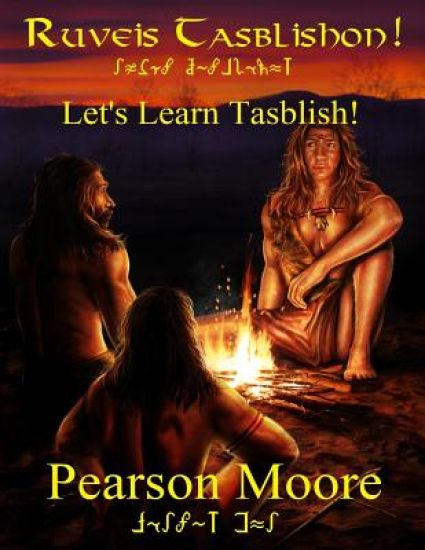
Let's Learn Tasblish Ruveis Tasblishon An Introduction to the Blishno Fitan Dialect of the Tasblish Conlang Developed by Pearson Moore The Clan is the all. Welcome to the Tasfit culture of Central Europe, 43,000 BCE. In Ruveis Tasblishon you will learn a language in which the ideas 'I' and 'you' do not exist. The clan is the all. Proximity to the hearth--the Glitfal Bestan--determines the personal and social standing of everyone in the world. Immersing yourself in an ancient Neandertal society, you will learn new ways of thinking about yourself, your companions, and the world around you. The Tasblish language is unlike any tongue you have ever spoken or even heard about. Everyone refers to herself in the third person, for there are no first person ('I') or second person ('you') forms in the grammar, and no one in any Tasfit clan or tribe understands the concept of 'I' or 'you'. The clan is the beginning, the end, and the focus of every thought and breath. In Ruveis Tasblishon you will discover new ways of considering personal, social, and geographic proximity to friends, acquaintances, and strangers. Nouns and verbs are not declined and conjugated as in most European languages. Rather, most words are proxigated--that is, they are modified according to the emotional, cultural, and physical proximity of the people or ideas they represent to the Glitfal Bestan, the Clan Hearth. Conlangers will find in these pages radical ways of thinking about the nature of language and its structure. The proxigation-based grammar allows nuanced and elegant communication about emotions and feelings, and establishes interpersonal relationship as the supreme determinant of linguistic meaning. Tasblish is central to the Tasfit Neandertal culture developed in Fire Wolf and Scimitar and in the science fiction world of Deneb, Pearson Moore's epic tale of culture clash set in multiple timelines from 43,000 BCE to 3000 AD. Few modern novels can claim such a fascinating and multi-dimensional backdrop, including a full 7800-word conlang, diverse prehistoric cultures spanning an entire continent, and social interaction unlike anything described in scientific or fictional literature. Lose yourself in a compelling, fascinating, utterly unique world. Ruveis Tasblishon Let's Learn Tasblish contains tasteful nude drawings and photographs, including original illustrations by the author as well as 19th century and early 20th century works.
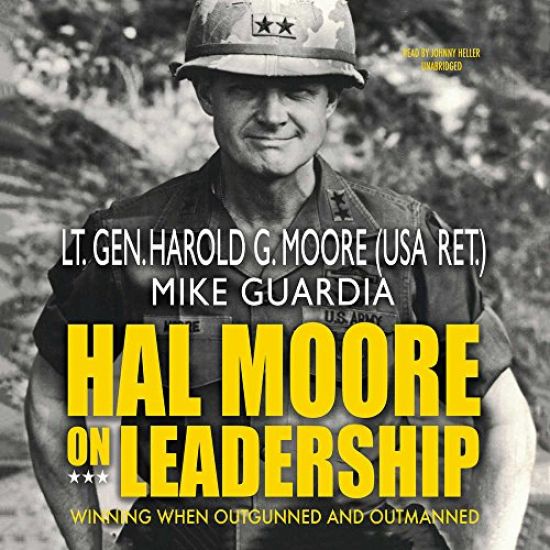
Hal Moore led his life by a set of principles--a code developed through years of experience, trial-and-error, and the study of leaders of every stripe. In a career spanning more than thirty years, Moore's life touched upon many historical events: the Occupation of Japan, the Korean War, Vietnam, and the refashioning of the US Army into an all-volunteer force. At each juncture, he learned critical lessons and had opportunities to affect change through measured responses. Hal Moore on Leadership offers a comprehensive guide to the principles that helped shape Moore's success both on and off the battlefield. They are strategies for the outnumbered, outgunned, and seemingly hopeless. They apply to any leader in any organization--business or military. These lessons and principles are nothing theoretical or scientific. They are simply rules of thumb learned and practiced by a man who spent his entire adult life leading others and perfecting his art of leadership.
George Augustus Moore (24 February 1852 - 21 January 1933) was an Irish novelist, short-story writer, poet, art critic, memoirist and dramatist. Moore came from a Roman Catholic landed family who lived at Moore Hall in Carra, County Mayo.He originally wanted to be a painter, and studied art in Paris during the 1870s. There, he befriended many of the leading French artists and writers of the day. As a naturalistic writer, he was amongst the first English-language authors to absorb the lessons of the French realists, and was particularly influenced by the works of mile Zola.His writings influenced James Joyce, according to the literary critic and biographer Richard Ellmann, and, although Moore's work is sometimes seen as outside the mainstream of both Irish and British literature, he is as often regarded as the first great modern Irish novelist. Moore returned to London in 1911, where, with the exception of frequent trips to France, he was to spend much of the rest of his life. In 1913, he traveled to Jerusalem to research for his next novel, The Brook Kerith (1916). The book saw Moore once again embroiled in controversy, as it was based on the supposition that a non-divine Christ did not die on the cross but instead was nursed back to health.Other books from this period include a further collection of short-stories called A Storyteller's Holiday (1918), a collection of essays called Conversations in Ebury Street (1924) and a play, The Making of an Immortal (1927). Moore also spent considerable time revising and preparing his earlier writings for new editions. Partly due to Maurice's pro-treaty activity, Moore Hall was burnt by anti-treaty forces in 1923, during the final months of the Irish Civil War.Moore eventually received compensation of 7,000 from the government of the Irish Free State. By this time George and Maurice had become estranged, mainly because of an unflattering portrait of the latter which appeared in Hail and Farewell. Tension also arose as a result of religious differences: Maurice frequently made donations to the Roman Catholic Church from estate funds.Moore later sold a large part of the estate to the Irish Land Commission for 25,000. Moore was friendly with many members of the expatriate artistic communities in London and Paris, and had a long-lasting relationship with Maud, Lady Cunard. Moore took a special interest in the education of Maud's daughter, the well-known publisher and art patron, Nancy Cunard.It has been suggested that Moore, rather than Maud's husband, Sir Bache Cunard, was Nancy's father, but this is not generally credited by historians, and it is not certain that Moore's relationship with Nancy's mother was ever more than platonic.Moore was believed by some to be impotent and was described as "one who told but didn't kiss". Moore's last novel, Aphroditis in Aulis, was published in 1930. He died at his home at Ebury Street in the London district of Belgravia in early 1933, leaving a fortune of 70,000. He was cremated in London at a service attended by Ramsay MacDonald among others. An urn containing his ashes was interred on Castle Island in Lough Carra in view of the ruins of Moore Hall..