Kirjojen hintavertailu. Mukana 12 016 292 kirjaa ja 12 kauppaa.

Kirjahaku

Etsi kirjoja tekijän nimen, kirjan nimen tai ISBN:n perusteella.

1000 tulosta hakusanalla R. Edwards

The Learning Factory

The Learning Factory

Edward R. Alef

University Press of America
1996
nidottu
In this book, the authors equate the university to a factory that takes raw material and adds value to output a finished product desired by corporations to buy at some competitive price. The Learning Factory applies the latest management theories to running a university like a company that must make a "profit" to survive. Contents: Preface; The Learning Factory in the Continuing Education Learning Market; The Players, the Playing Field, and the Rules of the Game; The Value of the Value Chain; The Learning Factory Products and Processes— Design, Development, and Market Implementation; Academic Quality Management in the Learning Factory; The Strategic Planning Process—A Formula for Winning; Executive Summary; Acknowledgments.

Shirley Temple Dolls and Fashions

Shirley Temple Dolls and Fashions

Edward R. Pardella

Schiffer Publishing Ltd
1999
nidottu
Shirley Temple remains the best-known child Hollywood movie star of all time and the Shirley Temple Doll(still being manufactured today) continues to be the champion of the doll industry. Since 1934, when the doll was first created, variations of the Shirley doll and associated collectibles have been avidly collected along with hundreds of costumes inspired by Shirley's roles in 57 films between 1931 and 1949. In this book, 350 beautiful color photographs present a nostalgic gallery along with original doll advertising and publicity shots from the movies. The author displays, organizes, and explains all the dolls and known costumes up to the present, and many collectibles related to them. His chronology of Shirley Temple's motion pictures, including the title, studio, date, running time, director and cast of each, is an important reference. Three generations of movie buffs, doll collectors, and vintage fashion enthusiasts alike, who have made the Shirley Temple Doll an American classic, will need to own this new book.
Random Processes for Image Signal Processing

Random Processes for Image Signal Processing

Edward R. Dougherty

IEEE Publications,U.S.
1998
sidottu
Random Processes for Image and Signal Processing Edward R. Dougherty Second in the SPIE/IEEE Series on Imaging Science & Engineering Science and engineering deal with temporal, spatial, and higher-dimensional processes that vary randomly from observation to observation. Deterministic analysis does not provide a framework for understanding the ensemble of observations, nor does it provide a mechanism for predicting future events. Random processes provide the tools to bridge these gaps. Readers of this book will gain an intuitive appreciation of random functions, in addition to understanding theory and processes necessary for sophisticated applications. The initial chapter covers basic theory of probability, with special attention to multivariate distributions and functions of several random variables. Subsequent topics include the basic properties of random functions, canonical representation, transform coding, optimal filter design (linear and nonlinear), neural networks, discrete- and continuous-time Markov chains, and the theory of random closed sets. This book can be used as a one-semester course for students with a strong background in probability and statistics or as a full-year course for students who lack such preparation. The large number of imaging applications also makes it useful for graduate courses on image processing. Contents: Probability theory. Random processes. Canonical representation. Optimal filtering. Random models. Bibliography. Index.
Nonlinear Filters for Image Processing

Nonlinear Filters for Image Processing

Edward R. Dougherty; Jaakko Astola

IEEE Publications,U.S.
1999
sidottu
Nonlinear Filters for Image Processing Editors: Edward R. Dougherty, Texas A&M University Jaakko T. Astola, Tampere University of Technology Part of the SPIE/IEEE Series on Imaging Science & Engineering This text covers key mathematical principles and algorithms for nonlinear filters used in image processing. Readers will gain an in-depth understanding of the underlying mathematical and filter design methodologies needed to construct and utilize nonlinear filters in a variety of applications. The 11 chapters, written by experts in the field, explore topics of contemporary interest as well as fundamentals drawn from nonlinear filtering’s historical roots in mathematical morphology and digital signal processing. Linear filtering has dominated image processing, partly because the mathematical analysis is much easier than for nonlinear operators. However, nonlinear filters often yield superior results. This book explains in depth various filter options and the types of applications for which they are best suited. The presentation is rigorous, yet accessible to engineers with a solid background in mathematics. Contents: Logical image operators (E. R. Dougherty, J. Barrera). Computational gray-scale operators (E. R. Dougherty, J. Barrera). Translation-invariant set operators (E. R. Dougherty). Granulometric filters (E.R. Dougherty, Y. Chen). Easy recipes for morphological filters (H. J. A. M. Heijmans). Introduction to connected operators (H. J. A. M. Heijmans). Representation and optimization of stack filters (J. T. Astola, P. Kuosmanen). Invariant signals of median and stack filters (J. T. Astola, P. Kuosmanen). Binary polynomial transforms and logical correlation (K. O. Egiazarian, J. T. Astola, S. S. Agaian). Applications of binary polynomial transforms (K. O. Egiazarian, J. T. Astola, S. S. Agaian, R. Öktem). Random sets in view of image filtering applications (I. S. Molchanov).
Spirituality in Social Work

Spirituality in Social Work

Edward R Canda

Routledge Member of the Taylor and Francis Group
1998
sidottu
As Spirituality in Social Work: New Directions shows you, there has been an increase of interest among social workers concerning spiritual matters. In response to this collective interest, Edward Canda and several other members of the Society for Spirituality and Social Work have compiled a thorough and timely compendium of social work research, theory, and practice. Their book will guide you in your efforts to meet the needs of your families and clients while still remaining educated and respectful of the many religous and nonreligious views different people have.In Spirituality in Social Work, you'll get an update on the current state of spirituality, social work scholarship, and education. From there, you'll move on to current appraisals of the many specialized ways social work educators are teaching spirituality in MSW programs, and you'll ultimately come full circle to a fuller understanding of the many ways social work and spirituality complement and inform each other in the classroom as well as in the field of practice. Most importantly, you'll get specific guidance on these topics:how to enhance the intuition of social workers when to apply the Transegoic model to a dying adolescent where to engage in conceptions of spirituality in social work literature what Taoist insights can do to enhance social work practice how social work can prosper in future efforts to link spirituality and social workIn many ways, Spirituality in Social Work is a spiritual awakening in its own right--for social workers, for individuals, and for communities at large. The demand for social work practitioners, educators, and community officials to be cross-trained in spirituality and social work is on the rise. So, if you're struggling to find new ways to deal with the ever-increasing and ever-diversifying demand for spiritual training in your particular social work setting, pick up this insightful edition and find new hope and direction in the many different ways that social work and spirituality can work together for you.
Transpersonal Perspectives on Spirituality in Social Work

Transpersonal Perspectives on Spirituality in Social Work

Edward R Canda; Elizabeth D Smith

Routledge Member of the Taylor and Francis Group
2001
sidottu
Use these ideas in your social work practice to help the whole person--including your client's spiritual side!Transpersonal Perspectives on Spirituality in Social Work brings to light the fact that spiritual well-being is an essential part of the health of every individual. It will show you how to facilitate and encourage growth in the transpersonal dimension for your clients and help you to address the full range of human potential--from material and psychological well-being to spiritual fulfillment.Beginning with conceptual and theoretical frameworks for understanding transpersonal theory, Transpersonal Perspectives on Spirituality in Social Work goes on to deliver empirical and clinical studies that center on true-life experiences and their social work practice implications. In this well-researched book you will find: a comparative analysis of various models of spirituality and spiritual development a study of chronically ill adults that shows how people can draw upon transpersonal experiences and beliefs to increase their resiliency suggestions for alleviating death-related anxiety with a transpersonal/social constructionist approach theoretical, empirical, and practical insights into transpersonally oriented hospice work a model for transpersonal couples work that promotes compatibility and intimacy ways to differentiate between delusions, hallucinations, and real spiritual breakthroughs an examination of the different styles of spirituality of African Americans and European Americans and how they relate to the expression of violenceIn this well-referenced volume, practical techniques and suggestions combine with ways to work for justice and empowerment for marginalized and oppressed populations as well as insights about the fundamental connectedness between people and nature. Helpful diagrams, charts, and tables make the information user-friendly. Transpersonal Perspectives on Spirituality in Social Work will help you expand the horizons of your practice and provide more effective services to your clients.
Transpersonal Perspectives on Spirituality in Social Work

Transpersonal Perspectives on Spirituality in Social Work

Edward R Canda; Elizabeth D Smith

Routledge Member of the Taylor and Francis Group
2001
nidottu
Use these ideas in your social work practice to help the whole person--including your client's spiritual side!Transpersonal Perspectives on Spirituality in Social Work brings to light the fact that spiritual well-being is an essential part of the health of every individual. It will show you how to facilitate and encourage growth in the transpersonal dimension for your clients and help you to address the full range of human potential--from material and psychological well-being to spiritual fulfillment.Beginning with conceptual and theoretical frameworks for understanding transpersonal theory, Transpersonal Perspectives on Spirituality in Social Work goes on to deliver empirical and clinical studies that center on true-life experiences and their social work practice implications. In this well-researched book you will find: a comparative analysis of various models of spirituality and spiritual development a study of chronically ill adults that shows how people can draw upon transpersonal experiences and beliefs to increase their resiliency suggestions for alleviating death-related anxiety with a transpersonal/social constructionist approach theoretical, empirical, and practical insights into transpersonally oriented hospice work a model for transpersonal couples work that promotes compatibility and intimacy ways to differentiate between delusions, hallucinations, and real spiritual breakthroughs an examination of the different styles of spirituality of African Americans and European Americans and how they relate to the expression of violenceIn this well-referenced volume, practical techniques and suggestions combine with ways to work for justice and empowerment for marginalized and oppressed populations as well as insights about the fundamental connectedness between people and nature. Helpful diagrams, charts, and tables make the information user-friendly. Transpersonal Perspectives on Spirituality in Social Work will help you expand the horizons of your practice and provide more effective services to your clients.
Presidents and Foreign Policy

Presidents and Foreign Policy

Edward R. Drachman; Alan Shank; Richard M. Pious

State University of New York Press
1997
pokkari
Examines ten important and controversial U.S. presidential foreign policy decisions in the post-World War II period, including one major controversy for each president from Truman to Clinton.Presidents and Foreign Policy examines countdowns to ten important and controversial decisions in the post-World War II period, using the case study approach. The authors include one major controversy for each president from Truman to Clinton. The cases cover central issues of diplomacy, war and peace, and covert action that shaped the Cold War period and its aftermath in all major areas of the world.After reviewing the historical background of each decision, each case examines the foreign and domestic policy context, the effectiveness of presidential decision-making, and results of the decision. The reader is challenged to think about each decision by responding to a unique evaluation scheme the authors developed and tested.
The Nature of God

The Nature of God

Edward R. Wierenga

Cornell University Press
2003
pokkari
The Nature of God explores a perennial problem in the philosophy of religion. Drawing upon developments in philosophy, most notably those in philosophical logic, Edward R. Wierenga examines the traditional divine attributes of omnipotence, omniscience, eternity, timelessness, immutability, and goodness. His philosophically defensible formulations of the nature of God are in accord with the views of classical theists. The author provides an account of each of the divine attributes by stating in contemporary terms what such classical theists as Augustine, Anselm, and Aquinas wrote about the nature of God; he then seeks to determine whether one can defend the ascription of traditional divine attributes to God against philosophical objections.Clearly written and comprehensive, The Nature of God contains a wealth of illuminating and original material on a central topic in the philosophy of religion
World in the Twentieth Century

World in the Twentieth Century

Edward R. Kantowicz

William B Eerdmans Publishing Co
1999
pokkari
Marked by two world wars, the Holocaust, and a host of violent conflicts, genocides, and violent revolutions, the twentieth century has been the most explosive and destructive in human history. As we enter the twenty-first century, it is vital that we understand what went wrong in the preceding hundred years. This book, the first of a two-volume work by historian Edward Kantowicz, provides an engaging narrative that chronicles the events, people, and ideas driving the world's social and political course in the twentieth century. The Rage of Nations covers the landmark events from 1900 through the Second World War: the Russo-Japanese War, the global repercussions of World War I, the Russian Revolution, the Great Depression, Mussolini's fascism, Hitler's nazism, Stalin's socialism, the Spanish Civil War, the China of Mao and Chiang Kai-shek, World War II, the development of the atomic bomb, and more. In addition, Kantowicz probes behind the events themselves, examining their source in the five terrible "isms" of the twentieth century-anarchism, socialism, imperialism, nationalism, and ethnocentrism.Providing compelling, often disconcerting reading, The Rage of Nations will help us make sense of what is happening in the world today by considering important lessons from our recent past.
World in the Twentieth Century

World in the Twentieth Century

Edward R. Kantowicz

William B Eerdmans Publishing Co
1999
pokkari
Marked by two world wars, the Holocaust, and a host of violent conflicts, the twentieth century has been the most explosive and destructive in human history. At the beginning of the twenty-first century, it is vital that we understand what went wrong in the preceding hundred years. Historian Edward Kantowicz provides an engaging narrative of the events, people, and ideas driving the world's social and political course in the twentieth century in his two-volume work, The World in the Twentieth Century. In Coming Apart, Coming Together, volume 2 of his narrative history of the twentieth century, Edward Kantowicz explores the landmark events that shaped the planet after World War II. Noting that this period was dominated by two global events-the superpower Cold War between the United States and the Soviet Union and the revolt against imperialism in Africa, Asia, and Latin America-Kantowicz shows how the trajectories of each have driven nations apart while, at the same time, also created political and regional alliances for bringing the world closer together.Providing compelling, often disconcerting reading, this volume helps make sense of what is happening in the world today by considering important lessons from our recent past.
Oil Security

Oil Security

Edward R. Fried; Philip H. Trezise

Brookings Institution
1993
nidottu
"Oil stands alone among primary commodities in its potential for sending economic shock waves across the world. The value of oil production is one and a half times the world's total production of food grains; demand is unresponsive to price in the short run; and the world's oil resources are heavily concentrated in the Middle East, where political disturbances have been chronic and oil supply is subject to sudden interruption. Together, these factors have made oil a virtual rogue elephant in the world economy since 1973.This book discusses the oil shocks of 1973-74, 1979-80, and the ""minishock"" of 1990-91, and examines the possibility of oil shocks over the next twenty years. The authors assess the world market outlook on the basis of underlying trends on world oil supply and demand. They take into account prospects for investment in oil production in the Persian Gulf states, the former Soviet republics, and Latin America; environmental factors and policies; and political uncertainties in the Middle East."
Introduction to Real–Time Imaging

Introduction to Real–Time Imaging

Dougherty Edward R.; Laplante Phillip A.

SPIE Press
1995
nidottu
"An invaluable source for both imaging and software engineers, this practical guide thoroughly covers information in real-time systems, imaging, optimization, algorithms and hardware for image processing. You'll gain a comprehensive knowledge of the structure, computation, and application of the fundamental algorithms necessary to get the most out of your imaging technology. Topics covered include:*Basic hardware architecture*Linear and non-linear image processing algorithms*Efficient algorithms*Optimization techniques*Programming languages*Hardware architectures*Choosing a processor, and more!"
Vision Voiced

Vision Voiced

Edward R Heidt

Peter Lang Publishing Inc
1991
sidottu
This study elaborates a detailed theory with which readers can approach their own and others' autobiographical writings. The theory focuses on the narrative voice and viewpoint of the autobiographer as factors. In the narratives of an autobiography proper, the voice is synecdochic to the extent that it separates itself as uniquely representative of the self. Whereas, in a memoir or reminiscence, the voice is metaphoric to the extent that it separates itself as multiple while in a confession or apology, the voice is metonymic to the extent that it connects multiple, conflicting selves. Varieties of writers from different periods are used to illustrate and enflesh the theory.
Buddhism and the Transformation of Old Age in Medieval Japan

Buddhism and the Transformation of Old Age in Medieval Japan

Edward R. Drott

University of Hawai'i Press
2016
sidottu
Scholars have long remarked on the frequency with which Japanese myths portrayed gods (kami) as old men or okina . Many of these ""sacred elders"" came to be featured in premodern theater, most prominently in Noh. In the closing decades of the twentieth-century, as the number of Japan's senior citizens climbed steadily, the sacred elder of premodern myth became a subject of renewed interest and was seen by some as evidence that the elderly in Japan had once been accorded a level of respect unknown in recent times. In Buddhism and the Transformation of Old Age in Medieval Japan, Edward R. Drott charts the shifting sets of meanings ascribed to old age in medieval Japan, tracing the processes by which the aged body was transformed into a symbol of otherworldly power and the cultural, political, and religious circumstances that inspired its reimagination.Drott examines how the aged body was used to conceptualize forms of difference and to convey religious meanings in a variety of texts: official chronicles, literary works, Buddhist legends and didactic tales. In early Japan, old age was most commonly seen as a mark of negative distinction, one that represented the ugliness, barrenness, and pollution against which the imperial court sought to define itself. From the late-Heian period, however, certain Buddhist authors seized upon the aged body as a symbolic medium though which to challenge traditional dichotomies between center and margin, high and low, and purity and defilement, crafting narratives that associated aged saints and avatars with the cults, lineages, sacred sites, or religious practices these authors sought to promote.Contributing to a burgeoning literature on religion and the body, Buddhism and the Transformation of Old Age in Medieval Japan applies approaches developed in gender studies to ""denaturalize"" old age as a matter of representation, identity, and performance. By tracking the ideological uses of old age in premodern Japan, this work breaks new ground, revealing the role of religion in the construction of generational categories and the ways in which religious ideas and practices can serve not only to naturalize, but also challenge ""common sense"" about the body.
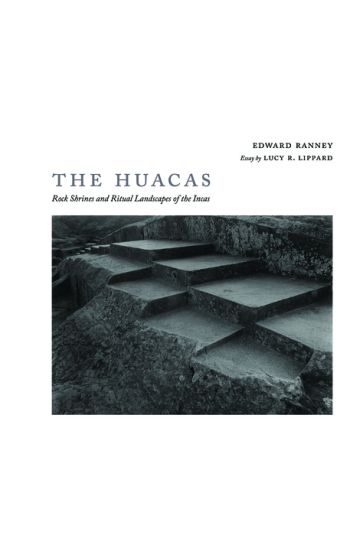
The Huacas

The Huacas

Edward R. Ranney; Lucy R. Lippard

UNIVERSITY OF NEW MEXICO PRESS
2024
sidottu
Distinguished photographer Edward Ranney presents nearly one hundred extraordinary photographs of the Peruvian huacas--the sacred rock shrines carved by Inca artisans roughly between 1440 and 1532 AD.Ranney's photographs evoke the sacred power that the highland landscape around Cuzco held for the Incas, revealing how aspects of nature such as caves and springs, in addition to rock outcrops, were integral to Inca culture and served as a focus of ritual attention. This extended to items on a more intimate scale, as with special stones or unusual landscape details. The book concludes with an extensive series of pictures featuring the shrines and landscape of Machu Picchu. In her closing essay, Lucy R. Lippard discusses the cultural context of the huacas and how contemporary research and thinking view this unique achievement of ancient America.