Kirjahaku
Etsi kirjoja tekijän nimen, kirjan nimen tai ISBN:n perusteella.
1000 tulosta hakusanalla Ray Thompson
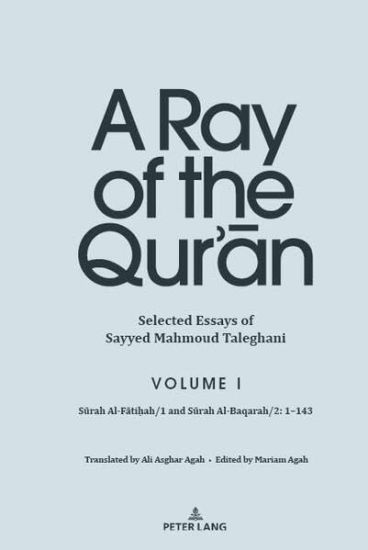
A Ray of the Qur’an: Selected Essays of Sayyed Mahmoud Taleghani, Volume I
PETER LANG PUBLISHING INC
2024
sidottu
The study and explanation of Surah Al-Fatihah and verses 1-143 of Surah Al-Baqara make up Volume I of A Ray of the Qur’an. Sayyed Mahmoud Taleghani follows the traditional ordinal presentation of these two chapters of the Qur’an. Appropriately, he begins his commentary with the first Surah: "The Opening.” He considers this Surah to be an invitation to people to recognize their creator and sustainer by knowing Allah’s attribute of mercy and as the giver of guidance to the straight path. Likewise, Taleghani invites people through another name given to this Surah, Al Hamd/The Praise, to praise their Lord exclusively. Taleghani’s approach to the Qur’an is holistic. This is evident in his reading of the initial five verses of Surah Al-Baqara as containing the foundational, pivotal notions that inform the grand ideas and the details of not only the rest of the Surah, but indeed the entire Qur’an. The word taqwa, used in Surah Al-Baqara and throughout the Qur’an, is sometimes translated as piety or fear of God but the full breadth of the term, as Taleghani shows, is better expressed in the phrase "to safeguard oneself with full awareness of divine laws." Those who show taqwa are made aware of the prophetic mission, and are assured of the hereafter if they accept and follow it in their thoughts and deeds. Thus, the reader is introduced in Surah Al-Baqara to Taleghani’s vision of the Qur’an, whereby, a ray from this book is said to touch the minds and hearts of those with taqwa and to launch them on their search for the truth. This is one way Taleghani distinguishes the Holy Qur’an from other books.
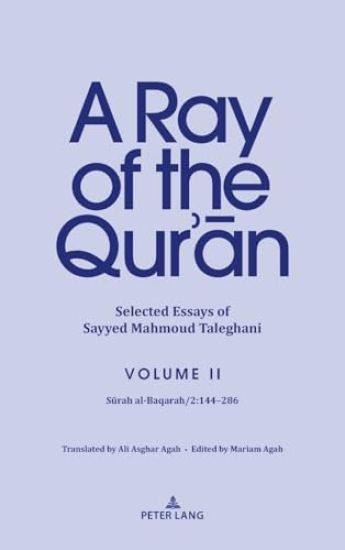
A Ray of the Qur’an: Selected Essays of Sayyed Mahmoud Taleghani, Volume II
PETER LANG PUBLISHING INC
2024
sidottu
The main theme of A Ray of the Qur’an is reflected in Sayyed Mahmoud Taleghani's unique and all-encompassing approach of using root definitions of key Qur’anic terms as the basis for his illumination of the Qur’an. Taleghani's method mirrors his thesis that drawing on the light of the Qur’an along with authentic prophetic tradition, sound theological argument, and a grasp of ethics, science, and human history reveals the observable interconnectedness in nature that exists on an individual and societal level and is constantly evolving as unified creation of one Creator. The relationship of humanity to the rest of creation as discussed in A Ray of the Qur’an elicits individual and societal human responsibility to know, care for, preserve, and promote both human society and all of nature in a just, fair, and morally balanced manner. Taleghani holds that the creator of the physical world and its human inhabitants lovingly and justly offers a blueprint and manual for action, and central to that is the Qur’an. Nonetheless, according to Taleghani’s own humble estimation, his work should not be described as an interpretation, explanation or explication but an effort to allow glimpses of divine guidance to shine on minds and hearts. A Ray of the Qur’an will shift the academic discourse around studies of Islam and the Qur’an, including within Islamic institutions. It offers a compelling and unique approach to theology, comparative religious studies, ethics, environmental studies, and Arabic studies.
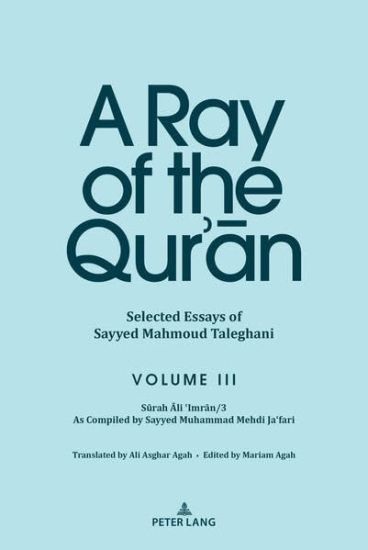
A Ray of the Qur’an: Selected Essays of Sayyed Mahmoud Taleghani, Volume III
PETER LANG PUBLISHING INC
2024
sidottu
The main theme of A Ray of the Qur’an is reflected in the author’s unique and all-encompassing approach of using root definitions of key Qur’anic terms as the basis for his illumination of the Qur’an. Talghani’s method mirrors his thesis that drawing on the light of the Qur’an along with authentic prophetic tradition, sound theological argument, and a grasp of ethics, science, and human history reveals the observable interconnectedness in nature that exists on an individual and societal level and is constantly evolving as unified creation of one Creator. The relationship of humanity to the rest of creation as discussed in A Ray of the Qur’an elicits individual and societal human responsibility to know, care for, preserve, and promote both human society and all of nature in a just, fair, and morally balanced manner. Taleghani holds that the creator of the physical world and its human inhabitants lovingly and justly offers a blueprint and manual for action, and central to that is the Qur’an. Nonetheless, according to Taleghani’s own humble estimation, his work should not be described as an interpretation, explanation or explication but an effort to allow glimpses of divine guidance to shine on minds and hearts. A Ray of the Qur’an will shift the academic discourse around studies of Islam and the Qur’an, including within Islamic institutions. It offers a compelling and unique approach to theology, comparative religious studies, ethics, environmental studies, and Arabic studies.
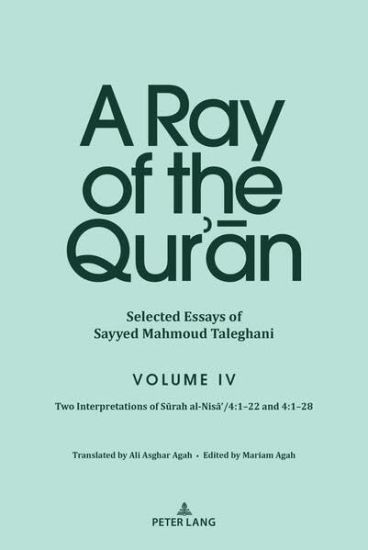
A Ray of the Qur’an: Selected Essays of Sayyed Mahmoud Taleghani, Volume IV
PETER LANG PUBLISHING INC
2024
sidottu
The main theme of A Ray of the Qur’an is reflected in the author’s unique and all-encompassing approach of using root definitions of key Qur’anic terms as the basis for his illumination of the Qur’an. Talghani’s method mirrors his thesis that drawing on the light of the Qur’an along with authentic prophetic tradition, sound theological argument, and a grasp of ethics, science, and human history reveals the observable interconnectedness in nature that exists on an individual and societal level and is constantly evolving as unified creation of one Creator. The relationship of humanity to the rest of creation as discussed in A Ray of the Qur’an elicits individual and societal human responsibility to know, care for, preserve, and promote both human society and all of nature in a just, fair, and morally balanced manner. Taleghani holds that the creator of the physical world and its human inhabitants lovingly and justly offers a blueprint and manual for action, and central to that is the Qur’an. Nonetheless, according to Taleghani’s own humble estimation, his work should not be described as an interpretation, explanation or explication but an effort to allow glimpses of divine guidance to shine on minds and hearts. A Ray of the Qur’an will shift the academic discourse around studies of Islam and the Qur’an, including within Islamic institutions. It offers a compelling and unique approach to theology, comparative religious studies, ethics, environmental studies, and Arabic studies.
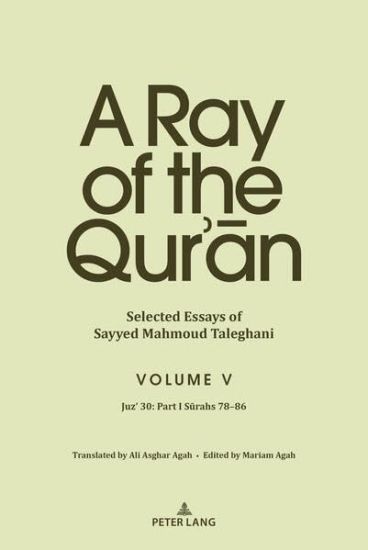
A Ray of the Qur’an: Selected Essays of Sayyed Mahmoud Taleghani, Volume V
PETER LANG PUBLISHING INC
2024
sidottu
The main theme of A Ray of the Qur’an is reflected in the author’s unique and all-encompassing approach of using root definitions of key Qur’anic terms as the basis for his illumination of the Qur’an. Taleghani’s method mirrors his thesis that drawing on the light of the Qur’an along with authentic prophetic tradition, sound theological argument, and a grasp of ethics, science, and human history reveals the observable interconnectedness in nature that exists on an individual and societal level and is constantly evolving as unified creation of one Creator. The relationship of humanity to the rest of creation as discussed in A Ray of the Qur’an elicits individual and societal human responsibility to know, care for, preserve, and promote both human society and all of nature in a just, fair, and morally balanced manner. Taleghani holds that the creator of the physical world and its human inhabitants lovingly and justly offers a blueprint and manual for action, and central to that is the Qur’an. Nonetheless, according to Taleghani’s own humble estimation, his work should not be described as an interpretation, explanation or explication but an effort to allow glimpses of divine guidance to shine on minds and hearts. A Ray of the Qur’an will shift the academic discourse around studies of Islam and the Qur’an, including within Islamic institutions. It offers a compelling and unique approach to theology, comparative religious studies, ethics, environmental studies, and Arabic studies.
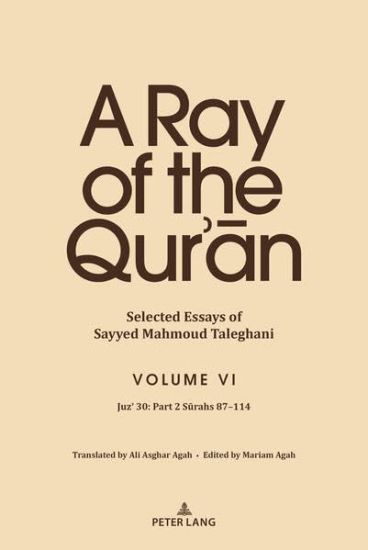
A Ray of the Qur’an: Selected Essays of Sayyed Mahmoud Taleghani, Volume VI
PETER LANG PUBLISHING INC
2024
sidottu
The main theme of A Ray of the Qur’an is reflected in the author’s unique and all-encompassing approach of using root definitions of key Qur’anic terms as the basis for his illumination of the Qur’an. Talghani’s method mirrors his thesis that drawing on the light of the Qur’an along with authentic prophetic tradition, sound theological argument, and a grasp of ethics, science, and human history reveals the observable interconnectedness in nature that exists on an individual and societal level and is constantly evolving as unified creation of one Creator. The relationship of humanity to the rest of creation as discussed in A Ray of the Qur’an elicits individual and societal human responsibility to know, care for, preserve, and promote both human society and all of nature in a just, fair, and morally balanced manner. Taleghani holds that the creator of the physical world and its human inhabitants lovingly and justly offers a blueprint and manual for action, and central to that is the Qur’an. Nonetheless, according to Taleghani’s own humble estimation, his work should not be described as an interpretation, explanation or explication but an effort to allow glimpses of divine guidance to shine on minds and hearts. A Ray of the Qur’an will shift the academic discourse around studies of Islam and the Qur’an, including within Islamic institutions. It offers a compelling and unique approach to theology, comparative religious studies, ethics, environmental studies, and Arabic studies.
A Ray of the Qur’an : Selected Essays of Sayyed Mahmoud Taleghani, Volume VII
PETER LANG PUBLISHING INC
2024
sidottu
The main theme of A Ray of the Qur’an is reflected in the author’s unique and all-encompassing approach of using root definitions of key Qur’anic terms as the basis for his illumination of the Qur’an. Talghani’s method mirrors his thesis that drawing on the light of the Qur’an along with authentic prophetic tradition, sound theological argument, and a grasp of ethics, science, and human history reveals the observable interconnectedness in nature that exists on an individual and societal level and is constantly evolving as unified creation of one Creator. The relationship of humanity to the rest of creation as discussed in A Ray of the Qur’an elicits individual and societal human responsibility to know, care for, preserve, and promote both human society and all of nature in a just, fair, and morally balanced manner. Taleghani holds that the creator of the physical world and its human inhabitants lovingly and justly offers a blueprint and manual for action, and central to that is the Qur’an. Nonetheless, according to Taleghani’s own humble estimation, his work should not be described as an interpretation, explanation or explication but an effort to allow glimpses of divine guidance to shine on minds and hearts. A Ray of the Qur’an will shift the academic discourse around studies of Islam and the Qur’an, including within Islamic institutions. It offers a compelling and unique approach to theology, comparative religious studies, ethics, environmental studies, and Arabic studies.
X-Ray Fluorescence Spectrometry (XRF) in Geoarchaeology
Springer-Verlag New York Inc.
2010
sidottu
Since the 1960s, x-ray fluorescence spectrometry (XRF), both wavelength and energy-dispersive have served as the workhorse for non-destructive and destructive analyses of archaeological materials. Recently eclipsed by other instrumentation such as LA-ICP-MS, XRF remains the mainstay of non-destructive chemical analyses in archaeology, particularly for volcanic rocks, and most particularly for obsidian. In a world where heritage and repatriation issues drive archaeological method and theory, XRF remains an important tool for understanding the human past, and will remain so for decades to come.Currently, there is no comprehensive book in XRF applications in archaeology at a time when the applications of portable XRF and desktop XRF instrumentation are exploding particularly in anthropology and archaeology departments worldwide. The contributors to this volume are the experts in the field, and most are at the forefront of the newest applications of XRF to archaeological problems. It covers all relevant aspects of the field for those using the newest XRF technologies to deal with very current issues in archaeology.
X-Ray Computed Tomography in Biomedical Engineering
Robert Cierniak
Springer London Ltd
2014
nidottu
Computed Tomography gives a detailed overview of various aspects of computed tomography. It discusses X-ray CT tomography from a historical point of view, the design and physical operating principles of computed tomography apparatus, the algorithms of image reconstruction and the quality assessment criteria of tomography scanners. Algorithms of image reconstruction from projections, a crucial problem in medical imaging, are considered in depth. The author gives descriptions of the reconstruction methods related to tomography scanners with a parallel X-ray beam, trough solutions with fan-shaped beam and successive modifications of spiral scanners. Computed Tomography contains a dedicated chapter for those readers who are interested in computer simulations based on studies of reconstruction algorithms. The information included in this chapter will enable readers to create a simulation environment in which virtual tomography projections can be obtained in all basic projection systems. This monograph is a valuable study on computed tomography that will be of interest to advanced students and researchers in the fields of biomedical engineering, medical electronics, computer science and medicine.
X-Ray Optics - The Diffraction of X-Rays by Finite and Imperfect Crystals
A. J. C. Wilson
READ BOOKS
2011
pokkari

Rex Ray celebrates life, work, and legacy of iconic San Francisco fine artist Rex Ray (1956–2015). This comprehensive volume features more than 100 of his works on canvas, wood, and paper—including never-before-seen pieces courtesy of the Rex Ray estate. His playful painted-paper-collages and organic, abstract forms have earned him comparisons to artists like Paul Klee and Henri Matisse. • Essays by celebrated writer Rebecca Solnit, art critic Christian Frock, and Ray's gallerist and friend Griff Williams • Ray's collages and paintings are both playful and geometric. • This vibrant book pays tribute to Ray's life and work. Rex Ray was a successful and prolific fine artist whose art has been shown at major museums and galleries throughout the United States. Now, longtime collectors and new fans alike can revel in the beauty of Ray's inimitable body of work. Ray's exuberantly colorful paintings and collages are a testament to the prolific artist's joy in the creative process. • This fine art monograph is perfect for Ray's fans and collectors, as well as those discovering the power and beauty of his work for the first time. • A perfect gift for lovers of pop art and modern design, museumgoers, fine art fans, artists, designers, and those interested in the San Francisco art scene and local history • Great for those who loved Rex Ray: We Are All Made of Light by Griff Williams, Kevin Killa, and Rene Paul Barilleaux; House Industries: The Process Is the Inspiration by House Industries; and Barry McGee by Aaron Rose and Barry McGee
The Ray of Hope: Poems that help you to grow and succeed
Amrit Rathi
Createspace Independent Publishing Platform
2010
nidottu
This book is full of wisdom and techniques that will help you grow and succeed. A very practical manual, it encompasses lessons in the core areas that matter the most: Peace, Love and Relationships, Work and People, and Freedom.It is not a book that just explains and prescribes what needs to be done in each of these areas-it is about changing your perspective, bringing stillness and love to your attitude, living in the present moment, enjoying your work and people, and achieving freedom from suffering and mental conditioning.You will find in this book much that you can relate to, many things of value. Perhaps certain concepts or techniques will strike you as most useful, others may seem less so, but they may be referred to in the future when required. The collection is more ' la carte' than 'set menu.' Take those teachings that work for you as an individual, where you are now, and leave the others for later.In the unique poetic format, the contents reflect simplicity and directness; you will naturally be drawn by and touched with the wonderful insights contained in this book.May you grow and succeed with this book

Tana Ray, And Its No Time to Play
Je Taptich
Createspace Independent Publishing Platform
2011
nidottu

A Ray of Hope, a Whispered Prayer, a Starlit Night Says God's Still There
Kenneth Wallace White
Xlibris
2011
pokkari

A Ray of Hope, A Whispered Prayer, A Starlit Night Says God's Still There
Kenneth Wallace White
Xlibris
2011
sidottu