Kirjojen hintavertailu. Mukana 12 363 129 kirjaa ja 12 kauppaa.

Kirjahaku

Etsi kirjoja tekijän nimen, kirjan nimen tai ISBN:n perusteella.

1000 tulosta hakusanalla "Civilization"

Civilization: The West and the Rest

Civilization: The West and the Rest

Niall Ferguson

PENGUIN BOOKS
2012
nidottu
From the bestselling author of The Ascent of Money and The Square and the Tower "A dazzling history of Western ideas." --The Economist "Mr. Ferguson tells his story with characteristic verve and an eye for the felicitous phrase." --Wall Street Journal " W]ritten with vitality and verve . . . a tour de force." --Boston Globe Western civilization's rise to global dominance is the single most important historical phenomenon of the past five centuries. How did the West overtake its Eastern rivals? And has the zenith of Western power now passed? Acclaimed historian Niall Ferguson argues that beginning in the fifteenth century, the West developed six powerful new concepts, or "killer applications"--competition, science, the rule of law, modern medicine, consumerism, and the work ethic--that the Rest lacked, allowing it to surge past all other competitors. Yet now, Ferguson shows how the Rest have downloaded the killer apps the West once monopolized, while the West has literally lost faith in itself. Chronicling the rise and fall of empires alongside clashes (and fusions) of civilizations, Civilization: The West and the Rest recasts world history with force and wit. Boldly argued and teeming with memorable characters, this is Ferguson at his very best.
Civilization and the Culture of Science

Civilization and the Culture of Science

Stephen Gaukroger

Oxford University Press
2022
nidottu
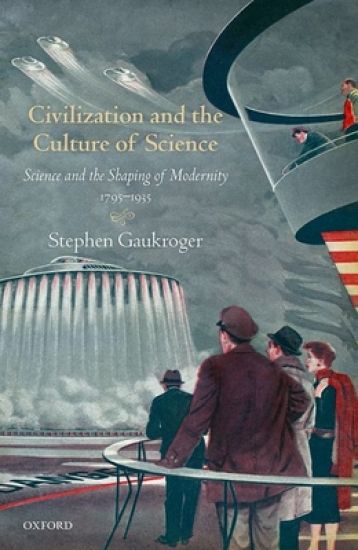
How did science come to have such a central place in Western culture? How did cognitive values—and subsequently moral, political, and social ones—come to be modelled around scientific values? In Civilization and the Culture of Science, Stephen Gaukroger explores how these values were shaped and how they began, in turn, to shape those of society. The core nineteenth- and twentieth-century development is that in which science comes to take centre stage in determining ideas of civilization, displacing Christianity in this role. Christianity had provided a unifying thread in the study of the world, however, and science had to match this, which it did through the project of the unity of the sciences. The standing of science came to rest or fall on this question, which the book sets out to show in detail is essentially ideological, not something that arose from developments within the sciences, which remained pluralistic and modular. A crucial ingredient in this process was a fundamental rethinking of the relations between science and ethics, economics, philosophy, and engineering. In his engaging description of this transition to a scientific modernity, Gaukroger examines five of the issues which underpinned this shift in detail: changes in the understanding of civilization; the push to unify the sciences; the rise of the idea of the limits of scientific understanding; the concepts of 'applied' and 'popular' science; and the way in which the public was shaped in a scientific image.
Civilization and the Culture of Science

Civilization and the Culture of Science

Stephen Gaukroger

Oxford University Press
2020
sidottu
How did science come to have such a central place in Western culture? How did cognitive values--and subsequently moral, political, and social ones--come to be modelled around scientific values? In Civilization and the Culture of Science, Stephen Gaukroger explores how these values were shaped and how they began, in turn, to shape those of society. The core nineteenth- and twentieth-century development is that in which science comes to take centre stage in determining ideas of civilization, displacing Christianity in this role. Christianity had provided a unifying thread in the study of the world, however, and science had to match this, which it did through the project of the unity of the sciences. The standing of science came to rest or fall on this question, which the book sets out to show in detail is essentially ideological, not something that arose from developments within the sciences, which remained pluralistic and modular. A crucial ingredient in this process was a fundamental rethinking of the relations between science and ethics, economics, philosophy, and engineering. In his engaging description of this transition to a scientific modernity, Gaukroger examines five of the issues which underpinned this shift in detail: changes in the understanding of civilization; the push to unify the sciences; the rise of the idea of the limits of scientific understanding; the concepts of 'applied' and 'popular' science; and the way in which the public was shaped in a scientific image.
Civilization without Sexes

Civilization without Sexes

Mary Louise Roberts

University of Chicago Press
1994
sidottu
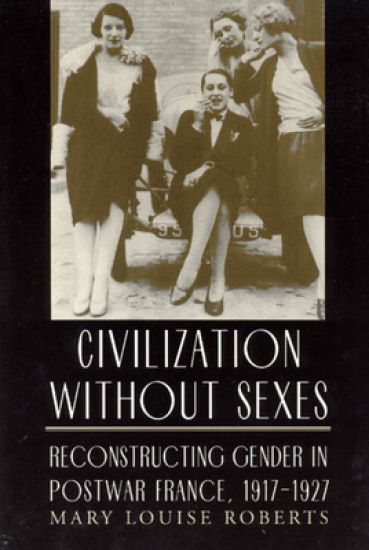
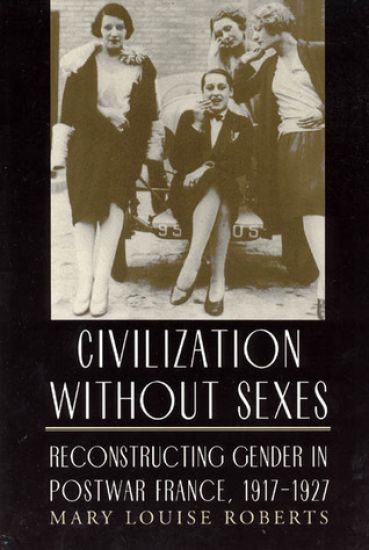
In the decade following World War I, newly blurred boundaries between male and female created fears among the French that theirs was becoming a civilization without sexes. This new gender confusion became a central metaphor for the War's impact on French culture and led to a marked increase in public debate concerning female identity and woman's proper role. Mary Louise Roberts examines how, in these debates, French society came to grips with the catastrophic horrors of the Great War. In sources as diverse as parliamentary records, newspaper articles, novels, medical texts, writings on sexology, and vocational literature, Roberts discovers a central question: how to come to terms with rapid economic, social, and cultural change and articulate a new order of social relationships. She examines the role of French trauma concerning the War in legislative efforts to ban propaganda for abortion and contraception, and explains anxieties about the decline of maternity by a crisis in gender relations that linked soldiery, virility, and paternity. Through these debates, Roberts locates the seeds of actual change. She shows how the willingness to entertain, or simply the need to condemn, non-traditional gender roles created an indecisiveness over female identity that ultimately subverted even the most conservative efforts to return to traditional gender roles and irrevocably altered the social organization of gender in postwar France.
Civilization without Sexes

Civilization without Sexes

Mary Louise Roberts

University of Chicago Press
1994
nidottu
In the decade following World War I, newly blurred boundaries between male and female created fears among the French that theirs was becoming a civilization without sexes. This new gender confusion became a central metaphor for the War's impact on French culture and led to a marked increase in public debate concerning female identity and woman's proper role. Mary Louise Roberts examines how, in these debates, French society came to grips with the catastrophic horrors of the Great War. In sources as diverse as parliamentary records, newspaper articles, novels, medical texts, writings on sexology, and vocational literature, Roberts discovers a central question: how to come to terms with rapid economic, social and cultural change and articulate a new order of social relationships. She examines the role of French trauma concerning the War in legislative efforts to ban propaganda for abortion and contraception, and explains anxieties about the decline of maternity by a crisis in gender relations that linked soldiery, virility, and paternity. Through these debates, Roberts locates the seeds of actual change. She shows how the willingness to entertain, or simply the need to condemn, non-traditional gender roles created an indecisiveness over female identity that ultimately subverted even the most conservative efforts to return to traditional gender roles and irrevocably altered the social organization of gender in postwar France.
Civilization Before Greece and Rome

Civilization Before Greece and Rome

H. W. F. Saggs

Yale University Press
1991
pokkari
For many centuries it was accepted that civilization began with the Greeks and Romans. During the last two hundred years, however, archaeological discoveries in Egypt, Mesopotamia, Crete, Syria, Anatolia, Iran, and the Indus Valley have revealed that rich cultures existed in these regions some two thousand years before the Greco-Roman era. In this fascinating work, H.W.F Saggs presents a wide-ranging survey of the more notable achievements of these societies, showing how much the ancient peoples of the Near and Middle East have influenced the patterns of our daily lives.Saggs discussesthe the invention of writing, tracing it from the earliest pictograms (designed for account-keeping) to the Phoenician alphabet, the source of the Greek and all European alphabets. He investigates teh curricula, teaching methods, and values of the schools from which scribes graduated. Analyzing the provisions of some of the law codes, he illustrates the operation of international law and the international trade that it made possible. Saggs highlights the creative ways that these ancient peoples used their natural resources, describing the vast works in stone created by the Egyptians, the development of technology in bronze and iron, and the introduction of useful plants into regions outside their natural habitat. In chapters on mathematics, astronomy, and medicine, he offers interesting explanations about how modern calculations of time derive from the ancient world, how the Egyptians practiced scientific surgery, and how the Babylonians used algebra. The book concludes with a discussion of ancient religion, showing its evolution from the most primitive forms toward monotheism.
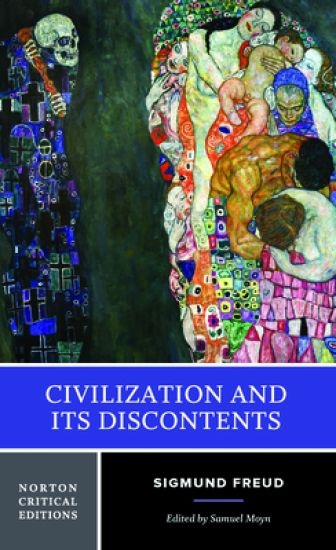
Civilization And Its Discontents

Civilization And Its Discontents

Sigmund Freud; James Strachey; Peter (AFT) Gay

WW Norton Co
2005
sidottu
Civilization and Its Discontents may be Sigmund Freud's best-known work. Originally published in 1930, it seeks to answer ultimate questions: What influences led to the creation of civilization? How did it come to be? What determines its course? In this seminal volume of twentieth-century thought, Freud elucidates the contest between aggression, indeed the death drive, and its adversary eros. He speaks to issues of human creativity and fulfillment, the place of beauty in culture, and the effects of repression. Louis Menand, author of the Pulitzer Prize-winning The Metaphysical Club, contributor to The New Yorker, and professor of English at Harvard University, reflects on the importance of this work in intellectual thought and why it has become such a landmark book for the history of ideas. Not available in hardcover for decades, this beautifully rendered anniversary edition will be a welcome addition to readers' shelves.
Civilization and Its Discontents

Civilization and Its Discontents

Sigmund Freud; Christopher (INT) Hitchens; James (EDT) Strachey

WW Norton Co
2010
pokkari
Written in the decade before Freud s death, Civilization and Its Discontents may be his most famous and most brilliant work. It has been praised, dissected, lambasted, interpreted, and reinterpreted. Originally published in 1930, it seeks to answer several questions fundamental to human society and its organization: What influences led to the creation of civilization? Why and how did it come to be? What determines civilization s trajectory? Freud s theories on the effect of the knowledge of death on human existence and the birth of art are central to his work. Of the various English translations of Freud s major works to appear in his lifetime, only Norton s Standard Edition, under the general editorship of James Strachey, was authorized by Freud himself. This new edition includes both an introduction by the renowned cultural critic and writer Christopher Hitchens as well as Peter Gay s classic biographical note on Freud."
Civilization in Transition

Civilization in Transition

C. G. Jung

Routledge
1964
sidottu
For this second edition of Civilization in Transition, essential corrections have been made in the text, and the bibliographical references have been brought up to date.This volume contains essays bearing on the contemporary scene and, in particular, on the relation of the individual to society. In the earliest one (1918), Jung advanced the theory that the European conflict was basically a psychological crisis originating in the collective unconscious of individuals. He pursued this theory in papers written during the '20s and '30s, focusing on the upheaval in Germany, and he gave it a much wider application in two major works of his last years ^DDL The Undiscovered Self, concerned with the relation between the individual and a mass society, and Flying Saucers, on the birth of a myth which Jung regarded as compensating the scientistic trends of our technological era. An appendix contains documents relating to Jung's association with the International General Medical Society for Psychotherapy.
Civilization and Empire

Civilization and Empire

Shogo Suzuki

Routledge
2009
sidottu
This book critically examines the influence of International Society on East Asia, and how its attempts to introduce ‘civilization’ to ‘barbarous’ polities contributed to conflict between China and Japan.Challenging existing works that have presented the expansion of (European) International Society as a progressive, linear process, this book contends that imperialism – along with an ideology premised on ‘civilising’ ‘barbarous’ peoples – played a central role in its historic development. Considering how these elements of International Society affected China and Japan’s entry into it, Shogo Suzuki contends that such states envisaged a Janus-faced International Society, which simultaneously aimed for cooperative relations among its ‘civilized’ members and for the introduction of ‘civilization’ towards non-European polities, often by coercive means. By examining the complex process by which China and Japan engaged with this dualism, this book highlights a darker side of China and Japan’s socialization into International Society which previous studies have failed to acknowledge.Drawing on Chinese and Japanese primary sources seldom utilized in International Relations, this book makes a compelling case for revising our understandings of International Society and its expansion. This book will be of strong interest to students and researcher of international relations, international history, European studies and Asian Studies.
Civilization, Nation and Modernity in East Asia
This book explores the crisis of cultural identity which has assaulted Asian countries since Western countries began to have a profound impact on Asia in the nineteenth century. Confronted by Western 'civilization' and by 'modernity', Asian countries have been compelled to rethink their identity, and to consider how they should relate to Western 'civilization' and 'modernity'. The result, the author argues, has been a redefining by Asian countries of their own character as nations, and an adaptation of 'civilization' and 'modernity' to their own special conditions. Asian nations, the author contends, have thereby engaged with the West and with modernity, but on their own terms, occasionally, and in various inconsistent ways in which they could assert a sense of difference, forcing changes in the Western concept of civilization. Drawing on postmodern theory, the Kyoto School, Confucian and other traditional Asian thought, and the actual experiences of Asian countries, especially China and Japan, the author demonstrates that Asian countries’ redefining of the concept of civilization in the course of their quest for an appropriate postmodern national identity is every bit as key a part of 'the rise of Asia' as economic growth or greater international political activity.
Civilization and Empire

Civilization and Empire

Shogo Suzuki

Routledge
2011
nidottu
This book critically examines the influence of International Society on East Asia, and how its attempts to introduce ‘civilization’ to ‘barbarous’ polities contributed to conflict between China and Japan.Challenging existing works that have presented the expansion of (European) International Society as a progressive, linear process, this book contends that imperialism – along with an ideology premised on ‘civilising’ ‘barbarous’ peoples – played a central role in its historic development. Considering how these elements of International Society affected China and Japan’s entry into it, Shogo Suzuki contends that such states envisaged a Janus-faced International Society, which simultaneously aimed for cooperative relations among its ‘civilized’ members and for the introduction of ‘civilization’ towards non-European polities, often by coercive means. By examining the complex process by which China and Japan engaged with this dualism, this book highlights a darker side of China and Japan’s socialization into International Society which previous studies have failed to acknowledge.Drawing on Chinese and Japanese primary sources seldom utilized in International Relations, this book makes a compelling case for revising our understandings of International Society and its expansion. This book will be of strong interest to students and researcher of international relations, international history, European studies and Asian Studies.
Civilization in Crisis

Civilization in Crisis

Joseph A. Camilleri

Cambridge University Press
1977
pokkari
First published in 1976, this book presupposes a future in which man will be increasingly confronted by a series of global disorders. By focusing attention on these, this book attempts to identify those forces which threaten not only the quality of life but the very survival of the human species. Dr Camilleri brings a multidisciplinary approach to the study of the cultural and institutional imbalances which underlie the organization of national and international society. He examines the economic philosophy of the advanced industrial countries and the fierce rivalries to which it has given rise within the western world as well as the inequality it has encouraged and perpetuated between overdeveloped and underdeveloped societies, and the consequences of this for the world's energy economy and ecological system. The author then advances some normative concepts and ethical options as sign posts towards an alternative future society.