Kirjojen hintavertailu. Mukana 11 699 587 kirjaa ja 12 kauppaa.

Kirjahaku

Etsi kirjoja tekijän nimen, kirjan nimen tai ISBN:n perusteella.

108 tulosta hakusanalla "Luke---Acts"

The Conclusion of Luke-Acts

The Conclusion of Luke-Acts

Charles B Puskas

Pickwick Publications
2009
sidottu
The conclusion of Luke-Acts is regarded as one of the most important chapters of Luke's two-volume work. Several significant Lukan themes are found in Acts 28, all of which make some contribution to the purpose and aim of the author in writing Luke-Acts: the Gentile mission, the triumph of God's Word, and the relationship of Christianity with Judaism and Rome. Acts 28 contains many historical problems that have been debated for centuries, including the "we" statements, the figure of Paul in Acts 28, and the abrupt-ending. Puskas compares the conclusion of Acts with other important chapters of Luke-Acts: the introduction of the Gospel, the conclusion of Acts, the "defense of Paul" chapters, as well as other passages. In this significant chapter of Acts 28 there are still fundamental problems of exegesis that need to be addressed: What is the literary function of Acts 28? What is Luke trying to tell his readers in the text?
The Spirit in Luke-Acts

The Spirit in Luke-Acts

Odette Mainville; Robert P Menzies

Wipf Stock Publishers
2018
sidottu
""Odette Mainville's...book, The Spirit in Luke-Acts, is a most careful, enlightening, and fresh interpretation of the Holy Spirit's Role in Luke and Acts, from the surprising starting point of a single verse, Acts 2:33...I wholeheartedly endorse this book...."" -William S. Kurz, S.J., Emeritus Professor of New Testament, Marquette University .".".As someone who has devoted a whole book to a theological exposition of Acts 2:33, I regard this as a most worthwhile endeavor. What emerges is a work that engages fully with the Spirit's vitality in the life of Jesus and in the mission of the church...."" -William P. Atkinson, PhD, Senior Lecturer, London School of Theology .".".I warmly recommend this insightful reading of Luke-Acts to you. It is filled with interesting exegesis and challenging observations....I trust that you will find this book as enjoyable, enriching, and edifying as I did."" -Robert P. Menzies, PhD, Missionary-Scholar (China), from the foreword ""Mainville's...work...integrates the central theme in Luke-Acts, in a way that traditional systematic theology does not, viz, Jesus's experiences with the Spirit toward the end of creating a 'community of prophets'..."" -Jon Mark Ruthven, PhD, Professor Emeritus, Regent University School of Divinity .".".Using a redactional and literary approach, Mainville demonstrates that the role of the Holy Spirit is not to be relegated to a mere appendage of Pauline soteriology..."" -James B Shelton, PhD, Professor of New Testament, Oral Roberts University Mainville's work is helpful both for its engagement with traditional approaches and for its fresh contributions and insights....This is surely a welcome study."" -Craig S. Keener, PhD, Professor of Biblical Studies, Asbury Theological Seminary
The Conclusion of Luke-Acts

The Conclusion of Luke-Acts

Charles B Puskas

Wipf Stock Publishers
2009
pokkari
The conclusion of Luke-Acts is regarded as one of the most important chapters of Luke's two-volume work. Several significant Lukan themes are found in Acts 28, all of which make some contribution to the purpose and aim of the author in writing Luke-Acts: the Gentile mission, the triumph of God's Word, and the relationship of Christianity with Judaism and Rome. Acts 28 contains many historical problems that have been debated for centuries, including the "we" statements, the figure of Paul in Acts 28, and the abrupt-ending. Puskas compares the conclusion of Acts with other important chapters of Luke-Acts: the introduction of the Gospel, the conclusion of Acts, the "defense of Paul" chapters, as well as other passages. In this significant chapter of Acts 28 there are still fundamental problems of exegesis that need to be addressed: What is the literary function of Acts 28? What is Luke trying to tell his readers in the text?
Marcion and Luke-acts

Marcion and Luke-acts

Joseph B. Tyson

University of South Carolina Press
2006
sidottu
Building on recent scholarship that argues for a second-century date for the book of ""Acts"", ""Marcion and Luke-Acts"" explores the probable context for the authorship not only of ""Acts"" but also of the canonical ""Gospel of Luke"". Tyson proposes that both ""Acts"" and the final version of ""Luke"" were published at the time when Marcion of Pontus was beginning to proclaim his version of the Christian gospel, in the years 120-125 C.E. He suggests that although the author was subject to various influences, a prominent motivation was the need to provide the church with writings that would serve in its fight against Marcionite Christianity. Tyson positions the controversy with Marcion as a defining struggle over the very meaning of the Christian message and the author of ""Luke-Acts"" as a major participant in that contest. Tyson concludes that the author of ""Acts"" made use of an earlier version of the ""Gospel of Luke"" and produced canonical ""Luke"" by adding, among other things, birth accounts and postresurrection narratives of Jesus.
Images of Judaism in Luke-Acts

Images of Judaism in Luke-Acts

University of South Carolina Press
2010
nidottu
Addresses the ways in which Jewish people and religious customs are presented in the Gospel of Luke and the Acts of the Apostles. Probing questions about the roots of modern anti-Semitism in relationship to the New Testament, Tyson concludes that there is a deep and complex ambivalence in Luke-Acts, making the texts both profoundly pro-Jewish and anti-Jewish.
Heaven and Earth in Luke-Acts

Heaven and Earth in Luke-Acts

Ming Gao

Langham Monographs
2017
nidottu
Dr Ming Gao delves into the much-overlooked heaven motif in Luke-Acts in this critical study of a central element in Christian belief. Focusing on several key passages from the biblical canon, Gao analyses them in their Jewish, Greco-Roman and broader literary contexts to enhance our comprehension of the meaning of "heaven" and it's significance for our worldview. Heaven is not simply a static place where God dwells or a symbol of his power, but is a dynamic arena. This study further reveals that arena as the scene of an unfolding of cosmic warfare, the effects of which are felt on earth. Dr Gao also elucidates how heaven, as well as being part of reality, acts as a concept that points to the arrival of God's eschatological kingdom on earth. This book will enhance efforts to understand "heaven," which is often viewed as an unfathomable mystery by so many Christians.
Joy in Luke-Acts

Joy in Luke-Acts

David H Wenkel

Paternoster Press
2015
nidottu
This monograph explores the joy theme in Luke- Acts as it relates to the dynamics of rhetoric, narrative and emotion. The Gospel of Luke has been called the "gospel of joy", and the joy theme has also been recognised in Acts. This theme, though, has received relatively little attention in NT scholarship. Joy in Luke-Acts examines the joy theme from a socio-rhetorical vantage point, showing that the joy theme empowers the Lukan rhetoric of reversal. The theme is a primary method in which the narrator seeks to persuade the reader to enter into the values and beliefs that characterise the 'upside-down' world in which YHWH has visited his people in Jesus.
The Davidic Messiah in Luke-Acts

The Davidic Messiah in Luke-Acts

Mark Strauss

Sheffield Academic Press
1995
sidottu
The nature of Lukan christology has been much debated in recent years, with scholars claiming the pre-eminence of such categories as Lord, Prophet, Christ, or Isaianic Servant. In the present work the author examines one major theme within Luke's christology, that of the coming king from the line of David. A study of the Lukan birth narrative and the speeches in Acts reveals that Luke shows a strong interest in this royal-messianic theme, introducing it into passages which are introductory and programmatic for his christology as a sermon, portraying Jesus in strongly prophetic terms. The author seeks a synthesis of these seemingly conflicting royal and prophetic portraits in Luke's interpretation of the Old Testament book of Isaiah. When Isaiah is read as a unity, the eschatological deliverer is at the same time Davidic king (Isa. 9.11), suffering servant of Yahweh (Isa. 42-53), and prophet herald of salvation (Isa. 61), leading God's people on an eschatological new exodus. On the basis of this synthesis the christology of Luke-Acts is seen to be both consistent and unified, forming an integral part of Luke's wider purpose in his two-volume work.
David in Luke-Acts

David in Luke-Acts

Yuzuru Miura

Mohr Siebeck
2007
nidottu
Yuzuru Miura undertakes a scholarly analysis of all references to David in Luke-Acts, which has not been done so far. Previous studies of David have dealt with parts of the references to David in Luke-Acts, focusing on the subject of Davidic messianism, but it was only the Davidic genealogical character. However, Davidic messianism has another aspect - the typological character. In order to analyze all references to David in Luke-Acts, the Davidic typological character in Davidic messianism has to be considered. Thus, in the first part of this book, the author seeks to grasp the first-century Jewish perceptions of the picture of David, such as David in the LXX, the OT Apocrypha and Pseudepigrapha, the Qumran Manuscripts, the writings of Philo and Josephus, and early rabbinic thought. Then, in the second part, he analyzes all references to David in Luke-Acts in light of the first-century Jewish perceptions of David. Such a perspective - considering both the genealogical and typological characters of Davidic messianism - uncovers the overall function of Luke's efficient and well-organized use of the figure of David in his narrative to legitimize Jesus as the Davidic Messiah. Furthermore, such a perspective throws fresh light on various Lukan theological issues.
Soldiers in Luke-Acts

Soldiers in Luke-Acts

Laurie Brink

Mohr Siebeck
2014
nidottu
The author of Luke-Acts constructs a portrait of the Roman military that relies on a variety of literary stereotypes, anticipating that his authorial audience, familiar with the stereotypes, will bring their experience to bear in the process of more fully characterizing the soldiers. Expecting their antipathy, Luke upsets his authorial audience's expectations. Laurie Brink demonstrates that the soldiers, in fact, do not wholly live up to their bad reputations. Engaging, contradicting and transcending the literary stereotypes, Luke creates a progressive portrait of the Roman soldier that demonstrates the attitudes and actions of a good disciple, and that serves as a critique of the authorial audience's original response.
Themes and Texts in Luke-Acts: Essays in Honour of Bart J. Koet
Twenty-three leading scholars interact in this volume with Luke-Acts. They study a variety of themes and pericopes. From Luke's view of money and property, the relationship of tamid and eucharist, to the reception of Luke-Acts in Cyprian's work, it brings new insights to the fore. The essays on individual passages interact with the Jewish and pagan contexts of the work and approach their topics through several different methodological approaches. Editors and authors offer this collection as a token of friendship and gratitude to Bart J. Koet, collected at the occasion of his retirement.
The Unity of Luke-Acts

The Unity of Luke-Acts

Peeters Publishers
1999
nidottu
This volume contains the papers presented at the 47th Colloquium Biblicum Lovaniense (Leuven, 1998). The general theme of the meeting was the unity of the Gospel of Luke and the Acts of the Apostles. Main papers on this topic were read by R.L. Brawley, J. Delobel, A. Denaux, J.A. Fitzmeyer, F.W. Horn, J. Kremer, A. Lindemann, O. Mainville, D. Marguerat, F. Neirynck, W. Radl, M. Rese, J. Taylor, C.M. Tuckett, and J. Verheyden. While a large majority of scholars agree that Luke intended his work to cover both the past and the continuing history of Jesus (Gospel and Acts), the essays also illustrate the complexities of this view on the unity of Luke-Acts when it comes to interpret the various aspects of Lukan theology, christology, pneumatology, and ecclesiology, the expansion of the Church in light of its Jewish origins, the genre of Luke-Acts, and the literary and stylistic means Luke used to make his work a unity. In total the volume includes some 40 papers, of which 24 are offered papers: L. Alexander, H. Baarlink, M. Bachmann, D. Bechard, T.L. Brodie, G.P. Carras, A. del Agua, C. Focant, G. Geiger, B.J. Koet, V. Koperski, D.P. Moessner, G. Oegema, J. Pichler, E. Plümacher, A. Puig i Tarrèch, U. Schmid, B. Schwank, N. Taylor, P.J. Tomson, S. Van den Eynde, S. Walton, G. Wasserberg, F. Wilk. This collection is an invaluable contribution to current discussions in Lukan study and to a nuanced understanding of the relationship between Luke's two volumes.
Sight and Blindness in Luke-Acts: The Use of Physical Features in Characterization
The ancient world often thought in terms of physiognomics--the idea that character can be discerned by studying outward, physical features. That physical descriptions carry moral freight in characterization has been largely missed in modern biblical scholarship, and this study brings that to the forefront. Specifically, this is a study of one particular physical marker--blindness. When we look at Greco-Roman literature, a kind of literary topos begins to emerge, a set of assumptions that ancient audiences would typically make when encountering blind characters. Luke-Acts makes use of such a topos in a way that becomes programmatic, serving as a kind of interpretive key to Luke-Acts that is generally unnoticed in modern scholarship.
The Gentiles and the Gentile Mission in Luke-Acts

The Gentiles and the Gentile Mission in Luke-Acts

Stephen G. Wilson

Cambridge University Press
2005
pokkari
A theological and historical study of the Gentiles and the Gentile missions in Luke and Acts. Dr Wilson examines Jesus' attitude to Gentiles and concludes that not only did he fail to anticipate a historical Gentile mission, but that his eschatological expectations logically disallowed it. Luke's views are then set against the tradition on the subject from Jesus up to and including Mark, and his theology is compared in detail with that of Paul. Dr Wilson goes on to consider the historical reliability of Acts and finds that most earlier assessments have been marred by oversimplification; Luke, he concludes, does intend to write good history but for a variety of reasons is not always successful. There has in recent years been a growing interest in the theology of Luke and this is a substantial addition to the literature on the subject. It will be of interest to all theologians and New Testament scholars.
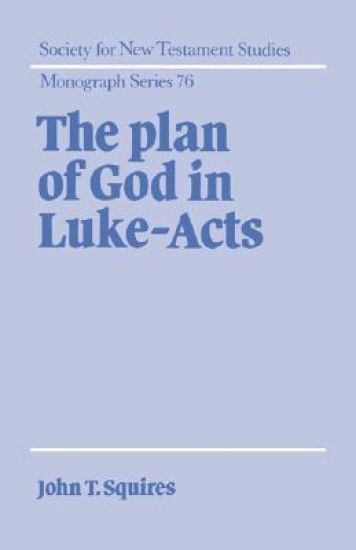
The Plan of God in Luke-Acts

The Plan of God in Luke-Acts

John T. Squires

Cambridge University Press
1993
sidottu
This study examines one significant theological theme in Luke-Acts, that of ‘The plan of God’. It traces the way this theme is developed throughout Luke-Acts, both through direct statements by the writer and through various associated means such as divine appearances, signs and wonders, the fulfilment of prophecy, and indications of fate as of necessity. Dr Squires locates Luke’s use of this theme in the context of the history-writing of the Hellenistic period, noting numerous passages in those works which illumine Luke’s theological purposes. His book shows how the notion of the plan of God is used by Luke as he writes to confirm his readers’ faith, encouraging them to bear witness to this faith, and equipping them for the task of defending it.