Kirjojen hintavertailu. Mukana 12 459 402 kirjaa ja 12 kauppaa.

Kirjahaku

Etsi kirjoja tekijän nimen, kirjan nimen tai ISBN:n perusteella.

1000 tulosta hakusanalla A Chandra

Durga Chandrakala Stuti: A Hymn on Durga by Appayya Deekshita: Text with Commentary
Durga chandrakala stuti is a hymn composed by Appayya deekshita the great shaiva and scholar of Vedas Puranas and mantra shastras who lived in Tamil nadu in the fifteenth century (1520-1593 CE)In this hymn various glories of the mother goddess durgā from Vedas and various puranas are summarized. The hymn comprises of eighteen shloka, the first shloka being the mangalacharana (invocation of the goddess) and the last shloka the phala shruti (description of benefits which are attained by the recitation of this hymn.)So the main hymn is of sixteen shlokas and hence the name durgā chandrakalā stuti (hymn to durga like the sixteen states of moon) is given to it by the composer. This hymn is considered very powerful by the practitioners of Shakta and Shaiva tradition - the worship of the mother goddess (the embodiment of all power) because this hymn is the summary of the great and powerful text Devi māhāthmyam of Mārkandeya purāna which is of 700 shlokas and hence also known as durgā saptashatī (seven hundred verses praising durgā) In addition to that Appayya Deekshita also summarizes various glorious incidents about goddess durgā and her manifold forms from various purānas. Hence reciting this hymn daily is equal to remembering all the important glorious deeds of the goddess mentioned in the puranas. The Devi mahatmya and the other anecdotes about the devi given in Varahapurana, Harivamsa, Bhagavata etc., are given in condensed form in this work to be precise.Reciting this hymn with devotion bestows the devotee with protection, wealth, wisdom, courage good fortune and liberation.
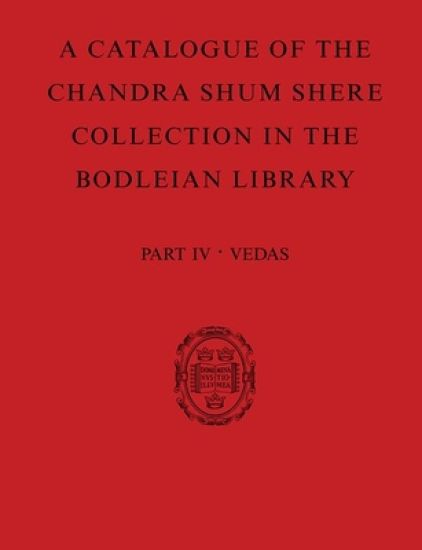
A Catalogue of the Chandra Shum Shere Collection in the Bodleian Library
The Chandra Shum Shere Collection, which arrived in Oxford from Varanasi over a century ago, is one of the largest Indian manuscript libraries in the world outside the Subcontinent. Part IV of this descriptive catalogue adds much to our knowledge of the collection as a whole and gives details of nearly 900 manuscripts in the field of Vedic literature, a fine and varied corpus of Sanskrit primary texts and commentaries. There are some indications that the original owner of this collection was a ritualist with interests both in sacrificial practice and in traditional Vedic scholarship. This element of the collection brings the published catalogue records near to the half-way point, and other subject volumes are present in preparation. Catalogue entries give full information of the coverage of the nature and extent of the texts, materials, scripts, scribes, dates and places of writing, and former owners of the manuscripts.
A Descriptive Catalogue of the Sanskrit and other Indian Manuscripts of the Chandra Shum Shere Collection in the Bodleian Library: Part II. Epics and Puranas
The arrival in 1909 of the library of manuscripts now known as the Chandra Shum Shere collection increased by well over six thousand the already substantial holdings of the Bodleian and Indian Institute libraries, and made Oxford the repository of the largest known collection of Sanskrit manuscripts outside the Indian subcontinent. It is a huge and uniquely valuable collection of paper and palm leaf manuscripts, purchased for Oxford University by Sir Chandra Shum Shere, the then Prime Minister of Nepal. The General Editor of the catalogue of the collection is Dr Jonathan Katz, Consultant to the Oriental Department of the Bodleian Library, formerly Librarian of the Indian Institute, and present Master of the Queen's Scholars at Westminster School.
A Descriptive Catalogue of the Sanskrit and other Indian Manuscripts of the Chandra Shum Shere Collection in the Bodleian Library: Part III. Stotras
The arrival in 1909 of the library of manuscripts now known as the Chandra Shum Shere collection increased by well over six thousand the already substantial holdings of the Bodleian and Indian Institute libraries, and made Oxford the repository of the largest known collection of Sanskrit manuscripts outside the Indian subcontinent. It is a huge and uniquely valuable collection of paper and palm leaf manuscripts, purchased for Oxford University by Sir Chandra Shum Shere, the then Prime Minister of Nepal. The General Editor of the catalogue of the collection is Dr Jonathan Katz, Consultant to the Oriental Department of the Bodleian Library, formerly Librarian of the Indian Institute, and present Master of the Queen's Scholars at Westminster School.
Sarat Chandra Bose, A Vision Denied
Sarat Chandra Bose (1889–1950) was an eminent barrister, political thinker, and a leader in India’s historic struggle against British rule in the first half of the 20th century. This collection of writings on and by Sarat Chandra Bose is expansive and enriched by a selection of archival material on the movement for India’s political freedom. Bose is often remembered as the supportive elder brother of Netaji Subhas Chandra Bose, but he was also a political visionary in his own right and a key figure in India’s freedom movement. An invaluable compendium of material not just on the life of Sarat Chandra Bose but a range of related political activity from the 1930’s until 1950, this volume includes significant primary archival material—writings and speeches on and by Sarat Bose; letters exchanged by national leaders; extracts and reports from the British India Government’s secret files that kept under close surveillance those Indians whom they considered dangerous. The book not only provides a deep insight into Bose’s active public life but also fleshes out the intricate nature of friendships and fallouts between powerful historical figures in India and the West, even as India, the ‘jewel in the crown’ of the British Empire, slipped away from the coloniser’s grasp. Rich in primary and archival material, this volume provides both public and private source materials of a key period of Indian history and will be an important resource for researchers and students of history, colonial and postcolonial studies, politics. It will also be of interest to those working on the history of Indian independence and its principal players as well as the partition of India.