Kirjahaku
Etsi kirjoja tekijän nimen, kirjan nimen tai ISBN:n perusteella.
1000 tulosta hakusanalla Activity Nest
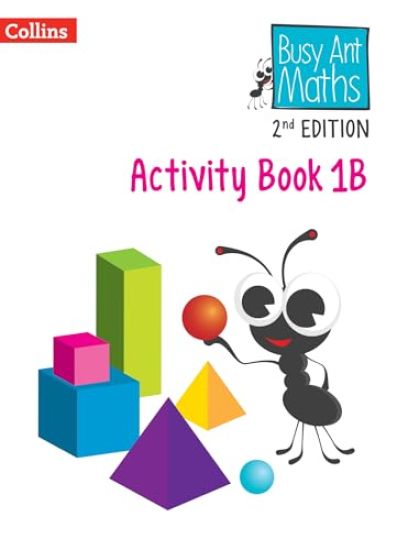
Written by an expert author team with over 50 years’ combined classroom experience, Busy Ant Maths is a flexible, whole-school mathematics programme that ensures conceptual understanding and mathematical fluency from the start. Collins Busy Ant Maths Activity Book 1B is packed with exciting activities to help build and develop the skills needed to be successful in Maths. Each page features lots of hands-on, highly visual activities and representations with a low level of text to give pupils confidence in learning maths. Activity Book 1B contains:• fun activities to consolidate the objectives covered in the daily maths lesson• objectives at the top of each page so the child is in control of their own learning• space to record answers, providing structure to each exercise• simple text.• engaging, colourful graphics. Used in conjunction with the Teacher's Guide, Textbook, Progress Guide and Homework Guide, the Busy Ant Maths Activity Book 1B is the best way to ensure that pupils achieve all the learning objectives of the Primary Maths National Curriculum.
Written by an expert author team with over 50 years’ combined classroom experience, Busy Ant Maths is a flexible, whole-school mathematics programme that ensures conceptual understanding and mathematical fluency from the start. Collins Busy Ant Maths Activity Book 1C is packed with exciting activities to help build and develop the skills needed to be successful in Maths. Each page features lots of hands-on, highly visual activities and representations with a low level of text to give pupils confidence in learning maths. Activity Book 1C contains:• fun activities to consolidate the objectives covered in the daily maths lesson• objectives at the top of each page so the child is in control of their own learning• space to record answers, providing structure to each exercise• simple text.• engaging, colourful graphics. Used in conjunction with the Teacher's Guide, Textbook, Progress Guide and Homework Guide, the Busy Ant Maths Activity Book 1C is the best way to ensure that pupils achieve all the learning objectives of the Primary Maths National Curriculum.
Activity Book 2A
Jo Power; Nicola Morgan; Cherri Moseley; Louise Wallace; Caroline Clissold; Janet Rees
HARPERCOLLINS PUBLISHERS
2024
nidottu
Written by an expert author team with over 50 years’ combined classroom experience, Busy Ant Maths is a flexible, whole-school mathematics programme that ensures conceptual understanding and mathematical fluency from the start. Collins Busy Ant Maths Activity Book 2A is packed with exciting activities to help build and develop the skills needed to be successful in Maths. Each page features lots of hands-on, highly visual activities and representations with a low level of text to give pupils confidence in learning maths. Activity Book 2A contains:• fun activities to consolidate the objectives covered in the daily maths lesson• objectives at the top of each page so the child is in control of their own learning• space to record answers, providing structure to each exercise• simple text.• engaging, colourful graphics. Used in conjunction with the Teacher's Guide, Textbook, Progress Guide and Homework Guide, the Busy Ant Maths Activity Book 2A is the best way to ensure that pupils achieve all the learning objectives of the Primary Maths National Curriculum.
Activity Book 2B
Louise Wallace; Cherri Moseley; Caroline Clissold; Jo Power; Nicola Morgan; Janet Rees
HARPERCOLLINS PUBLISHERS
2024
nidottu
Written by an expert author team with over 50 years’ combined classroom experience, Busy Ant Maths is a flexible, whole-school mathematics programme that ensures conceptual understanding and mathematical fluency from the start. Collins Busy Ant Maths Activity Book 2B is packed with exciting activities to help build and develop the skills needed to be successful in Maths. Each page features lots of hands-on, highly visual activities and representations with a low level of text to give pupils confidence in learning maths. Activity Book 2B contains:• fun activities to consolidate the objectives covered in the daily maths lesson• objectives at the top of each page so the child is in control of their own learning• space to record answers, providing structure to each exercise• simple text.• engaging, colourful graphics. Used in conjunction with the Teacher's Guide, Textbook, Progress Guide and Homework Guide, the Busy Ant Maths Activity Book 2B is the best way to ensure that pupils achieve all the learning objectives of the Primary Maths National Curriculum.
Activity Book 2C
Nicola Morgan; Caroline Clissold; Jo Power; Louise Wallace; Cherri Moseley; Janet Rees
HARPERCOLLINS PUBLISHERS
2024
nidottu
Written by an expert author team with over 50 years’ combined classroom experience, Busy Ant Maths is a flexible, whole-school mathematics programme that ensures conceptual understanding and mathematical fluency from the start. Collins Busy Ant Maths Activity Book 2C is packed with exciting activities to help build and develop the skills needed to be successful in Maths. Each page features lots of hands-on, highly visual activities and representations with a low level of text to give pupils confidence in learning maths. Activity Book 2C contains:• fun activities to consolidate the objectives covered in the daily maths lesson• objectives at the top of each page so the child is in control of their own learning• space to record answers, providing structure to each exercise• simple text.• engaging, colourful graphics. Used in conjunction with the Teacher's Guide, Textbook, Progress Guide and Homework Guide, the Busy Ant Maths Activity Book 2C is the best way to ensure that pupils achieve all the learning objectives of the Primary Maths National Curriculum.
Activity-Based Approaches to Travel Analysis
Pergamon Press
1997
sidottu
Societal trends have made the need for better travel demand forecasts more urgent, at the same time as making people's travel and activity patterns far more complex. Traditional traffic flow models are no longer sophisticated enough to cope. Activity analysis is seen by many as the solution. It has had a short but intense history in geography, urban planning, time use research and, more recently, transportation. Pioneering activity-based models have now been developed to the point where, some argue, it is time to abandon the traditional four-step model for transportation demand forecasting and to adopt activity-based approaches instead. Others claim that the complexity of such approaches, and their tremendous data requirements, prevent them from having a significant impact. This book explores these claims and the issues associated with them. An introductory section outlines the debate. The body of the work is organised in four sections: modelling developments; theories and empirical analyses; data needs and data representation; and policy analysis. The final section discusses future research directions.
Activity For Mental Health explores all activities, including physical, social, natural, cognitive, art/hobby and music as a means to both preventing and treating mental illness. This book not only reviews evidence-based research behind activity, but also explores how these forms of activity can treat mental illnesses. First, the reader is introduced to the concepts of Formal Behavioral Activation Therapy (BAT) and informal activity as an effective treatment option. Case examples aid in connecting the benefits to real life scenarios. Following the introduction, each activity is introduced in separate chapters, including physical, social, natural, cognitive, art/hobby and music. This book will provide researchers and clinicians the information needed to help customize treatment options for their patients suffering from mental illness.
Activity Manual with Integrated Review Worksheets for Using & Understanding Mathematics
Jeffrey Bennett; William Briggs
Pearson
2018
nidottu
More than 30 activities correlated to Bennett/Briggs' Using & Understanding Mathematics: A Quantitative Approach Plus MyLab Math with Integrated Review, 7egive students hands-on experiences that reinforce the course content. Activities can be completed individually or in a group. Each activity includes an overview, estimated time of completion, objectives, guidelines for group size, and list of materials needed. Additionally, the manual provides the worksheets for the Integrated Review version of the MyLab(TM) Math course. 0135168201 / 9780135168202 Student Activity Manual with Integrated Review Worksheets for Using & Understanding Mathematics: A Quantitative Approach Plus MyLab Math with Integrated Review, 7/e
Activity and Participation in Late Antique and Early Christian Thought
Torstein Theodor Tollefsen
Oxford University Press
2012
sidottu
Activity and Participation in Late Antique and Early Christian Thought is an investigation into two basic concepts of ancient pagan and Christian thought. The study examines how activity in Christian thought is connected with the topic of participation: for the lower levels of being to participate in the higher means to receive the divine activity into their own ontological constitution. Torstein Theodor Tollefsen sets a detailed discussion of the work of church fathers Gregory of Nyssa, Dionysius the Areopagite, Maximus the Confessor, and Gregory Palamas in the context of earlier trends in Aristotelian and Neoplatonist philosophy. His concern is to highlight how the Church Fathers thought energeia (i.e. activity or energy) is manifested as divine activity in the eternal constitution of the Trinity, the creation of the cosmos, the Incarnation of Christ, and in salvation understood as deification.
Allow your kids to go grand on skills occasionally. This is a book of mazes. Letting your child solve them on their own pace will help improve problem-solving skills, creativity and logic. It will also improve hand to eye coordination, along with the ability to grade an activity. Grab a copy and encourage your child to solve these mazes today
Counting and telling time are two concepts that are banked on your child's number sense. You can improve your child's number sense by allowing him/her to work on progressive exercises on his/her own pace. Telling time is a step above counting because it involves skip counting and the understanding of how numerals hold different meanings. Grab a copy today
Addition and subtraction form the basics of arithmetic. If your child can master these two concepts, then division and multiplication will become a breeze. Mastery of addition and subtraction can only be reached through repeat and progressive exercises. This workbook provides the activities your child needs. Go ahead and secure a copy today.
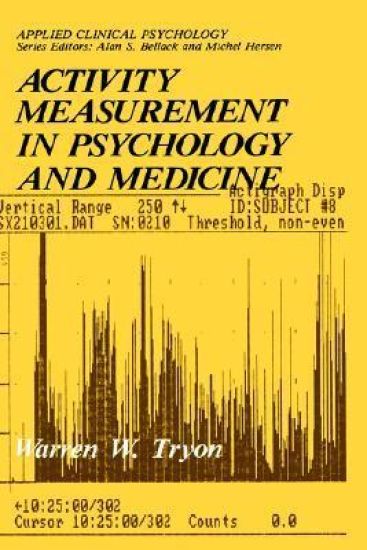
Activity Measurement in Psychology and Medicine
Warren W. Tryon
Kluwer Academic/Plenum Publishers
1991
sidottu
In his treatment of activity measurement in the fields of medicine and psychology, Tryon gives us a book that clearly accomplishes the three purposes set out in its preface. The reader is definitely encouraged to wrestle with the concepts ofbehavior and activity in terms of "dynamic physical quantities." Moreover, the reader cannot help but become familiarized with the technology available for performing activity measurements. Motivation to use some of this technology is enhanced by the very extensive summary of other people's uses of it provided throughout the book. Readers may find the book provocative on a number of Ievels. It is concep tually provocative to those of us struggling with understanding basic issues in the assessment and measurement of behavior. It is practically provocative to those of us working with various forms of behavioral difference, especially in clinical popula tions. The book provokes because it is essentially an unfinished exploration, open ing us to numerous pathways that, when traveled, reveal still more paths to explore. In this sense the book should be heuristically useful both in the more traditional empirical sense, and in terms of its Stimulation of conceptual discussion.
Activity Analysis in the Theory of Growth and Planning
M O L Bacharachd
Palgrave Macmillan
1967
sidottu
Activity Theory and Collaborative Intervention in Education
Katsuhiro Yamazumi
Routledge
2021
sidottu
By applying cultural-historical activity theory and expansive learning theory to educational research, this volume illuminates new forms of educational activities as collaborative interventions in schools and communities where learners and practitioners generate expansive learning so that they can collectively transform their activities and expand their agency for themselves. It covers four cases of activity-theoretical formative intervention studies conducted in Japan, which are related to: fostering children’s expansive learning in classroom lessons; teachers as collaborative change agents in redesigning schools; expanding the school activity from below; and emerging knotworking agency in community-based disaster prevention learning. This book employs activity theory as a general theoretical framework of human learning and development to connect focal data from empirical and interventional studies on real human learning in specific educational settings in Japan. In this way, the book illustrates how the general theoretical framework could be used to understand a specific socio-cultural milieu, that is, the Japanese context. It also shows the universal relevance of the Japanese context of educational activity on broader international research, analyzing concrete empirical data from specific settings in Japan. In conclusion this book creates new understanding and develops a cohesive framework of the agentic and hybrid nature of educational activities as collaborative interventions in the expansion of learning.
Activity Theory and Collaborative Intervention in Education
Katsuhiro Yamazumi
TAYLOR FRANCIS LTD
2022
nidottu
By applying cultural-historical activity theory and expansive learning theory to educational research, this volume illuminates new forms of educational activities as collaborative interventions in schools and communities where learners and practitioners generate expansive learning so that they can collectively transform their activities and expand their agency for themselves. It covers four cases of activity-theoretical formative intervention studies conducted in Japan, which are related to: fostering children’s expansive learning in classroom lessons; teachers as collaborative change agents in redesigning schools; expanding the school activity from below; and emerging knotworking agency in community-based disaster prevention learning. This book employs activity theory as a general theoretical framework of human learning and development to connect focal data from empirical and interventional studies on real human learning in specific educational settings in Japan. In this way, the book illustrates how the general theoretical framework could be used to understand a specific socio-cultural milieu, that is, the Japanese context. It also shows the universal relevance of the Japanese context of educational activity on broader international research, analyzing concrete empirical data from specific settings in Japan. In conclusion this book creates new understanding and develops a cohesive framework of the agentic and hybrid nature of educational activities as collaborative interventions in the expansion of learning.
Activity and Sign
Springer-Verlag New York Inc.
2005
sidottu
The advancement of a scientific discipline depends not only on the "big heroes" of a discipline, but also on a community’s ability to reflect on what has been done in the past and what should be done in the future. This volume combines perspectives on both. It celebrates the merits of Michael Otte as one of the most important founding fathers of mathematics education by bringing together all the new and fascinating perspectives created through his career as a bridge builder in the field of interdisciplinary research and cooperation. The perspectives elaborated here are for the greatest part motivated by the impressing variety of Otte’s thoughts; however, the idea is not to look back, but to find out where the research agenda might lead us in the future. This volume provides new sources of knowledge based on Michael Otte’s fundamental insight that understanding the problems of mathematics education – how to teach, how to learn, how to communicate, how to do, and how to represent mathematics – depends on means, mainly philosophical and semiotic, that have to be created first of all, and to be reflected from the perspectives of a multitude of diverse disciplines.
Activity, Recovery, Growth: The Communal Role of Planned Activities
Joan Mowat Erikson
W. W. Norton Company
1976
nidottu
The authors offer a rationale for their own ideas of the central role of activity in all recovery and rehabilitation, emphasizing throughout that planned activities in therapeutic communities are not just another form of adjunctive therapy. Activity is a vital component of change, and without activity and change there is no recovery and no growth.
Teaching children about peace and peaceful strategies, learning to handle conflict creatively, tackling injustice and racial prejudice, is imperative and relevant for today's children. Packed with topical ideas for the primary school teacher, this book offers material for 40+ primary assemblies, easy to use in an assembly or for preparation. A great resource to dip into for one-off assemblies or follow as a programme of themed assemblies for a term, it is helpfully split into topic areas on peace which include: CooperationChildren’s writingPlaces and challengesAssembly playsEnvironmentStories.Each assembly starts with a drama, story or interactive activity, followed by a prayer and ‘reflection’ and a hymn or a song. There are suggestions for questions and ideas for developing the theme which include using masks and puppets, as well as stories from six major world religions: Christianity, Buddhism, Hinduism, Islam, Judaism and Sikhism.The book will be invaluable to headteachers, deputy headteachers, primary schools teacher or any trainee teacher who is looking for a collection of assembly ideas that promote peace, tolerance and understanding in the widest possible context and in a variety of different ways.
Activity Theory in Practice
Routledge
2009
sidottu
This ground-breaking book brings together cutting-edge researchers who study the transformation of practice through the enhancement and transformation of expertise. This is an important moment for such a contribution because expertise is in transition - moving toward collaboration in inter-organizational fields and continuous shaping of transformations. To understand and master this transition, powerful new conceptual tools are needed and are provided here. The theoretical framework which has shaped these studies is Cultural Historical Activity Theory (CHAT). CHAT analyses how people and organisations learn to do something new, and how both individuals and organisations change. The theoretical and methodological tools used have their origins in the work of Lev Vygotsky and A.N. Leont’ev. In recent years this body of work has aroused significant interest across the social sciences, management and communication studies.Working as part of an integrated international team, the authors identify specific findings which are of direct interest to the academic community, such as: the analysis of vertical learning between operational and strategic levels within complex organizations; the refinement of notions of identity and subject position within CHAT; the introduction of the concept of ‘labour power’ into CHAT; the development of a method of analysing discourse which theoretically coheres with CHAT and the design of projects. Activity Theory in Practice will be highly useful to practitioners, researchers, students and policy-makers who are interested in conceptual and empirical issues in all aspects of ‘activity-based’ research.