Kirjojen hintavertailu. Mukana 11 342 296 kirjaa ja 12 kauppaa.

Kirjahaku

Etsi kirjoja tekijän nimen, kirjan nimen tai ISBN:n perusteella.

1000 tulosta hakusanalla Al Gore

Al Capone Shines My Shoes

Al Capone Shines My Shoes

Gennifer Choldenko

Puffin Books
2011
nidottu
What do you do when your neighbors are a bunch of hit men, con men, and mad dog murderers? Well, if you're Moose Flanagan, you ask the most notorious convict of them all, Al Capone, for help. But when that convict comes through for you and then asks you for a favor in return suddenly it's a whole different ball game. Picking up where the Newbery Honor winning Al Capone Does My Shirts left off, this lively second romp featuring Moose, his friends, and some of Alcatraz's "finest" is just as satisfying as the first.
Al Capone Does My Homework

Al Capone Does My Homework

Gennifer Choldenko

Penguin Young Readers Group
2014
nidottu
Alcatraz Island in the 1930s isn't the most normal place to grow up, but it's home for Moose Flanagan, his autistic sister, Natalie, and all the families of the guards. When Moose's dad gets promoted to Associate Warden, despite being an unlikely candidate, it's a big deal. But the cons have a point system for targeting prison employees, and his dad is now in serious danger. After a fire starts in the Flanagan's apartment, Natalie is blamed, and Moose bands with the other kids to track down the possible arsonist. Then Moose gets a cryptic note from the notorious Al Capone himself. Is Capone trying to protect Moose's dad too? If Moose can't figure out what Capone's note means, it may be too late. The last heart-pounding installment in the New York Times bestselling, Newbery Honor-winning Alcatraz trilogy is not to be missed "Superlative historical fiction." -- School Library Journal (starred review for Al Capone Shines My Shoes)
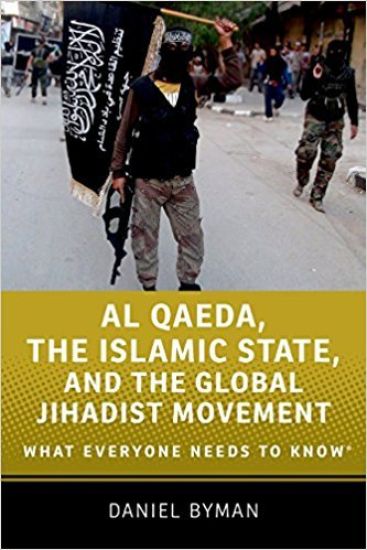
Al Qaeda, the Islamic State, and the Global Jihadist Movement
On the morning of September 11, 2001, the entire world was introduced to Al Qaeda and its enigmatic leader, Osama bin Laden. But the organization that changed the face of terrorism forever and unleashed a whirlwind of counterterrorism activity and two major wars had been on the scene long before that eventful morning. In Al Qaeda, the Islamic State, and the Global Jihadist Movement: What Everyone Needs to Know, Daniel L. Byman, an eminent scholar of Middle East terrorism and international security who served on the 9/11 Commission, provides a sharp and concise overview of Al Qaeda, from its humble origins in the mountains of Afghanistan to the present, explaining its perseverance and adaptation since 9/11 and the limits of U.S. and allied counterterrorism efforts. The organization that would come to be known as Al Qaeda traces its roots to the anti-Soviet jihad in Afghanistan in the 1980s. Founded as the Soviets withdrew from Afghanistan, Al Qaeda achieved a degree of international notoriety with a series of spectacular attacks in the 1990s; however, it was the dramatic assaults on the World Trade Center and the Pentagon on 9/11 that truly launched Al Qaeda onto the global stage. The attacks endowed the organization with world-historical importance and provoked an overwhelming counterattack by the United States and other western countries. Within a year of 9/11, the core of Al Qaeda had been chased out of Afghanistan and into a variety of refuges across the Muslim world. Splinter groups and franchised offshoots were active in the 2000s in countries like Pakistan, Iraq, and Yemen, but by early 2011, after more than a decade of relentless counterterrorism efforts by the United States and other Western military and intelligence services, most felt that Al Qaeda's moment had passed. With the death of Osama bin Laden in May of that year, many predicted that Al Qaeda was in its death throes. Shockingly, Al Qaeda has staged a remarkable comeback in the last few years. In almost every conflict in the Muslim world, from portions of the Xanjing region in northwest China to the African subcontinent, Al Qaeda franchises or like-minded groups have played a role. Al Qaeda's extreme Salafist ideology continues to appeal to radicalized Sunni Muslims throughout the world, and it has successfully altered its organizational structure so that it can both weather America's enduring full-spectrum assault and tailor its message to specific audiences. Authoritative and highly readable, Byman's account offers readers insightful and penetrating answers to the fundamental questions about Al Qaeda: who they are, where they came from, where they're going-and, perhaps most critically-what we can do about it.
Al Qaeda, the Islamic State, and the Global Jihadist Movement
On the morning of September 11, 2001, the entire world was introduced to Al Qaeda and its enigmatic leader, Osama bin Laden. But the organization that changed the face of terrorism forever and unleashed a whirlwind of counterterrorism activity and two major wars had been on the scene long before that eventful morning. In Al Qaeda, the Islamic State, and the Global Jihadist Movement: What Everyone Needs to Know, Daniel L. Byman, an eminent scholar of Middle East terrorism and international security who served on the 9/11 Commission, provides a sharp and concise overview of Al Qaeda, from its humble origins in the mountains of Afghanistan to the present, explaining its perseverance and adaptation since 9/11 and the limits of U.S. and allied counterterrorism efforts. The organization that would come to be known as Al Qaeda traces its roots to the anti-Soviet jihad in Afghanistan in the 1980s. Founded as the Soviets withdrew from Afghanistan, Al Qaeda achieved a degree of international notoriety with a series of spectacular attacks in the 1990s; however, it was the dramatic assaults on the World Trade Center and the Pentagon on 9/11 that truly launched Al Qaeda onto the global stage. The attacks endowed the organization with world-historical importance and provoked an overwhelming counterattack by the United States and other western countries. Within a year of 9/11, the core of Al Qaeda had been chased out of Afghanistan and into a variety of refuges across the Muslim world. Splinter groups and franchised offshoots were active in the 2000s in countries like Pakistan, Iraq, and Yemen, but by early 2011, after more than a decade of relentless counterterrorism efforts by the United States and other Western military and intelligence services, most felt that Al Qaeda's moment had passed. With the death of Osama bin Laden in May of that year, many predicted that Al Qaeda was in its death throes. Shockingly, Al Qaeda has staged a remarkable comeback in the last few years. In almost every conflict in the Muslim world, from portions of the Xanjing region in northwest China to the African subcontinent, Al Qaeda franchises or like-minded groups have played a role. Al Qaeda's extreme Salafist ideology continues to appeal to radicalized Sunni Muslims throughout the world, and it has successfully altered its organizational structure so that it can both weather America's enduring full-spectrum assault and tailor its message to specific audiences. Authoritative and highly readable, Byman's account offers readers insightful and penetrating answers to the fundamental questions about Al Qaeda: who they are, where they came from, where they're going-and, perhaps most critically-what we can do about it.
Al-Shabaab in Somalia: The History and Ideology of a Militant Islamist Group
Since early 2007 a new breed of combatants has appeared on the streets of Mogadishu and other towns in Somalia: the 'Shabaab', or youth, the only self-proclaimed branch of al-Qaeda to have gained acceptance (and praise) from Ayman al-Zawahiri and 'AQ centre' in Afghanistan. Itself an offshoot of the Islamic Courts Union, which split in 2006, Shabaab has imposed Sharia law and is also heavily influenced by local clan structures within Somalia itself. It remains an infamous and widely discussed, yet little-researched and understood, Islamist group. Hansen's remarkable book attempts to go beyond the media headlines and simplistic analyses based on alarmist or localist narratives and, by employing intensive field research conducted within Somalia, as well as on the ground interviews with Shabaab leaders themselves, explores the history of a remarkable organisation, one that has survived predictions of its collapse on several occasions. Hansen portrays al-Shabaab as a hybrid Islamist organization that combines a strong streak of Somali nationalism with the rhetorical obligations of international jihadism, thereby attracting a not insignificant number of foreign fighters to its ranks. Both these strands of Shabaab have been inadvertently boosted by Ethiopian, American and African Union attempts to defeat it militarily, all of which have come to nought.
Al-Qaeda 2.0: A Critical Reader

Al-Qaeda 2.0: A Critical Reader

Donald Holbrook

Oxford University Press, USA
2018
nidottu
On 16 June 2011, three days before his sixtieth birthday, Ayman al-Zawahiri was declared the new leader of Al- Qaeda, replacing the fallen Osama bin Laden. The veteran Egyptian jihadist had little of his predecessor's charisma and enjoyed much less popularity, respect and celebrity. Yet, as scores of jihadi commanders from different organisations have succumbed to their enemies' missiles, bombs and bullets, Zawahiri has soldiered on. His tenure as Al-Qaeda's leader has been marked by some of its darkest and most challenging moments, which have threatened the viability and future of Al-Qaeda's central leadership. The gravest such development has been the emergence of Islamic State as a separate and rival jihadist entity. The best way to gauge Zawahiri's response to these threats is by studying the official statements and public communiqu s that he has issued since taking the reins. This book provides the reader with professional translations of Zawahiri's key statements during his first five years as leader of Al-Qaeda. These official communications are introduced and contextualised to provide the reader with a comprehensive sourcebook, outlining the Al-Qaeda leadership's stance on the challenges to its existence since the death of bin Laden.
Al hanisim (For the miracles)
for SSAATTBB unaccompanied This prayer briefly recounts the miraculous story of Chanukah as told in the first book of Maccabeus. It combines traditional Jewish melodic cantillation modes with more modern harmonies and compositional techniques.
Al-Kindi

Al-Kindi

Peter Adamson

Oxford University Press Inc
2006
sidottu
The first book in the Great Medieval Thinkers series to focus on an Islamic philosopher. It offers a brief, accessible introduction to the thought of the philosopher al -Kindi (died roughly 870 AD). His works, though brief, are of great historical importance. Al-Kindi was the first philosopher of the Islamic world. Peter Adamson will survey what is known of al-Kindi's life, examine his thought on a wide range of topics, and consider the relationship of al-Kindi's work to his Greek sources.
Al-Kindi

Al-Kindi

Peter Adamson

Oxford University Press Inc
2007
nidottu
This will be the first book in the Great Medieval Thinkers series to focus on an Islamic philosopher. It will offer a brief, accessible introduction to the thought of the philosopher al-Kindî (died about 870 AD). The classical tradition of Arabic philosophy may be said to have five most prominent figures: al-Kindî, al-Fârâbî, Avicenna, al-Ghazâlî, and Averroes. Of these, only al-Kindî has not been the subject of a scholarly monograph. This is despite the fact that his philosophy is much more tractable than that of the others insofar as the corpus of his surviving works is of modest size. His works, though brief, are of great historical importance. Al-Kindî was the first philosopher of the Islamic world. He was a central figure in the translation movement of 9th-century Baghdad, which rendered much of Greek philosophy, science, and medicine into Arabic. His works are also of great intrinsic philosophical interest, since al-Kindî, in engaging with the Greek tradition, develops original theories on key questions of philosophy of religion, metaphysics, physical science, and ethics. Peter Adamson will survey what is known of al-Kindîs life, examine his thought on a wide range of topics, and consider the relationship of al-Kindîs work to his Greek sources. Adamson is also preparing a one-volume translation of al-Kindîs works to be published in OUP Pakistan's series, Studies in Islamic Philosophy. Together these two volumes will offer the only reliable access for non-specialists to this important thinker.
Al- Ghazali's Philosophical Theology

Al- Ghazali's Philosophical Theology

Frank Griffel

Oxford University Press Inc
2009
sidottu
The Muslim theologian al-Ghazali, who was active at the turn of the 12th century in Iran, Iraq, and Syria, was one of the most influential theologians of Islam. In this book, Frank Griffel will present the most comprehensive examination to date of the life and thought of this important figure. The book is divided into two parts. In the first, Griffel gives an account of what it known about al-Ghazali's life, offers brief discussions of his major works, and examines the legacy of his thought by tracing the lineage of his students and followers. In the second part, he provides a systematic exploration of al-Ghazali's theology. He explicates al-Ghazali's views on epistemology, cosmology, physical theory, creation, ethics, theodicy, and a host of other topics. Throughout, he offers a serious revision to traditional views of al-Ghazali, showing that his most important achievement was the creation of a new rationalist theology in which he transformed the Aristotelian views of thinkers such as Avicenna to accord with motives that were well-established within Muslim theological discourse. The result is the most thorough available examination of a major thinker.
Al-Razi

Al-Razi

Peter Adamson

Oxford University Press Inc
2021
nidottu
This book introduces readers to Abu Bakr al-Razi (known in Latin as Rhazes), one of the most innovative and divisive figures of the early philosophical tradition in the Islamic world. Drawing on his extant works on ethics and a range of quotations and testimony from often hostile medieval authors, Adamson reconstructs Razi's cosmological system, which posits four principles alongside God for the making of the universe: Soul, Matter, Time, and Place. Adamson argues that this system is fundamentally based on Plato, while it accepts Aristotle's physics as a "relative" or superficial description of the universe. This notorious theory of the "five eternals" led to charges of heresy. But through an examination of his debates with contemporary Islamic theologians and representatives of Ismaili Shiism, Adamson shows that Razi's ideas about religion and prophecy may have been distorted by intellectual opponents. Razi's scientific contributions are also considered in depth. One chapter is devoted to the philosophically rewarding aspects of Razi's extensive writings on medicine. His ideas about alchemy are also discussed along with his atomist account of matter. The final chapter looks at Razi's views on ethics, and argues against a prominent interpretation of him as a hedonist inspired by Epicureanism. The book presupposes no prior knowledge of Razi or specialist knowledge of this period in the history of philosophy. It will be rewarding for anyone with an interest in the reception of Greek philosophy, especially Plato, in the history of medicine, or of medieval philosophy more generally.
Al-Ghazali and the Ideal of Godlikeness

Al-Ghazali and the Ideal of Godlikeness

Sophia Vasalou

Oxford University Press
2025
sidottu
The idea that improving our character requires modelling ourselves on another will seem natural to many. But what might it mean to take God as a model for virtue? This book investigates how Muslim thinkers developed this idea against a rich backdrop of historical reflection on the topic and how one particular intellectual, Abu ?amid al-Ghazali, shaped the conversation. The idea that becoming virtuous means becoming like God has a long history. It was a calling card of Plato's philosophy and popular among many of the ancient philosophical schools. In the Islamic world, it assumed a vivid form at the hands of Sufi thinkers who took the beautiful names of God as the headline of a project of self-transformation. God's beautiful names aren't just objects for abstract understanding; they represent moral and spiritual ideals. Moved by both philosophical and Sufi inspirations, al-Ghazali casts the idea in a distinctive form which lets us into the sources of its fascination--and to the welter of questions it provokes. What, for example, does it even mean to ascribe virtues to God, given how closely the virtues seem to be tied to human limitations? Does the imitation of God set an achievable standard-and given the risks of aiming for it, should we even try? Drawing on a range of broader perspectives on virtue, character education, and the role of exemplars, this book works through such questions and places al-Ghazali at the heart of an unfolding conversation.
Al-Andalus Rediscovered: Iberia's New Muslims

Al-Andalus Rediscovered: Iberia's New Muslims

Marvine Howe

Oxford University Press, USA
2012
sidottu
Iberia is a special place of colliding myths over its Islamic past and the Christian reconquista, the Inquisition and massive expulsion of Muslims and Jews some five centuries ago. Long a land of emigrants and explorers, it has now become home to Europe's latest, rapidly growing Muslim communities. Al-Andalus Rediscovered focuses on Iberia's new Muslims, and their lives in a largely Roman Catholic region. Also featured are the Spanish and Portuguese officials, academics, NGOs and ordinary citizens who are trying to find better ways to integrate Muslims and other immigrants, despite domestic and European pressures for tougher counter-measures. This book seeks to answer the basic questions: whether an Iberian model of a humane immigration policy is possible in 'fortress' Europe and whether the partisans of the Andalusian spirit of tolerance and diversity can prevail at this time of economic hardship and heightened radicalism in both the Islamic World and the West.
Al-Ghazali's Philosophical Theology

Al-Ghazali's Philosophical Theology

Frank Griffel

Oxford University Press Inc
2012
nidottu
The Muslim thinker al-Ghazali (d. 1111) was one of the most influential theologians and philosophers of Islam and has been considered an authority in both Western and Islamic philosophical traditions. Born in northeastern Iran, he held the most prestigious academic post in Islamic theology in Baghdad, only to renounce the position and teach at small schools in the provinces for no money. His contributions to Islamic scholarship range from responding to the challenges of Aristotelian philosophy to creating a new type of Islamic mysticism and integrating both these traditions-falsafa and Sufism-into the Sunni mainstream. This book offers a comprehensive study of al-Ghazali's life and his understanding of cosmology-how God creates things and events in the world, how human acts relate to God's power, and how the universe is structured. Frank Griffel presents a serious revision of traditional views on al-Ghazali, showing that his most important achievement was the creation of a new rationalist theology in which he transformed the Aristotelian views of thinkers such as Avicenna to accord with intellectual currents that were well-established within Muslim theological discourse. Using the most authoritative sources, including reports from al-Ghazali's students, his contemporaries, and his own letters, Griffel reconstructs every stage in a turbulent career. The al-Ghazali that emerges offers many surprises, particularly on his motives for leaving Baghdad and the nature of his "seclusion" afterwards. Griffel demonstrates that al-Ghazali intended to create a new cosmology that moved away from concerns held earlier by Muslim theologians and Arab philosophers. This new theology aimed to provide a framework for the pursuit of the natural sciences and a basis for Islamic science and philosophy to flourish beyond the 12th century. Al-Ghazali's Philosophical Theology is the most thorough examination to date of this important thinker.
Al-Ghazali's Moderation in Belief

Al-Ghazali's Moderation in Belief

al-Ghazali

University of Chicago Press
2013
sidottu
Centuries after his death, al-Ghazali remains one of the most influential figures of the Islamic intellectual tradition. Although he is best known for his Incoherence of the Philosophers, Moderation in Belief is his most profound work of philosophical theology. In it, he offers what scholars consider to be the best defense of the Ash'arite school of Islamic theology that gained acceptance within orthodox Sunni theology in the twelfth century, though he also diverges from Ash'arism with his more rationalist approach to the Qur'an. Together with The Incoherence of the Philosophers, Moderation in Belief informs many subsequent theological debates, and its influence extends beyond the Islamic tradition, informing broader questions within Western philosophical and theological thought. The first complete English edition of Moderation in Belief, this new annotated translation by Aladdin M. Yaqub draws on the most esteemed critical editions of the Arabic texts and offers detailed commentary that analyzes and reconstructs the arguments found in the work's four treatises. Explanations of the historical and intellectual background of the texts also enable readers with a limited knowledge of classical Arabic to fully explore al-Ghazali and this foundational text for the first time. With the recent resurgence of interest in Islamic philosophy and the conflict between philosophy and religion, this new translation will be a welcome addition to the scholarship.
Al-Ghazali's "Moderation in Belief"

Al-Ghazali's "Moderation in Belief"

Abu Hamid Muhammad Al-Ghazali

University of Chicago Press
2017
nidottu
Centuries after his death, al-Ghazali remains one of the most influential figures of the Islamic intellectual tradition. Although he is best known for his Incoherence of the Philosophers, Moderation in Belief is his most profound work of philosophical theology. In it, he offers what scholars consider to be the best defense of the Ash'arite school of Islamic theology that gained acceptance within orthodox Sunni theology in the twelfth century, though he also diverges from Ash'arism with his more rationalist approach to the Quran. Together with The Incoherence of the Philosophers, Moderation in Belief informs many subsequent theological debates, and its influence extends beyond the Islamic tradition, informing broader questions within Western philosophical and theological thought. The first complete English-language edition of Moderation in Belief, this new annotated translation by Aladdin M. Yaqub draws on the most esteemed critical editions of the Arabic texts and offers detailed commentary that analyzes and reconstructs the arguments found in the work's four treatises. Explanations of the historical and intellectual background of the texts also enable readers with a limited knowledge of classical Arabic to fully explore al-Ghazali and this foundational text for the first time. With the recent resurgence of interest in Islamic philosophy and the conflict between philosophy and religion, this new translation will be a welcome addition to the scholarship.
Al Rescate

Al Rescate

Activity Crusades

Activity Crusades
2017
pokkari
Anime a sus hijos a trabajar en laberintos con regularidad para obtener tantos beneficios como sea posible. Veras, los laberintos son herramientas excelentes que potenciar habilidades de resolucion de problemas de su hijo. Su hijo va a utilizar tanto la logica y la creatividad rastrear las salidas o la otra manera alrededor. Hacerlo tambien mejorara motor fina y la motricidad visual. Obtener una copia de hoy.
Al Salvataggio

Al Salvataggio

Activity Crusades

Activity Crusades
2017
pokkari
Incoraggiate i vostri figli a lavorare sui labirinti regolarmente per raccogliere quanto piu benefici possibili. Vedete, labirinti sono strumenti di apprendimento eccellente che aumentano la capacita di problem-solving del vostro bambino. Il bambino utilizzera sia logica e creativita di rintracciare le uscite o l'altro senso intorno. In questo modo miglioreranno anche motore fine e visual abilita motorie. Ottenere una copia oggi.