Kirjojen hintavertailu. Mukana 11 627 463 kirjaa ja 12 kauppaa.

Kirjahaku

Etsi kirjoja tekijän nimen, kirjan nimen tai ISBN:n perusteella.

1000 tulosta hakusanalla Antonio Forcellino

Antonio Obá

Antonio Obá

Circle Books
2023
sidottu
Reimagining the iconography and the eroticization of Blackness in Brazil Brazilian artist Antonio Obá (born 1983) works across painting, sculpture, installation and performance to explore the construction of Black bodies in historical and political narratives. He is particularly interested in how this construction figures within his own country, frequently experimenting with Brazilian iconography. In his landscapes and portraits, Obá either underscores the absence of Black figures in local traditions or inserts Black figures into existing cultural narratives. Encompassing two decades of the artist’s oeuvre, this survey offers the most substantive presentation of his work to date. Curators Diane Lima and Diana Campbell examine issues raised by Obá’s multimedia oeuvre, including allusions to racial and political identity, religious subjects and the eroticization of the Black male body.

Antonio Carlos Jobim and the Art of Bossa Nova
(Jazz Play Along). For use with all Bb, Eb, and C instruments, the JAZZ PLAY ALONG SERIES is the ultimate learning tool for all jazz musicians. With musician-friendly lead sheets, melody cues, and other split-track choices on the included CD, this first-of-its-kind package makes learning to play jazz easier than ever before. FOR STUDY, each tune includes a split track with: * Melody cue with proper style and inflection * Professional rhythm tracks * Choruses for soloing * Removable bass part * Removable piano part. FOR PERFORMANCE, each tune also has: * An additional full stereo accompaniment track (no melody) * Additional choruses for soloing. INCLUDES: Desafinado (Slightly Out of Tune) * The Girl from Ipanema (Garota De Ipanema) * Jazz 'N' Samba (So Danco Samba) * How Insensitive (Insensatez) * Meditation (Meditacao) * Once I Loved (Amor Em Paz) (Love in Peace) * One Note Samba (Samba De Uma Nota So) * Quiet Nights of Quiet Stars (Corcovado) * Triste * Wave.
Antonio Candido

Antonio Candido

Antonio Candido

Princeton University Press
2014
pokkari
Here Howard Becker makes available for an English-speaking audience a collection of the provocative work of Antonio Candido, one of the leading men of letters in Brazil. Trained as a sociologist, Candido conceives of literature as a social project and is equally at home in textual analyses, discussions of literary theory, and sociological, anthropological, and historical argument. It would be impossible to overstate his impact on the intellectual life of his own country, and on Latin American scholars who can read Portuguese, but he is little known in the rest of the world. In literary, women's, and cultural studies, as well as in sociology, this book contributes a sophisticated and unusual perspective that will dazzle readers unfamiliar with Candido's work. Emphasizing the breadth of Candido's interests, the essays include those on European literature (Dumas, Conrad, Kafka, and Cavafy, for example), on Brazilian literature (Machado de Assis and others), on Brazilian cultural life and politics, and on general problems of criticism (the relations between sociology and criticism, and the problem of literature in underdeveloped countries). Of particular interest is a long piece on Teresina Carini Rocchi, an Italian immigrant to Brazil, who was a lifelong socialist. Originally published in 1995. The Princeton Legacy Library uses the latest print-on-demand technology to again make available previously out-of-print books from the distinguished backlist of Princeton University Press. These editions preserve the original texts of these important books while presenting them in durable paperback and hardcover editions. The goal of the Princeton Legacy Library is to vastly increase access to the rich scholarly heritage found in the thousands of books published by Princeton University Press since its founding in 1905.
Antonio Candido

Antonio Candido

Antonio Candido

Princeton University Press
2016
sidottu
Here Howard Becker makes available for an English-speaking audience a collection of the provocative work of Antonio Candido, one of the leading men of letters in Brazil. Trained as a sociologist, Candido conceives of literature as a social project and is equally at home in textual analyses, discussions of literary theory, and sociological, anthropological, and historical argument. It would be impossible to overstate his impact on the intellectual life of his own country, and on Latin American scholars who can read Portuguese, but he is little known in the rest of the world. In literary, women's, and cultural studies, as well as in sociology, this book contributes a sophisticated and unusual perspective that will dazzle readers unfamiliar with Candido's work. Emphasizing the breadth of Candido's interests, the essays include those on European literature (Dumas, Conrad, Kafka, and Cavafy, for example), on Brazilian literature (Machado de Assis and others), on Brazilian cultural life and politics, and on general problems of criticism (the relations between sociology and criticism, and the problem of literature in underdeveloped countries). Of particular interest is a long piece on Teresina Carini Rocchi, an Italian immigrant to Brazil, who was a lifelong socialist. Originally published in 1995. The Princeton Legacy Library uses the latest print-on-demand technology to again make available previously out-of-print books from the distinguished backlist of Princeton University Press. These editions preserve the original texts of these important books while presenting them in durable paperback and hardcover editions. The goal of the Princeton Legacy Library is to vastly increase access to the rich scholarly heritage found in the thousands of books published by Princeton University Press since its founding in 1905.
Antonio's Revenge

Antonio's Revenge

Manchester University Press
1999
nidottu
Part of the major re-launch of MUP's most prestigious series.. The text is supported by variant readings, detailed notes, and a statistical breakdown of word use.. A number of these plays are being performed at the Globe Theatre and in rep as well as being set on a number of drama courses.. The acclaimed and most authoritative version of these plays thought of as the 'companion' to the Arden Shakespeare.. The only commercially available edition of the play currently in print.
Antonio and Mellida

Antonio and Mellida

Manchester University Press
2005
nidottu
Antonio and Mellida was the first play by John Marston performed by the newly revived Paul's Company in 1599. Marston sought to display a variety of talents, comic, tragic, satiric and historical, advertising his own dramatic skills and the prowess of the choristers of Paul's. The play is based on incidents in the reigns of Sforza, Francesco, Galeazzo and Lodovico, who were Dukes of Milan in the late fifteenth and early sixteenth centuries. Marston displays a detailed knowledge of the dramatic works of Shakespeare, Seneca, Kyd and Nashe as well as the prose of Sidney, Erasmus, Montaigne, Florio and others.This edition relates the play to a wide variety of literary contexts. It also includes a comprehensive introduction, an analysis of staging, and full commentary. The text is based on a collation of all known copies of the 1602 Quarto and is presented in a thoroughly modernised format.
Antonio Negri

Antonio Negri

Timothy Murphy

Polity Press
2012
sidottu
The Italian philosopher and militant Antonio Negri has been a provocative and controversial figure for over forty years. He has been a professor of law at the University of Padua, a labor organizer in the Veneto, a political prisoner in Rome, a member of Italian parliament, a political refugee in Paris and most recently, as a consequence of the success of his book Empire (written in collaboration with American Michael Hardt), an internationally influential theorist of globalization. He has written over forty other books, which have been translated into dozens of languages, and his work has challenged orthodoxy in intellectual history, political science, labor relations, theology, and literary and cultural studies. This book is the first comprehensive study of Negri's work in any language. It follows the development of Negri's critical framework and theoretical innovations from his early work as a historian of legal philosophy in the Fifties, through his period of intense and unconventional leftist activism during the Sixties and Seventies and his imprisonment and exile during the Eighties and Nineties, culminating in a clear, thorough and evenhanded account of his important contributions to the emerging study of - and struggle over - globalization. The book also includes discussions of Negri's critics and the reception of his work at each stage.
Antonio Negri

Antonio Negri

Timothy Murphy

Polity Press
2012
nidottu
The Italian philosopher and militant Antonio Negri has been a provocative and controversial figure for over forty years. He has been a professor of law at the University of Padua, a labor organizer in the Veneto, a political prisoner in Rome, a member of Italian parliament, a political refugee in Paris and most recently, as a consequence of the success of his book Empire (written in collaboration with American Michael Hardt), an internationally influential theorist of globalization. He has written over forty other books, which have been translated into dozens of languages, and his work has challenged orthodoxy in intellectual history, political science, labor relations, theology, and literary and cultural studies. This book is the first comprehensive study of Negri's work in any language. It follows the development of Negri's critical framework and theoretical innovations from his early work as a historian of legal philosophy in the Fifties, through his period of intense and unconventional leftist activism during the Sixties and Seventies and his imprisonment and exile during the Eighties and Nineties, culminating in a clear, thorough and evenhanded account of his important contributions to the emerging study of - and struggle over - globalization. The book also includes discussions of Negri's critics and the reception of his work at each stage.
Antonio Gaudí

Antonio Gaudí

Juan Bassegoda Nonell

Abbeville Press Inc.,U.S.
2000
sidottu
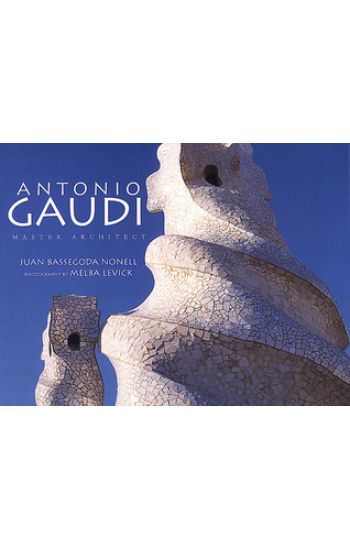
Antonio Gaudí (1852-1926) is one of the most admired architects of the 20th century. Even today, some 75 years after Gaudí's death, his fanciful, exuberant buildings define Barcelona's cityscape and continue to influence architects, sculptors, and designers. Perhaps best known for the dynamic, sculptural facades, found on such buildings as the church of the Sagrada Familia and Casa Milà, Gaudí is as much respected as a technological innovator as a daring stylist. In this enlightening volume, a concise, knowledgeable text by the director of the Royal Gaudí Chair at the Polytechnical University of Catalonia (Barcelona) combines with striking images by a well-known architectural photographer to provide a new perspective on Gaudí's remarkable career. The text covers the full range of his oeuvre, describing early assignments in the 1870s as a draftsman for leading architects in Barcelona, the innovative buildings he created for the Güell Palace and Estate, daring new structural solutions at Bellesguard, architecture inspired by nature at the Casa Calvet and in the Park Güell, and the construction of his unfinished masterpiece, the Church of the Sagrada Familia, which occupied him until his death. The author traces all the influences that led to his definitive style, from his fascination with the Orient and neogothicism to his affinity for naturalism and specific geometric forms. Brilliantly illustrated, this incisive overview of Gaudí's visionary work is ideal for those who delight in his architecture as well as those who look forward to travelling to Spain to see his monumental legacy.
Antonio's Devils

Antonio's Devils

Jeremy Asher Dauber

Stanford University Press
2004
sidottu
Antonio's Devils deals both historically and theoretically with the origins of modern Hebrew and Yiddish literature by tracing the progress of a few remarkable writers who, for various reasons and in various ways, cited Scripture for their own purpose, as Antonio's "devil," Shylock, does in The Merchant of Venice. By examining the work of key figures in the early history of Jewish literature through the prism of their allusions to classical Jewish texts, the book focuses attention on the magnificent and highly complex strategies the maskilim employed to achieve their polemical and ideological goals. Dauber uses this methodology to examine foundational texts by some of the Jewish Enlightenment's most interesting and important authors, reaching new and often surprising conclusions.
Antonio Gramsci

Antonio Gramsci

LOUISIANA STATE UNIVERSITY PRESS
1990
nidottu
Dante Germino's biography of the Italian communist and political theorist Antonio Gramsci offers a major reassessment of this important twentieth-century thinker. Germino analyses Gramsci's remarkable life as well as his extensive oeuvre, from the early Turin articles to the meditative Prison Notebooks.Gramsci saw society as composed of a small but powerful political center and a large body of emarginati, marginalized people at the periphery of society who are denied access to traditional positions of power. That vision led Gramsci to concentrate on the significance of the ""common man"" as he developed his theory of the political organisation of society. The persistent theme in Gramsci's work is how the ordinary man thinks, feels, and endures, and how the course of political institutions is shaped by the efforts of the marginalized to erode the boundaries of the center. Gramsci's approach is perhaps best expressed as a reunion of philosophy and experience and a revaluation of the quotidian.Gramsci's new politics of inclusion anticipated by well over a half-century the recent epoch-making developments in the USSR and in Eastern Europe. His antiauthoritarian leadership style as secretary of the Italian Communist party in the 1920s prefigured Gorbachev's policies of perestroika and glasnost. Gramsci's insistence on the international Communist movement's openness to new social formations at the grass roots is supremely relevant to developments in Romania, Czechoslovakia, East Germany, and Poland, where forces hitherto kept at the margins of political life by ossified Communist-party structures have burst on the scene with unprecedented vitality.Gramsci refused to revere Marx as a ""shepherd with a crook."" Equating history with the ""rhythm of liberty,"" he emerges as a prophetic voice in the desert of a bureaucratic and dogmatic communism. The dramatic recent changes in the Italian Communist party under Achille Ochetto also owe their ultimate inspiration to this diminutive, hunchbacked theorist-practitioner from Italy's periphery.Germino's compelling study of Gramsci's personal life and intellectual development offers fresh insights into Gramsci's work that will be of interest to all students of cultural and political theory. Of particular interest is his extensive consideration of the preprison writings both in their own right and for the light they cast on the Prison Notebooks.
The Songs of António Botto

The Songs of António Botto

António Botto

University of Minnesota Press
2010
sidottu
António Botto was one of Portugal's first openly gay writers, a poète maudit whose unapologetic and candid verses about homosexual life and passion were both praised and reviled when they appeared in Portuguese in 1922 under the title Canções. Botto's poetic voice-confessional, personal, and intimate-revels and luxuriates in eroticism while expressing the ache of longing, silence, and suffering. Yet for all of his acclaim and notoriety-he was both hailed as one of the great poets of his day and condemned for his frank depictions of male-male desire-Botto and his work fell into oblivion after his death.The Songs of António Botto recovers this important, urgent voice in modern poetry by making available-for the first time since its private publication in 1948-the English-language translation of Canções that Botto's friend and artistic collaborator, Fernando Pessoa, completed in 1933. Pessoa, Portugal's preeminent modernist literary figure, considered Botto the only Portuguese poet worthy of the label "aesthete" and, as a critic and publisher, championed his work. Featuring an introduction to Botto's work and Pessoa's previously unpublished foreword to the 1948 edition as well as a new translation of Botto's 1941 elegy to Pessoa, The Songs of António Botto establishes Botto as a pioneering figure in modern gay literature and places him alongside C. P. Cavafy and Federico García Lorca as one of the major poetic voices of the twentieth century.
The Songs of António Botto

The Songs of António Botto

António Botto

University of Minnesota Press
2010
nidottu
António Botto was one of Portugal's first openly gay writers, a poète maudit whose unapologetic and candid verses about homosexual life and passion were both praised and reviled when they appeared in Portuguese in 1922 under the title Canções. Botto's poetic voice-confessional, personal, and intimate-revels and luxuriates in eroticism while expressing the ache of longing, silence, and suffering. Yet for all of his acclaim and notoriety-he was both hailed as one of the great poets of his day and condemned for his frank depictions of male-male desire-Botto and his work fell into oblivion after his death.The Songs of António Botto recovers this important, urgent voice in modern poetry by making available-for the first time since its private publication in 1948-the English-language translation of Canções that Botto's friend and artistic collaborator, Fernando Pessoa, completed in 1933. Pessoa, Portugal's preeminent modernist literary figure, considered Botto the only Portuguese poet worthy of the label "aesthete" and, as a critic and publisher, championed his work. Featuring an introduction to Botto's work and Pessoa's previously unpublished foreword to the 1948 edition as well as a new translation of Botto's 1941 elegy to Pessoa, The Songs of António Botto establishes Botto as a pioneering figure in modern gay literature and places him alongside C. P. Cavafy and Federico García Lorca as one of the major poetic voices of the twentieth century.
Antonio: A Story of Saint Anthony of Padua

Antonio: A Story of Saint Anthony of Padua

Madeline Pecora Nugent

Pauline Books Media
2022
nidottu
The story of Saint Anthony of Padua has been told many times. But never like this. In this compelling biography, Madeline Nugent seamlessly unites historical facts with engaging narrative that reads like a novel. She draws on primary sources, scholarly research, time spent in Italy, and interviews with Franciscan experts to vividly present the world of Saint Anthony through the eyes of those who knew him best--and through the words of Anthony himself.
Antonio Enriquez Gomez

Antonio Enriquez Gomez

Nechama Kramer-Hellinx

Peter Lang Publishing Inc
1993
sidottu
Contemporaneo de Calderon de la Barca y de Lope de Vega, Antonio Enriquez Gomez, un judaizante espanol, no obtuvo mucha fama hasta estos ultimos anos, a pesar de que varias obras suyas fueron atribuidas, erroneamente, a estos dos dramaturgos celebres. Este estudio fascinante sobre la obra mas conocida de Antonio Enriquez Gomez, El siglo pitagorico y Vida de don Gregorio Guadana, explora varios temas, tendencias y tecnicas literarias. La obra investiga y demuestra la relacion directa entre la vida de nuestro autor judaizante, la sociedad y la Inquisicion del siglo 17, y los movimientos literarios y filosoficos, tal como la picaresca y la filosofia pitagorica de la transmigracion de las almas.
Moscovia of Antonio Possevino, S.J., The

Moscovia of Antonio Possevino, S.J., The

Antonio Possevino; Hugh F. Graham

University of Pittsburgh Press
1977
nidottu
This translation provides a descriptive account of the court of Tsar Ivan IV, in sixteenth-century Moscow, as seen through the eyes of papal envoy and Jesuit Antonio Possevino S.J. , who was sent to negotiate a peace between Muscovy and the Polish-Lithuanian commonwealth.