Kirjojen hintavertailu. Mukana 11 244 527 kirjaa ja 12 kauppaa.

Kirjahaku

Etsi kirjoja tekijän nimen, kirjan nimen tai ISBN:n perusteella.

1000 tulosta hakusanalla Arjun Subedi

Management of High Grade Bladder Cancer: A Multidisciplinary Approach, An Issue of Urologic Clinics
The Guest Editors have assembled top key opinion leaders to provide current reviews on the multidisciplinary approach to the management of high-grade bladder cancer. Articles are devoted to fluorescence cystoscopy, confocal laser endomicroscopy, narrow band imaging; Novel therapeutic approaches for recurrent nonmuscle invasive bladder cancer; Trimodality therapy in bladder cancer; the data and the reality of perioperative chemotherapy in muscle invasive bladder cancer; radical transurethral resection alone, robotic or partial cystectomy or extended lymphadenectomy: Neoadjuvant paradigm for drug development in muscle invasive bladder cancer; Novel biomarkers to predict response and prognosis in localized bladder cancer; Immunotherapy in Advanced/Metastatic Urothelial Cancer ; and Adjuvant Chemotherapy in High Grade Upper Tract Urothelial Cancer.
The Teaching of Kathakali in Australia
This book tells the story of teaching Kathakali, a seventeenth century Indian dance-drama, to contemporary performers in Australia.A rigorous analysis and detailed documentation of the teaching of multiple learners in Melbourne, both in the group workshop mode and one-on-one, combined with the author’s ethnographic research in India, leads to a unique insight into what the author argues persuasively is at the heart of the art’s aesthetic- a practical realisation of the theory of rasa as first articulated in the ancient Sanskrit treatise on drama The Natyashastra. The research references the latest discoveries in neuroscience on ‘mirror neurons’ and argues for a reconceptualization of Kathakali’s imitative methodology, advancing it from the reductive category of ‘mimicry’ to a more contemporary and complex mirroring which is where its value lies in Australian actor performer training.The Teaching of Kathakali in Australia will be of great interest to students and scholars of theatre and dance, intercultural actor training, practice-led research, and interdisciplinary studies of neuroscience and performance.
The Teaching of Kathakali in Australia

The Teaching of Kathakali in Australia

Arjun Raina

TAYLOR FRANCIS LTD
2022
nidottu
This book tells the story of teaching Kathakali, a seventeenth century Indian dance-drama, to contemporary performers in Australia.A rigorous analysis and detailed documentation of the teaching of multiple learners in Melbourne, both in the group workshop mode and one-on-one, combined with the author’s ethnographic research in India, leads to a unique insight into what the author argues persuasively is at the heart of the art’s aesthetic- a practical realisation of the theory of rasa as first articulated in the ancient Sanskrit treatise on drama The Natyashastra. The research references the latest discoveries in neuroscience on ‘mirror neurons’ and argues for a reconceptualization of Kathakali’s imitative methodology, advancing it from the reductive category of ‘mimicry’ to a more contemporary and complex mirroring which is where its value lies in Australian actor performer training.The Teaching of Kathakali in Australia will be of great interest to students and scholars of theatre and dance, intercultural actor training, practice-led research, and interdisciplinary studies of neuroscience and performance.
A Military History of India since 1972

A Military History of India since 1972

Arjun Subramaniam

University Press of Kansas
2021
sidottu
A Military History of India since 1972 is a definitive work of military history that gives the Indian military its rightful place as a key contributor to Indian democracy. Arjun Subramaniam offers an engaging narrative that combines superb storytelling with the academic rigor of deep research and analysis. It is a comprehensive account of India's resolute, responsible, and restrained use of force as an instrument of statecraft and how the military has played an essential role in securing the country's democratic tradition along with its rise as an economic and demographic power.This book is also about how the Indian nation-state and its armed forces have coped with the changing contours of modern conflict in the decades since 1972. These include the 2016 'surgical' or cross-border strikes across the Line of Control with Pakistan by the Indian Army's Special Forces, the face-offs with the Chinese at Doklam in 2017 and in Ladakh in 2020, the preemptive punitive strikes by the Indian Air Force against terrorist camps in Pakistan in 2019, and the large-scale aerial engagement between the Indian Air Force and the Pakistan Air Force the following day. These conflicts also include the long-running insurgencies in the northeast, terrorism and proxy war in Jammu and Kashmir, separatist violence in Punjab, and the Indian Peace Keeping Force's intervention in Sri Lanka. The author also includes a chapter on the development of India's nuclear capabilities.Arjun Subramaniam enlivens the narrative with a practitioner's insights amplified by interviews and conversations with almost a hundred serving and retired officers, including former chiefs from all the three armed forces for an in-depth exploration of land, air, and naval operations. The structure of the book offers readers a choice of either embarking on a comprehensive and chronological examination of war and conflict in contemporary India or a selective reading based on specific timelines or campaigns.
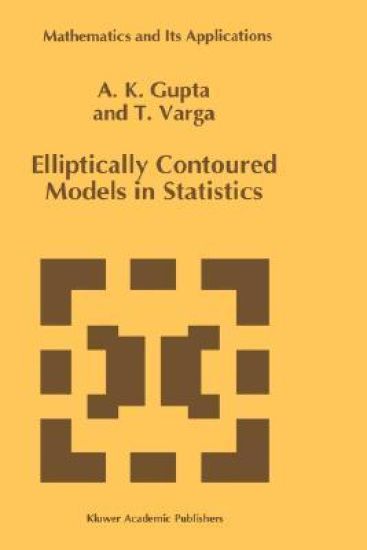
Elliptically Contoured Models in Statistics

Elliptically Contoured Models in Statistics

Arjun K. Gupta; Tamas Varga

Springer
1993
sidottu
In multivariate statistical analysis, elliptical distributions have recently provided an alternative to the normal model. Most of the work, however, is spread out in journals throughout the world and is not easily accessible to the investigators. Fang, Kotz, and Ng presented a systematic study of multivariate elliptical distributions, however, they did not discuss the matrix variate case. Recently Fang and Zhang have summarized the results of generalized multivariate analysis which include vector as well as the matrix variate distributions. On the other hand, Fang and Anderson collected research papers on matrix variate elliptical distributions, many of them published for the first time in English. They published very rich material on the topic, but the results are given in paper form which does not provide a unified treatment of the theory. Therefore, it seemed appropriate to collect the most important results on the theory of matrix variate elliptically contoured distributions available in the literature and organize them in a unified manner that can serve as an introduction to the subject. The book will be useful for researchers, teachers, and graduate students in statistics and related fields whose interests involve multivariate statistical analysis. Parts of this book were presented by Arjun K Gupta as a one semester course at Bowling Green State University. Some new results have also been included which generalize the results in Fang and Zhang. Knowledge of matrix algebra and statistics at the level of Anderson is assumed. However, Chapter 1 summarizes some results of matrix algebra.
Many Tongues, One People

Many Tongues, One People

Arjun Guneratne

Cornell University Press
2002
pokkari
The Tharu of lowland Nepal are a group of culturally and linguistically diverse people who, only a few generations ago, would not have acknowledged each other as belonging to the same ethnic group. Today the Tharu are actively redefining themselves as a single ethnic group in Nepal's multiethnic polity. In Many Tongues, One People, Arjun Guneratne argues that shared cultural symbols—including religion, language, and common myths of descent—are not a necessary condition for the existence of a shared sense of peoplehood. The many diverse and distinct socio-cultural groups sharing the name "Tharu" have been brought together, Guneratne asserts, by a common relationship to the state and a shared experience of dispossession and exploitation that transcends their cultural differences. Tharu identity, the author shows, has developed in opposition to the activities of a modernizing, centralizing state and through interaction with other ethnic groups that have immigrated to the Tarai region where the Tharu live.This book"s claims have wide implications for the study of ethnic identity and are applicable far beyond Nepal. The emergence of the category of Native American, for example, may be considered an analogous case because that ethnic identity, like the Tharu, subsumes people of different cultural origin, and has been defined both through the state and against it.
Modernity At Large

Modernity At Large

Arjun Appadurai

University of Minnesota Press
1996
nidottu
Examines the role of imagination in the cultural development of our shrinking world. The world is growing smaller. Every day we hear this idea expressed and witness its reality in our lives-through the people we meet, the products we buy, the foods we eat, and the movies we watch. In this bold look at the cultural effects of a shrinking world, leading cultural theorist Arjun Appadurai places these challenges and pleasures of contemporary life in a broad global perspective. Offering a new framework for the cultural study of globalization, Modernity at Large shows how the imagination works as a social force in today's world, providing new resources for identity and energies for creating alternatives to the nation-state, whose era some see as coming to an end. Appadurai examines the current epoch of globalization, which is characterized by the twin forces of mass migration and electronic mediation, and provides fresh ways of looking at popular consumption patterns, debates about multiculturalism, and ethnic violence. He considers the way images-of lifestyles, popular culture, and self-representation-circulate internationally through the media and are often borrowed in surprising (to their originators) and inventive fashions. Appadurai simultaneously explores and explodes boundaries-between how we imagine the world and how that imagination influences our self-understanding, between social institutions and their effects on the people who participate in them, between nations and peoples that seem to be ever more homogeneous and yet ever more filled with differences. Modernity at Large offers a path to move beyond traditional oppositions between culture and power, tradition and modernity, global and local, pointing out the vital role imagination plays in our construction of the world of today-and tomorrow.
Probability and Statistical Models

Probability and Statistical Models

Arjun K. Gupta; Wei-Bin Zeng; Yanhong Wu

Birkhauser Boston Inc
2010
sidottu
Probability models are now a vital componentof every scienti c investigation. This book is intended to introduce basic ideas in stochastic modeling, with emphasis on models and techniques. These models lead to well-known parametric lifetime distributions, such as exponential, Weibull, and gamma distributions, as well as the change-point and mixture models. They also motivate us to consider more general notions of nonparametric lifetime distribution classes. Particular attention has been paid to their applications in reliability, insurance mathematics, and economics. The following topics are the focus in this volume: 1. Exponential Distributions and the Poisson Process; 2. Parametric Lifetime Distributions; 3. Nonparametric Lifetime Distribution Classes; 4. Multivariate Exponential Extensions; 5. Association and Dependence; 6. Renewal Theory; 7. Applications to Reliability, Insurance, Finance, and Credit Risk. Chapter1providesnotationandbasicresultsinprobabilitytheorythatareneeded in the consequent chapters. Chapters 2 and 3 are devoted to models related to exponential distribution and Poisson processes. Particular attentions is paid to the characterizations of exponential distribution and the Poisson process. Two of the most important properties that characterize exponential distribution: the lack of memory property and constant failure rate are discussed in detail. Then the g- eralizations of exponential distribution are examined in three directions: through its parametric form that leads to parametric families of lifetime distributions; via notionsof aging(such as monotonefailure rate) that lead to a varietyof lifetime d- tribution classes; and through lifetime distributions of multiple component systems that lead to multivariate (mainly bivariate) exponential extension.
Fear of Small Numbers

Fear of Small Numbers

Arjun Appadurai

Duke University Press
2006
sidottu
The period since 1989 has been marked by the global endorsement of open markets, the free flow of finance capital and liberal ideas of constitutional rule, and the active expansion of human rights. Why, then, in this era of intense globalization, has there been a proliferation of violence, of ethnic cleansing on the one hand and extreme forms of political violence against civilian populations on the other?Fear of Small Numbers is Arjun Appadurai’s answer to that question. A leading theorist of globalization, Appadurai turns his attention to the complex dynamics fueling large-scale, culturally motivated violence, from the genocides that racked Eastern Europe, Rwanda, and India in the early 1990s to the contemporary “war on terror.” Providing a conceptually innovative framework for understanding sources of global violence, he describes how the nation-state has grown ambivalent about minorities at the same time that minorities, because of global communication technologies and migration flows, increasingly see themselves as parts of powerful global majorities. By exacerbating the inequalities produced by globalization, the volatile, slippery relationship between majorities and minorities foments the desire to eradicate cultural difference.Appadurai analyzes the darker side of globalization: suicide bombings; anti-Americanism; the surplus of rage manifest in televised beheadings; the clash of global ideologies; and the difficulties that flexible, cellular organizations such as Al-Qaeda present to centralized, “vertebrate” structures such as national governments. Powerful, provocative, and timely, Fear of Small Numbers is a thoughtful invitation to rethink what violence is in an age of globalization.
Fear of Small Numbers

Fear of Small Numbers

Arjun Appadurai

Duke University Press
2006
pokkari
Providing a conceptually innovative framework for understanding sources of global violence, this work describes how the nation-state has grown ambivalent about minorities at the same time that minorities, because of global communication technologies and migration flows, increasingly see themselves as parts of powerful global majorities.
Globalization

Globalization

Arjun Appadurai

Duke University Press
2000
pokkari
This second installment of Public Culture’s Millennial Quartet seeks to intervene in the increasingly heated debates surrounding the cultural dimensions of globalization, which includes debates about what globalization is and whether it is a meaningful term. The volume focuses in particular on the way that changing sites-local, regional, diasporic-are the scenes of emergent forms of sovereignty in which matters of style, sensibility, and ethos articulate new legalities and new kinds of violence.Seeking an alternative to the dead-end debate between those who see globalization as a phenomenon wholly without precedent and those who see it simply as modernization, imperialism, or global capitalism with a new face, the contributors seek to illuminate how space and time are transforming each other in special ways in the present era. They examine how this complex transformation involves changes in the situation of the nation, the state, and the city. While exploring distinct regions-China, Africa, South America, Europe-and representing different disciplines and genres-anthropology, literature, political science, sociology, music, cinema, photography-the contributors are concerned with both the political economy of location and the locations in which political economies are produced and transformed. A special strength of the collection is its concern with emergent styles of subjectivity, citizenship, and mobilization and with the transformations of state power through which market rationalities are distributed and embodied locally.Contributors. Arjun Appadurai, JÉrome BindÉ, NÉstor GarcÍa Canclini, Leo Ching, Steven Feld, Ralf D. Hotchkiss, Wu Hung, Andreas Huyssen, Boubacar TourÉ MandÉmory, Achille Mbembe, Saskia Sassen, Fatu Kande Senghor, Seteney Shami, Anna Tsing, Zhang Zhen
The Nuclear Power Deception

The Nuclear Power Deception

Arjun Makhijani; Scott Saleska

Apex Press
1999
nidottu
This book provides critical analysis and historical evidence to refute the claims of the nuclear power industry that nuclear power can alleviate the build-up of greenhouse gases and reduce U.S. dependence on foreign oil. It also reveals the hazards of further proliferation of nuclear weapons from the growing quantities of plutonium generated by existing nuclear power plants throughout the world. Prepared under the auspices of a scientifically respected institute, "The Nuclear Power Deception" exposes the flagrant misrepresentation of nuclear power as "to cheap to meter" and environmentally benign and safe by government and industry officials in the 1940s and 1950s when they had ample evidence to the contrary. Instead they suppressed that evidence, much of which is presented in this book. Essential background reading for students, teachers, peace and environmental activists, and others concerned about the threat nuclear power continues to pose for the future of humankind.
Structural Design of Interlocking Concrete Block Pavements

Structural Design of Interlocking Concrete Block Pavements

Arjun Siva Rathan R.T; Sunitha V

TAYLOR FRANCIS LTD
2024
sidottu
This book focuses on the structural design of Interlocking Concrete Block Pavement (ICBP) including application, analysis, design, construction, and the fundamental design concept of ICBP backed by case studies to demonstrate long- term performance of ICBP. It helps to draw conclusions regarding the various geometric properties that must be applied to achieve the performance of ICBP.Features: Promotes the use of ICBP in the construction of pavements. Provides a comprehensive overview of concrete block paving. Discusses specifications from codes like ASCE 58- 16, ASTM, BS and IRC codes and datasets online. Includes chapters on choosing the materials and designing the type and the shape of the concrete block and the thickness of all layers of the pavement. Lists appropriate stipulated values for the various geometric properties. Aids in understanding the history and comprehensive application of ICBP.This book is aimed at graduate students and researchers in pavement and civil engineering.
Death at the Durbar: The Second Maharaja Mystery [Large Print 16 Pt Edition]
December, 1911. All of India is in a tizzy. A vast tent city has sprung up outside the old walled enclave of Mughal Delhi, where the British are hosting a grand Durbar to celebrate the coronation of the new King, George V. From across India, all the Maharajas and Nawabs have gathered at the Viceroy of India's command to pay homage and swear loyalty to the King Emperor, the first monarch of England to travel out to India personally...
Interpreting Ibn 'Arabi

Interpreting Ibn 'Arabi

Arjun Nair

TAYLOR FRANCIS LTD
2025
sidottu
Ibn ?Arabi (d. 638/1240) is perhaps the most challenging intellectual figure of later Islamic history, being at once highly celebrated and highly vilified. This book explores an interpretive and commentary tradition around his controversial ideas.
Sleepless Nights Scribbling

Sleepless Nights Scribbling

Arjun Unnikrishnan

Earthadathu
2024
sidottu
Sleepless Nights Scribbling is a collection of writings tracing the evolution of the writer over a decade. This book brings to the reader a refreshing look at stories and essays from the perspective of a millennial Indian facing the challenges of a changing nation. Politics, entertainment, human condition, sexuality, social taboos, customs, religion; various topics pertinent in the minds of the young Indian are touched upon in these short pieces that aim to question, challenge, as well as entertain.