Kirjahaku
Etsi kirjoja tekijän nimen, kirjan nimen tai ISBN:n perusteella.
1000 tulosta hakusanalla Arthur B. Darling
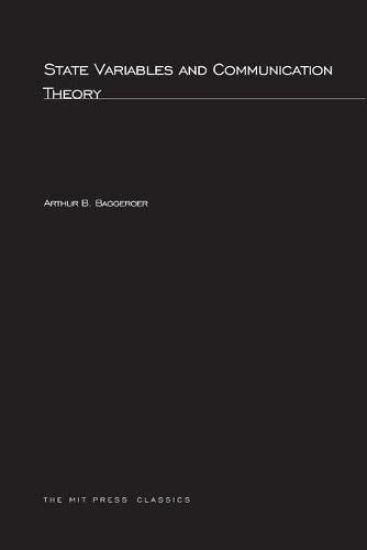
Although state variable concepts are a part of modern control theory, they have not been extensively applied in communication theory. The purpose of this book is to demonstrate how the concepts and methods of state variables can be used advantageously in analyzing a variety of communication theory problems. In contrast to the impulse response and covariance function description of systems and random processes commonly used in the analysis of communication problems, Professor Baggeroer points out that a state variable approach describes these systems and processes in terms of differential equations and their excitation, which is usually a white-noise process. Theoretically, such a description provides a very general characterization on which a large class of systems, possibly time varying and nonlinear, can be modeled. Practically, the state variable approach often provides a more representative physical description of the actual dynamics of the systems involved and, most importantly, can lead to solution techniques that are readily implemented on a computer and that yield specific numerical results. The work focuses on how state variables can be used to solve several of the integral equations that recur in communication theory including, for example, the Kahunen-Loeve theorem, the detection of a known signal in the presence of a colored noise, and the Wiener-Hopf equation. The book is divided into two parts. The first part deals with the development from first principles of the state variable solution techniques for homogeneous and inhomogeneous Fredholm integral solutions. The second part considers two specific applications of the author's integral equation theory: to optimal signal design for colored noise channels, and to linear estimation theory. The main thrust of the material presented in this book is toward finding effective numerical procedures for analyzing complex problems. Professor Baggeroer has combined several different mathematical tools not commonly used together to attack the detection and signal design problems. Numerous examples are presented throughout the book to emphasize the numerical aspects of the author's methods. If the reader is familiar with detection and estimation theory and with deterministic state variable concepts, the ideas, techniques, and results contained in this work will prove highly relevant, if not directly applicable, to a large number of communication theory problems.MIT Research Monograph No. 61

This brilliant study of Verne's three cycles (1850-62, 1862-86, 1886-1916) analyzes the works from a biographical, sociohistorical, ideological, and narratological point of view. With a deep focus on Verne's pedagogical slant, Evans demonstrates convincingly the parallels between the French author's aim to `de-alienate' science and his aim to valorize learning, knowledge, and reading (his heroes conquer more knowledge for themselves and for the world). Choice This first modern American study of Jules Verne offers a wide-ranging reappraisal of a very familiar but often misunderstood author and his works. In spite of his status as one of the most translated novelists of all time, Verne and his Voyages Extraordinaires have long been neglected in American literary scholarship. This book seeks to reaffirm Verne's significant contribution to the development of early science fiction through a detailed investigation of his romans scientifiques. Evans has focused his study on the didactic dimension of Verne's narratives, which were originally intended to teach the rudements of science and morality to French youth through the medium of popular fiction.
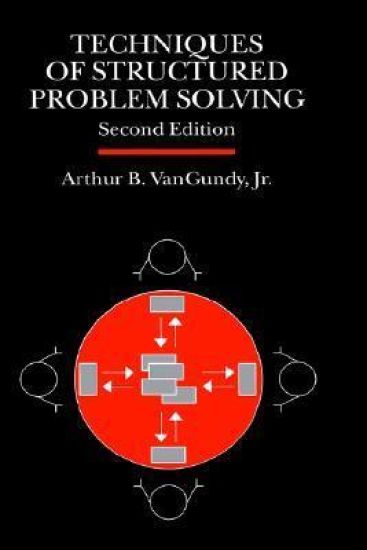
Techniques of Structured Problem Solving
Arthur B. VanGundy
Van Nostrand Reinhold Inc.,U.S.
1988
sidottu




Key players in organized labour in the USA and abroad are busy modernizing their communications and making creative and effective use of computers and other technology. The author of this book argues that the road to CyberUnion has begun and that those unions are ensuring a future strength.
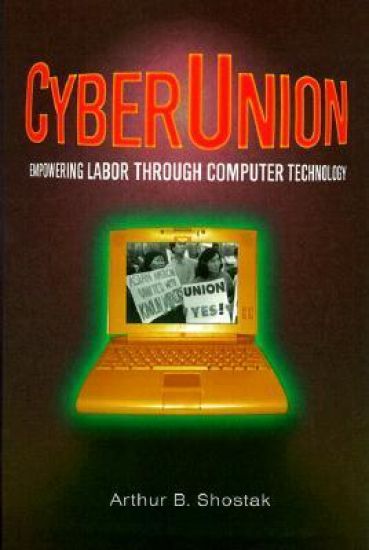
Key players in organized labour in the USA and abroad are busy modernizing their communications and making creative and effective use of computers and other technology. The author of this book argues that the road to CyberUnion has begun and that those unions are ensuring a future strength.
The Cyberunion Handbook: Transforming Labor Through Computer Technology
Arthur B Shostak
Routledge
2001
sidottu
In his original CyberUnion, the author presented a bold plan for unions to develop a more significant role in the 21st century by adopting four strategic aids - futuristics, innovations, services, and traditions (F-I-S-T) - knit together by cutting-edge Info Tech resources. CyberUnions in Action expands on the F-I-S-T model and looks at gains and setbacks in pioneering efforts to create "CyberUnions". It highlights relevant websites, and features interviews with key CyberUnion advocates (and some critics). Shostak reviews overseas union efforts for transferable lessons, and pays special attention to the AFL-CIO campaign to ensure Labor's advances in the use of computer networks, the Internet, wireless devices, and more.
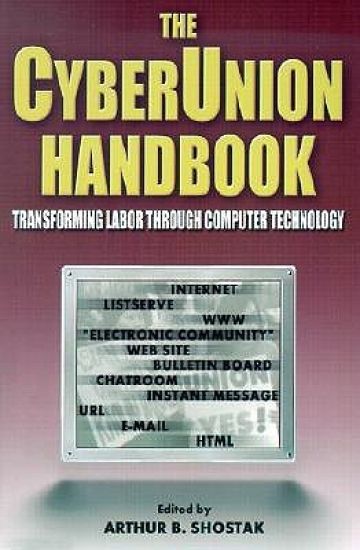
The Cyberunion Handbook: Transforming Labor Through Computer Technology
Arthur B Shostak
Routledge
2002
nidottu
In his original CyberUnion, the author presented a bold plan for unions to develop a more significant role in the 21st century by adopting four strategic aids - futuristics, innovations, services, and traditions (F-I-S-T) - knit together by cutting-edge Info Tech resources. CyberUnions in Action expands on the F-I-S-T model and looks at gains and setbacks in pioneering efforts to create "CyberUnions". It highlights relevant websites, and features interviews with key CyberUnion advocates (and some critics). Shostak reviews overseas union efforts for transferable lessons, and pays special attention to the AFL-CIO campaign to ensure Labor's advances in the use of computer networks, the Internet, wireless devices, and more.

Knowledge representation is fundamental to the study of mind. All theories of psychological processing are rooted in assumptions about how information is stored. These assumptions, in turn, influence the explanatory power of theories. This book fills a gap in the existing literature by providing an overview of types of knowledge representation techniques and their use in cognitive models. Organized around types of representations, this book begins with a discussion of the foundations of knowledge representation, then presents discussions of different ways that knowledge representation has been used. Both symbolic and connectionist approaches to representation are discussed and a set of recommendations about the way representations should be used is presented. This work can be used as the basis for a course on knowledge representation or can be read independently. It will be useful to students of psychology as well as people in related disciplines--computer science, philosophy, anthropology, and linguistics--who want an introduction to techniques for knowledge representation.
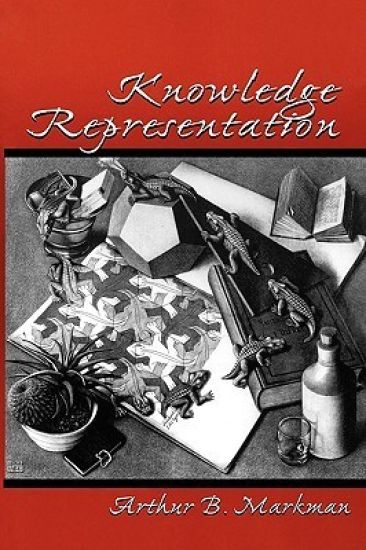
Knowledge representation is fundamental to the study of mind. All theories of psychological processing are rooted in assumptions about how information is stored. These assumptions, in turn, influence the explanatory power of theories. This book fills a gap in the existing literature by providing an overview of types of knowledge representation techniques and their use in cognitive models. Organized around types of representations, this book begins with a discussion of the foundations of knowledge representation, then presents discussions of different ways that knowledge representation has been used. Both symbolic and connectionist approaches to representation are discussed and a set of recommendations about the way representations should be used is presented. This work can be used as the basis for a course on knowledge representation or can be read independently. It will be useful to students of psychology as well as people in related disciplines--computer science, philosophy, anthropology, and linguistics--who want an introduction to techniques for knowledge representation.

Historians know a great deal about how English thinkers of the sixteenth and seventeenth centuries saw the "documentable" past, but relatively little about how they perceived times stretching back beyond history. Arthur B. Ferguson shows in this elegant essay that prehistory had great meaning in Renaissance England. Commentators of various sorts-from poets to antiquaries-looked to the most distant past for the vanishing point that would perfect their historical perspective and orient them in an age of increasing change. In this pursuit they had often to let imagination serve the purposes of interpretation. Though largely speculative, their efforts reveal much about the intellectual life of Renaissance England.Since the Bible left little room for speculation on prehistory-in fact no room at all for the concept itself-Utter Antiquity concentrates on myth and legend outside of the biblical context and on those who conjured prehistory out of these sources. A subtle conflict between belief and skepticism emerges from these pages, as Ferguson reveals how some Renaissance writers struggled with ancient explanations that flouted reason and experience, while others sidestepped such doubts by relating prehistory to man's social evolution. By isolating and analyzing topics such as skepticism, rationalism, and poetic history, Ferguson illuminates the development of historical consciousness in early modern England. His accessible and eloquent study contributes significantly to an understanding of the Renaissance mind and intellectual history in general.

Teaching General Chemistry
Arthur B. Ellis; Margret J. Geselbracht; Brian J. Johnson; George C. Lisensky; William R. Robinson
American Chemical Society
1993
nidottu
This resource volume, written especially for teachers of introductory chemistry courses, is in a ready-to-use format that will enable instructors to integrate materials chemistry into their curriculum. The book collects a critical mass of text, demonstrations, and laboratory experiments. The first ten chapters present a general introduction to solids; numerous easy-to-do teacher demonstrations are integrated into the material. The second part of the volume consists of fifteen laboratory experiments for students. Examples from cutting-edge research, as well as everyday life, spark student interest while illustrating the basic ideas that are important to an understanding of chemistry.