Kirjojen hintavertailu. Mukana 11 244 527 kirjaa ja 12 kauppaa.

Kirjahaku

Etsi kirjoja tekijän nimen, kirjan nimen tai ISBN:n perusteella.

1000 tulosta hakusanalla Arvind Kumar

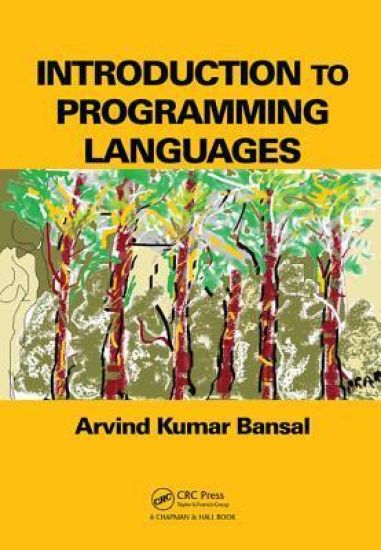
Introduction to Programming Languages

Introduction to Programming Languages

Arvind Kumar Bansal

CRC Press Inc
2013
nidottu
In programming courses, using the different syntax of multiple languages, such as C++, Java, PHP, and Python, for the same abstraction often confuses students new to computer science. Introduction to Programming Languages separates programming language concepts from the restraints of multiple language syntax by discussing the concepts at an abstract level.Designed for a one-semester undergraduate course, this classroom-tested book teaches the principles of programming language design and implementation. It presents: Common features of programming languages at an abstract level rather than a comparative levelThe implementation model and behavior of programming paradigms at abstract levels so that students understand the power and limitations of programming paradigms Language constructs at a paradigm levelA holistic view of programming language design and behaviorTo make the book self-contained, the author introduces the necessary concepts of data structures and discrete structures from the perspective of programming language theory. The text covers classical topics, such as syntax and semantics, imperative programming, program structures, information exchange between subprograms, object-oriented programming, logic programming, and functional programming. It also explores newer topics, including dependency analysis, communicating sequential processes, concurrent programming constructs, web and multimedia programming, event-based programming, agent-based programming, synchronous languages, high-productivity programming on massive parallel computers, models for mobile computing, and much more. Along with problems and further reading in each chapter, the book includes in-depth examples and case studies using various languages that help students understand syntax in practical contexts.
Introduction to Computational Health Informatics

Introduction to Computational Health Informatics

Arvind Kumar Bansal; Javed Iqbal Khan; S. Kaisar Alam

Productivity Press
2020
nidottu
This class-tested textbook is designed for a semester-long graduate or senior undergraduate course on Computational Health Informatics. The focus of the book is on computational techniques that are widely used in health data analysis and health informatics and it integrates computer science and clinical perspectives. This book prepares computer science students for careers in computational health informatics and medical data analysis.Features Integrates computer science and clinical perspectives Describes various statistical and artificial intelligence techniques, including machine learning techniques such as clustering of temporal data, regression analysis, neural networks, HMM, decision trees, SVM, and data mining, all of which are techniques used widely used in health-data analysis Describes computational techniques such as multidimensional and multimedia data representation and retrieval, ontology, patient-data deidentification, temporal data analysis, heterogeneous databases, medical image analysis and transmission, biosignal analysis, pervasive healthcare, automated text-analysis, health-vocabulary knowledgebases and medical information-exchange Includes bioinformatics and pharmacokinetics techniques and their applications to vaccine and drug development
Einfluss von THI-Veränderungen auf hämatobiochemische und hormonelle Parameter
Der Viehsektor entwickelt sich zu einem wichtigen Wachstumshebel der indischen Wirtschaft. Als Bestandteil des Agrarsektors ist sein Anteil am Bruttoinlandsprodukt allm hlich gestiegen, w hrend der des Pflanzensektors r ckl ufig war. Die Tierressourcen Indiens sind vielleicht die reichsten der Welt. Indien ist eines der wenigen L nder der Welt, das einen gro en Beitrag zum internationalen Genpool f r Nutztiere geleistet hat. Rinderrassen indischen Ursprungs werden in einigen L ndern, darunter Australien, S dafrika, Lateinamerika und den USA, f r die Entwicklung gro er Tierwirtschaften (FAO, 1998) mit allein etwa 485,0 Millionen Nutztieren (ohne Gefl gel) ausgebeutet. Indien hat ungef hr 19% der weltweiten Rinder- und B ffelpopulation (FAO, 2008). In Indien gibt es 26 gut anerkannte Rinderrassen, von denen nur 4 Milchvieh sind, n mlich Sahiwal, Red Sindhi, Tharparkar und Gir. Unter diesen ist Sahiwal eine der besten Milchrassen tropischer und subtropischer Regionen. Indien besitzt nur wenige K pfe von Sahiwal, aber nicht mehr als 3000 K pfe, von denen 2000 z chtbare Frauen sind und nur in einigen organisierten Farmen gehalten werden.
Effet des changements de THI sur les paramètres hématobiochimiques et hormonaux
Le secteur de l' levage est en train de devenir un levier de croissance important de l' conomie indienne. En tant que composante du secteur agricole, sa part dans le produit int rieur brut a augment progressivement, tandis que celle du secteur des cultures a diminu . Les ressources animales de l'Inde sont peut- tre les plus riches du monde. L'Inde est l'un des rares pays au monde avoir largement contribu au pool g n tique international du b tail. Les races bovines d'origine indienne sont exploit es dans un certain nombre de pays, dont l'Australie, l'Afrique du Sud, l'Am rique latine et les tats-Unis, pour le d veloppement des principales conomies d' levage (FAO, 1998) avec environ 485 millions de t tes de b tail ( l'exclusion de la volaille). L'Inde compte environ 19% de la population mondiale de bovins et de buffles (FAO, 2008). L'Inde compte 26 races de bovins bien connues, dont seulement 4 sont de type laitier, savoir le Sahiwal, le Red Sindhi, le Tharparkar et le Gir. Parmi ceux-ci, Sahiwal est l'une des meilleures races laiti res des r gions tropicales et subtropicales. L'Inde poss de peu de t tes de Sahiwal mais pas plus de 3000 t tes, dont 2000 sont des femelles reproductibles et ne sont maintenues que dans certaines fermes organis es.