

Kirjahaku
Etsi kirjoja tekijän nimen, kirjan nimen tai ISBN:n perusteella.
1000 tulosta hakusanalla Auguste Ehrhard




The Mounments Of Upper Egypt, A Translation Of The "itineraire De La Haute Egypte," Of Auguste Mariette-bey
Auguste Mariette
Hutson Street Press
2025
sidottu

The Mounments Of Upper Egypt, A Translation Of The "itineraire De La Haute Egypte," Of Auguste Mariette-bey
Auguste Mariette
Hutson Street Press
2025
pokkari

First published in 1928, Auguste Comte is a biography of the famous French philosopher Auguste Comte, the founder of the doctrine of positivism. In this book, the author traces Comte’s journey from his birth till his death. The final chapter ‘After Days’ provides a commentary on the changes the society underwent over a course of seventy years after Comte’s death. The author draws upon the works of Auguste Comte published during the period 1829–1927 to give an extensive and well researched account of the philosopher’s life and work.

First published in 1928, Auguste Comte is a biography of the famous French philosopher Auguste Comte, the founder of the doctrine of positivism. In this book, the author traces Comte’s journey from his birth till his death. The final chapter ‘After Days’ provides a commentary on the changes the society underwent over a course of seventy years after Comte’s death. The author draws upon the works of Auguste Comte published during the period 1829–1927 to give an extensive and well researched account of the philosopher’s life and work.






Lettres D'Auguste Comte A John Stuart Mill 1841-1846 (1877)
Auguste Comte
KESSINGER PUBLISHING, LLC
2009
pokkari
The Positive Philosophy of Auguste Comte 2 Volume Paperback Set
Auguste Comte
Cambridge University Press
2009
muu
The Positive Philosophy of Auguste Comte is a condensed English version of the French philosopher's controversial work, freely translated by Harriet Martineau and published in two volumes in 1853. Martineau's abridged and more easily digestible version of Comte's work was intended to be readily accessible to a wide general readership, particularly those she felt to be morally and intellectually adrift, and Comte's philosophy indeed attracted a significant following in Britain in the later nineteenth century. Comte's 'doctrine' promoted personal and public ethics and social cohesion based no longer on metaphysics but on strict scientific method, and anticipated twentieth-century logical positivism and secular humanism. Volume 1 covers mathematics and science, while Volume 2 presents Comte's new science of 'social physics' and outlines his theories about society and human progress.
The Positive Philosophy of Auguste Comte is a condensed English version of the French philosopher's controversial work, freely translated by Harriet Martineau and published in two volumes in 1853. Martineau's abridged and more easily digestible version of Comte's work was intended to be readily accessible to a wide general readership, particularly those she felt to be morally and intellectually adrift, and Comte's philosophy indeed attracted a significant following in Britain in the later nineteenth century. Comte's 'doctrine' promoted personal and public ethics and social cohesion based no longer on metaphysics but on strict scientific method, and anticipated twentieth-century logical positivism and secular humanism. The first volume of this translation contains Parts 1 to 5 and sets out the nature and importance of positivism, leading on to an overview of the 'positive sciences': mathematics, astronomy, physics, chemistry and biology.
The Positive Philosophy of Auguste Comte is a condensed English version of the French philosopher's controversial work, freely translated by Harriet Martineau and published in two volumes in 1853. Martineau's abridged and more easily digestible version of Comte's work was intended to be readily accessible to a wide general readership, particularly those she felt to be morally and intellectually adrift, and Comte's philosophy indeed attracted a significant following in Britain in the later nineteenth century. Comte's 'doctrine' promoted personal and public ethics and social cohesion based no longer on metaphysics but on strict scientific method, and anticipated twentieth-century logical positivism and secular humanism. The second volume of this translation is devoted entirely to Comte's new science of 'social physics' and human progress, and outlines his theories about society and its development through various phases - theological, humanistic and finally scientific.
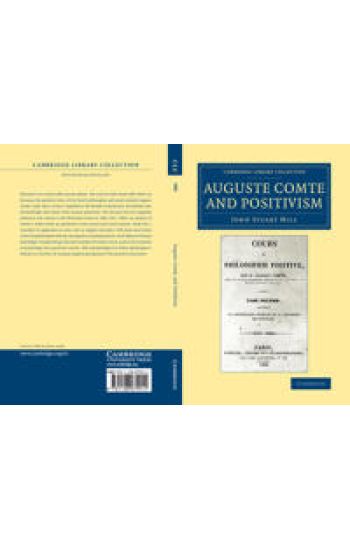
Reissued in its revised 1866 second edition, this work by John Stuart Mill (1806–73) discusses the positivist views of the French philosopher and social scientist Auguste Comte (1798–1857). Comte is regarded as the founder of positivism, the doctrine that all knowledge must derive from sensory experience. The two-part text was originally printed as two articles in the Westminster Review in 1865. Part 1 offers an analysis of Comte's earlier works on positivism in the natural and social sciences, while Part 2 considers its application in areas such as religion and ethics. Mill states that Comte is the first philosopher who has attempted to extend positivism 'to all objects of human knowledge'. Despite being critical of a number of Comte's views, such as the exclusion of psychology from positivist science, Mill acknowledges his fellow philosopher's influence in the face of common negative perceptions of the positivist movement.