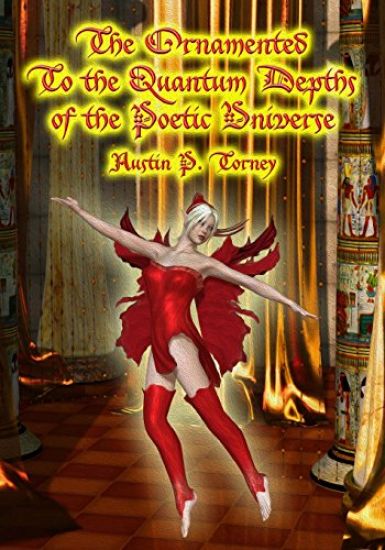
This 6x9 b/w text edition contains all 650 or so of my rubaiyat-style quatrains. (Illustrated editions contain an illustration for every quatrain, and have 'art scapes' in the title.) Prologue: Inspired by Omar, I have endeavored to capture his spirit for more modern times, although I have surely been influenced by Edward FitzGerald's translated gems. There is a companion prose version, 'The Triumph of Life, Love, and Being', in which a loving couple take a long, picaresque journey through the countryside to explore the joys and follies of the human condition, living out the quatrains. The Discovery: Long before I'd ever heard of Omar Khayy m, I had come to some of the same conclusions as had he, or so my friend told me one day, saying that I was already living out and proving Omar's philosophy. Amazed that I hadn't heard of Omar, my friend gave me a copy of The Rub iy t, one of those charming small-sized editions from the late 1800's. Of course, The Rub iy t struck a chord in me which was already resonating to Omar's frequency, so I read it cover to cover several times, with both wonderment and amazement. The Insight: As the years went by, I found other Rubaiyat editions and began collecting them. At the same time, I began writing down some experiences of my own, most of which I had either lived through or had seen through the eyes of my friends. It eventually occurred to me that I could write my own set of quatrains. Somehow, inexplicably, the verses came to me, as I lived through all the experiences described. The Human Condition: My quatrains, like Omar's, aim into the heart of life's dilemmas, offering simple, common sense solutions. In this hectic, complicated world of ours, we often forget that it is the simple things in life that are still the most enjoyable and inexpensive. Some may read my quatrains but immediately revert back to old habits, for change is not an easy thing. Please try. Likewise, the spirit of Omar's heady Persia-fume has reached me across the centuries, and has overtaken me unaware, inspiring me to live and write, in that order. Illuminations: A few of the quatrains were obtained from my other poetry books, which poems in their full text can be found in 'Epic Thoughts: The Best Of'. Edward and Omar: Edward FitzGerald was among the first to translate Omar's Rub iy t from the Persian into English, and he rather loosely paraphrased it; however, he caught its spirit and even improved upon it. In translation, one cannot preserve literal meaning, rhyme, rhythm, and meter; therefore, what is left has to be enhanced and rearranged until everything fits. Fortunately, Edward FitzGerald was sufficiently overtaken by Omar's fumes wafting across the centuries, and so he went on through the language barrier to recondense the Persia-fumes and redistill them into a Victorian age masterpiece.
This 6x9 b/w text edition contains the cr me de la cr me of my Omaresque style quatrains.This 8.5x11 color illustrated edition contains the cr me de la cr me of my Omaresque style quatrains, as selected from the larger volume of 'Austin's Rubaiyat'. These are not translations, but are my own inventions.(Illustrated editions contain an illustration for every quatrain, and have 'art scapes' in the title.Prologue: Inspired by Omar, I have endeavored to capture his spirit for more modern times, although I have surely been influenced by Edward FitzGerald's translated gems.There is a companion prose version, 'The Triumph of Life, Love, and Being', in which a loving couple take a long, picaresque journey through the countryside to explore the joys and follies of the human condition, living out the quatrains.The Discovery: Long before I'd ever heard of Omar Khayy m, I had come to some of the same conclusions as had he, or so my friend told me one day, saying that I was already living out and proving Omar's philosophy.Amazed that I hadn't heard of Omar, my friend gave me a copy of The Rub iy t, one of those charming small-sized editions from the late 1800's. Of course, The Rub iy t struck a chord in me which was already resonating to Omar's frequency, so I read it cover to cover several times, with both wonderment and amazement. The Insight: As the years went by, I found other Rubaiyat editions and began collecting them. At the same time, I began writing down some experiences of my own, most of which I had either lived through or had seen through the eyes of my friends. It eventually occurred to me that I could write my own set of quatrains. Somehow, inexplicably, the verses came to me, as I lived through all the experiences described.The Human Condition: My quatrains, like Omar's, aim into the heart of life's dilemmas, offering simple, common sense solutions. In this hectic, complicated world of ours, we often forget that it is the simple things in life that are still the most enjoyable and inexpensive.Some may read my quatrains but immediately revert back to old habits, for change is not an easy thing. Please try. Likewise, the spirit of Omar's heady Persia-fume has reached me across the centuries, and has overtaken me unaware, inspiring me to live and write, in that order.Illuminations: A few of the quatrains were obtained from my other poetry books, which poems in their full text can be found in 'Epic Thoughts: The Best Of'.Edward and Omar: Edward FitzGerald was among the first to translate Omar's Rub iy t from the Persian into English, and he rather loosely paraphrased it; however, he caught its spirit and even improved upon it. In translation, one cannot preserve literal meaning, rhyme, rhythm, and meter; therefore, what is left has to be enhanced and rearranged until everything fits.Fortunately, Edward FitzGerald was sufficiently overtaken by Omar's fumes wafting across the centuries, and so he went on through the language barrier to recondense the Persia-fumes and redistill them into a Victorian age masterpiece.
It is still that the apparent atoms and molecules make the happenings, via physical-chemical reactions; however, this observation cannot be equated to an "explanation", for we must wonder what underlies all this chemical mattering and reacting that seems to have a unity of direction to it. I venture into the otherworld to find out more. Greatly ornamented and embellished.
Here is a collection of thoughtful poetry that I hope inspires you as much as it does me. The topics can apply to several everyday things in life. There's one that is tragic, which I pray that no one has experienced. When I was writing it, I was led to write through it with a devastating ending.
"It turns out there are all kinds of things about working in an ER that most of us haven't learned from TV or having sat in one. In Something for the Pain, Paul Austin—the ER doc you'd hope to get if something really bad happened—tells us, vividly and with uncommon candor, how, if you aren't careful, saving people's lives can make you sick."—Ted Conover, author of NewjackIn this eye-opening account of life in the ER, Paul Austin recalls how the daily grind of long, erratic shifts and endless hordes of patients with sad stories sent him down a path of bitterness and cynicism. His own life becomes Exhibit A, as he details the emotional detachment that estranges him from himself and his family. Gritty, powerful, and ultimately redemptive, Austin's memoir is a revealing glimpse into the fragility of compassion and sanity in the industrial setting of today's hospitals.
Title: Pericles Brum, or the Last of the De Veres. A satirical romance.Publisher: British Library, Historical Print EditionsThe British Library is the national library of the United Kingdom. It is one of the world's largest research libraries holding over 150 million items in all known languages and formats: books, journals, newspapers, sound recordings, patents, maps, stamps, prints and much more. Its collections include around 14 million books, along with substantial additional collections of manuscripts and historical items dating back as far as 300 BC.The FICTION & PROSE LITERATURE collection includes books from the British Library digitised by Microsoft. The collection provides readers with a perspective of the world from some of the 18th and 19th century's most talented writers. Written for a range of audiences, these works are a treasure for any curious reader looking to see the world through the eyes of ages past. Beyond the main body of works the collection also includes song-books, comedy, and works of satire. ++++The below data was compiled from various identification fields in the bibliographic record of this title. This data is provided as an additional tool in helping to insure edition identification: ++++ British Library Pember, Austin; 1884.]. 323 p.; 8 . 12636.s.9.