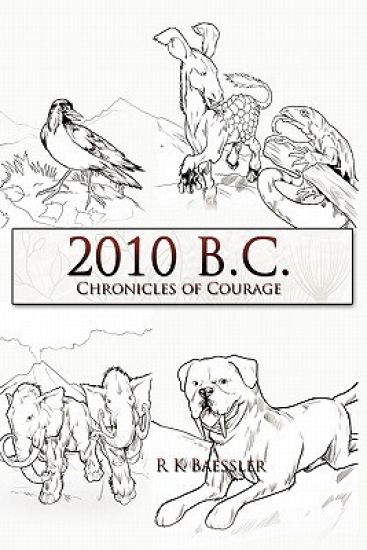
2010 BC The Chonicles of Courage is a book about Fantosaurs. Have you ever heard of a Hectorectoroptimus or a Monitorial Lizardosaur? How about an Elephanticus or even a Bald-faced Hominid? Maybe you think that these creatures never existed. Now they will they not only exist - they will become a part of your family.Find a comfortable chair and travel with these lovable Fantosaurs on their courageous adventures in Ameritor where they journey to such places as the Sea of No See, the Ocean of Motion, the Forest of Future Past and the Freedom River. Now let's go see what Hec is up to in the Pecant Grove.
2010 BC The Chonicles of Courage is a book about Fantosaurs. Have you ever heard of a Hectorectoroptimus or a Monitorial Lizardosaur? How about an Elephanticus or even a Bald-faced Hominid? Maybe you think that these creatures never existed. Now they will they not only exist - they will become a part of your family.Find a comfortable chair and travel with these lovable Fantosaurs on their courageous adventures in Ameritor where they journey to such places as the Sea of No See, the Ocean of Motion, the Forest of Future Past and the Freedom River. Now let's go see what Hec is up to in the Pecant Grove.
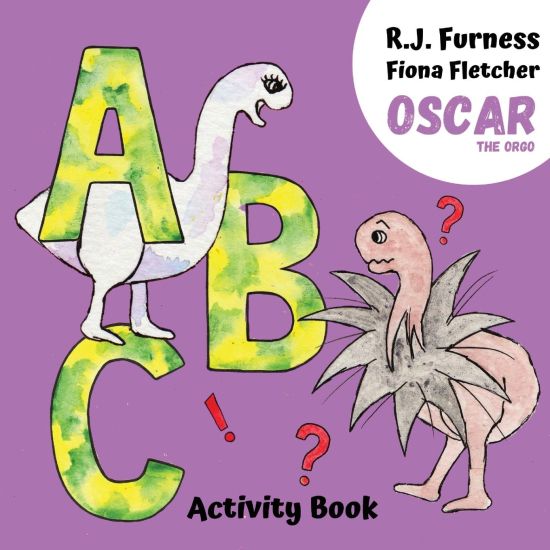
Join 'Oscar The Orgo' and all his friends in this exciting activity book based on the much-loved picture book 'Have You Ever Heard Of An Orgo' by R.J. Furness and Fiona Fletcher.Filled with colouring sheets, puzzles, activities and more, the 'A B C (Oscar The Orgo Activity Book)' is the perfect gift for birthdays, school holidays and when it's raining. There's plenty to keep 'Oscar The Orgo' fans busy.Watch out for: '1 2 3 (Oscar The Orgo Activity Book)'.
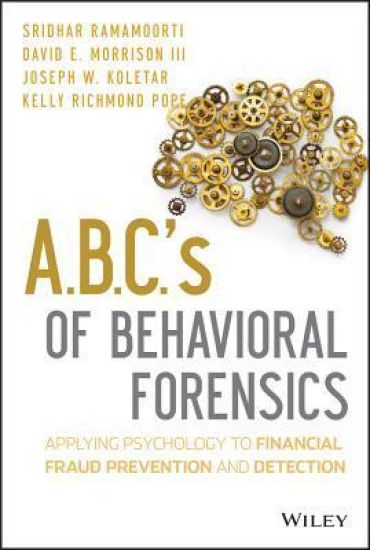
Get practical insights on the psychology of white-collar criminals—and how to outsmart them Understand how the psychologies of fraudsters and their victims interact as well as what makes auditors/investigators/regulators let down their guard. Learn about the psychology of fraud victims, including boards of directors and senior management, and what makes them want to believe fraudsters, and therefore making them particularly vulnerable to deception. Just as IT experts gave us computer forensics, we now have a uniquely qualified team immersed in psychology, sociology, psychiatry as well as accounting and auditing, introducing the emerging field of behavioral forensics to address the phenomenon of fraud. Ever wonder what makes a white-collar criminal tick? Why does she or he do what they do? For the first time ever, see the mind of the fraudster laid bare, including their sometimes twisted rationalizations; think like a crook to catch a crook! The A.B.C.'s of Behavioral Forensics takes you there, with expert advice from a diverse but highly specialized authoring team of professionals (three out of the four are Certified Fraud Examiners): a former accounting firm partner who has a PhD in psychology, a former FBI special agent who has been with investigative practices of two of the Big Four firms, an industrial psychiatrist who has worked closely with the C-level suite of large and small companies, and an accounting professor who has interviewed numerous convicted felons. Along with a fascinating exploration of what makes people fall for the common and not-so-common swindles, the book provides a sweeping characterization of the ecology of fraud using The A.B.C.'s of Behavioral Forensics paradigm: the bad Apple (rogue executive), the bad Bushel (groups that collude and behave like gangs), and the bad Crop (representing organization-wide or even societally-sanctioned cultures that are toxic and corrosive). The book will make you take a longer look when hiring new employees and offers a deeper more complex understanding of what happens in organizations and in their people. The A.B.C. model will also help those inside and outside organizations inoculate against fraud and make you reflect on instilling the core values of your organization among your people and create a culture of excellence and integrity that acts as a prophylactic against fraud. Ultimately, you will discover that, used wisely, behavioral methods trump solely economic incentives. With business fraud on the rise globally, The A.B.C.'s of Behavioral Forensics is the must-have book for investigators, auditors, the C-suite and risk management professionals, the boards of directors, regulators, and HR professionals. Examines the psychology of fraud in a practical way, relating it to aspects of fraud prevention, deterrence, detection, and remediationHelps you understand that trust violation—the essence of fraud—is a betrayal of behavioral assumptions about "trusted" peopleExplains how good people go bad and how otherwise honest people cross the lineUnderscores the importance of creating a culture of excellence and integrity that inoculates an organization from fraud risk (i.e., honest behavior pays, while dishonesty is frowned upon)Provides key takeaways on what to look for when hiring new employees and in your current employees, as well as creating and maintaining a culture of control consciousnessIncludes narrative accounts of interviews with convicted white-collar criminals, as well as interpretive insights and analysis of their rationalizationsFurnishes ideas about how to enhance professional skepticism, how to resist fraudsters, how to see through their schemes, how to infuse internal controls with the people/behavioral element, and make them more effective in addressing behavioral/integrity risksProvides a solid foundation for training programs across the fraud risk management life cycle all the way from the discovery of fraud to its investigation as well as remediation (so the same fraud doesn't happen again)Enables auditors/investigators to engage in self-reflection and avoid cognitive and emotional biases and traps that lead to professional judgment errors (e.g., overconfidence, confirmation, self-deception, groupthink, halo effect, availability, speed-accuracy trade-off, etc.) Ever since the accounting scandals surrounding Enron and WorldCom surfaced, leading to the passage of the Sarbanes Oxley Act of 2002, as well as the continuing fall out from the Wall Street financial crisis precipitating the Dodd-Frank Act of 2010, fraud has been a leading concern for executives globally. If you thought you knew everything there was to know about financial fraud, think again. Get the real scoop with The A.B.C.'s of Behavioral Forensics.
The documents here published are all instructions of an official or semi-official nature issued by the Persian satrap of Egypt or other high-ranking Persian officers to subordinate Persian administrative officers in Egypt; only one contains instructions from the satrap to Persian and Babylonian officers commanding districts on the way from Babylonia to Syria. All are drafted in the form of private letters, but, thanks to the high position of the senders, several of them refer to or are concerned with affairs of considerable public importance. The letters deal for the most part with a single subject, the administration of the domain-lands in Egypt held by highly placed Persian officers and the difficulties arising out of the mutual relations of the local officers of the administration to one another and to the subject population. The problems raised in them are the collection and transport of the revenues of these domains, the assignment of a father's revenues to a son who has succeeded to his office, the transfer of a domain to a deceased tenant's son, a summons to appear before the satrap, measures to be taken for the protection of the satrap's property and for recruiting additional staff for employment on his estate, the release of soldiers wrongfully seized and detained, an order to a negligent officer to carry out his instructions, the reprimand of an officer who has disobeyed an order to assign or transfer some men to another officer and has, moreover, been guilty of robbery, assault and battery, and the punishment of servants or slaves who have robbed the officer in charge of them and run away. --from the Introduction
Embark on an unforgettable journey with "Through Unknown Nigeria" by John R. Raphael, a captivating exploration of a land shrouded in mystery and wonder. Rediscovered after decades out of print, this timeless classic has been lovingly restored and republished by Alpha Editions, offering readers a rare glimpse into Nigeria's rich tapestry of cultures and landscapes. Raphael's vivid narrative and keen observations transport you to the heart of early 20th-century Nigeria, unveiling its hidden beauty and untold stories. This edition is not just a reprint; it's a collector's item and a cultural treasure, meticulously preserved for today's and future generations. Whether you're a casual reader or a connoisseur of classic literature, this book promises to ignite your imagination and enrich your understanding of a world long past. Dive into a narrative that is as engaging as it is enlightening, and discover why "Through Unknown Nigeria" remains a cherished piece of literary history. Don't miss the chance to own this beautifully restored masterpiece a testament to the enduring power of exploration and storytelling.
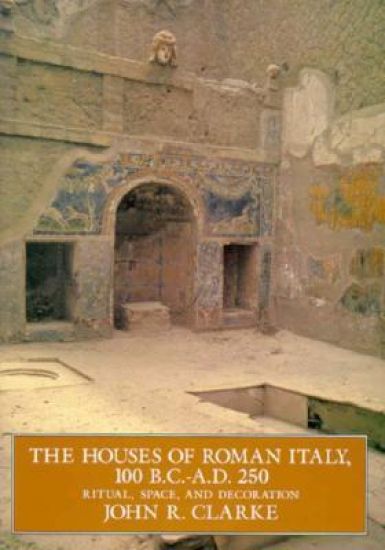
In this richly illustrated book, art historian John R. Clarke helps us see the ancient Roman house 'with Roman eyes'. Clarke presents a range of houses, from tenements to villas, and shows us how enduring patterns of Roman wall decoration tellingly bear the cultural, religious, and social imprints of the people who lived with them. In case studies of seventeen excavated houses, Clarke guides us through four centuries of Roman wall painting, mosaic, and stucco decoration, from the period of the 'Four Styles' (100 B.C. to A.D. 79) to the mid- third century. The First Style Samnite House shows its debt to public architecture in its clear integration of public and private spaces. The Villa of Oplontis asserts the extravagant social and cultural climate of the Second Style. Gem-like Third-Style rooms from the House of Lucretius Fronto reflect the refinement and elegance of Augustan tastes. The Vettii brothers' social climbing helps explain the overburdened Fourth-Style decoration of their famous house. And evidence of remodelling leads Clarke to conclude that the House of Jupiter and Ganymede became a gay hotel in the second century. In his emphasis on social and spiritual dimensions, Clarke offers a contribution to Roman art and architectural history that is both original and accessible to the general reader. The book's superb photographs not only support the author's findings but help to preserve an ancient legacy that is fast succumbing to modern deterioration resulting from pollution and vandalism.

![Alexanders Saga, Norske Bearbeidelse [Attr. to B. JÃ3nsson, in Prose] Fra Trettende Aarhundrede Af P. Gautiers Latinske Digt Alexandreis, Med En Ordsamling Udg. Af C.R. Unger](/covers/9781023889940.jpg)