Kirjojen hintavertailu. Mukana 11 379 002 kirjaa ja 12 kauppaa.

Kirjahaku

Etsi kirjoja tekijän nimen, kirjan nimen tai ISBN:n perusteella.

685 tulosta hakusanalla Bertolt Brecht

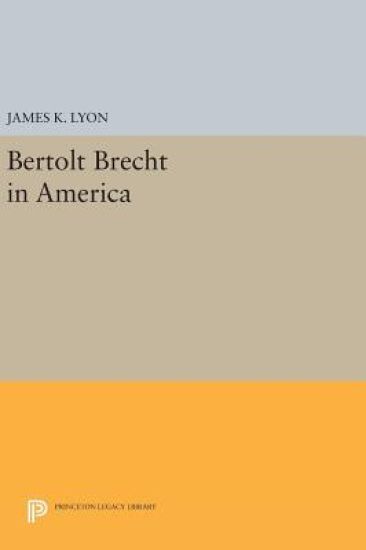
Bertolt Brecht in America

Bertolt Brecht in America

James K. Lyon

Princeton University Press
2014
pokkari
This colorful account of Bertolt Brecht's move from Germany to America during the Hitler era explores his activities as a Hollywood writer, a playwright determined to conquer Broadway, a political commentator and activist, a social observer, and an exile in an alien land. Originally published in 1980. The Princeton Legacy Library uses the latest print-on-demand technology to again make available previously out-of-print books from the distinguished backlist of Princeton University Press. These editions preserve the original texts of these important books while presenting them in durable paperback and hardcover editions. The goal of the Princeton Legacy Library is to vastly increase access to the rich scholarly heritage found in the thousands of books published by Princeton University Press since its founding in 1905.
Bertolt Brecht in America

Bertolt Brecht in America

James K. Lyon

Princeton University Press
2016
sidottu
This colorful account of Bertolt Brecht's move from Germany to America during the Hitler era explores his activities as a Hollywood writer, a playwright determined to conquer Broadway, a political commentator and activist, a social observer, and an exile in an alien land. Originally published in 1980. The Princeton Legacy Library uses the latest print-on-demand technology to again make available previously out-of-print books from the distinguished backlist of Princeton University Press. These editions preserve the original texts of these important books while presenting them in durable paperback and hardcover editions. The goal of the Princeton Legacy Library is to vastly increase access to the rich scholarly heritage found in the thousands of books published by Princeton University Press since its founding in 1905.
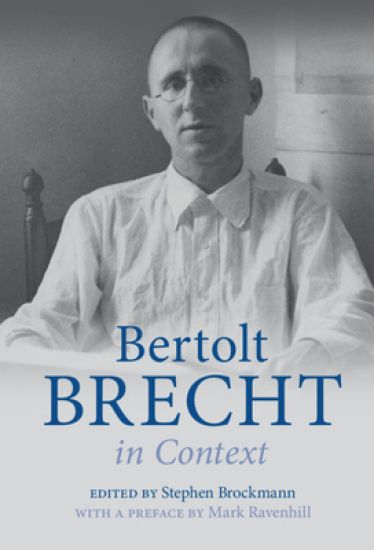
Bertolt Brecht in Context

Bertolt Brecht in Context

Cambridge University Press
2021
sidottu
Bertolt Brecht in Context examines Brecht's significance and contributions as a writer and the most influential playwright of the twentieth century. It explores the specific context from which he emerged in imperial Germany during the late nineteenth and early twentieth centuries, as well as Brecht's response to the turbulent German history of the twentieth century: World Wars One and Two, the Weimar Republic, the Nazi dictatorship, the experience of exile, and ultimately the division of Germany into two competing political blocs divided by the postwar Iron Curtain. Throughout this turbulence, and in spite of it, Brecht managed to remain extraordinarily productive, revolutionizing the theater of the twentieth century and developing a new approach to language and performance. Because of his unparalleled radicalism and influence, Brecht remains controversial to this day. This book – with a Foreword by Mark Ravenhill – lays out in clear and accessible language the shape of Brecht's contribution and the reasons for his ongoing influence.
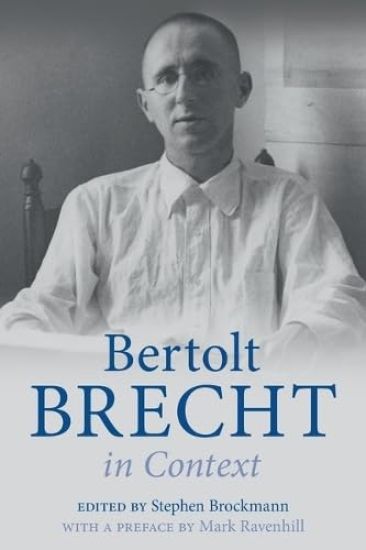
Bertolt Brecht in Context

Bertolt Brecht in Context

Cambridge University Press
2026
pokkari
Bertolt Brecht in Context examines Brecht's significance and contributions as a writer and the most influential playwright of the twentieth century. It explores the specific context from which he emerged in imperial Germany during the late nineteenth and early twentieth centuries, as well as Brecht's response to the turbulent German history of the twentieth century: World Wars One and Two, the Weimar Republic, the Nazi dictatorship, the experience of exile, and ultimately the division of Germany into two competing political blocs divided by the postwar Iron Curtain. Throughout this turbulence, and in spite of it, Brecht managed to remain extraordinarily productive, revolutionizing the theater of the twentieth century and developing a new approach to language and performance. Because of his unparalleled radicalism and influence, Brecht remains controversial to this day. This book – with a Foreword by Mark Ravenhill – lays out in clear and accessible language the shape of Brecht's contribution and the reasons for his ongoing influence.
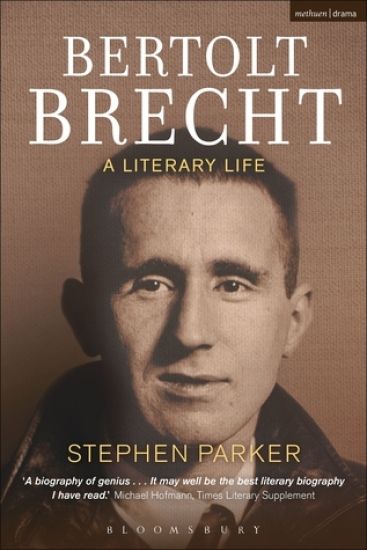
Bertolt Brecht: A Literary Life

Bertolt Brecht: A Literary Life

Stephen Parker

Methuen Drama
2015
nidottu
This first English language biography of Bertolt Brecht (1898–1956) in two decades paints a strikingly new picture of one of the twentieth century’s most controversial cultural icons. First published in 2014 and now available in paperback, it was critically lauded and declared the definitive life of this great artist and writer. Drawing on letters, diaries and unpublished material, including Brecht’s medical records, Parker offers a rich and enthralling account of Brecht’s life and work, viewed through the prism of the artist. Tracing his extraordinary life, from his formative years in Augsburg, through the First World War, his politicisation during the Weimar Republic and his years of exile, up to the Berliner Ensemble’s dazzling productions in Paris and London, Parker shows how Brecht achieved his transformative effect upon world theatre and poetry. Bertolt Brecht: A Literary Life is a powerful portrait of a great, compulsively contradictory personality, whose artistry left its lasting imprint on modern culture.
Bertolt Brecht: Die Schwierigkeit, ein dramatisches Ereignis im Kunstwerk darzustellen
In seinen theoretischen Schriften behauptet Brecht unentwegt, dass der Hauptzweck des Schauspieles in der Belehrung der Zuschauer besteht. Sicherlich muss man aber denken, dass jede Zeit seine "Inquisition" hat: wenn der Wissenschaftler von Leben des Galilei sich vor der Kirche beugen sollte, hatte Brecht einen ebenso m chtigen politischen Zensor. Jedenfalls konnte es nicht der einzige Grund sein, aus dem Brecht von den geschichtlichen Katastrophen nie deutlich, sondern fast nur durch hnlichkeiten sprach. Die N tzlichkeit, die Zweckm igkeit und die M glichkeit, Gr sslichkeiten im Kunstwerk darzustellen, bleibt eine strittige Frage. Es ist ziemlich offenbar, dass eine ausf hrliche Darstellung einer Katastrophe eine total unerw nschte Auswirkung f r Brecht erreichen w rde: die Zuschauer w rden eine tiefe Einf hlung empfinden, die ihr Gewissen und ihre Analysef higkeit tr ben w rde. Eine solche Darstellung w re nicht nur sch dlich f r die Verfremdung, aber auch fast unm glich in der Durchf hrung: die Details eines Ungl cks sind in einem Kunstwerk kaum auff hrbar. Darum wird die Parabelform benutzt und die strukturelle Zweiteiligkeit der Parabelgeschichte (Realit t - Gleichnis) wird in Wirklichkeit eine prinzipielle Dreiteiligkeit: der dritte Schritt mu vom Leser oder Zuschauer vollzogen werden. Das Publikum mu n mlich die im Bild gewonnene Erkenntnis auf die Wirklichkeit zur ck ber tragen.
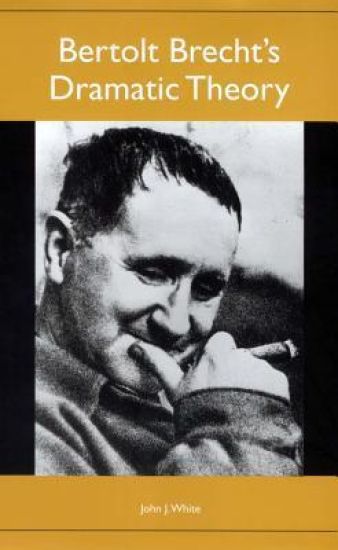
Bertolt Brecht's Dramatic Theory

Bertolt Brecht's Dramatic Theory

John J. White

Camden House Inc
2010
pokkari
Detailed analysis of Brecht's extensive theoretical writings on the theater, including newly available works. As an integral part of his work as a political playwright and dramaturge, Bertolt Brecht concerned himself extensively with the theory of drama. He was convinced that the Aristotelian ideal of audience catharsis through identification with a hero and the resultant experience of terror and pity worked against his goal of bettering society. He did not want his audiences to feel, but to think, and his main theoretical thrusts -- "Verfremdungseffekte" (de-familiarization devices) and epic theater, among others -- were conceived in pursuit of this goal. This is the first detailed study in English of Brecht's writings on the theater to take account of works first made available in the recent German edition of his collected works. It offers in-depth analyses of Brecht's canonical essays on the theater from 1930 to the late 1940s and early GDR years. Close readings of the individual essays are supplemented by surveys of the changing connotations within Brecht's dramaturgical oeuvre of key theoretical terms, including epic and anti-Aristotelian theater, de-familiarization, historicization, and dialectical theater. Brecht's distinct contribution to the theorizing of acting and audience response is examined in detail, and each theoretical essay and concept is placed in the context of the aesthetic debates of the time, subjected to a critical assessment, and consideredin light of subsequent scholarly thinking. In many cases, the playwright's theoretical discourse is shown to employ methods of "epic" presentation and techniques of de-familiarization that are corollaries of the dramatic techniques for which his plays are justly famous. John J. White is Emeritus Professor of German and Comparative Literature at King's College London.
Bertolt Brecht in Wien

Bertolt Brecht in Wien

Günther Berger

Peter Lang AG
2018
sidottu
Bereits fruh rezensierten oesterreichische Zeitungen Werke von Bertolt Brecht. Dieses Buch subsumiert erstmals Bertolt Brechts vielseitige Kontakte zu Wien. Seine Stucke wurden erfolgreich im renommierten Raimund Theater aufgefuhrt. Brecht kam mehrmals nach Wien und hatte sowohl privat als kunstlerisch zeitlebens entscheidende Beziehungen zu OEsterreich. Ereignisse oesterreichischer Zeitgeschichte inspirierten ihn zu Dichtungen. Die Verleihung der oesterreichischen Staatsburgerschaft schurte den Brecht-Boykott der (Wiener) Buhnen. Das Buch erlautert auch die Wandlung vom fanatisch boykottierten Autor zum beliebten Schriftsteller in OEsterreich, dem in Wien ein Platz gewidmet ist.
Bertolt Brecht in Skandinavien

Bertolt Brecht in Skandinavien

Isabella Antonia Kortz

AV Akademikerverlag
2012
pokkari
Inhaltlich unver nderte Neuauflage. Bis in das 21. Jahrhundert hinein nehmen die Theaterst cke und Theorien des deu-tschen Dramatikers Bertolt Brecht eine besondere Stellung innerhalb der skan-dinavischen Theateraktivit ten ein. Vor allem f r B hnenexperimente und die Produktionen von Studententheatergruppen werden in Skandinavien bis heu-te Brechts Ideen als Vorlagen genutzt. Wie l sst sich die bis heute wirk-sa-me Popularit t Brechts im hohen Norden erkl ren? Was sind die Gr nde f r Brechts Einfluss auf die skandinavische Theaterlandschaft? Die Autorin Isabella Kortz beginnt ihre systematische Suche nach Erkl rungen f r die Sonderstellung Bertolt Brechts mit der historischen Betrachtung der The-aterentwicklungen in Skandinavien. Die Wirkungsweise von Brechts The-o-rien und den Inszenierungen seiner Theaterst cke bildet die Grundlage f r die n he-re Auseinandersetzung mit dem skandinavischen Amateurtheater, das Brecht zu gro em Erfolg im hohen Norden verholfen hat. Basierend auf die-sen Erkenntnissen erl utert die Autorin die tiefgreifende Beziehung zwischen Brecht und Skandinavien, die weit ber dessen Exilaufenthalte in D nemark, Schweden und Finnland hinausgeht. Das vorliegende Buch richtet sich sowohl an Fachpublikum, wie etwa Stu-den-ten der Theaterwissenschaft, Literaturwissenschaft und Germanistik, als auch an Interessierte der Zeitgeschichte und Theaterbegeisterte.
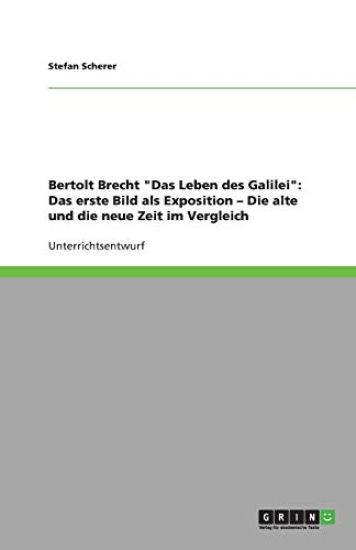
Bertolt Brecht "Das Leben des Galilei"

Bertolt Brecht "Das Leben des Galilei"

Stefan Scherer

Grin Publishing
2009
pokkari
Unterrichtsentwurf aus dem Jahr 2008 im Fachbereich Deutsch - P dagogik, Didaktik, Sprachwissenschaft, Note: 3+, Sprache: Deutsch, Abstract: Das erste Bild f hrt den Zuschauer im Sinne einer Exposition in das dramatische Geschehen ein. Die Hauptfiguren, in besonderem Ma e Galilei, werden vorgestellt und sich sp ter weiterentwickelnde Konflikte sind hier bereits angelegt. In dieser Stunde wird die werkimmanente Betrachtung des St cks er ffnet, indem die Zeitenwende am Text durch die Gegen berstellung von "alter" und "neuer Zeit" erarbeitet werden. Zus tzlich zu den Kennzeichen der Zeit, soll auch das mitschwingende Lebensgef hl erfasst werden. Die beiden Zeiten werden aus der Sicht Galileis im Gespr ch mit Andrea zu Beginn des ersten Bildes sehr subjektiv dargestellt.
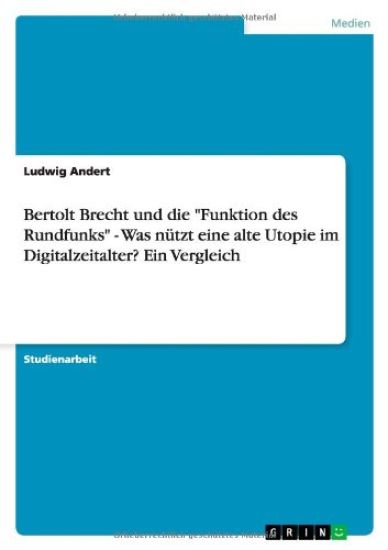
Bertolt Brecht und die "Funktion des Rundfunks" - Was nützt eine alte Utopie im Digitalzeitalter? Ein Vergleich
Studienarbeit aus dem Jahr 2007 im Fachbereich Medien / Kommunikation - Massenmedien allgemein, Note: 1,0, Universit t Siegen, Veranstaltung: Radio und Rundfunk - Theorie, Geschichte, Praxis, Sprache: Deutsch, Abstract: Es besteht kein Zweifel daran, dass das Radio die Erwartungen von Brechts Utopie nicht erf llen konnte. berraschenderweise zeigt jedoch ein Blick auf die mediale Entwicklung der letzten f nf bis zehn Jahre Tendenzen, die der utopischen Rundfunkkommunikation gar nicht so un hnlich sind: Im Zuge des gigantischen Wachstums des Internets tummelt sich unter dem Schlagwort "Web 2.0" eine Vielzahl von Kommunikationsangeboten, die Millionen von Kleinstakteuren zur Beteiligung anregen. "Broadcast Yourself" hei t es etwa in der Amateurvideodatenbank youtube.com, und damit scheint die alte Forderung, "allen alles zu sagen" und damit jeden Einzelnen an der Ausstrahlung von Inhalten zu beteiligen, geradezu w rtlich ins 21. Jahrhundert bersetzt. Doch ist das Zeitalter des "User Generated Content" tats chlich die Brechtsche Rundfunkrevolution im postmodernen Gewand? Taugt das Internet als politisches Medium f r jedermann? Oder k nnen jene Visionen ein f r alle mal als gescheitert gelten, da man, "wenn man es sich berlegt," noch immer "nichts zu sagen" hat? Die Vorliegende Arbeit m chte einen berblick ber Bertolt Brechts Radiotheorie geben und einen Vergleich mit aktuellen Ph nomenen der Onlinekommunikation wagen. Ein Abriss ber die Entwicklung des Rundfunks von seinen Anf ngen bis heute sowie einige Begriffser rterungen aus dem Bereich des World Wide Web sollen diesen Vergleich vertiefen, um ein Urteil ber Erfolg und Misserfolg der neuen alten Theorie zu erm glichen.