Questo lavoro un contributo alla previsione e alla valutazione dell'efficienza di cucitura di un indumento prima della produzione. Abbiamo scelto un disegno sperimentale con i parametri del materiale e della cucitura (peso base del tessuto, densit dei punti e numero di fili di cucitura) come parametri di input e l'efficienza di cucitura come parametro di output. Questo disegno stato applicato a tre gruppi di tessuti con composizioni diverse e in due direzioni di cucitura (ordito e trama). In primo luogo, abbiamo dimostrato la significativit e l'importanza dei parametri di input e delle loro interazioni sull'efficienza di cucitura. In secondo luogo, sulla base del metodo della regressione lineare, abbiamo determinato un modello per l'efficienza di cucitura in ciascuna delle direzioni di cucitura e in ciascun gruppo di tessuti. Questa modellizzazione stata convalidata nella pratica. La previsione della qualit delle cuciture garantisce al confezionista la qualit desiderata fin dal primo colpo, riducendo cos lo spreco di tempo e di materia prima. Di conseguenza, la perdita di costi di produzione sar minore.
Este trabalho uma contribui o para a previs o e avalia o da efici ncia da costura de uma pe a de vestu rio antes da produ o. Opt mos por um plano de experi ncias com os par metros do material e da costura (gramagem do tecido, densidade dos pontos e contagem das linhas de costura) como par metros de entrada e a efici ncia da costura como par metro de sa da. Este plano foi aplicado a tr s grupos de tecidos com diferentes composi es e em duas direc es de costura (teia e trama). Em primeiro lugar, demonstr mos o significado e a import ncia dos par metros de entrada e das suas interac es na efici ncia da costura. Em segundo lugar, com base no m todo de regress o linear, determin mos um modelo para a efici ncia da costura em cada uma das direc es de costura e em cada um dos grupos de tecidos. Esta modela o foi validada na pr tica. A previs o da qualidade da costura garante ao confecionador a qualidade desejada desde a primeira passagem, pelo que haver menos desperd cio de tempo e de mat ria-prima. Consequentemente, haver menos perda de custos de fabrico.
Vue leur importance conomique, les c r ales occupent une place de choix dans les changes du commerce international. N anmoins la production c r ali re dans les pays en voie de d veloppement est d ficitaire, irr guli re et conjugu e une population constamment croissante. Pour combler leurs besoins en c r ales, ces pays disposent de deux alternatives: les importations, en croissance r guli re et co teuses, et/ou l'augmentation de leur production. Or, cette derni re repose sur l'extension des terres arables, le recours aux cultures intensives, l'am lioration des rendements travers le renforcement du statut professionnel des producteurs et l'instauration des exploitations agricoles durables. C'est dans ce cadre que s'inscrit le pr sent document qui traite: - Les aspects agro- conomiques des cultures c r ali res en modes conventionnel et biologique. - Les aspects biologique et technique des plus importantes esp ces c r ali res: Bl , Orge, Triticale, Avoine, Sorgho et Ma s. Ce document, garni d'illustrations, s'adresse une large population int ress e par la c r aliculture, entre autres, les tudiants agronomes, le cadre technique agricole et les producteurs c r aliers.
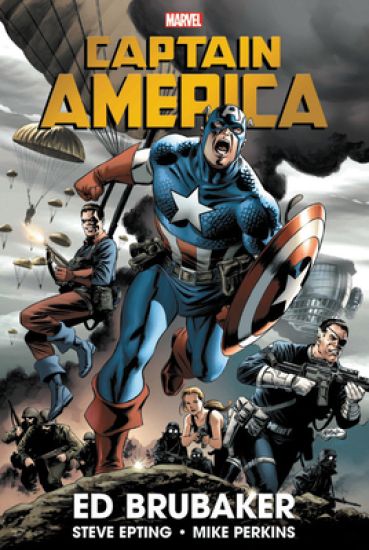
Collecting Eisner Award-nominated Best Writer Ed Brubaker's first twenty-five landmark issues of Captain America in one titanic tome, plus the Captain America 65th Anniversary Special and Winter Soldier: Winter Kills one-shots This deluxe hardcover, fat-packed with extras, features the story that stunned readers worldwide and sent shockwaves through the entire Marvel Universe: the death of Captain America Also including the return of Cap's wartime partner, Bucky Barnes, as the Winter Soldier; the death and life of his greatest enemy, the Red Skull; and the emergences of a new threat, General Aleksander Lukin, the head of one of the most powerful corporations in the world Captain America (2005) 1-25, Captain America 65th Anniversary Special (2006) 1, Winter Soldier: Winter Kills (2007)
Ed Brubaker (b. 1966) has emerged as one of the most popular, significant figures in art comics since the 1990s. Most famous as the man who killed Captain America in 2007, Brubaker's work on company-owned properties such as Batman and Captain America and creator-owned series like Criminal and Fatale live up to the usual expectations for the superhero and crime genres. And yet, Brubaker layers his stories with a keen self-awareness, applying his expansive knowledge of American comic book history to invigorate his work and challenge the dividing line between popular entertainment and high art. This collection of interviews explores the sophisticated artist's work, drawing upon the entire length of the award-winning Brubaker's career.With his stints writing Catwoman, Gotham Central, and Daredevil, Brubaker advanced the work of crime comic book writers through superhero stories informed by hard-boiled detective fiction and film noir. During his time on Captain America and his series Sleeper and Incognito, Brubaker revisited the conventions of the espionage thriller. With double agents who lose themselves in their jobs, the stories expose the arbitrary superhero standards of good and evil. In his series Criminal, Brubaker offered complex crime stories and, with a clear sense of the complicated lost world before the Comics Code, rejected crusading critic Fredric Wertham's myth of the innocence of early comics.Overall, Brubaker demonstrates his self-conscious methodology in these often little-known and hard-to-find interviews, worthwhile conversations in their own right as well as objects of study for both scholars and researchers.
Ed Brubaker (b. 1966) has emerged as one of the most popular, significant figures in art comics since the 1990s. Most famous as the man who killed Captain America in 2007, Brubaker’s work on company-owned properties such as Batman and Captain America and creator-owned series like Criminal and Fatale live up to the usual expectations for the superhero and crime genres. And yet, Brubaker layers his stories with a keen self-awareness, applying his expansive knowledge of American comic book history to invigorate his work and challenge the dividing line between popular entertainment and high art. This collection of interviews explores the sophisticated artist’s work, drawing upon the entire length of the award-winning Brubaker’s career.With his stints writing Catwoman, Gotham Central, and Daredevil, Brubaker advanced the work of crime comic book writers through superhero stories informed by hard-boiled detective fiction and film noir. During his time on Captain America and his series Sleeper and Incognito, Brubaker revisited the conventions of the espionage thriller. With double agents who lose themselves in their jobs, the stories expose the arbitrary superhero standards of good and evil. In his series Criminal, Brubaker offered complex crime stories and, with a clear sense of the complicated lost world before the Comics Code, rejected crusading critic Fredric Wertham’s myth of the innocence of early comics.Overall, Brubaker demonstrates his self-conscious methodology in these often little-known and hard-to-find interviews, worthwhile conversations in their own right as well as objects of study for both scholars and researchers.
This genealogy book details the descendants of John Brubaker, who lived from 1777-1846. With comprehensive research and detailed family trees, this book is a valuable resource for anyone studying the Brubaker family history.This work has been selected by scholars as being culturally important, and is part of the knowledge base of civilization as we know it.This work is in the "public domain in the United States of America, and possibly other nations. Within the United States, you may freely copy and distribute this work, as no entity (individual or corporate) has a copyright on the body of the work.Scholars believe, and we concur, that this work is important enough to be preserved, reproduced, and made generally available to the public. We appreciate your support of the preservation process, and thank you for being an important part of keeping this knowledge alive and relevant.
In You Don't Know Jack: Murder in Marin County, Jack Brubaker, veteran sailor and private investigator, becomes embroiled in a gruesome Marin County murder case while searching for his missing sister. In his hunt for the murderer, the world weary Brubaker teams up with homicide detective Ellen Jacobs and is aided by a collection of local eccentrics in the San Francisco Bay town of Sausalito. Hired by the victim's wife, Jack himself becomes the focus of the police investigation as he delves into the murky side of Marin County, complete with trailer parks, meth houses, and Cult compounds. During Jack's investigation he is forced to revisit the sailing death of his father, while coming to terms with his failed relationship with his sister Lucy.
Dale Brubaker tells why teachers need more than the traditional top-down, get-higher-test-scores approach to education. He describes the benefits of developing your own "inner curriculum." He also shows the importance of attending to both political power and spiritual power in becoming a creative curriculum leader. Dale Brubaker shows you how to create settings and learning communities that empower people to identify and use their talents. Creative curriculum leaders ask: "How can I understand myself better so that I can enjoy my work and my life more?" and, "How can I improve the settings that are important to me?" Two new chapters are included in this updated Second Edition ( Chapter 8. Creating Learning Communities and Chapter 9. Teacher Leaders), also several new appendices have also been added.