Kirjahaku
Etsi kirjoja tekijän nimen, kirjan nimen tai ISBN:n perusteella.
62 tulosta hakusanalla Brepols Publishers

La Tete Vegetalisee Dans Les Decors Romains: Origine d'Un Theme Ornemental
Brepols Publishers
Brepols Publishers
2024
sidottu
Dans la multitude de formes nees de la confrontation a la nature, les etres hybrides mi-humains mi-vegetaux, images d'une nature prodigue mais subversive, materialisent croyances, peurs et aspirations. Parmi eux, il est une curiosite qui traversa les ages et les frontieres, survecut aux manipulations les plus diverses et conserva toute la puissance des regnes qui la composent: la " tete vegetalisee ". Victime de la devalorisation moderne de l'ornement, elle fait pour la premiere fois l'objet d'une etude globale et pluridisciplinaire permettant de retracer son origine et de determiner les conditions de sa diffusion, dans l'ensemble de l'Empire romain, de sa naissance a son assimilation par le monde chretien. Entre traditions et innovations, la tete vegetalisee du monde romain developpa des specificites iconographiques perennes lui conferant une signification inherente a toute forme d'hybridite vegetale, tout en permettant a differentes visions du monde de s'exprimer en elle sans se dissoudre. Elle constitue de ce fait un temoin privilegie de la culture visuelle des Romains.
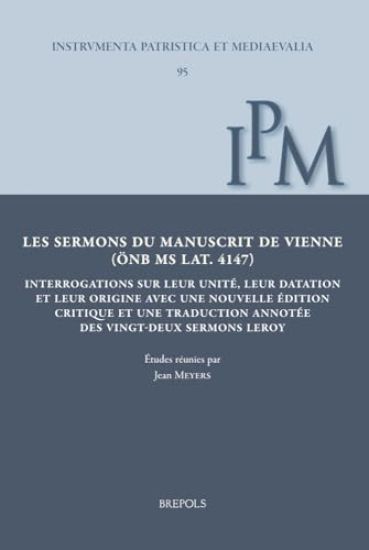
Les Sermons Du Manuscrit de Vienne (Onb MS Lat. 4147): Interrogations Sur Leur Unite, Leur Datation Et Leur Origine Avec Une Nouvelle Edition Critique
Brepols Publishers
Brepols Publishers
2024
sidottu
En 1994, Francois-Joseph Leroy publiait vingt-deux sermons inedits, qu'il attribua a un contemporain d'Augustin et dans lesquels il vit une collection, non apologetique et non polemique, de textes donatistes. C'etait la une decouverte exceptionnelle. Pourtant, depuis l'edition provisoire de Leroy, la recherche ne s'est guere penchee sur ce corpus. C'est la raison pour laquelle le Groupe de Recherches sur l'Afrique Antique (GRAA) a entrepris une nouvelle edition critique de ces 22 sermons, accompagnee de la premiere traduction annotee, et rassemble autour de ce corpus les contributions de differents specialistes, historiens et litteraires, pour en analyser tant la langue, le style et les procedes homiletiques que la portee supposee donatiste, la spiritualite et la theologie.

Recherches Augustiniennes Et Patristiques 39/2021
Brepols Publishers
Brepols Publishers
2021
nidottu

Archives Internationales d'Histoire Des Sciences 67/2-179, 2017
Brepols Publishers
Brepols Publishers
2019
nidottu

The culmination of over a decade's research on verbal culture in the pre- and post-Conversion medieval North at Bergen's Centre for Medieval Studies, this volume traces the movement of words and texts temporally, geographically, and intellectually across different media and genres. The contributions gathered here begin with a reassessment of how the unique verbal cultures of Scandinavia and Iceland can be understood in a broader European context, and then move on to explore foundational Nordic Latin histories and vernacular sagas. Key case studies are put forward to highlight the importance of institutional and individual writing communities, epistolary and list-making cultures, and the production of manuscripts as well as runic inscriptions. Finally, the oral-written continuum is examined, with a focus on important works such as Islendingabok and Landnamabok, Old-Norse Icelandic translated romances, and the development of prosimetra. Together, these essays form a state-of-the-art volume that offers new and vital insights into the role of literacy in the Norse-speaking world.


Troianalexandrina 18 (2018): Troie En Europe Au Moyen Age. d'Un Imaginaire, l'Autre; d'Une Langue, l'Autre
Brepols Publishers
Brepols Publishers
2019
nidottu

Bibliographie Annuelle Du Moyen Age Tardif. Auteurs Et Textes Latins 29/2019
Brepols Publishers
Brepols Publishers
2020
nidottu
In Monte Artium. Journal of the Royal Library of Belgium, 12, 2019
Brepols Publishers
Brepols Publishers
2020
nidottu

The Journal of Medieval Monastic Studies 8 (2019)
Brepols Publishers
Brepols Publishers
2019
nidottu

European Renaissance Festivals are noted for their extravagance, for their inherited classical culture, and as evidence of how court and civic spectacles could express political, religious, social and economic aspirations. In this new monograph, the accent is firmly on the violent context of Magnificence: it examines how war affected the minds and practice of both artists and princes, and shows how victims and their suffering were as prominent in festival as were conquerors and their projections of victory. What emerges here is the dark side represented in princely entries where imperial ambitions are built upon civic devastation and where myths elaborate and expose their ambiguous nature and message. Artists and poets collaborated in bringing victory and violence together: Mantegna and Durer in triumphal processions; Frans Floris and Rubens on the canvases they created for triumphal arches where mythology was put to work to arouse excitement for deeds of heroism and death, while engravers depicted scenes of war and destruction to accommodate contemporary taste.

Antiquite Tardive 27/2019: L'Alimentation Dans l'Antiquite Tardive
Brepols Publishers
Brepols Publishers
2020
nidottu