Kirjojen hintavertailu. Mukana 11 424 844 kirjaa ja 12 kauppaa.

Kirjahaku

Etsi kirjoja tekijän nimen, kirjan nimen tai ISBN:n perusteella.

1000 tulosta hakusanalla Brian P. W. Mercer

Stars of the Now

Stars of the Now

Brian P. Fox

Polite Society
2014
nidottu
The F.B.I has infiltrated Hunter's affluent suburb and as he navigates the divide between high school and the waiting world, we're led down a dizzying spiral into worlds we're not supposed to see. As he searches for the shining moments in the spaces of everyday, youthful debauchery melds with real world stakes, shattering the invincibility of youth. Stars of the Now is a frantic, energized, queasy ride following a brief period of time in Hunter's life, that at times enlightens and at others pins him beneath the cold, bleak surface of appearances. Taking place primarily in Cleveland, Ohio, it is a raw look at the drug culture pervading our suburbs and shirking the binds of others' expectations in order to become something more. With alternating narrative voices and graphic depictions of "how it is" in the grind toward adulthood, Stars of the Now simultaneously fills us with triumphant joy and nausea.
Magic and the Dignity of Man

Magic and the Dignity of Man

Brian P. Copenhaver

The Belknap Press
2019
sidottu
“This book is nothing less than the definitive study of a text long considered central to understanding the Renaissance and its place in Western culture.” —James Hankins, Harvard UniversityPico della Mirandola died in 1494 at the age of thirty-one. During his brief and extraordinary life, he invented Christian Kabbalah in a book that was banned by the Catholic Church after he offered to debate his ideas on religion and philosophy with anyone who challenged him. Today he is best known for a short speech, the Oration on the Dignity of Man, written in 1486 but never delivered. Sometimes called a “Manifesto of the Renaissance,” this text has been regarded as the foundation of humanism and a triumph of secular rationality over medieval mysticism.Brian Copenhaver upends our understanding of Pico’s masterwork by re-examining this key document of modernity. An eminent historian of philosophy, Copenhaver shows that the Oration is not about human dignity. In fact, Pico never wrote an Oration on the Dignity of Man and never heard of that title. Instead he promoted ascetic mysticism, insisting that Christians need help from Jews to find the path to heaven—a journey whose final stages are magic and Kabbalah. Through a rigorous philological reading of this much-studied text, Copenhaver transforms the history of the idea of dignity and reveals how Pico came to be misunderstood over the course of five centuries. Magic and the Dignity of Man is a seismic shift in the study of one of the most remarkable thinkers of the Renaissance.
In Her Own Words

In Her Own Words

Brian P. Sowers

Harvard University, Center for Hellenic Studies
2021
nidottu
In Her Own Words: The Life and Poetry of Aelia Eudocia is the first full-length study to examine Eudocia’s writings as a unified whole and to situate them within their wider fifth-century literary, social, and religious contexts. Responsible for over 3,000 lines of extant poetry, Eudocia is one of the best-preserved ancient female poets. Because she wrote in a literary mode frequently suppressed by proto-orthodox (male) leaders, much of her poetry does not survive, and what does survive remains understudied and underappreciated. This book represents a detailed investigation into Eudocia’s works: her epigraphic poem in honor of the therapeutic bath at Hammat Gader, her Homeric cento—a poetic paraphrase of the Bible using lines from Homer—and her epic on the fictional magician-turned-Christian, Cyprian of Antioch.Reading her poetry as a whole and in context, Eudocia emerges as an exceptional author representing three unique late-antique communities: poets interested in preserving and transforming classical literature; Christians whose religious views positioned them outside and against traditional power structures; and women who challenged social, religious, and literary boundaries.
Misfire

Misfire

Brian P. Farrell

UNIVERSITY PRESS OF KANSAS
2025
sidottu
Of all the Allied strategic defensive campaigns in the first half of World War II, the fight to defend Malaya and Singapore provided perhaps the best chance to use special forces to wider effect. In December 1941 the issue in the East during World War II was whether or not the Japanese could drive the Western Allies out of Southeast Asia before the Allies could reinforce strongly enough to prevent it. Consequently, the British Army organized, trained, and specifically equipped special-forces combat units to operate independently, for long periods of time if necessary, physically separated from the main forces in the field. British Army special-forces units were usually directed to carry out two broad but often closely related missions: provide direct assistance to main force operations; and harass enemy movements, lines of supply, and communications. Special forces were also frequently used to destroy specific targets, sometimes in completely independent operations with no main force in the field, and especially to act as the eyes and ears of the main force, gathering intelligence on enemy movements and or screening those of friendly forces. In Misfire, Brian Farrell analyzes how and why the British Army developed special forces in the early years of World War II; what uses it made of them; and the role that special and irregular forces played in defending Malaya and Singapore against Japanese invasion, from prewar preparations to capitulation in February 1942. Farrell’s examination of the use of special and irregular forces helps us understand both the Malayan campaign and wider efforts to defend Southeast Asia as well as what that campaign tells us about the evolution of such forces in the British and Empire armies.
Markets Don't Fail!

Markets Don't Fail!

Brian P. Simpson

Lexington Books
2005
sidottu
In all of the contemporary economics textbooks that have been written there is typically at least one chapter that addresses "market failure." Markets Don't Fail! is a response to what author Brian Simpson sees as a fundamental error in the thinking of some economists. The chapter titles of this book are crafted against the premises of "market failure" arguments, and a significant portion of this book focuses on exposing the invalid premises upon which the claims of market failure are based and providing a proper basis upon which to judge the free market. The material in this book provides a strong antidote to the arguments typically presented in contemporary economics textbooks. Through example and argument, Brian Simpson shows that the claims against the free market are not true. In fact, he demonstrates how free markets succeed, how they raise the standard of living of all individuals who live within them, and how free markets allow human life to flourish. However, the book goes much deeper than economics by providing a moral and epistemological defense of the free market. Markets Don't Fail! gets to the fundamental, philosophical reasons why the claims of market failure are false and why markets actually succeed. Through an integration of economics and philosophy Simpson is able to provide a comprehensive, rigorous, and logically consistent defense of the free market. The specific topics covered in the book include monopoly, antitrust laws and predatory pricing, "externalities," the regulation of safety and quality, environmentalism, economic inequality, "public goods," and asymmetric information. This book is an invaluable tool for anyone who wants to gain a sound understanding of the free market.
Markets Don't Fail!

Markets Don't Fail!

Brian P. Simpson

Lexington Books
2005
nidottu
In all of the contemporary economics textbooks that have been written there is typically at least one chapter that addresses 'market failure.' Markets Don't Fail! is a response to what author Brian Simpson sees as a fundamental error in the thinking of some economists. The chapter titles of this book are crafted against the premises of 'market failure' arguments, and a significant portion of this book focuses on exposing the invalid premises upon which the claims of market failure are based and providing a proper basis upon which to judge the free market. The material in this book provides a strong antidote to the arguments typically presented in contemporary economics textbooks. Through example and argument, Brian Simpson shows that the claims against the free market are not true. In fact, he demonstrates how free markets succeed, how they raise the standard of living of all individuals who live within them, and how free markets allow human life to flourish. However, the book goes much deeper than economics by providing a moral and epistemological defense of the free market. Markets Don't Fail! gets to the fundamental, philosophical reasons why the claims of market failure are false and why markets actually succeed. Through an integration of economics and philosophy Simpson is able to provide a comprehensive, rigorous, and logically consistent defense of the free market. The specific topics covered in the book include monopoly, antitrust laws and predatory pricing, 'externalities,' the regulation of safety and quality, environmentalism, economic inequality, 'public goods,' and asymmetric information. This book is an invaluable tool for anyone who wants to gain a sound understanding of the free market.
Democracy in California

Democracy in California

Brian P. Janiskee; Ken Masugi

Rowman Littlefield Publishers
2007
pokkari
In Democracy in California, Brian P. Janiskee and Ken Masugi clearly explain the politics and character of California's governmental institutions and the dynamics affecting the lives of its citizens. The Second Edition is updated throughout and includes special discussions of the recent 2006 election, the 2005 special election, and the 2003 recall effort.
The Defence and Fall of Singapore 1941-1942

The Defence and Fall of Singapore 1941-1942

Brian P Farrell

The History Press Ltd
2005
sidottu
Shortly after midnight on 8 December 1941, two divisions of crack troops of the Imperial Japanese Army began a seaborne invasion of southern Thailand and northern Malaya. Their assault developed into a full-blown advance towards Singapore, the main defensive position of the British Empire in the Far East. The defending British, Indian, Australian and Malayan forces were outmanoeuvred on the ground, overwhelmed in the air and scattered on the sea. By the end of January 1942, British Empire forces were driven back onto the island of Singapore itself, cut off from further outside help.When the Japanese stormed the island with an all-out assault, the defenders were quickly pushed back into a corner from which there was no escape. Singapore's defenders finally capitulated on 15 February, to prevent the wholesale pillage of the city itself. Their rapid and total defeat was nothing less than military humiliation and political disaster. Based on the most extensive use yet of primary documents in Britain, Japan, Australia and Singapore, Brian Farrell provides the fullest picture of how and why Singapore fell and its real significance to the outcome of the Second World War.
Skin Like Milk, Hair of Silk: What Are Similes and Metaphors?
Are you as clever as a fox? Or perhaps you're as sharp as any spike? If so, this book will be a piece of cake Clever rhymes from Brian P. Cleary and humorous illustrations from Brian Gable present similes and metaphors. When it comes to grammar, this team is not as slow as thick molasses. Oh no, they're as bright as polished pennies Each simile and metaphor is printed in color for easy identification in this gem of a book. Read it aloud and share in the delight of the sense--and nonsense--of words.
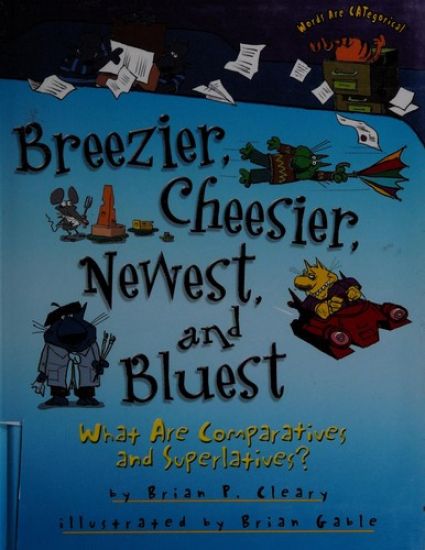
Breezier, Cheesier, Newest, and Bluest: What Are Comparatives and Superlatives?
What are comparatives and superlatives? After reading this book, you'll have a much clearer idea and will be the best at forming these descriptive words Brian P. Cleary and Brian Gable explain how these forms of adjectives compare nouns, through the cleverest rhymes and illustrations that are sillier than ever. Each comparative or superlative word is printed in color for easier identification.Breezier, Cheesier, Newest, and Bluest: What Are Comparatives and Superlatives? turns traditional grammar lessons on end. Read it aloud and share in the delight of the sense--and nonsense--of words.
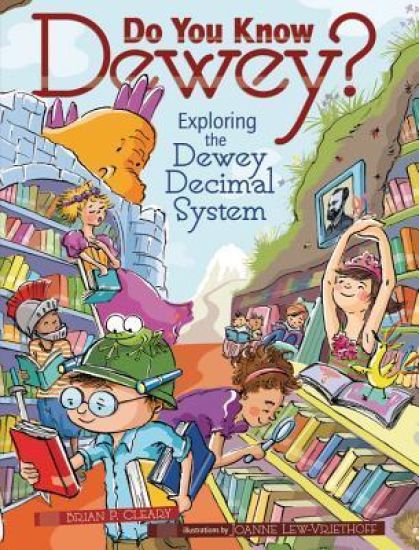
Do You Know Dewey?: Exploring the Dewey Decimal System
Are you ready for a library adventure? Join a group of children as they explore the Dewey decimal system Search for ghosts in the 100s section, track down everything from costumes to cars in the 300s, and be on the lookout for sports and music in the 700s. By the end of the book, you'll be more than ready to dive into Dewey on your own