A retired officer shares her experience as a whistle blower. When you hear about incidents of whistleblowing in policing. You don't hear much about things that happen in the day to day after whistleblowing. I will share my journal-diary as a Whistleblower and what happened during and after I blew the whistle the second time. Being ostracized and retaliated against during the second occurrence led me to discover that I had a heart condition This book explains how the whistle being blown on me helped in that discovery.
Poetry is all about love. But what happens when love is absent? In her first poetry chapbook, Charron Andrus, gives the love torn a volume of thirteen pieces that move the reader from the newly heartbroken "Living Without" to the heart break survivor "Broken". Words That Occur in the Absence of Love is a terrific exploration into heartbreak and its aftermath.
The North American Aerospace Defense Command (NORAD) has undergone wide-ranging changes since 2006, when it was given a new maritime warning mission and the NORAD Agreement was signed in perpetuity. Andrea Charron and James Fergusson trace NORAD’s recent history, marked by innovations in technology and in command and control, but also by unprecedented threats. The shared defence of North America remains an important issue that should extend to other areas, such as the joint defence of the maritime and cyber domains. Fuelled by a deep curiosity about the command and its decisions made in the face of inevitable geopolitical and technological changes, this book uses a functional lens to evaluate NORAD’s options and the technological and organizational solutions needed to defend North America. The authors investigate the ways in which the NORAD command might adapt in the future as it struggles to modernize and keep ahead of new threats.This book comes at a critical time. The rise of new peer competitors requires a fundamental reconsideration of North American defence. As one of very few contemporary analyses of the command and its future, NORAD will be a vital tool for scholars and practitioners.
The North American Aerospace Defense Command (NORAD) has undergone wide-ranging changes since 2006, when it was given a new maritime warning mission and the NORAD Agreement was signed in perpetuity. Andrea Charron and James Fergusson trace NORAD’s recent history, marked by innovations in technology and in command and control, but also by unprecedented threats. The shared defence of North America remains an important issue that should extend to other areas, such as the joint defence of the maritime and cyber domains. Fuelled by a deep curiosity about the command and its decisions made in the face of inevitable geopolitical and technological changes, this book uses a functional lens to evaluate NORAD’s options and the technological and organizational solutions needed to defend North America. The authors investigate the ways in which the NORAD command might adapt in the future as it struggles to modernize and keep ahead of new threats.This book comes at a critical time. The rise of new peer competitors requires a fundamental reconsideration of North American defence. As one of very few contemporary analyses of the command and its future, NORAD will be a vital tool for scholars and practitioners.
Randi's Country Kitchen Cookbook is filled with easy, healthy, and delicious gourmet recipes that are easy to prepare for the experienced chef as well as those just starting out. The recipes are inspired by the author's travels around the world and Vermont country living where the ingredients are simple, fresh, and locally sourced.Randi's motto is that "anyone can cook, they only need fresh simple ingredients, and simple easy recipes to make gourmet meals that their family and friends will love." This book is full of healthy recipes such as soups and salads, meats, pasta, seafood, desserts, and even meatless dishes. It is sure to become a go-to favorite for great, easy, delicious, and often quick recipes. Enjoy and Happy Cooking!
This book examines the application of the UN Security Council's mandatory sanctions since 1946, and, in particular, the regimes adopted for specific types of conflict.Beginning in the Cold War period with South Africa and Southern Rhodesia and continuing today, following the post-9/11 experience with Al Qaeda and the Taliban, sanctions are a key tool in the UN's efforts to deal with conflict. This book argues that the type of threat greatly influences the types of sanctions measures applied by the Security Council, who is targeted, as well as the objectives tied to the sanctions. The question of sanctions application is approached by classifying all 29 mandatory Security Council sanctions regimes into four conflict types: interstate; intrastate; international norm-breaking states; and support to terrorism. All of the sanctions regimes within each conflict type are analysed for: the objectives sought by the Council through the application of sanctions measures the targets chosen what measures are applied and in what sequence compared to other Security Council tools (such as peacekeeping missions or peace negotiations). The book sheds new light on how the Security Council approaches international peace and security beyond the application of force. Offering an excellent summary of the ins-and-outs of UN sanctions, and useful summary tables of UN sanctions regimes by conflict type, this book will be of great interest to students of international organisations, peace and conflict studies, conflict resolution, security studies and international relations or politics in general.
This book examines the application of the UN Security Council's mandatory sanctions since 1946, and, in particular, the regimes adopted for specific types of conflict.Beginning in the Cold War period with South Africa and Southern Rhodesia and continuing today, following the post-9/11 experience with Al Qaeda and the Taliban, sanctions are a key tool in the UN's efforts to deal with conflict. This book argues that the type of threat greatly influences the types of sanctions measures applied by the Security Council, who is targeted, as well as the objectives tied to the sanctions. The question of sanctions application is approached by classifying all 29 mandatory Security Council sanctions regimes into four conflict types: interstate; intrastate; international norm-breaking states; and support to terrorism. All of the sanctions regimes within each conflict type are analysed for: the objectives sought by the Council through the application of sanctions measures the targets chosen what measures are applied and in what sequence compared to other Security Council tools (such as peacekeeping missions or peace negotiations). The book sheds new light on how the Security Council approaches international peace and security beyond the application of force. Offering an excellent summary of the ins-and-outs of UN sanctions, and useful summary tables of UN sanctions regimes by conflict type, this book will be of great interest to students of international organisations, peace and conflict studies, conflict resolution, security studies and international relations or politics in general.
In this book the authors tackle the concept of 'quality of government' (QoG) both conceptually and empirically and apply their focus to EU countries and regions. In a pioneering empirical effort, they map out regional QoG for the first time for 172 NUTS 1 and 2 regions throughout 18 countries in the EU, and provide a detailed methodology. They follow up the quantitative assessment with three case studies demonstrating the wide variation of QoG found within the countries of Italy, Belgium and Romania. The book concludes with important lessons and ideas for future research.Quality of Government and Corruption from a European Perspective will offer a unique insight to an important issue of development within the EU that speaks to students and academics in the field of comparative politics, EU politics, development, governance and corruption.With contributions from: Lewis Dijkstra, Jonas Håkansson and Oana Borcan
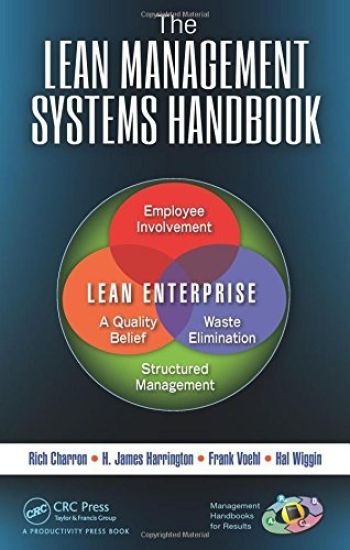
Performance management, the primary focus of a Lean organization, occurs through continuous improvement programs that focus on education, belief systems development, and effective change management. Presenting a first-of-its-kind approach, The Lean Management Systems Handbook details the critical components required for sustainable Lean management.Positioning Lean as a management operational philosophy far beyond the traditional set of improvement tools, the book explains how managers at all levels of the organization can integrate Lean into their daily management activities. It defines the Lean philosophy as well as the beliefs and behaviors required to develop a thriving Lean company culture.The book captures the essence of Lean learning and Lean doing and illustrates practical applications of Lean management. It begins by covering the basics that encompass Lean management and leadership in two critical areas: maintenance/control and improvement.After reading this book, you will better understand how to see waste, measure waste, eliminate waste, and develop an active change improvement workplace. You will also gain the practical understanding required to determine which Lean tool is best suited to your particular need for supporting an organization-wide management system.Expounding on essential Lean concepts, this is an ideal guide to help new managers and leaders make the transition from theory to successful application in the field. Complete with brief summaries and examples of the most important tools in Lean management systems development in each chapter, the book provides a reliable roadmap for deploying a Lean management system across your organization, and subsequently across your entire value stream.
Good writing begins with good reading. This book is written on the premise that students must embrace reading as a part of the full process of good writing. It may be used by classroom teachers (Grades 6-12) individually or collectively as members of a professional learning community, by pre-service teachers in a literacy course, or by other educators working to support literacy in the classroom. Interdisciplinary discussions relate to all types or genres of reading and writing. This book offers practical lessons and ideas for teaching and motivating all learners using Universal Design for Learning principles. Formatting provides additional ideas for challenged students, including students with special needs, accelerated learners, and English Language Learners, and is aligned with Common Core State Standards for content subjects as well as for language arts. It takes ideas that were formerly reserved for the upper echelon of students in English language arts and reformulates teaching approaches to reach students across the learning spectrum and in all disciplines. All teachers need to be involved in raising the literacy bar, and this book provides activities and strategies for use in the classroom that can promote success for all learners.