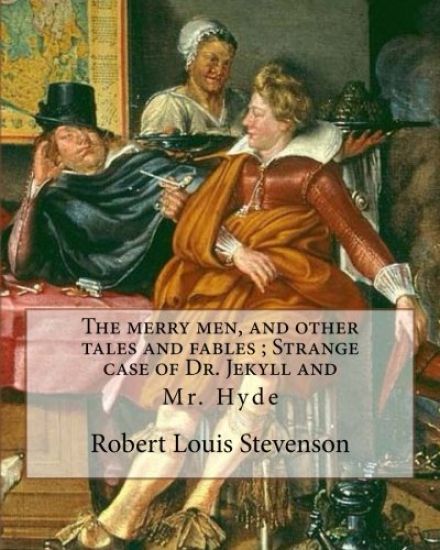
The Merry Men and Other Tales and Fables is a collection of short stories by Robert Louis Stevenson. The title derives from the local name given to a group of waves in the title short story, not from the Merry Men of Robin Hood tales. Robert Louis Balfour Stevenson (13 November 1850 - 3 December 1894) was a Scottish novelist, poet, essayist, and travel writer. His most famous works are Treasure Island, Kidnapped, Strange Case of Dr Jekyll and Mr Hyde and A Child's Garden of Verses. A literary celebrity during his lifetime, Stevenson now ranks among the 26 most translated authors in the world.His works have been admired by many other writers, including Jorge Luis Borges, Bertolt Brecht, Marcel Proust, Arthur Conan Doyle, Henry James, Cesare Pavese, Ernest Hemingway, Rudyard Kipling, Jack London, Vladimir Nabokov, J. M. Barrie, and G. K. Chesterton, who said of him that he "seemed to pick the right word up on the point of his pen, like a man playing spillikins." Childhood and youth--Stevenson was born at 8 Howard Place, Edinburgh, Scotland, on 13 November 1850 to Thomas Stevenson (1818-87), a leading lighthouse engineer, and his wife Margaret Isabella (n e Balfour; 1829-97). He was christened Robert Lewis Balfour Stevenson. At about age 18, Stevenson was to change the spelling of "Lewis" to "Louis", and in 1873 he dropped "Balfour." Lighthouse design was the family's profession: Thomas's father (Robert's grandfather) was the famous Robert Stevenson, and both of Thomas's brothers (Robert's uncles) Alan and David, were in the same field.Indeed, even Thomas's maternal grandfather, Thomas Smith, had been in the same profession. However, Robert's mother's family were not of the same profession. Margaret's natal family, the Balfours, were gentry, tracing their lineage back to a certain Alexander Balfour who had held the lands of Inchyra in Fife in the fifteenth century. Margaret's father, Lewis Balfour (1777-1860), was a minister of the Church of Scotland at nearby Colinton, and her siblings included the physician George William Balfour and the marine engineer James Balfour. Stevenson spent the greater part of his boyhood holidays in his maternal grandfather's house. "Now I often wonder," wrote Stevenson, "what I inherited from this old minister. I must suppose, indeed, that he was fond of preaching sermons, and so am I, though I never heard it maintained that either of us loved to hear them." Lewis Balfour and his daughter both had weak chests, so they often needed to stay in warmer climates for their health. Stevenson inherited a tendency to coughs and fevers, exacerbated when the family moved to a damp, chilly house at 1 Inverleith Terrace in 1851.The family moved again to the sunnier 17 Heriot Row when Stevenson was six years old, but the tendency to extreme sickness in winter remained with him until he was eleven. Illness would be a recurrent feature of his adult life and left him extraordinarily thin. Contemporary views were that he had tuberculosis, but more recent views are that it was bronchiectasisor even sarcoidosis.Stevenson's parents were both devout and serious Presbyterians, but the household was not strict in its adherence to Calvinist principles.............
When a small midwestern gallery is burgled, artworks by an American icon disappear into the international market for stolen art, but the gallery's owners refuse to give up the search.
Since the early beginning of literature the double motif has served in its different models to trace the features of the ego, individuality and perception. The double plays an important role in literature: it portays confusion and transformation, reflects inner desires and spreads anxiety. But the phenomenon is not just an invention of literature. Again and again people claim to see oneself like some famous persons such as Catharine the Great and Johann Wolfgang von Goethe. This term paper will analyze the Double-motif in Robert Louis Stevenson's novel The Strange Case of Dr. Jekyll and Mr. Hyde with regard to psychoanalysis. While citing secondary literature it became obvious that a good portion of these examinations use psychological criteria which offer a wider range of insight into the oddly logic of Stevenson's text which he to no purpose named The Strange Case. Three texts from Freud lend themselves to work with the novel: "Die 'kulturelle' Sexualmoral und die moderne Nervosit t" (1908), "Das Unheimliche" (1919) and "Das Unbehagen in der Kultur" (1930). In "Das Unheimliche" Freud deals with the background of the double motif. He interprets the phenomenon from its probable beginning in mythology till the masterly usage of it in E.T.A Hoffmann's "Sandman."In section two of this term paper I will give an overview of the double motif in literature. For this, I will explain the development of the term and its psychological implications. The third section will constitute the main part of the paper: I will first discuss two moments which can be interpreted with the help of psychology and then I will try to apply Freud's theorems to the primary source which is full of repressed drives and desires.
Studienarbeit aus dem Jahr 2003 im Fachbereich Anglistik - Literatur, Note: 2,3, Universit t Trier (Fachbereich II Anglistik), Veranstaltung: The Gothic Novel, Sprache: Deutsch, Abstract: "The voices only speak to me - that's why you are jealous." This joke mocks someone hearing voices. In the modern world this circumstance is considered an illness which can be cured. However in former times, in the middle ages or even in the 19th century the people feared doubles or doppelg nger. In literature the motif of the double can be traced back to authors like Sophocles in the ancient Greece, who wrote Oedipus Rex in which he "raises the question of the extent to which Man can be entirely accountable for his actions since because of his human aspect he is here, while, at the same time, because of his superhuman aspect he is elsewhere." During the ages the double changed and evolved. Finally in the 19th century two great novels entered the world of literature with the effect of changing that world forever: Mary Shelley wrote her novel Frankenstein, or the Modern Prometheus which "has retained an undying international fame which places it in a class apart from its bloodcurdling contemporaries" . Later in that century Robert Louis Stevenson published his novel The Strange Case of Dr Jekyll and Mr Hyde which deals with a similar problem - the problem of the double. Those novels brought up many followers and imitators and eventually the genre of science-fiction . At first this paper tries to give some information on the authors and their works. However its core is to describe the motif of the doppelg nger in both - Frankenstein and Dr Jekyll and Mr Hyde - by discussing them separately and later by comparing them. The main sources which helped writing this assignment were Intimations of ambiguity by Juliane Forssmann and the two essays on the double in the Companion to literary Myths, Heroes and Archetypes, edited by Pierre Brunel and in Elisabeth Frenzel's Motive der Weltliter
THE BRAIN HAS NO FIREWALLPierce Reston is a member of an elite unit of extreme persuasion experts.After people across the nation begin reporting 'missing time', and a series of unexplained terrifying coincidences, he's assigned to investigate.Women going missing in Prague, and a national outbreak of amnesia trigger a full-scale search.Pierce soon learns that someone is hell bound to use a secret "key" that causes a complete loss of mental control - engineering an epidemic that will change the course of history.While investigating with Kelly Kennedy, a brand new operative, Pierce discovers something has been lost. A video. The most dangerous video on earth. Finding a link between the horrific crimes and the sinister coincidences happening around the world, Pierce and Kelly unveil a terrifying neuroscience laboratory that has chilling secrets no one should know.Finding out who is responsible might be impossible, especially when they realize there are tremendous forces that will do anything to stop them. Pierce and Kelly are forced to dig into the darkest secrets of human psychology to discover the truth.And their target is watching them.
Partnering with families just got easier In his bestselling book, Engage Every Family, Dr. Steve Constantino introduced school leaders to the five simple principles of family engagement: a pathway and process designed to bring all families into the school community—including those that have traditionally been disengaged or disenfranchised. This official companion book, co-authored by Dr. Margaret Constantino, uses examples and exercises to aid in the implementation of those principles. Organized around a collection of rich, diverse case studies mirroring challenges educators face every day, this hands-on workbook offers opportunities to address your own school’s current conditions, identify strengths and areas for improvement, and use best practices to support every student by engaging every family. Features include 20 carefully constructed case studies illustrating the five simple principlesAdaptable processes and strategies to apply at the classroom, school, and district levelPrompts to aid in identifying root causes of common engagement issues so you can successfully support each studentQuestions to guide reflection, discussion, and deeper thinking about each case To give students their best chance at success, we must ensure coordinated support at school and at home. This workbook gives educators the tools, materials, and ideas they need to reach every family—no matter the situation—and partner with them to grow their students’ achievement.
This text is a companion to the 2nd edition of Intellectual Property Law And New Media: Free for a Fee. Moving the coverage of case analysis to this separate volume, enables the authors to focus their attention on important trial and legal procedures that apply extant law to, largely, new circumstances.Readers can focus on history and concepts while reading the main text, allowing them to bring understandings derived there to bear on the cases found in this analytic text. The approach offers relief from information overload and allows time and space to «shift gears» between concepts and cases. To aid understanding and learning, the authors provide focused interpretations and analysis throughout. The coverage allows these books to serve as an excellent resource for undergraduates studying interactive media, as well as being a primer for first year IP law students, a handbook for entrepreneurs, a guidebook for general lawyers to assist in referrals, and an interesting read for those simply curious about the field.The books are supplemented by freeforafee.com, a blog providing textual updates, online links to bibliographic materials, and extensive resource aggregation. Learning objectives for each chapter and a glossary of key terms are provided within the texts.
The best solution to any problem is to refer to past experiences. This book includes a collection of case studies and situations relating to educational technology and library media, covering issues such as copyright, instructional issues, and hardware and software. This useful resource provides a framework in which to address common situations that school leaders encounter regarding educational technology and school library media programs. For each situation, the book provides a contextual setting of both the school and the community, the immediate background of the situation and the articulated problem. Most of the cases are expressed as an assignment from the superintendent or a principal, and include a listing of appropriate reference sources for further information.
Case Method and the Arabic Teacher: A Practical Guide compiles original case studies that address the unique challenges of teaching Arabic at the high school level. The book's engaging and accessible classroom scenarios reflect the experiences of a diverse group of Arabic teachers working in a variety of educational settings ranging from elite private schools to large public schools with low income student populations. In the case studies, teachers offer compelling accounts of the political, institutional, and curricular issues they encountered not only in their classrooms, but also in their wider schools and communities. Combining research-based methodology with firsthand pedagogical narratives, this book is a valuable resource for teachers, teacher trainers, researchers, and other stakeholders who support the teaching of Arabic.
Case studies have become a widely-used instructional tool in many educational environments. The use of case studies began in the 1950s at Harvard Business School. Today, they may be used as part of a course of study, or as the main focus of a course, to which other material is added. While the use of case studies is prevalent in schools of business and medicine, they are not often used in adult education or human resource development. This may be because there are no current major publications that deal with the use of case studies in these disciplines; nor are there any major databases of adult education or human resource development case studies for instructors to use. Good case studies can bring reality into the classroom. They can provide frameworks for discussion based on issues that must be faced in real life. Complex case issues can be broken down and examined for greater understanding, then pulled together again for resolution.Case studies can be used successfully in adult education. I propose a book based on the use of case-based learning in adult education and human resource development (HRD). The book could be positioned as a supplement to course textbooks for courses in adult education and HRD. I would write the cases and develop the exercises, but could also get others to contribute a case study or exercise to the book. Cases would each be a half-page to maybe 2-3 pages at the long end, and would include questions for students/readers. Supplementary information (possibly in the form of a DVD) could be put together for instructors. This information would include case study focal points and examples of possible responses for each study/exercise.