Kirjojen hintavertailu. Mukana 11 244 527 kirjaa ja 12 kauppaa.

Kirjahaku

Etsi kirjoja tekijän nimen, kirjan nimen tai ISBN:n perusteella.

159 tulosta hakusanalla Csaba Moldicz

Budapest Exit

Budapest Exit

Csaba Teglas

Texas A M University Press
2007
nidottu
Faced with fascism, communism, and the 1956 Revolution, Csaba Teglas responded with ingenuity and hope. In ""Budapest Exit"", he tells the story of his twenty-year quest for freedom. Teglas rummaged the scrap heap of World War II for anything he could sell to get food money for his family. The income from selling bits of rubber and ball bearings was often the family's only sustenance. Teglas and his family and friends lived in constant fear; some were even subjected to communist jails and torture chambers. Teglas protested, sometimes quietly, sometimes more vocally, against the Soviet and communist presence in Hungary. During the 1956 revolution, he became more involved in the opposition. When it became clear that the revolutionaries would not succeed, he knew he had to leave. Teglas recounts his dramatic escape through the heavily guarded Iron Curtain and his subsequent journey to North America, where life as an immigrant presented new challenges. This memoir is Csaba Teglas' personal story of his youth, told from the point of view of a man with sons of his own. He found in America the freedom for which he had been searching, but he has raised his American sons to remain proud of their Hungarian heritage.
Roman Religion in the Danubian Provinces
The Danubian provinces represent one of the largest macro-units within the Roman Empire, with a large and rich heritage of Roman material evidence. Although the notion itself is a modern 18th-century creation, this region represents a unique area, where the dominant, pre-Roman cultures (Celtic, Illyrian, Hellenistic, Thracian) are interconnected within the new administrative, economic and cultural units of Roman cities, provinces and extra-provincial networks. This book presents the material evidence of Roman religion in the Danubian provinces through a new, paradigmatic methodology, focusing not only on the traditional urban and provincial units of the Roman Empire, but on a new space taxonomy. Roman religion and its sacralised places are presented in macro-, meso- and micro-spaces of a dynamic empire, which shaped Roman religion in the 1st-3rd centuries AD and created a large number of religious glocalizations and appropriations in Raetia, Noricum, Pannonia Superior, Pannonia Inferior, Moesia Superior, Moesia Inferior and Dacia. Combining the methodological approaches of Roman provincial archaeology and religious studies, this work intends to provoke a dialogue between disciplines rarely used together in central-east Europe and beyond. The material evidence of Roman religion is interpreted here as a dynamic agent in religious communication, shaped by macro-spaces, extra-provincial routes, commercial networks, but also by the formation and constant dynamics of small group religions interconnected within this region through human and material mobilities. The book also presents for the first time a comprehensive list of sacralised spaces and divinities in the Danubian provinces.
Sanctuaries in Roman Dacia

Sanctuaries in Roman Dacia

Csaba Szabo

Archaeopress
2018
nidottu
This book is the first comprehensive work focusing on lived ancient religious communication in Roman Dacia. Testing for the first time the ‘Lived Ancient Religion’ approach in terms of a peripheral province from the Danubian area, this work looks at the role of ‘sacralised’ spaces, known commonly as sanctuaries in the religious communication of the province. The author analyses the role of space sacralisation, religious appropriation, embodiment and the social impact of religious communication in urban contexts (Apulum), military contexts (Porolissum and Mehadia), and numerous examples from rural (non-urban) environments (Ampelum, Germisara, Ad Mediam, and many others). The book concentrates not only on the creation and maintenance of sacralised spaces in public and secondary locations, but also on their role at the micro-level of objects, semi-micro level of spaces (settlements), and the macro-level of the province and the Danubian region as a whole. Innovatively as regards provincial archaeological research, this book emphasises the spatial aspects of lived ancient religion by analysing for the first time the sanctuaries as spaces of religious communication in Dacia. The work also contains a significant chapter on the so-called ‘small-group’ religions (the Bacchic, Mithraic and Dolichenian groups of the province), which are approached for the first time in detail. The study also gives the first comprehensive list of archaeologicallyepigraphically- attested, and presumed sacralised spaces within Dacia.
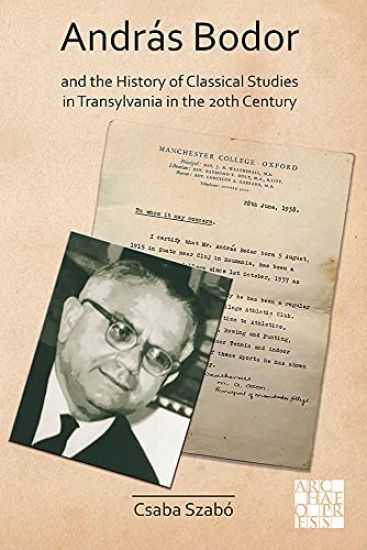
András Bodor and the History of Classical Studies in Transylvania in the 20th century
András Bodor and the history of classical studies in Transylvania in the 20th century is the first comprehensive work focusing on the life of a classicist from Transylvania, presenting in detail the life and academic heritage of András Bodor (1915-1999). Based on 1348 newly identified letters, 209 photographs (including 25 portraits), András Bodor’s complete bibliography and his unpublished memoir from 1915-1959, the work offers also the first publication of Bodor’s academic correspondence (107 letters) and also extracts from his unpublished journal. Based on a large number of unpublished documents and the major works of Bodor, the book tries to reconstruct the life and academic heritage of a classicist from the periphery of Europe, a region that changed so many times over the long course of the 20th century. András Bodor appears as a student torn between theology and classical studies, a Transylvanian Hungarian who ended up at Oxford, a lecturer at the Hungarian University of Cluj, a researcher who had the idea of establishing a new school of classics, marginalised and compromising, a quiet teacher of the newly established Babe?-Bolyai University and also a senior professor engaged in education policy. The personality and work of Bodor is presented through the short history of classics in Transylvania, Romania, reflecting on the European and global changes of the discipline.
Forgotten Heroes

Forgotten Heroes

Csaba B Stenge

HELION COMPANY
2023
pokkari
Prior to the beginning of the Second World War, the Royal Hungarian Armed Forces - including the Air Force - prepared to engage the Little Entente forces; however, after a short skirmish prior to the war with the Slovaks, during the war, their opponents became the Soviet and American aviators. The Hungarian aces fought gallantly against such heavy odds and, after the war's end, the new Hungarian communist regime turned against them as well; this book is the unique story of the 38 Hungarian air aces of the Second World War. The overwhelming majority of the related materials have been lost or destroyed, so the author has demonstrated truly Herculean efforts during his 23-year-long extensive research to write this monumental work. The book is based mostly on previously unpublished primary sources from Hungarian, German, Russian and American Archives, and also on the preserved documents of the aces and their families. The text is not limited to the highly detailed biographies of the 38 Hungarian aces; it also covers some important and related aspects such as air victory confirmation systems, air combat tactics and obtained awards. Besides this, the book contains more than 350 rare images - many of them are previously unpublished - and a selection of superb color profiles, which show camouflage and markings for the aircraft of the aces.
Forgotten Heroes

Forgotten Heroes

Csaba B. Stenge

Helion Company
2019
sidottu
Prior to the beginning of the Second World War, the Royal Hungarian Armed Forces - including the Air Force - prepared to engage the Little Entente forces; however, after a short skirmish prior to the war with the Slovaks, during the war, their opponents became the Soviet and American aviators. The Hungarian aces fought gallantly against such heavy odds and, after the war’s end, the new Hungarian communist regime turned against them as well; this book is the unique story of the 38 Hungarian air aces of the Second World War. The overwhelming majority of the related materials have been lost or destroyed, so the author has demonstrated truly Herculean efforts during his 23-year-long extensive research to write this monumental work. The book is based mostly on previously unpublished primary sources from Hungarian, German, Russian and American Archives, and also on the preserved documents of the aces and their families. The text is not limited to the highly detailed biographies of the 38 Hungarian aces; it also covers some important and related aspects such as air victory confirmation systems, air combat tactics and obtained awards. Besides this, the book contains more than 350 rare images - many of them are previously unpublished - and a selection of superb colour profiles, which show camouflage and markings for the aircraft of the aces.
Uncommon Sense in Unusual Times: How to stay relevant in the 21st century by understanding ourselves and others better than social media algorithms an
A TRANSFORMATIONAL BOOK WITH OVER 500 WORTH OF RESOURCESHave you ever felt that you were talking to someone and the other person had no common sense at all? No matter how hard you tried to explain your point of view, it seemed you were talking about a completely different situation. Most of us have experienced this frustration and seemingly pointless uphill battle.Have you ever considered that the other side had exactly the same feeling about you, but for a different reason?I lost my first business and ruined friendships because I used to think that speaking the same language, having common sense and good intentions, would be enough to get along with others. I was wrong.Just like most people who don't change until it hurts enough, I waited for that personal and professional slap in the face to embark on my mission to find out why people think, feel, and behave so differently; and how we can turn those differences into synergy.There are plenty of books and online courses about cultural intelligence, personal and leadership development. They tend to be informative but rarely transformative as knowledge without practice is like a teabag without hot water, potential waiting to be released.But in this hybrid book, every chapter is fully integrated with an interactive coaching platform to challenge your views on concepts you might have taken for granted and stretch your comfort zone to a point where life is going to make much more sense in these unusual times.Testimonials"Csaba has put together valuable insights to equip readers with a solid foundation and practical tools to master people - the most important asset of our businesses. Whether we are enhancing individual, team or organisational performance, this book provides the framework to make things happen in the most effective and efficient way possible."Tinette Cortes - CEO of ConsultAsia GlobalGlobal DISC is a powerful tool for Intelligent Leaders to leverage personal and cultural differences for competitive advantage, to enable trust and to build high-performing teams at home and globally." - John Mattone, the #1 Authority on Intelligent Leadership and the World's Top Executive Coach, Steve Jobs' former coach"Bridging the gap between our intention and the actual impact on others is the foundation of great leadership. Global DISC makes this process clear and highly actionable."Marshall Goldsmith - Only two-time Thinkers 50 #1 Leadership Thinker in the world."The book is very interesting and as I read it reminds me the excitement of reading Tim Ferriss's 4-hour work week book."Svetana Jordanova - Business Development and leadership coach
Musings Of A Mad Hungarian

Musings Of A Mad Hungarian

Csaba Méra

Native Book Publishing
2023
pokkari
Csaba M ra's "Musings of A Mad Hungarian" is a collection of poetry that reflects on the complexities of life, drawing from the author's experiences as a refugee, foreigner, physician, husband, father, and teacher. Born and raised in Hungary, Csaba's life has been shaped by significant events, including his near-death experience at age two, his family's escape from Hungary during the 1956 revolution, and his subsequent struggles to adapt to new countries and cultures.The poems in this collection are a testament to Csaba's resilience, humor, and a deep sense of empathy. The author's reflections on life's joys and challenges are both personal and universal, touching on themes such as love, loss, hope, and the beauty of the natural world. The poems are written in a variety of styles, from free verse to haiku, and are infused with Csaba's unique perspective on the world.One of the strengths of this collection is its ability to capture the emotional complexity of life in a way that is both relatable and deeply moving. Csaba's poetry is full of vivid imagery and powerful metaphors that invite readers to explore their own emotions and experiences. Whether he is writing about the fleeting beauty of a sunset or the enduring power of love, Csaba's words are infused with a sense of wonder and awe.Another standout feature of "Musings of A Mad Hungarian" is its intimate portrayal of the author's life. Through his poetry, Csaba offers readers a glimpse into his personal journey, from his childhood in Hungary to his career as a physician in the United States. His experiences as a refugee and a foreigner are a recurring theme in the collection, and his reflections on these topics are poignant and thought-provoking.Overall, "Musings of A Mad Hungarian" is a deeply moving and beautifully crafted collection of poetry. Csaba M ra's ability to capture the complexities of life in a way that is both personal and universal is truly remarkable. I highly recommend this book to anyone who is looking for a thoughtful and engaging exploration of the human experience.One of the standout features of the book is the author's ability to capture the many different aspects of life, from the joys and sorrows of human relationships to the mysteries of the universe and the nature of existence itself. Through his poetry, Csaba explores the nature of time, the meaning of reality, and the inevitability of death, all while maintaining a sense of wonder and awe at the beauty and complexity of the world.To conclude, the poems in Csaba M ra's "Musings of A Mad Hungarian" offer a unique and insightful perspective on life, and I cannot deny the author's talent for exploring complex philosophical concepts in an artistic and inspiring way.An anonymous friend. Follow Csaba on his Facebook Page: https: //www.facebook.com/csabathemadhungarianFor more information on Csaba, visit csabamera.com
Multi-Level Bayesian Models for Environment Perception

Multi-Level Bayesian Models for Environment Perception

Csaba Benedek

Springer Nature Switzerland AG
2022
sidottu
This book deals with selected problems of machine perception, using various 2D and 3D imaging sensors. It proposes several new original methods, and also provides a detailed state-of-the-art overview of existing techniques for automated, multi-level interpretation of the observed static or dynamic environment. To ensure a sound theoretical basis of the new models, the surveys and algorithmic developments are performed in well-established Bayesian frameworks. Low level scene understanding functions are formulated as various image segmentation problems, where the advantages of probabilistic inference techniques such as Markov Random Fields (MRF) or Mixed Markov Models are considered. For the object level scene analysis, the book mainly relies on the literature of Marked Point Process (MPP) approaches, which consider strong geometric and prior interaction constraints in object population modeling. In particular, key developments are introduced in the spatial hierarchical decomposition of the observed scenarios, and in the temporal extension of complex MRF and MPP models. Apart from utilizing conventional optical sensors, case studies are provided on passive radar (ISAR) and Lidar-based Bayesian environment perception tasks. It is shown, via several experiments, that the proposed contributions embedded into a strict mathematical toolkit can significantly improve the results in real world 2D/3D test images and videos, for applications in video surveillance, smart city monitoring, autonomous driving, remote sensing, and optical industrial inspection.
Multi-Level Bayesian Models for Environment Perception

Multi-Level Bayesian Models for Environment Perception

Csaba Benedek

Springer Nature Switzerland AG
2023
nidottu
This book deals with selected problems of machine perception, using various 2D and 3D imaging sensors. It proposes several new original methods, and also provides a detailed state-of-the-art overview of existing techniques for automated, multi-level interpretation of the observed static or dynamic environment. To ensure a sound theoretical basis of the new models, the surveys and algorithmic developments are performed in well-established Bayesian frameworks. Low level scene understanding functions are formulated as various image segmentation problems, where the advantages of probabilistic inference techniques such as Markov Random Fields (MRF) or Mixed Markov Models are considered. For the object level scene analysis, the book mainly relies on the literature of Marked Point Process (MPP) approaches, which consider strong geometric and prior interaction constraints in object population modeling. In particular, key developments are introduced in the spatial hierarchical decomposition of the observed scenarios, and in the temporal extension of complex MRF and MPP models. Apart from utilizing conventional optical sensors, case studies are provided on passive radar (ISAR) and Lidar-based Bayesian environment perception tasks. It is shown, via several experiments, that the proposed contributions embedded into a strict mathematical toolkit can significantly improve the results in real world 2D/3D test images and videos, for applications in video surveillance, smart city monitoring, autonomous driving, remote sensing, and optical industrial inspection.
Algorithms for Reinforcement Learning

Algorithms for Reinforcement Learning

Csaba Szepesvári

Springer International Publishing AG
2010
nidottu
Reinforcement learning is a learning paradigm concerned with learning to control a system so as to maximize a numerical performance measure that expresses a long-term objective. What distinguishes reinforcement learning from supervised learning is that only partial feedback is given to the learner about the learner's predictions. Further, the predictions may have long term effects through influencing the future state of the controlled system. Thus, time plays a special role. The goal in reinforcement learning is to develop efficient learning algorithms, as well as to understand the algorithms' merits and limitations. Reinforcement learning is of great interest because of the large number of practical applications that it can be used to address, ranging from problems in artificial intelligence to operations research or control engineering. In this book, we focus on those algorithms of reinforcement learning that build on the powerful theory of dynamic programming. We give a fairly comprehensive catalog of learning problems, describe the core ideas, note a large number of state of the art algorithms, followed by the discussion of their theoretical properties and limitations. Table of Contents: Markov Decision Processes / Value Prediction Problems / Control / For Further Exploration
In situ Combined Electrochemical Techniques for Conducting Polymers

In situ Combined Electrochemical Techniques for Conducting Polymers

Csaba Visy

Springer International Publishing AG
2017
nidottu
This book outlines methods to improve functioning of these polymer based devices – in particular, the multi-faceted cognition of these materials. In situ electrochemical techniques are studied to elucidate redox switching between non-conducting and conducting states.The book examines the advantages of combinations of in situ electrochemical techniques in a hyphenated mode for analyzing conducting polymers.
Solarturmreceiver für überkritische Dampfprozesse und ihre technische und ökonomische Bewertung
Csaba Singer untersucht die Kostensenkungspotenziale bei der Stromerzeugung mit solarthermischen Turmkraftwerken. Sein Ziel ist die Steigerung des Receiverwirkungsgrades und das Aufzeigen und Bewerten kritischer Aspekte von innovativen Receivertechnologien. Zunächst erfolgt eine Konzeptstudie, die dazu dient, den Stand der Technik der Solarturmkraftwerke mit ausgewählten Receiveroptionen für die Erhöhung der Dampfprozesstemperaturen zu vergleichen. Diese Studie zeigt, dass die Direktabsorption auf der inneren Mantelfläche des Receivers mit nach unten geöffneter Apertur und Flüssigfilmkühlung die höchsten Potenziale zwischen den verglichenen Optionen aufweist. Daraufhin erfolgt die detaillierte strömungsmechanische und thermodynamische Modellbildung dieses Receiverkonzepts im Maßstab 1:1, mit der die Analyse der Machbarkeit und der Funktionalität erfolgt. ?
Psychosocial oncology needs

Psychosocial oncology needs

Csaba László Dégi

LAP Lambert Academic Publishing
2018
pokkari
Cancer distress, the 6th vital sign is a universal cancer-related experience and a human rights issue. It is a multifaceted reality with the undisputable advantage of 'reminding us that people with cancer are human beings'. Cancer, an unregulated form of life, launches attack on the body, but from the very moment the affected person becomes aware of it, the devastating effects of cancer start working in the person's psychological and social living as well. Cancer can easily become emotional and charged with prejudices due to guilt, punishment, atonement and the image of death associated with the malignant nature. For some, the cancer experience has a significantly negative impact on mental health and wellbeing as for others it has a positive psychological and social outcome, including survivorship. Upon examining cancer patients' emotional distress and quality of life, we set out from the interaction of somatic, psychological and social factors. Levels of neglected psychosocial needs in cancer patients reach an alarming level in Romania. The Romanian public health system can by no means offer qualitative psychosocial care for cancer patients since cancer distress is not assessed.