The 18th century was a wealth of knowledge, exploration and rapidly growing technology and expanding record-keeping made possible by advances in the printing press. In its determination to preserve the century of revolution, Gale initiated a revolution of its own: digitization of epic proportions to preserve these invaluable works in the largest archive of its kind. Now for the first time these high-quality digital copies of original 18th century manuscripts are available in print, making them highly accessible to libraries, undergraduate students, and independent scholars.Western literary study flows out of eighteenth-century works by Alexander Pope, Daniel Defoe, Henry Fielding, Frances Burney, Denis Diderot, Johann Gottfried Herder, Johann Wolfgang von Goethe, and others. Experience the birth of the modern novel, or compare the development of language using dictionaries and grammar discourses. ++++The below data was compiled from various identification fields in the bibliographic record of this title. This data is provided as an additional tool in helping to insure edition identification: ++++British LibraryT052741Vol. 2 is dated 1717. M. Wotton has been replaced by J. Wotton in the imprints to vols. 5 and 6. Variant: M. Wotton has been replaced by J. Wotton in the imprint to vol. 1.London: printed for J. Walthoe, M. Wotton, J. Nicholson, J. Sprint, G. Conyers, and 6 others in London], 1716-17. 6v., plates; 8
The 18th century was a wealth of knowledge, exploration and rapidly growing technology and expanding record-keeping made possible by advances in the printing press. In its determination to preserve the century of revolution, Gale initiated a revolution of its own: digitization of epic proportions to preserve these invaluable works in the largest archive of its kind. Now for the first time these high-quality digital copies of original 18th century manuscripts are available in print, making them highly accessible to libraries, undergraduate students, and independent scholars.Western literary study flows out of eighteenth-century works by Alexander Pope, Daniel Defoe, Henry Fielding, Frances Burney, Denis Diderot, Johann Gottfried Herder, Johann Wolfgang von Goethe, and others. Experience the birth of the modern novel, or compare the development of language using dictionaries and grammar discourses. ++++The below data was compiled from various identification fields in the bibliographic record of this title. This data is provided as an additional tool in helping to insure edition identification: ++++British LibraryT052741Vol. 2 is dated 1717. M. Wotton has been replaced by J. Wotton in the imprints to vols. 5 and 6. Variant: M. Wotton has been replaced by J. Wotton in the imprint to vol. 1.London: printed for J. Walthoe, M. Wotton, J. Nicholson, J. Sprint, G. Conyers, and 6 others in London], 1716-17. 6v., plates; 8
The 18th century was a wealth of knowledge, exploration and rapidly growing technology and expanding record-keeping made possible by advances in the printing press. In its determination to preserve the century of revolution, Gale initiated a revolution of its own: digitization of epic proportions to preserve these invaluable works in the largest archive of its kind. Now for the first time these high-quality digital copies of original 18th century manuscripts are available in print, making them highly accessible to libraries, undergraduate students, and independent scholars.Western literary study flows out of eighteenth-century works by Alexander Pope, Daniel Defoe, Henry Fielding, Frances Burney, Denis Diderot, Johann Gottfried Herder, Johann Wolfgang von Goethe, and others. Experience the birth of the modern novel, or compare the development of language using dictionaries and grammar discourses. ++++The below data was compiled from various identification fields in the bibliographic record of this title. This data is provided as an additional tool in helping to insure edition identification: ++++British LibraryT128962Titlepage in red and black.London: printed for J. and R. Tonson and S. Draper, 1755. 72p.: ill.; 12
The 18th century was a wealth of knowledge, exploration and rapidly growing technology and expanding record-keeping made possible by advances in the printing press. In its determination to preserve the century of revolution, Gale initiated a revolution of its own: digitization of epic proportions to preserve these invaluable works in the largest archive of its kind. Now for the first time these high-quality digital copies of original 18th century manuscripts are available in print, making them highly accessible to libraries, undergraduate students, and independent scholars.Western literary study flows out of eighteenth-century works by Alexander Pope, Daniel Defoe, Henry Fielding, Frances Burney, Denis Diderot, Johann Gottfried Herder, Johann Wolfgang von Goethe, and others. Experience the birth of the modern novel, or compare the development of language using dictionaries and grammar discourses. ++++The below data was compiled from various identification fields in the bibliographic record of this title. This data is provided as an additional tool in helping to insure edition identification: ++++British LibraryT033579Also issued as part of: 'The new English theatre' vol.5, London, 1776-77. With a final advertisement leaf.London: printed for T. Lowndes; T. Caslon; W. Nicoll; and S. Bladon, 1776. 101, 3]p., plate; 12
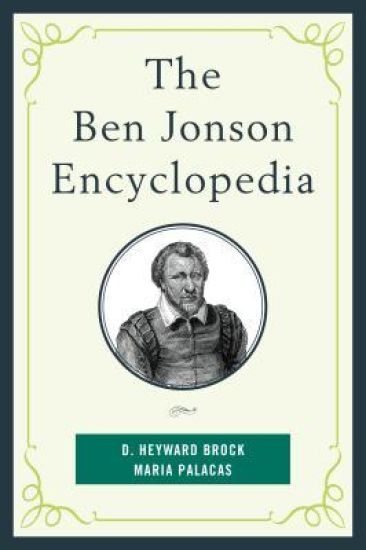
Friend and rival of Shakespeare, Ben Jonson was one of the most learned and interesting men of his age. Throughout his fascinating life, he served not only as a bricklayer but also a soldier, an adventurer, an actor, a poet, and a playwright. The breadth of his experiences, acquaintances, friends, and enemies was legendary, and his literary canon is equally as diverse. The Ben Jonson Encyclopedia covers in detail the works, life, and times of this seminal figure of the English Renaissance. The cross-referenced entries include summaries of all Jonson’s plays, masques, and entertainments, as well as sketches of Jonson’s friends, enemies, patrons, disciples, actors, and fellow writers. In addition, the book identifies historical figures, mythological characters, and classical authors, as well as Jonson’s contemporaries and London place names mentioned in the works. Individuals who danced or participated in the masques and entertainments or tournaments for which Jonson wrote speeches are noted, as are the main actors known to have acted in the plays. All major scholars—from Jonson’s own day until the twenty-first century—who have commented on Jonson or his works are also included. An extensive bibliography completes this invaluable scholarly reference tool. Because of Jonson’s centrality to—and influence in and beyond—his age, this encyclopedia provides a dynamic, unparalleled vision of the English Renaissance literary scene. Capturing the depth and breadth of Jonson’s understanding of early Modern England, The Ben Jonson Encyclopedia will be especially useful for students, librarians, and academics interested in the literary and cultural scene from 1500 to 1650.