

Kirjahaku
Etsi kirjoja tekijän nimen, kirjan nimen tai ISBN:n perusteella.
1000 tulosta hakusanalla David Benner; Bob Benner

Loving It All: Living with an Awakening Heart
David Banner Phd
Createspace Independent Publishing Platform
2014
nidottu

Rebel Politics analyzes the changing dynamics of the civil war in Myanmar, one of the most entrenched armed conflicts in the world. Since 2011, a national peace process has gone hand-in-hand with escalating ethnic conflict. The Karen National Union (KNU), previously known for its uncompromising stance against the central government of Myanmar, became a leader in the peace process after it signed a ceasefire in 2012. Meanwhile, the Kachin Independence Organization (KIO) returned to the trenches in 2011 after its own seventeen-year-long ceasefire broke down. To understand these puzzling changes, Brenner conducted ethnographic fieldwork among the KNU and KIO, analyzing the relations between rebel leaders, their rank-and-file, and local communities in the context of wider political and geopolitical transformations. Drawing on Political Sociology, Rebel Politics explains how revolutionary elites capture and lose legitimacy within their own movements and how these internal contestations drive the strategies of rebellion in unforeseen ways. Brenner presents a novel perspective that contributes to our understanding of contemporary politics in Southeast Asia, and to the study of conflict, peace and security, by highlighting the hidden social dynamics and everyday practices of political violence, ethnic conflict, rebel governance and borderland politics.

Rebel Politics analyzes the changing dynamics of the civil war in Myanmar, one of the most entrenched armed conflicts in the world. Since 2011, a national peace process has gone hand-in-hand with escalating ethnic conflict. The Karen National Union (KNU), previously known for its uncompromising stance against the central government of Myanmar, became a leader in the peace process after it signed a ceasefire in 2012. Meanwhile, the Kachin Independence Organization (KIO) returned to the trenches in 2011 after its own seventeen-year-long ceasefire broke down. To understand these puzzling changes, Brenner conducted ethnographic fieldwork among the KNU and KIO, analyzing the relations between rebel leaders, their rank-and-file, and local communities in the context of wider political and geopolitical transformations. Drawing on Political Sociology, Rebel Politics explains how revolutionary elites capture and lose legitimacy within their own movements and how these internal contestations drive the strategies of rebellion in unforeseen ways. Brenner presents a novel perspective that contributes to our understanding of contemporary politics in Southeast Asia, and to the study of conflict, peace and security, by highlighting the hidden social dynamics and everyday practices of political violence, ethnic conflict, rebel governance and borderland politics.

Studien zur Kampfkunst in Japan
David Bender; Heiko Bittmann
Createspace Independent Publishing Platform
2017
nidottu
Im umfangreichen Schrifttum zur Theorie, Philosophie und Ethik der vormodernen Kampfk nste Japans ist der Ausdruck bunbu-ryodo, verstanden im Sinne "einer gemeinsamen kulturellen, moralischen und k mpferischen Schulung", h ufig anzutreffen. In pr gnanter Weise bringt er die ganze Bandbreite und Diversit t damit verbundener Anschauungen zum Ausdruck. Der vorliegende Sammelband umfasst Beitr ge von Mitgliedern des bunbu-Forschungskreises (bunbu-kenkyukai) zu Geschichte, Literatur und Praxis japanischer Kampf- und Kriegsk nste. Bei dem Forschungskreis handelt es sich um einen Zusammenschluss wissenschaftlich-japanologisch arbeitender Personen, die sich mit verschiedenen Themenfeldern unter je spezifischem Blickwinkel befassen.

On this island, lies live in deep waters, and danger lurks around every turn. Two years after being wrongfully convicted for the murder of her father, Ezra Ayres is released and goes back home to the idyllic Mirren Island to get her life back. Things have changed in the time she's been away, though, Without her father, the resort her family owns has fallen onto hard times, and the island that had been home to the best days of her life has grown cold and nearly desolate.When murders very much like the one that claimed her father start back up again, Ezra knows it's up to her to get to the bottom of it. With the police still suspicious of her and her family holding secrets of their own, Ezra has her back against the wall as she searches for the truth in a den of lies. When she finds out not only who is behind the murders but what it has to do with the death of her father, Ezra just might find that this island is one she'll never leave. Get hooked on the newest thrilling Sea Adventure from bestselling author David Banner. THE WOMAN FROM THE ISLAND

The Intelligent Social Change Journey: Foundation for the Possibilities That Are You! Series
David Bennet; Arthur Shelley; Theresa Bullard
Mqipress Conscious Look Books
2018
nidottu

The Course of Knowledge: A 21st Century Theory
David Bennet; Joyce Avedisian; Alex Bennet
Mqipress Knowledge Series
2019
nidottu
Knowledge is at the core of what it is to be human, the substance which informs our thoughts and determines the course of our actions. Our growing focus on, and understanding of, knowledge and its consequent actions is changing our relationship with the world. Because knowledge determines the quality of every single decision we make, it is critical to learn about and understand what knowledge is. From a 21st century viewpoint, we explore a theory of knowledge that is both pragmatic and biological. Pragmatic in that it is based on taking effective action, and biological because it is created by humans via patterns of neuronal connections in the mind/brain. As humanity moves toward intelligent activity, knowledge, incomplete and imperfect, is the currency of our journey. The better our understanding of this human capacity, the greater the opportunity for making good choices. We begin by laying the foundation with clear definitions of information and knowledge, and levels and types of knowledge, then enter the realms of the voiced and unvoiced, delving into the dimensions of knowledge (explicit, implicit and tacit), engaging tacit knowledge and living through context. From a neuroscience perspective, we explore the magnificent mind/brain, social knowledge and the fallacy of knowledge reuse. Finally, we look at knowledge as values, moving from knowledge to wisdom, the relationship of knowledge and knowing, and sub-personalities as knowledge. We are in a continuous cycle of knowledge creation such that every moment offers the opportunity for the emergence of new and exciting ideas, all waiting to be put in service to an interconnected world. Learn more about this exciting human capacity
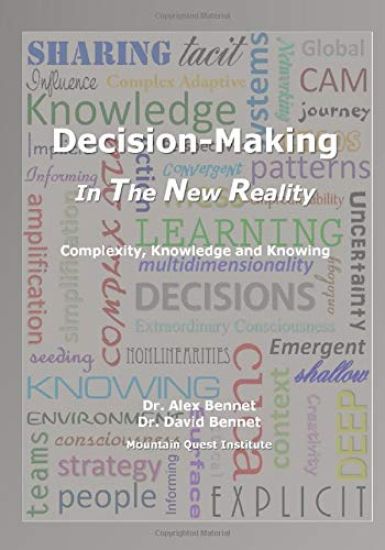
Decision-Making in the New Reality: Complexity, Knowledge and Knowing
David Bennet; Alex Bennet
Mqipress
2019
nidottu
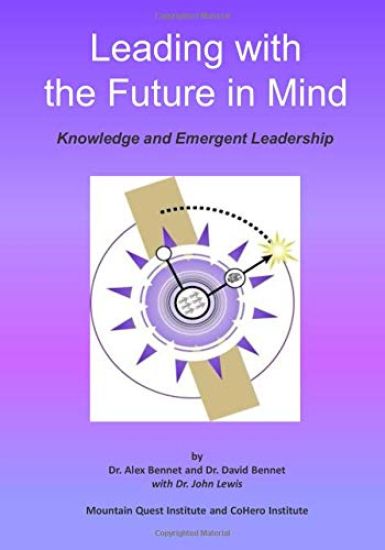
Leading with the Future in Mind: Knowledge and Emergent Leadership
David Bennet; John Lewis; Alex Bennet
Mqipress
2019
nidottu
A tour de force for the Future of Leadership ...We exist in a new reality, a global world where the individuated power of the mind/brain offers possibilities beyond our imagination. It is within this framework that thought leading emerges, and when married to our collaborative nature, makes the impossible an everyday occurrence. Leading with the Future in Mind, building on profound insights unleashed by recent findings in neuroscience, provides a new view that converges leadership, knowledge and learning for individual and organizational advancement.This book provides a research-based tour de force for the future of leadership. Moving from the leadership of the past, for the few at the top, using authority as the explanation, we now find leadership emerging from all levels of the organization, with knowledge as the explanation. The future will be owned by the organizations that understand and can master the relationships between knowledge and leadership. Being familiar with the role of a knowledge worker is not the same as understanding the role of a knowledge leader. As the key ingredient, collaboration is much more than "getting along"; it embraces and engages. Knowledge and leadership, a quality of organizations, have always been in relationship. However, the significant mental growth emerging throughout the 20th century-where individuals at all levels began to expand their capacity to learn-and the expansion of the capacity for social knowledge in the interconnected world of the 21st century has propelled humanity into a new age. Knowledge-and the responsibility for how that knowledge is used-sits squarely on the shoulders of leadership at all levels. The nature of the organization has moved beyond the factory and process metaphor, and is now understood as an intelligent complex adaptive system (ICAS). Leading with the Future in Mind covers the essentials of working, learning, and leading in an ICAS, covering knowledge and complexity, but also passion and spiritual energy. As social creatures living in an entangled world, our brains are linked together. We are in continuous interaction with those around us, and the brain is continuously changing in response. Wrapped in the mantle of collaborative leadership and engaging our full resources-physical, mental, emotional and spiritual-we open the door to possibilities. We are dreaming the future together.

Journey into the Myst: A true story of the Paranormal
David Bennet; Alex Bennet
Mqipress
2020
nidottu
Part I shares the Bennets' extraordinary Journey into the Myst. As they write, "What we are about to tell you would have been quite unbelievable to me before this journey began. It is not a story of the reality either of us has known for well over our 60 and 70 years of age, but rather, the reality of dreams and fairy tales." This is the true story of a sequence of events that happened at Mountain Quest Institute, situated in a high valley of the Allegheny Mountains of West Virginia. The story begins with a miracle, expanding into the capture and cataloging of thousands of pictures of electromagnetic spheres widely known as "orbs." This joyous experience became an exploration into the unknown with the emergence of what the author's fondly call the Myst, the forming and shaping of non-random patterns such as human faces, angels and animals. As this phenomenon unfolds, you will discover how the Drs. Alex and David Bennet began to observe and interact with the Myst. Part II, Patterns in the Myst, brings Science into the Spiritual experience, bringing to bear what the Drs. Bennets have learned through their research and educational experiences in physics, neuroscience, human systems, change, knowledge management and human development. Embracing the paralogical, patterns in the Myst are observed, felt, interpreted, analyzed and compared in terms of their physical make-up, non-randomness, intelligent sources and potential implications. Along the way, the Bennets were provided amazing pictures reflecting the forming of the Myst. In Part III, The Mind and the Myst, the Bennets shift to introspection to explore the continuing impact of the Myst experience on the human psyche.

What we are about to tell you would have been quite unbelievable to me before this journey began. Thus begins The Journey into the Myst, the first book in the Myst series. This second book in the series explores the phenomenon of the Myst, the forming and shaping of non-random patterns such as human faces, angels and animals. The authors integrate Science into the Spiritual experience, bringing to bear what the Drs. Bennets have learned through their research and educational experiences in physics, neuroscience, human systems, change, knowledge management and human development. Embracing the paralogical, patterns in the Myst are observed, felt, interpreted, analyzed and compared in terms of their physical make-up, non-randomness, intelligent sources and potential implications. Along the way, the Bennets share insights and amazing pictures reflecting the forming of the Myst.

Inhaltlich unver nderte Neuauflage. Die Bew ltigung vielz hliger Anspr che aus einer komplexen Unternehmensumwelt und der versch rfte Wettbewerb um Zusch sse und Kunden geh ren zu den zentralen Aufgaben, mit denen sich Sozialunternehmen zuk nftig auseinandersetzen m ssen. Die vorliegende Arbeit nimmt sich dieser Thematik an und skizziert, wie Unternehmen des Sozialwesens mithilfe des Stakeholder- Management-Ansatzes die Erwartungen der relevantesten Anspruchsgruppen erkennen und diese in die strategische Unternehmensplanung integrieren k nnen. Dazu werden eingangs der Gegenstandsbereich der Sozialen Arbeit und Aspekte der verst rkt gef hrten Qualit tsdebatte thematisiert. Im Anschluss daran wird auf das Konzept des Stakeholder-Managements eingegangen und aufgezeigt, dass Sozialunternehmen durch die Einbeziehung strategischer Kennzahlen in den Stakeholder-Management-Prozess sowohl die systematische Integration wichtiger Anspruchsgruppen als auch die Durchf hrung von Qualit tsmanagementma nahmen erm glicht wird. Dieses Buch richtet sich an F hrungskr fte sozialer Einrichtungen und deren Mitarbeiter, Studierende der Sozialarbeitswissenschaft sowie an Interessierte aus den Bereichen Gesundheits- und Pflegemanagement.


This book is designed in a way that is easy to understand and covers a variety of modern empirical methods used in microeconomics. It teaches students the basic tools of analysis and demonstrates how these tools can be applied to explain and predict economic phenomena. The book assumes that the reader has a good understanding of econometrics and is intended for graduate students, early-career academic researchers, and empirical economists who want to enhance their skills.
This book ""Organisational Planning"" is a comprehensive guide that thoroughly examines the topic of planning within a business. It explains the basics of planning and provides examples of real-life situations that demonstrate why planning is so important for business growth. Additionally, the book highlights different tools and methods that can be used to create successful strategies. The book also explores new trends in the business world, such as flexible systems management, and how these new practices impact the way we work. It pays particular attention to the role of technology, physical resources, and human resources in modern-day workplaces.
This book looks at how the strategies and attitudes of entrepreneurs can impact how well an organization performs. It then talks about how these ideas can be applied in modern businesses, and the difficulties that researchers face when studying this on a global scale. Basically, the book is a big picture look at how organizations can be successful by using smart strategies and entrepreneurial thinking. It's an important resource for people who study management all over the world because it brings together a lot of different research and ideas into one place.

This book covers everything you need to know about running an office, from the general tasks and duties to managing staff, ensuring security, and providing a range of services. It also covers a wide range of topics related to office management, such as the office environment, employees, systems, and functions. This book covers everything you need to know about running an office, from the general tasks and duties to managing staff, ensuring security, and providing a range of services. It also covers a wide range of topics related to office management, such as the office environment, employees, systems, and functions.


BERDYAEV AS A PHILOSOPHER How shall a non-Russian, above all a North American, assimilate the extraordinary assemblage of ideas which is Berdyaev's philosophy? Dr. Richardson does not exaggerate the difficulties. And he introduces us with great care (and what a formidable task it must have been) precisely to what is most strange in this writer, his fusion of historical .. eschatological-metaphysical-mystical-Christian conceptions. By some standards Berdyaev is a theologian rather than a philosopher; for he takes the truth of the Christian revelation for granted and his work can readily be viewed as an elaborate apologetic for one religion against all others and against irreligion. Yet I incline to sympathize with him in his claim to be a philosopher. What an eccentric one, however! There are indeed some partial analogies in the general European tradition. Certainly this Russian is a disciple of Kant, and strong traces of Kantianism survive in him. He also moved away from Kant somewhat as did Fichte, Hegel, and, above all, Schelling in his last period. His sympathetic response to Heracleitos and Boehme recalls Hegel. The interest in Boehme and Schelling is found also in Tillich. Like the late German-American, Berdyaev rejects conceptual in favor of symbolic speech about God. Like Bergson, he stresses intuition and makes a radical distinction between scientific logical analytic thought and the mode of apprehension by which, he believes, metaphysical truth is to be appropriated. Here one thinks also of Heidegger.