

Kirjahaku
Etsi kirjoja tekijän nimen, kirjan nimen tai ISBN:n perusteella.
1000 tulosta hakusanalla David C. King

A Tribute To The Memory Of David C. Broderick (1860)
Walter G. Sherwin
KESSINGER PUBLISHING, LLC
2010
sidottu

In early 1970's Bruce L. Cook, eldest son of David C. III, was given 16 typewritten pages by Earl Heindel. It was explained that he had acted as informal historian for the company and wanted his history to be given to a family member so it would not be lost. Now that Earl is gone and the main offices of the company have moved away from Elgin, Bruce wanted to make this history (and a few images) available to the many former employees and their families who retired and/or remained in Elgin. The text is supplemented with an index (including many employee names) and photos. Many current and former employees will enjoy Earl's treasure trove of memories.

Broderick: The Life and Death of David C. Broderick
James Emmett Thompson
Createspace Independent Publishing Platform
2017
nidottu
More than any other man, United States Senator David Broderick was the man responsible for keeping California from seceding at the outbreak of the Civil War. Broderick was a political enigma, a contradiction. In New York in the 1840s, he was, in turn, an apprentice stonemason, a volunteer fireman, and the keeper of a saloon that was a meeting place for political radicals. Following the gold rush to San Francisco in 1849, Broderick became the first leader of the California state senate. He stood up for the rights of the common people, the city's Irish and German immigrants. With their support, he built a political machine powerful enough to topple William McKendree Gwin, the leader of the Chivalry, the aristocratic transplanted Southern gentlemen who dominated California politics in the years before the Civil War. As a politician, Broderick was thoroughly corrupt. He sold political offices, demanded kickbacks from aspiring candidates, and employed a gang of toughs to battle his opponents, enforce party discipline, and stuff ballot boxes. San Francisco's Committee of Vigilance of 1856 exiled his goons. However, in 1857, the resilient Broderick still had enough clout to convince the state legislature to elect him to the Senate of the United States. But David Broderick was much more than just another corrupt politician. He was also a man of courage and principle. Broderick was on the right side of the defining social issue of his day, human slavery, which he saw as an immoral, cruel anachronism. Things came to a head over the admission of Kansas in the late 1850s, when the President, James Buchanan, and his powerful supporters, tried to use the Lecompton constitution to force slavery down the throats of the unwilling settlers of Kansas Territory. Broderick was so outspoken in his opposition that by 1859, he found himself in the cross hairs of fire eaters, men like California's Chief Justice, David S. Terry, who were willing to gun down anybody who spoke out against the extension of slavery. These men came to believe that David Broderick had to be silenced if California were to follow their dream and secede from the Union.
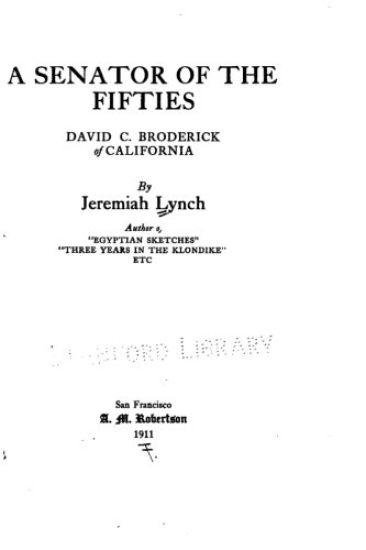
A Senator of the Fifties, David C. Broderick, of California
Jeremiah Lynch
Createspace Independent Publishing Platform
2016
nidottu
The Reminiscences of Vice Adm. David C. Richardson, USN (Ret.)
Naval Institute Press
2017
sidottu
After growing up in Mississippi, Richardson attended the Naval Academy, where he was on the boxing team. Following his graduation in 1936, he served as a junior officer in the battleship USS Tennessee (BB-43), and was on board when she went aground in San Francisco in 1937. He completed flight training in 1940 and reported to Fighting Squadron Five; the squadron was at times in USS Saratoga (CV-3), USS Ranger (CV-4), USS Yorktown (CV-5), and USS Wasp (CV-7). He flew F3Fs and F4Fs, including combat in the latter during the Guadalcanal campaign in 1942. Later in the war he was involved in tactical aviation training in Florida and carrier group readiness training in Hawaii. After the war Richardson studied at the Royal Navy Staff College in London, later at the U.S. Naval War College, where he helped write analyses of wartime battles. He commanded Carrier Air Group 13 in the USS Princeton (CV-37), helped plan for the NATO military structure, and then was XO of the escort carrier USS Badoeng Strait (CVE-116) off Korea. After duty in aviation planning for ComAirPac and OP-05, he was on the CinCSouth staff in Naples, then commanded the oiler USS Cimarron (AO-22) and ASW carrier USS Hornet (CVS-12). He had a tour from 1961 to 1964 in the OP-06 organization in OpNav, then served as Commander Fleet Air Norfolk during his first flag tour. In 1966 Admiral David McDonald, the CNO, chose Richardson to command Task Force 77 during carrier air strikes against North Vietnam. In that billet, Richardson did much to integrate intelligence, planning, and operations. After a tour as Assistant DCNO (Air), he served as Commander Sixth Fleet in the Mediterranean, 1968-70. That tour was notable for Richardson's role in creating the Ocean Surveillance Information System to monitor Soviet naval operations. His final active tour was as Deputy CinCPacFlt prior to his retirement in 1972. Since that time he has remained quite active in various roles in connection with the naval intelligence community.
The Reminiscences of Vice Adm. David C. Richardson, USN (Ret.)
Naval Institute Press
2018
pokkari
After growing up in Mississippi, Richardson attended the Naval Academy, where he was on the boxing team. Following his graduation in 1936, he served as a junior officer in the battleship USS Tennessee (BB-43), and was on board when she went aground in San Francisco in 1937. He completed flight training in 1940 and reported to Fighting Squadron Five; the squadron was at times in USS Saratoga (CV-3), USS Ranger (CV-4), USS Yorktown (CV-5), and USS Wasp (CV-7). He flew F3Fs and F4Fs, including combat in the latter during the Guadalcanal campaign in 1942. Later in the war he was involved in tactical aviation training in Florida and carrier group readiness training in Hawaii. After the war Richardson studied at the Royal Navy Staff College in London, later at the U.S. Naval War College, where he helped write analyses of wartime battles. He commanded Carrier Air Group 13 in the USS Princeton (CV-37), helped plan for the NATO military structure, and then was XO of the escort carrier USS Badoeng Strait (CVE-116) off Korea. After duty in aviation planning for ComAirPac and OP-05, he was on the CinCSouth staff in Naples, then commanded the oiler USS Cimarron (AO-22) and ASW carrier USS Hornet (CVS-12). He had a tour from 1961 to 1964 in the OP-06 organization in OpNav, then served as Commander Fleet Air Norfolk during his first flag tour. In 1966 Admiral David McDonald, the CNO, chose Richardson to command Task Force 77 during carrier air strikes against North Vietnam. In that billet, Richardson did much to integrate intelligence, planning, and operations. After a tour as Assistant DCNO (Air), he served as Commander Sixth Fleet in the Mediterranean, 1968-70. That tour was notable for Richardson's role in creating the Ocean Surveillance Information System to monitor Soviet naval operations. His final active tour was as Deputy CinCPacFlt prior to his retirement in 1972. Since that time he has remained quite active in various roles in connection with the naval intelligence community.
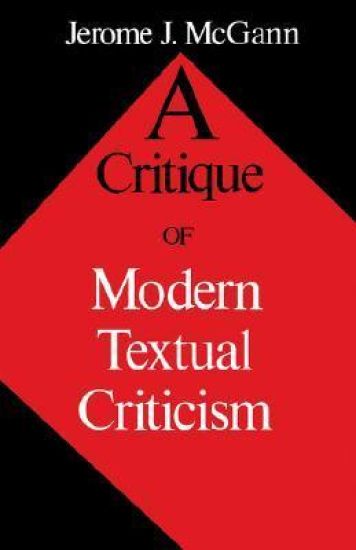
A Critique of Modern Textual Criticism, Foreword by David C Greetham
Jerome J. McGann
University of Virginia Press
1992
nidottu
This work initiated a major shift in literary theory and method when it was first published in 1983. Starting from a critical inquiry into certain specialised issues in the practice of editing, "A Critique of Modern Textual Criticism" gradually unfolds an argument for a general revaluation of the grounds of literary study as a whole. McGann's point of departure is the controversy he opens with the once-dominant line of traditional textual and editorial scholarships as it evolved through the fundamental work of W.W. Greg, Fredson Bowers and G. Thomas Transelle. In departing from the canonical approach to the technical question of copy-text, McGann argues that theory of text must ground itself in a recovery of the entire productive and reproductive history of the text. His book proposes combining literary criticism and bibliographical scholarship with social, institutional and collaborative models of creation and production. Although focused on cases located in the past 200 years, "A Critique of Modern Textual Criticism" has had a wide-ranging influence on the scholarship of all literary periods. It is one of the seminal works of modern textual theory.

Willensfreiheit und die Grenzen der Erziehung. Theorien nach Arthur Schopenhauer und David C. Rowe
Manfred Klein
GRIN Verlag
2017
pokkari

Exploring the ways that contemporary Israeli poets have made use of images from the Bible in their poetry, this work features close readings of 50 poems from poets such as Amir Gilboa, T. Carmi and Nathan Yonathan. They are presented in their original Hebrew and in English translation.

The Baptist Denomination Its History, Doctrines, and ordinances ... by D.C. Haynes. With An introduction by John Dowling ...
David C Haynes
University of Michigan Library
2006
pokkari

From the late 1970s to the early 1980s, I committed my thoughts to paper almost daily. This period started with my self-separation from both my birth families and commenced with my becoming a registered nurse after graduating from the nursing program at the City College of San Francisco.Although I have shared some of what I wrote with a few people, I never wrote anything with the intention of anyone else ever seeing it.I recently rediscovered, after about forty years, what I had written and felt that others might benefit from the thoughts I had once committed to paper. So whoever you are and wherever you may be, may these thoughts help you get from where you are to where you want to be.

Splendour in the Dark – C. S. Lewis`s Dymer in His Life and Work
Jerry Root; David C. Downing
IVP Academic
2020
nidottu
Several years before he converted to Christianity, C. S. Lewis published a narrative poem, Dymer, under the pseudonym Clive Hamilton. Later, of course, Lewis became well known for his beloved imaginative stories, such as The Chronicles of Narnia and Till We Have Faces, as well as his ability to defend and articulate the faith in works such as Mere Christianity. But what about his literary work before his conversion? In this Hansen Lectureship volume, Jerry Root contends that Lewis's early poem Dymer can not only shed light on the development of Lewis's literary skills but also offer a glimpse of what was to come in his intellectual and spiritual growth—a "splendour in the dark," to borrow one of Lewis's own lines from the poem. Under Root's careful analysis, Dymer becomes a way to understand both Lewis's change of mind as well as the way in which each of us is led on a journey of faith. This volume also includes the complete text of Dymer with annotations from David C. Downing, co-director of the Marion E. Wade Center. Based on the annual lecture series hosted at Wheaton College's Marion E. Wade Center, volumes in the Hansen Lectureship Series reflect on the imaginative work and lasting influence of seven British authors: Owen Barfield, G. K. Chesterton, C. S. Lewis, George MacDonald, Dorothy L. Sayers, J. R. R. Tolkien, and Charles Williams.

The Impeachment of Chief Justice David Brock
John Cerullo; David C. Steelman
Lexington Books
2017
sidottu
At this juncture in American history, some of our most hard-fought state-level political struggles involve control of state supreme courts. New Hampshire witnessed one of the most dramatic of these, culminating in the impeachment of Chief Justice David Brock in 2000, but the issues raised by the case are hardly confined to New Hampshire. They involved the proper nature and operation of judicial independence within a “populist” civic culture that had long assumed the primacy of the legislative branch, extolled its “citizen legislators” over insulated and professionalized elites, and entrusted those legislators to properly supervise the judiciary. In the last few decades of the 20th Century, New Hampshire’s judiciary had been substantially reconfigured: constitutional amendments and other measures endorsed by the national judicial-modernization movement had secured for it a much higher level of independence and internal unification than it had historically enjoyed. However, a bipartisan body of legislators remained committed to the principle of legislative supremacy inscribed in the state constitution of 1784. The 1980s and 1990s witnessed a series of clashes over court administration, allegations of judicial corruption, and finally a bitter and protracted battle over Court decisions on educational funding. Chief Justice Brock publicly embodied the judicial branch's new status and assertiveness. When information came to light regarding some of his administrative actions on the high court, deepening antipathy toward him exploded into an impeachment crisis. The struggle over Brock’s conduct raised significant questions about the meaning and proper practice of impeachment itself as a feature of democratic governance. When articles of impeachment were voted by the House of Representatives, the state Senate faced the difficult task of establishing trial protocols that would balance the political and juridical responsibilities devolved on them, simultaneously, by the state constitution. Having struck that balance, the trial they conducted would finally acquit Brock of all charges. Nevertheless, David Brock’s impeachment was a highly consequential ordeal that provided a needed catalyst for reforms intended to produce a productive recalibration of legislative-judicial relations.


Contribution À l'Amélioration de la Précision Des Robots Parallèles
David-C
Omniscriptum
2018
pokkari


Harvard Professor David C. McClelland shares research and analysis on the reasoning behind the fluctuating development of society.The Achieving Society provides a factual basis for evaluating economic, historical, and sociological theories that explain the rise and fall of civilizations. Within this book, readers will learn about McClelland’s notable descriptions of the type of motivational needs society has: achievement motivation, authority and power motivation, and affiliation motivation.

The Official Guide to Christmas in the South: Or, If You Can't Fry It, Spraypaint It Gold
David C. Barnette
William Morrow Company
2005
sidottu
No place celebrates Christmas like Dixie, and with this charming, humorous guide, anyone can learn how to deck the halls, Southern style It's the one time of the year when both the divine and debutantes take center stage in a perfect storm of hot glue and cheese grits: Christmas. But successfully navigating through the holiday season can be more complex than Santa's midnight journey. There are pitfalls hotter than any chimney -- and social situations more slippery than any roof But now The Official Guide to Christmas in the South has arrived to reveal the finer and sometimes unspoken details of Dixie etiquette. Perfect for a true Southerner's coffee table or an imposter's survival guide, The Official Guide to Christmas in the South is the gift that will keep on regifting season after season.
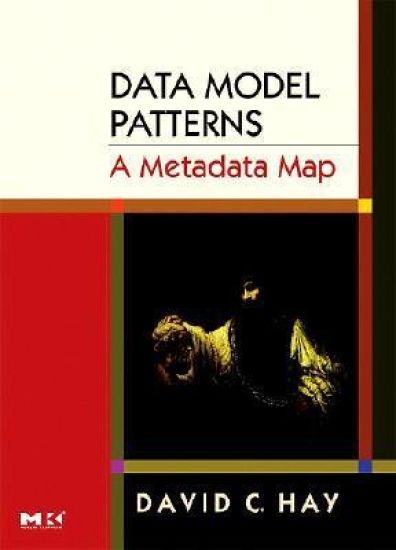
Data Model Patterns: A Metadata Map not only presents a conceptual model of a metadata repository but also demonstrates a true enterprise data model of the information technology industry itself. It provides a step-by-step description of the model and is organized so that different readers can benefit from different parts. It offers a view of the world being addressed by all the techniques, methods, and tools of the information processing industry (for example, object-oriented design, CASE, business process re-engineering, etc.) and presents several concepts that need to be addressed by such tools. This book is pertinent, with companies and government agencies realizing that the data they use represent a significant corporate resource recognize the need to integrate data that has traditionally only been available from disparate sources. An important component of this integration is management of the "metadata" that describe, catalogue, and provide access to the various forms of underlying business data. The "metadata repository" is essential to keep track of the various physical components of these systems and their semantics. The book is ideal for data management professionals, data modeling and design professionals, and data warehouse and database repository designers.