Kirjojen hintavertailu. Mukana 11 373 074 kirjaa ja 12 kauppaa.

Kirjahaku

Etsi kirjoja tekijän nimen, kirjan nimen tai ISBN:n perusteella.

1000 tulosta hakusanalla David Crystal

A Dictionary of Linguistics and Phonetics

A Dictionary of Linguistics and Phonetics

David Crystal

Wiley-Blackwell (an imprint of John Wiley Sons Ltd)
2008
sidottu
David Crystal's A Dictionary of Linguistics and Phonetics has long been the standard single-volume reference for its field. Now available in its sixth edition, it has been revised and updated to reflect the latest terms in the field. Includes in excess of 5,100 terms, grouped into over 3,000 entriesCoverage reflects recommendations by a team of experts in phonetics, phonology, syntax, semantics, sociolinguistics and psycholinguistics, making it exceptionally comprehensiveIncorporates new ideas stemming from the minimalist programContains a separate table of abbreviations and table of symbols, along with an updated International Phonetic AlphabetUpdates entries to reflect the way established terms are now perceived in light of changes in the field, providing a unique insight into the historical development of linguisticsRemains the standard single-volume reference for the field of linguistics and phonetics.
The Disappearing Dictionary

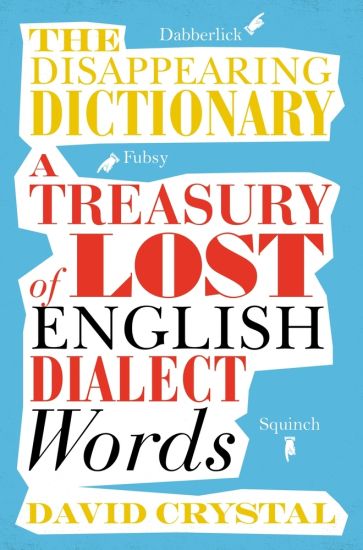
The Disappearing Dictionary

David Crystal

Pan Books
2016
pokkari
Wherever you go in the English-speaking world, there are linguistic riches from times past awaiting rediscovery. All you have to do is choose a location, find some old documents, and dig a little. In The Disappearing Dictionary, linguistics expert Professor David Crystal collects together delightful dialect words that either provide an insight into an older way of life, or simply have an irresistible phonetic appeal. Like a mirror image of The Meaning of Liff that just happens to be true, The Disappearing Dictionary unearths some lovely old gems of the English language, dusts them down and makes them live again for a new generation.dabberlick [noun, Scotland]A mildly insulting way of talking about someone who is tall and skinny. 'Where's that dabberlick of a child?'fubsy [adjective, Lancashire]Plump, in a nice sort of way. squinch [noun, Devon]A narrow crack in a wall or a space between floorboards. 'I lost sixpence through a squinch in the floor'.
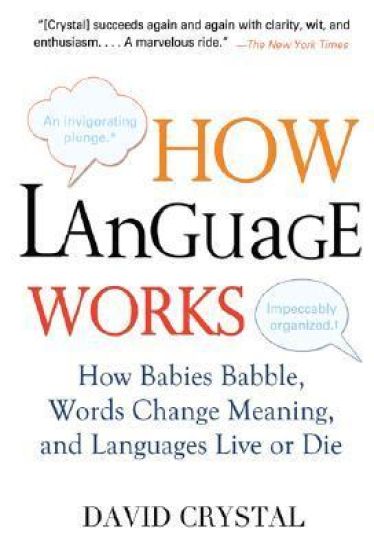
How Language Works: How Babies Babble, Words Change Meaning, and Languages Live or Die
Steven Pinker meets Bill Bryson in this landmark exploration of language. In the author's own words, "How Language Works is not about music, cookery, or sex. But it is about how we talk about music, cookery, and sex-or, indeed, anything at all." Language is so fundamental to everyday life that we take it for granted. But as David Crystal makes clear in this work of unprecedented scope, language is an extremely powerful tool that defines the human species. Crystal offers general readers a personal tour of the intricate workings of language. He moves effortlessly from big subjects like the origins of languages, how children learn to speak, and how conversation works to subtle but revealing points such as how email differs from both speech and writing in important ways, how language reveals a person's social status, and how we decide whether a word is rude or polite. Broad and deep, but with a light and witty touch, How Language Works is the ultimate layman's guide to how we communicate with one another.
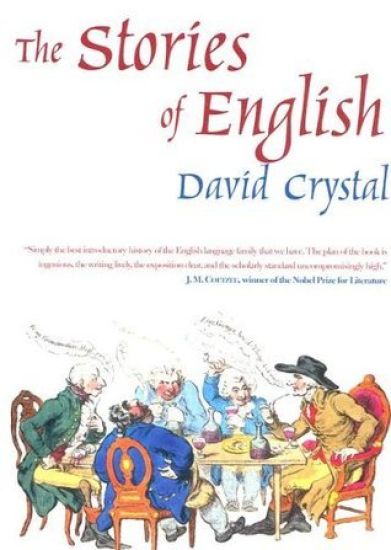
The Stories of English

The Stories of English

David Crystal

Harry N. Abrams
2005
nidottu
A groundbreaking and entertaining history of worldwide English in all its dialects, differences, and linguistic delights. "A work of impeccable scholarship." --New York Times "Informative . . . distinctive . . . a spirited celebration." --The Guardian "Simply the best introductory history of the English language family that we have. The plan of the book is ingenious, the writing lively, the exposition clear, and the scholarly standard uncompromisingly high." --J.M. Coetzee, winner of the Nobel Prize in Literature In this "well-informed and appealing" work (Publishers Weekly), David Crystal provides a startlingly original view of where the richness, creativity, and diversity of the language truly lies--in the accents and dialects of English users all over the world. Whatever their regional, social, or ethnic background, each group has a story worth telling, whether it is in Scotland or Somerset, South Africa or Singapore. He reminds us that for several hundred wonderful years, there was no such thing as "incorrect" English--and traces the evolution of the language from a few thousand Anglo-Saxons to the 1.5 billion people who speak it today. Moving from Beowulf to Chaucer to Shakespeare to Dickens and the present day, Crystal puts regional speech and writing at center stage, giving a sense of the social realities behind the development of English. This significant shift in perspective enables us to understand for the first time the importance of everyday, previously marginalized, voices in our language--and provides an argument too for the way English should be taught in the future. "Learned and often provocative . . . demonstrates repeatedly that common conceptions about language are often historically inaccurate--split infinitives bothered no one until recently (likewise sentence-ending prepositions)." --Kirkus (starred review)
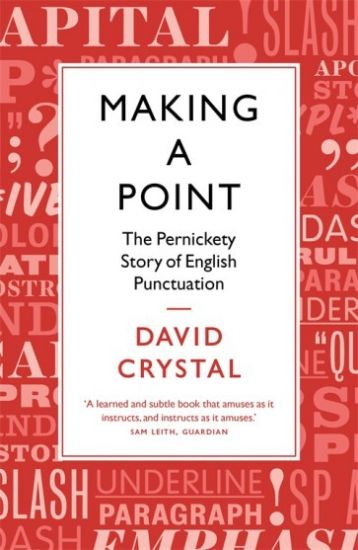
Making a Point

Making a Point

David Crystal

Profile Books Ltd
2016
pokkari
This 'engaging history of punctuation' (Wall Street Journal) is not only the first history of its kind, but a complete guide on how to use English punctuation. Behind every punctuation mark lies a thousand stories. The punctuation of English, marked with occasional rationality, is founded on arbitrariness and littered with oddities. For a system of a few dozen marks it generates a disproportionate degree of uncertainty and passion, inspiring organisations like the Apostrophe Protection Society and sending enthusiasts, correction-pens in hand, in a crusade against error. Professor Crystal leads us through this minefield with characteristic wit, clarity and commonsense. He gives a fascinating account of the origin and progress of every kind of punctuation mark over one and a half millennia, and he offers sound advice on how punctuation may be used to meet the needs of every occasion and context.
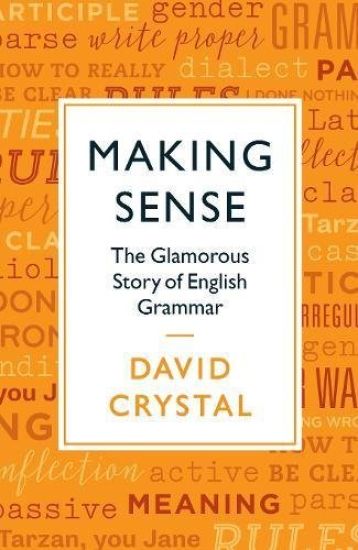
Making Sense

Making Sense

David Crystal

Profile Books Ltd
2017
pokkari
The world's greatest authority on language explains the secrets and subtleties of the grammar of English. David Crystal explores its history and varieties, explains its rules and irregularities and shows how to navigate its snares and pitfalls. He gives practical guidance on how grammar is used in different ways for different purposes and in different social settings. In a series of revealing illustrations he also considers what learned and prominent people have said about English grammar over the centuries. Like its three companion volumes Making Sense will appeal to everyone interested in the English language and how to use it.
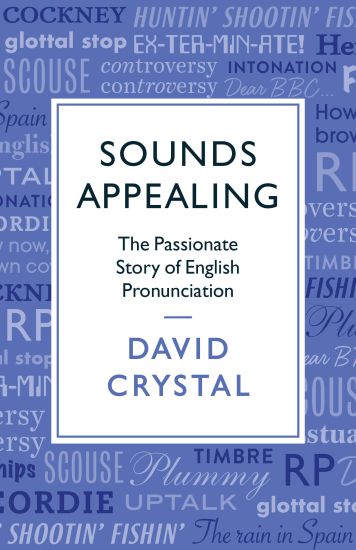
Sounds Appealing

Sounds Appealing

David Crystal

Profile Books Ltd
2019
pokkari
It's not what you say, it's the way that you say it ... There have long been debates about 'correct' pronunciation in the English language, and Britain's most distinguished linguistic expert, David Crystal, is here to set the record straight. Sounds Appealing tells us exactly why, and how, we pronounce words as we do. Pronunciation is integral to communication, and is tailored to meet the demands of the two main forces behind language: intelligibility and identity. Equipping his readers with knowledge of phonetics, linguistics and physiology - with examples ranging from Eliza Doolittle to Winston Churchill - David Crystal explores the origins of regional accents, how they are influenced by class and education, and how their peculiarities have changed over time.
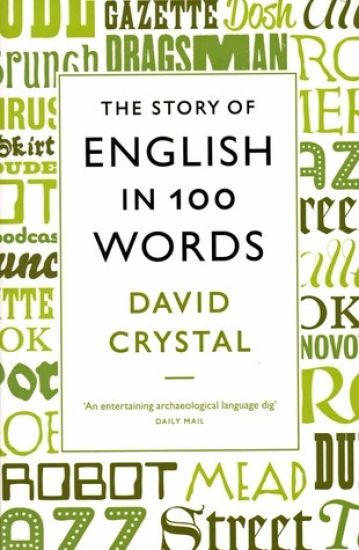
The Story of English in 100 Words

The Story of English in 100 Words

David Crystal

Profile Books Ltd
2012
pokkari
Featuring Latinate and Celtic words, weasel words and nonce-words, ancient words ('loaf') to cutting edge ('twittersphere') and spanning the indispensable words that shape our tongue ('and', 'what') to the more fanciful ('fopdoodle'), Crystal takes us along the winding byways of language via the rude, the obscure and the downright surprising. In this unique new history of the world's most ubiquitous language, linguistics expert David Crystal draws on words that best illustrate the huge variety of sources, influences and events that have helped to shape our vernacular since the first definitively English word was written down in the fifth century ('roe', in case you are wondering).
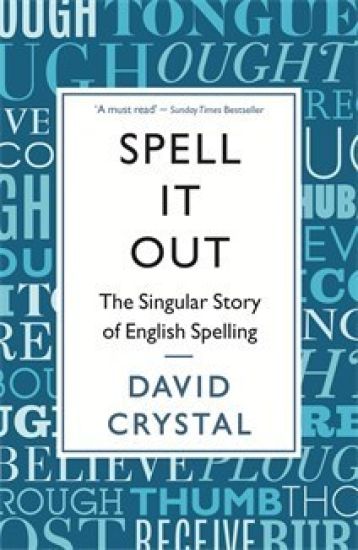
Spell It Out

Spell It Out

David Crystal

Profile Books Ltd
2013
pokkari
Why is there an 'h' in ghost? William Caxton, inventor of the printing press and his Flemish employees are to blame: without a dictionary or style guide to hand in fifteenth century Bruges, the typesetters simply spelled it the way it sounded to their foreign ears, and it stuck. Seventy-five per cent of English spelling is regular but twenty-five per cent is complicated, and in Spell It Out our foremost linguistics expert David Crystal extends a helping hand to the confused and curious alike. He unearths the stories behind the rogue words that confound us, and explains why these peculiarities entered the mainstream, in an epic journey taking in sixth century monks, French and Latin upstarts, the Industrial Revolution and the internet. By learning the history and the principles, Crystal shows how the spellings that break all the rules become easier to get right.
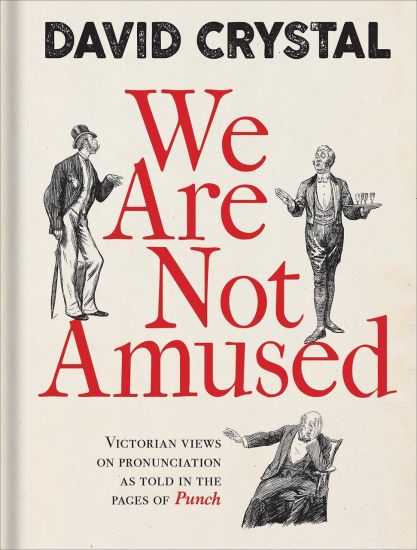
We Are Not Amused

We Are Not Amused

David Crystal

Bodleian Library
2017
sidottu
Pronunciation governs our regional and social identity more powerfully than any other aspect of spoken language. No wonder, then, that it has attracted most attention from satirists. In this intriguing book, David Crystal shows how our feelings about pronunciation today have their origins in the way our Victorian predecessors thought about the subject, as revealed in the pages of the satirical magazine, Punch. In the sixty years between its first issue in 1841 and the death of Queen Victoria in 1901, jokes about the fashions affecting English usage provide one of Punch's most fruitful veins of humour, from the dropped aitches of the Cockney accent to the upper-class habit of dropping the final ‘g’ (huntin’ and fishin’). For 'We Are Not Amused', David Crystal has examined all the issues during the reign of Queen Victoria and brought together the cartoons and articles that poked fun at the subject of pronunciation, adding a commentary on the context of the times, explaining why people felt so strongly about accents, and identifying which accents were the main source of jokes. The collection brings to light a society where class distinction ruled, and where the way you pronounced a word was seen as a sometimes damning index of who you were and how you should be treated. It is a fascinating, provocative and highly entertaining insight into our on-going amusement at the subject of how we speak.
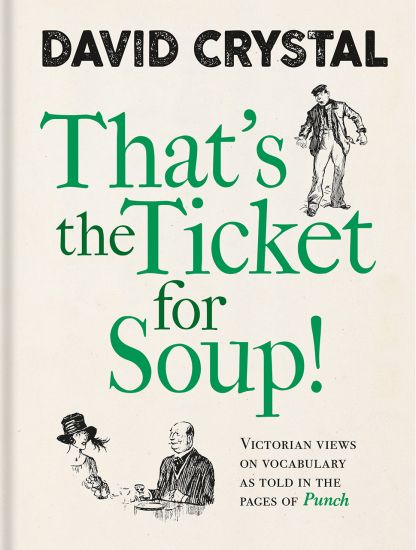
That's the Ticket for Soup!

That's the Ticket for Soup!

David Crystal

Bodleian Library
2020
sidottu
The vocabulary of past times, no longer used in English, is always fascinating, especially when we see how it was pilloried by the satirists of the day. Here we have Victorian high and low society, with its fashionable and unfashionable slang, its class awareness and the jargon of steam engines, motor cars and other products of the Industrial Revolution. Then as now, people had strong feelings about the flood of new words entering English. Swearing, new street names and the many borrowings from French provoked continual irritation and mockery, as did the Americanisms increasingly encountered in the British press. In this intriguing collection, David Crystal has pored through the pages of the satirical magazine, Punch, between its first issue in 1841 and the death of Queen Victoria in 1901, and extracted the articles and cartoons that poked fun at the jargon of the day, adding a commentary on the context of the times and informative glossaries. In doing so he reveals how many present-day feelings about words have their origins over a century ago.
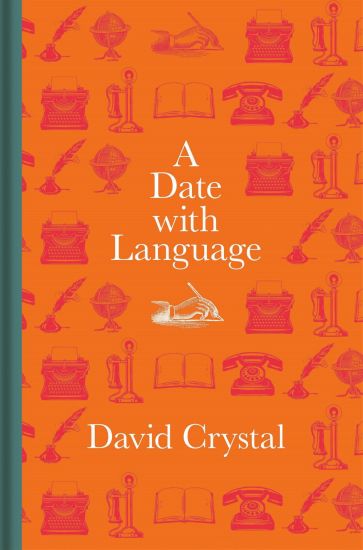
A Date with Language

A Date with Language

David Crystal

BODLEIAN LIBRARY
2023
sidottu
In this ingenious and diverse collection of 366 stories, events and facts about language, David Crystal presents a selection of insights from literary and linguistic writers, poets and global institutions, together with the weird and wonderful creations of language enthusiasts to enliven each day of the year. The day-by-day treatment illustrates the extraordinary breadth of the subject, from ‘Morse Code Day’ to ‘Talk Like William Shatner Day’, from forensic phonetics used to catch serial killers to heroines of speed reading, and covers writers from many different eras and cultures, including William Shakespeare, Oscar Wilde, Emily Dickinson, Toni Morrison, R. K. Narayan, Wole Soyinka and many more. Some days focus on pronunciation, orthography, grammar or vocabulary. Others focus on the way language is used in science, religion, politics, broadcasting, publishing, the Internet and the arts. There are days that acknowledge the achievements of language study, such as in language teaching, speech therapy, deaf education and forensic science, as well as technological progress, from the humble pencil to digital software. Several days celebrate individual languages, such as those recognised as ‘official’ by the United Nations, but not forgetting those spoken by small communities, along with their associated cultural identities. A celebration of the remarkable creativity of all who have illuminated our understanding of language, this book is ideal for anyone wanting to add an extra point of interest to their language day.
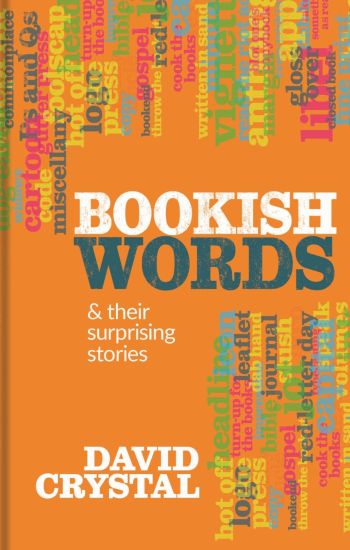
Bookish Words & their Surprising Stories

Bookish Words & their Surprising Stories

David Crystal

BODLEIAN LIBRARY
2025
sidottu
The world of books has played a striking role in the history of English vocabulary. Book itself is one of the oldest words in the language, originating from boc in Old English, and appears in many commonly used expressions today – by the book, bring to book and bookworm – to name a few. With the arrival of printing, typesetting and the development of the newspaper industry came terminology that developed into commonly used phrases such as stop the press, front-page news and hit the headlines, and the emergence of the internet generated still more. This anthology presents a selection of more than 100 words which show the influence of writing, reading and publishing books on our everyday vocabulary over the centuries, telling the stories behind their linguistic origins, and uncovering some surprising twists in the development of their meaning through time.
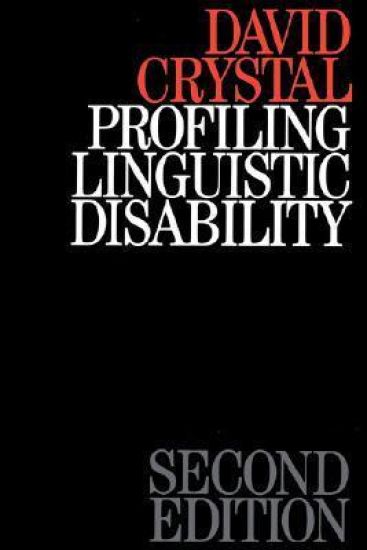
Profiling Linguistic Disability

Profiling Linguistic Disability

David Crystal

Whurr Publishers Ltd
1992
nidottu
Profiling has been acknowledged as a major contribution to the treatment of language disorder. First developed with reference to grammatical disability, profiling is extended in this book to cover segmental phonology, prosody and semantics. The book also includes a revised version of the grammatical profiling procedure, LARSP. For this second edition of the book all the existing material has been updated. In addition there is a new chapter, entitled "Putting Profiles into Practice", which contains extracts from case studies and several guidelines for teaching and therapy.
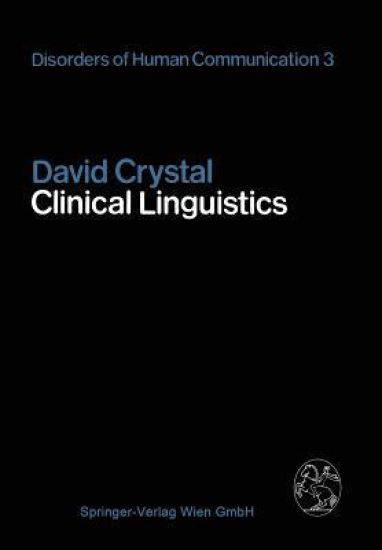
Clinical Linguistics

Clinical Linguistics

David Crystal

Springer Verlag GmbH
2013
nidottu
This volume is one in a series of monographs being issued under the general title of "Disorders of Human Communication". Each monograph deals in detail with a particular aspect of vocal communication and its disorders, and is written by internationally distinguished experts. Therefore, the series will provide an authoritative source of up-to-date scientific and clinical informa­ tion relating to the whole field of normal and abnormal speech communication, and as such will succeed the earlier monumental work "Handbuch der Stimm­ und Sprachheilkunde" by R. Luchsinger and G. E. Arnold (last issued in 1970). This series will prove invaluable for clinicians, teachers and research workers in phoniatrics and logopaedics, phonetics and linguistics, speech pathology, otolaryngology, neurology and neurosurgery, psychology and psychiatry, paediatrics and audiology. Several of the monographs will also be useful to voice and singing teachers, and to their pupils. G. E. Arnold, Jackson, Miss. F. Winckel, Berlin B. D. Wyke, London Preface This book tries to illustrate the practice as well as the principles involved in applying linguistics to the analysis of language disability. In writing it, I have as­ sumed an audience of professional speech and hearing clinicians who have had little or no formal training in linguistics. Each Chapter therefore begins with a resu­ me of the main theoretical and descriptive principles needed in order to carry out a clinical linguistic analysis. The relevance oflanguage acquisition studies is a major theme within this resume.
William Tyndale and the English Language

William Tyndale and the English Language

David Crystal

BODLEIAN LIBRARY
2026
sidottu
‘Dearly beloved’, ‘say the word’, ‘the powers that be’, ‘for ever and ever’ – these familiar phrases and many more were set down in print for the first time by William Tyndale. For his groundbreaking English translation of the Bible, he deliberately chose to write in a way that could be understood by the widest possible audience. In the first half of this pioneering exploration of the extraordinary impact Tyndale’s writing had on the development of the English language, David Crystal provides an analysis of his prose style, demonstrating its character as a novel genre of ‘written speech’, and bringing to light the remarkable number of cases where Tyndale is the first recorded user of a word or phrase in English. He also draws attention to the hitherto unrecognised role of Tyndale as an early lexicographer. The second half of the book is a linguistic detective story, devising an innovative lexical and grammatical metric to investigate the often-stated claim that eighty per cent of later biblical translations display Tyndale’s influence. The result is a fascinating exploration of the work of the Father of the English Bible.
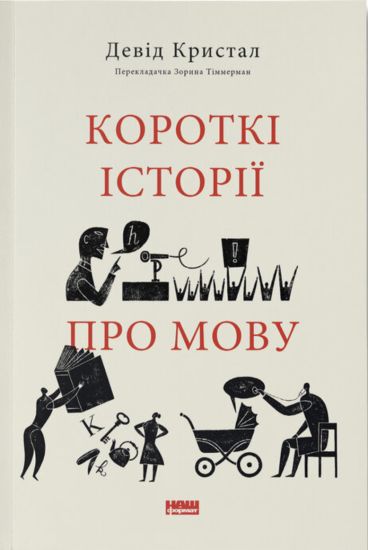
Korotki istoriji pro movu

Korotki istoriji pro movu

David Crystal

Nash Format
2026
nidottu
*Skilki u sviti mov?*Chomu zhestova mova peredaje ne okremi slova, a tsili znachennja? *Jak diti formujut vlasnij movnij vsesvit?*Chi zminjuje internet nashe spilkuvannja? Devid Kristal iz legkistju doslidnika j zakhvatom ditini provodit chitacham ekskurs u minule, teperishnje ta majbutnje mov. Vi diznajetesja, chomu reperam potribno znati pravopis, jak aktsent sprijaje vizhivannju, chomu Joda rozmovljaje v takij nezvichajnij maneri, a dialekti - tse schos bilshe, nizh prosto "girsha" versija literaturnoji movi.Avtor pojednuje naukovu tochnist i zhvavij stil, pojasnjuje na istorijakh, skhemakh ta legko vikladenikh faktakh. Chimalo prikladiv spetsialno adaptovano pid ukrajinsku movu. Use tse dopomagaje pogljanuti na movu ne jak na sukhu teoriju, a jak na nezbagnennij zhivij organizm.
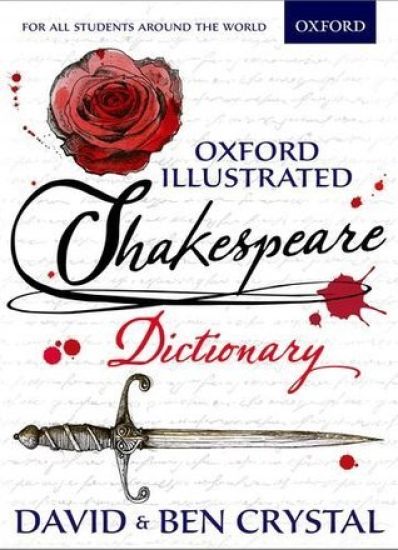
Oxford Illustrated Shakespeare Dictionary

Oxford Illustrated Shakespeare Dictionary

David Crystal; Ben Crystal

Oxford University Press
2015
nidottu
Winner of Best Book, Publication, or Recording prize at the Falstaff Awards 2015 and shortlisted for the 2016 SLA Information Book Award. This innovative dictionary is written by leading experts in linguistics and Shakespeare, David and Ben Crystal. It provides students with invaluable support while they read and understand Shakespeare's plays. Key features include: • Over 4000 difficult words explained with clear definitions from the 12 most-studied plays including Macbeth, Hamlet, Romeo and Juliet, A Midsummer Night's Dream, and Henry V • Language and usage notes include fascinating insights into Shakespeare's world and the Elizabethan theatre • 24 full colour illustrated pages on themes such as dress, armour, maps, music and more, bringing Shakespearean times to life • Easy to use with its clear signposting, accessible design, and expertly levelled contemporary look and feel • For children aged 11-16 and a great supporting resource for GCSE preparation
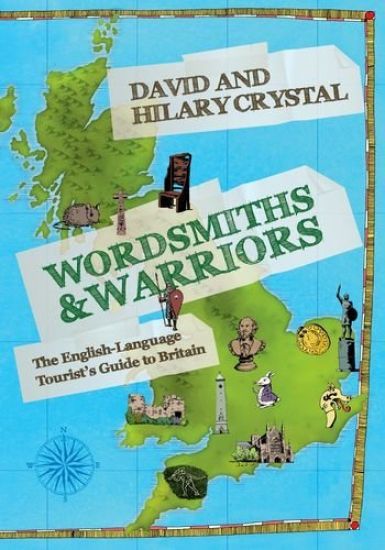
Wordsmiths and Warriors

Wordsmiths and Warriors

David Crystal; Hilary Crystal

Oxford University Press
2015
nidottu
Wordsmiths and Warriors explores the heritage of English through the places in Britain that shaped it. It unites the warriors, whose invasions transformed the language, with the poets, scholars, reformers, and others who helped create its character. The book relates a real journey. David and Hilary Crystal drove thousands of miles to produce this fascinating combination of English-language history and travelogue, from locations in south-east Kent to the Scottish lowlands, and from south-west Wales to the East Anglian coast. David provides the descriptions and linguistic associations, Hilary the full-colour photographs. They include a guide for anyone wanting to follow in their footsteps but arrange the book to reflect the chronology of the language. This starts with the Anglo-Saxon arrivals in Kent and in the places that show the earliest evidence of English. It ends in London with the latest apps for grammar. In between are intimate encounters with the places associated with such writers as Chaucer, Shakespeare, and Wordsworth; the biblical Wycliffe and Tyndale; the dictionary compilers Cawdrey, Johnson, and Murray; dialect writers, elocutionists, and grammarians, and a host of other personalities. Among the book's many joys are the diverse places that allow warriors such as Byrhtnoth and King Alfred to share pages with wordsmiths like Robert Burns and Tim Bobbin, and the unexpected discoveries that enliven every stage of the authors' epic journey.