
Kirjahaku
Etsi kirjoja tekijän nimen, kirjan nimen tai ISBN:n perusteella.
1000 tulosta hakusanalla David F. Hendry

The Religion of Technology: The Divinity of Man and the Spirit of Invention
David F. Noble
PENGUIN BOOKS
1999
nidottu
Are religion and science really at war with one another? Not according to David F. Noble, who argues that the flourishing of both religion and technology today is nothing new but rather the continuation of a 1,000-year-old Western tradition.The Religion of Technology demonstrates that modern man's enchantment with things technological was inspired by and grounded in religious expectations and the quest for transcendence and salvation. The two early impulses behind the urge to advance in science, he claims, are the conviction that apocalypse is imminent, and the belief that increasing human knowledge helps recover what was lost in Eden. Noble traces the history of these ideas by examining the imaginings of monks, explorers, magi, scientists, Freemasons, and engineers, from Sir Isaac Newton to Joseph Priestley to Wernher von Braun.Noble suggests that the relationship between religion and technology has perhaps outlived its usefulness. Whereas it once aimed to promote human well-being, it has ultimately become a threat to our survival. Thus, with The Religion of Technology, Noble aims to redirect our efforts toward more worldly and humane ends.

Infants and children are the often-ignored heroes when it comes to understanding human evolution. Evolutionary pressures acted upon the young of our ancestors more powerfully than on adults, and changes over the course of development in our ancestors were primarily responsible for the species and the people we have become. This book takes an evolutionary developmental perspective, emphasizing that developmental plasticity--the ability to change our physical and psychological selves early in life--is the creative force in evolution, with natural selection serving as a filter, eliminating novel developmental outcomes that did not benefit survival. This book is about becoming--of becoming human and of becoming mature adults. Bjorklund asks, "How can an understanding of human development help us better understand human evolution?" Then, turning the relation between evolution and development on its head, Bjorklund demonstrates how an understanding of our species' evolution can help us better understand current development and how to better rear successful and emotionally healthy children.
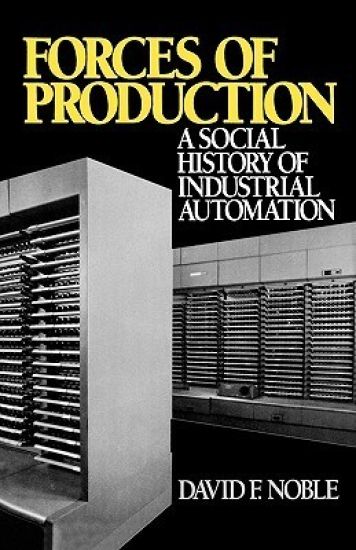
Focusing on the postwar automation of the American metal-working industry--the heart of the modern industrial economy--this is a provocative study of how automation has assumed a critical role in America. David Noble argues that industrial automation--more than merely a technological advance--is a social process that reflects very real divisions and pressures within our society. The book explains how technology is often spurred and shaped by the military, corporations, universities, and other mighty institutions. Using detailed case studies, Noble also demonstrates how engineering design is influenced by political, economic, and sociological considerations, and how the deployment of equipment is frequently entangled with certain managerial concerns.
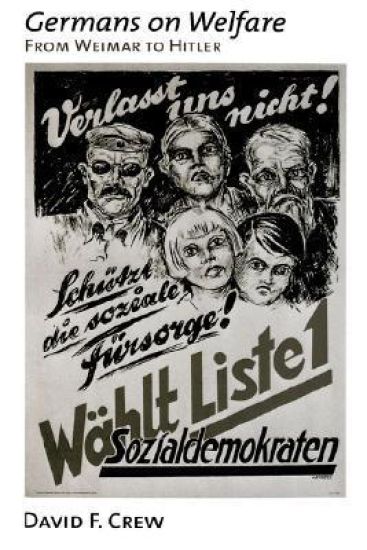
Germans on Welfare is a comprehensive study of the welfare system in the Weimar Republic. Adopting a "history of everyday life" perspective, David Crew examines not only high-level policy and debate, but also ordinary Germans' daily experiences and encounters with the welfare state, upon which millions depended for their livelihood. Crew ultimately shows why the collapse of the welfare system, one of the pillars of the Weimar social republic, led so quickly to the Nazi racial state in the years after 1933.

The welfare state was one of the pillars of the Weimar Republic. The Weimar experiment in democracy depended to no small degree upon the welfare system's ability to give German citizens at least a fundamental level of material and mental security in the face of the new risks to which they had been exposed by the effects of the lost war, revolution, and inflation. But the problems of the postwar period meant that, even in its best years, the Weimar welfare state was dangerously overburdened. The onset of the Depression and the growth of mass unemployment after 1929 destroyed republican democracy and the welfare state upon which it was based. On the ruins of Weimars social republic, the Nazis built a murderous racial state. Existing work on the Weimar welfare state concentrates largely on the discussions of social reformers, welfare experts, feminists, and the laws and institutions that their debates produced. Yet the Weimar welfare state was not simply the product of discourse and discursive struggles; it was also constructed and re-produced by the daily interactions of hard-pressed officials and impatient, often desperate clients. Adopting a "history of everyday life" perspective, Germans on Welfare: From Weimar to Hitler, 1919-1935 shows how welfare discourse and policy were translated into welfare practices by local officials and appropriated, contested, or re-negotiated by millions of welfare clients.

The American Disease is a classic study of the development of drug laws in the USA. Supporting the theory that Americans' attitudes toward drugs have followed a cyclic pattern of tolerance and restraint, author David Musto examines the relations between public outcry and the creation of prohibitive drug laws from the end of the Civil War to the present day. The book traces the development of narcotic use, legislation, American foreign policy, attitudes towards groups associated with particular drugs, and the roles of physicians and the growing pharmaceutical industry. Originally published in 1973, with an expanded edition in 1987, this revised and expanded third edition contains a new chapter and preface that cover the renewed debate on policy and drug legislation from the end of the Reagan administration to the present Clinton administration. Musto investigates how our nation has dealt with issues including the controversies over prevention programs and mandatory minimum sentencing, the catastrophe of the crack epidemic, the fear of a heroin revival, and the continued debate over the legalization of marijuana.

Written to meet the needs of thousands of students and pre-professional singers participating in production workshops and classes in opera and musical theater, Acting for Singers leads singing performers step by step from the studio or classroom through audition and rehearsals to a successful performance. Using a clear, systematic, positive approach, this practical guide explains how to analyze a script or libretto, shows how to develop a character building on material in the score, and gives the singing performer the tools to act believably. More than just a "how-to" acting book, however, Acting for Singers also addresses the problems of concentration, trust, projection, communication, and the self-doubt that often afflicts performers pursuing the goal of believable performance. Part I establishes the basic principles of acting and singing together, and teaches the reader how to improvise as a key tool to explore and develop characters. Part II teaches the singer how to analyze theatrical work for rehearsing, and performing. Using concrete examples from Carmen and West Side Story, and imaginative exercises following each chapter, this text teaches all singers how to be effective singing actors.

The Gestural Origin of Language
David F. Armstrong; Sherman E. Wilcox
Oxford University Press Inc
2007
sidottu
In The Gestural Origin of Language, Wilcox and Armstrong use evidence from and about sign languages to explore the origins of language as we know it today. According to their model, it is sign, not spoken languages, that is the original mode of human communication. The authors demonstrate that modern language is derived from practical actions and gestures that were increasingly recognised as having the potential to represent and hence to communicate. In other words, the fundamental ability that allows us to use language is our ability to use pictures of icons, rather than linguistic symbols. Evidence from the human fossil record supports the authors' claim by showing that we were anatomically able to produce gestures and signs before we were able to speak fluently. Although speech evolved later as a secondary linguistic communication device that eventually replaced sign language as the primary mode of communication, speech has never entirely replaced signs and gestures.

In Learning Without Lessons, David F. Lancy fills a rather large gap in the field of child development and education. Drawing on focused, empirical studies in cultural psychology, ethnographic accounts of childhood, and insights from archaeological studies, Lancy offers the first attempt to review the principles and practices for fostering learning in children that are found in small-scale, pre-industrial communities across the globe and through history. His analysis yields a consistent and coherent "pedagogy" that can be contrasted sharply with the taken-for-granted pedagogy found in the West. The practices that are rare or absent from indigenous pedagogy include teachers, classrooms, lessons, verbal instruction, testing, grading, praise, and the use of symbols. Instead, field studies document the prevalence of self-guided learners who rely on observation, listening, learning in play from peers the hands-on use of real tools and, learning through voluntary participation in everyday activities such as foraging. Aiming to reverse the customary relation between western and non-Western theories or ideas about child learning and development, this book concludes that the pedagogy found in communities before the advent of schooling differs in very significant ways from that practiced in schools and in the homes of schooled parents.

Key Concepts in Measurement
David F. Gillespie; Brian E. Perron
Oxford University Press Inc
2015
nidottu
Measurement refers generally to the process of assigning a numeric value to, or ordering characteristics or traits of, entities under study. Measurement is necessary for building and testing theory, specifying problems, and defining goals. It is arguably one of the most important and diffcult tasks in social work research. Social work researchers who are not expert in developing, selecting, and using measures will not be able to contribute maximally to the social work knowledge base. Such knowledge and skills related to measurement ultimately determines the extent to which social work research can effectively inform social policy and social work interventions. This book is to serve as a guide for developing, selecting, and using measures in social work research. In particular, this book provides a detailed review of contemporary validity theory; an update on the major issues of reliability; common errors in measurement of latent variables; and suggestions on measurement of social networks and collectives. An important theme of this book is the focus on the creative potential of measurement - that is, helping social work researchers think about the wide variety of ways that social work concepts can be measured. Reflecting on these differences raises questions about underlying assumptions that in turn inspires creative theoretical insights. Rather than seeing measurement as simply a task to be completed in the research process, we will encourage the reader to think creatively about measurement and theory. This book also addresses the interdependency of measurement and theory construction. In other words, this book covers how measurement and theory are connected in two different ways. First, every measure has its own working theory that relates the measure to the concept being measured. Second, theory construction is dependent on measurement. What we learn using a given measure could be different if a concept was measured in a different way.

In "The Political Theory of "The Federalist,"" David F. Epstein offers a guide to the fundamental principles of American government as they were understood by the framers of the Constitution. Epstein here demonstrates the remarkable depth and clarity of The Federalist's argument, reveals its specifically political (not merely economic) view of human nature, and describes how and why the American regime combines liberal and republican values.

In The Liberal Tradition in America (1955), Louis Hartz first put forth his thesis that the American political tradition derives essentially from consensual liberal principles. The many detractors to this theory include Bernard Bailyn, who argued that preliberal, republican values initially held sway in eighteenth-century American politics. In The Shaping of American Liberalism, David Ericson offers an innovative reinterpretation of both positions by redefining the terms of the argument. Focusing on three critical debates in American history--the debate between Anti-Federalists and Federalists over the ratification of the Constitution; the debate between the national republicans and the states-rights republicans over the nullification of the tariff; and the Lincoln-Douglas debates over slavery and pluralist democracy--Ericson shows that republicanism, rather than being opposed to liberalism, is in fact an offshoot of it. His descriptions of republicanism and pluralism represent the poles of an evolving tradition of liberal ideas in America: the former championing the claims of the public sphere, general welfare, and civic virtue; the latter protecting the rights of the individual to liberty, property, and privacy. Republicanism and pluralism are therefore more properly understood as two sets of competing ideas that evolved from common roots. Ericson concludes that although republican themes persist in American politics, the profound transformations brought about by the Civil War made the ascendancy of pluralism virtually inevitable. This highly original discussion of the relation between liberalism and republicanism--the central concern of much of the recent scholarship in American political thought--will be important reading for those interested in American politics, history, and culture.

In The Liberal Tradition in America (1955), Louis Hartz first put forth his thesis that the American political tradition derives essentially from consensual liberal principles. The many detractors to this theory include Bernard Bailyn, who argued that preliberal, republican values initially held sway in eighteenth-century American politics. In The Shaping of American Liberalism, David Ericson offers an innovative reinterpretation of both positions by redefining the terms of the argument. Focusing on three critical debates in American history—the debate between Anti-Federalists and Federalists over the ratification of the Constitution; the debate between the national republicans and the states-rights republicans over the nullification of the tariff; and the Lincoln-Douglas debates over slavery and pluralist democracy—Ericson shows that republicanism, rather than being opposed to liberalism, is in fact an offshoot of it. His descriptions of republicanism and pluralism represent the poles of an evolving tradition of liberal ideas in America: the former championing the claims of the public sphere, general welfare, and civic virtue; the latter protecting the rights of the individual to liberty, property, and privacy. Republicanism and pluralism are therefore more properly understood as two sets of competing ideas that evolved from common roots. Ericson concludes that although republican themes persist in American politics, the profound transformations brought about by the Civil War made the ascendancy of pluralism virtually inevitable. This highly original discussion of the relation between liberalism and republicanism—the central concern of much of the recent scholarship in American political thought—will be important reading for those interested in American politics, history, and culture.
"At various times, homosexuality has been considered the noblest of loves, a horrible sin, a psychological condition or grounds for torture and execution. David F. Greenberg's careful, encyclopedic and important new book argues that homosexuality is only deviant because society has constructed, or defined, it as deviant. The book takes us over vast terrains of example and detail in the history of homosexuality."—Nicholas B. Dirks, New York Times Book Review

Drawing on the work of Foucault and Bourdieu, this book sets out to illuminate the practical imagination as it was exhibited in the transformation of the political and social sciences during 19th-century Germany. Using information derived from many sources, including state and university archives, private correspondence, and a survey of lecture offerings in German universities, it examines the original group of learned disciplines which originated in 18th-century Germany as a curriculum to train state officials in the administration and reform of society. These disciplines included economics, statistics, public administration, finance and state law, as well as agriculture, forestry and mining. The book explores the ways in which some systems of knowledge became extinct, and how new ones came into existence, while others migrated to different subject areas. Lindenfeld argues that these sciences of state developed a technique of deliberation on practical issues such as tax policy and welfare which serves as a model for contemporary administrations.

The Practical Imagination – The German Sciences of State in the Nineteenth Century
David F Lindenfeld
University of Chicago Press
1997
nidottu
Drawing on the work of Foucault and Bourdieu, this book sets out to illuminate the practical imagination as it was exhibited in the transformation of the political and social sciences during 19th-century Germany. Using information derived from many sources, including state and university archives, private correspondence, and a survey of lecture offerings in German universities, it examines the original group of learned disciplines which originated in 18th-century Germany as a curriculum to train state officials in the administration and reform of society. These disciplines included economics, statistics, public administration, finance and state law, as well as agriculture, forestry and mining. The book explores the ways in which some systems of knowledge became extinct, and how new ones came into existence, while others migrated to different subject areas. Lindenfeld argues that these sciences of state developed a technique of deliberation on practical issues such as tax policy and welfare which serves as a model for contemporary administrations.
Read the news about America’s colleges and universities—rising student debt, affirmative action debates, and conflicts between faculty and administrators—and it’s clear that higher education in this country is a total mess. But as David F. Labaree reminds us in this book, it’s always been that way. And that’s exactly why it has become the most successful and sought-after source of learning in the world. Detailing American higher education’s unusual struggle for survival in a free market that never guaranteed its place in society—a fact that seemed to doom it in its early days in the nineteenth century—he tells a lively story of the entrepreneurial spirit that drove American higher education to become the best. And the best it is: today America’s universities and colleges produce the most scholarship, earn the most Nobel prizes, hold the largest endowments, and attract the most esteemed students and scholars from around the world. But this was not an inevitability. Weakly funded by the state, American schools in their early years had to rely on student tuition and alumni donations in order to survive. This gave them tremendous autonomy to seek out sources of financial support and pursue unconventional opportunities to ensure their success. As Labaree shows, by striving as much as possible to meet social needs and fulfill individual ambitions, they developed a broad base of political and financial support that, grounded by large undergraduate programs, allowed for the most cutting-edge research and advanced graduate study ever conducted. As a result, American higher education eventually managed to combine a unique mix of the populist, the practical, and the elite in a single complex system. The answers to today’s problems in higher education are not easy, but as this book shows, they shouldn’t be: no single person or institution can determine higher education’s future. It is something that faculty, administrators, and students—adapting to society’s needs—will determine together, just as they have always done.

Austria. (October 1918-March 1919). Transition from Empire to Republic
David F. Strong
Columbia University Press
2022
sidottu