Kirjojen hintavertailu. Mukana 12 459 402 kirjaa ja 12 kauppaa.

Kirjahaku

Etsi kirjoja tekijän nimen, kirjan nimen tai ISBN:n perusteella.

1000 tulosta hakusanalla David H. Price

Unified Protocol for Transdiagnostic Treatment of Emotional Disorders

Unified Protocol for Transdiagnostic Treatment of Emotional Disorders

David H. Barlow; Todd J. Farchione; Shannon Sauer-Zavala; Heather Murray Latin; Kristen K. Ellard; Jacqueline R. Bullis; Kate H. Bentley; Hannah T. Boettcher; Clair Cassiello-Robbins

Oxford University Press Inc
2018
nidottu
Leading therapists and researchers have come to understand that many psychological disorders share common features and respond to common therapeutic treatments. This deepened understanding of the nature of psychological disorders, their causes, and their symptoms has led to the development of new, comprehensive treatment programs that are effective for whole classes of disorders. Unified Protocol for Transdiagnostic Treatment of Emotional Disorders is one such program. Designed for individuals suffering from emotional disorders, including panic disorder, social anxiety disorder, generalized anxiety disorder, posttraumatic stress disorder, obsessive compulsive disorder, and depression, this program focuses on helping you to better understand your emotions and identify what you're doing in your responses to them that may be making things worse. Throughout the course of treatment you will learn different strategies and techniques for managing your emotional experiences and the symptoms of your disorder. You will learn how to monitor your feelings, thoughts, and behaviors; confront uncomfortable emotions; and learn more effective ways of coping with your experiences. By proactively practicing the skills presented in this book-and completing the exercises, homework assignments and self-assessment quizzes provided in each chapter, you will address your problems in a comprehensive and effective way so you can regulate your emotional experiences and return to living a happy and functional life.
Brain and Visual Perception

Brain and Visual Perception

David H. Hubel; Torsten N. Wiesel

Oxford University Press Inc
2004
sidottu
Scientists' understanding of two central problems in neuroscience, psychology, and philosophy has been greatly influenced by the work of David Hubel and Torsten Wiesel: What is it to see? This relates to the machinery that underlies visual perception, How do we acquire the brain's mechanisms for vision? This is the nature-nurture question as to whether the nerve connections responsible for vision are innate or whether they develop through experience in the early life of an animal or human. This is a book about the collaboration between Hubel and Wiesel, which began in 1958, lasted until about 1982, and led to a Nobel Prize in 1981. It opens with short autobiographies of both men, describes the state of the field when they started, and tells about the beginnings of their collaboration. It emphasizes the importance of various mentors in their lives, especially Stephen W. Kuffler, who opened up the field by studying the cat retina in 1950, and founded the department of neurobiology at Harvard Medical School, where most of their work was done. The main part of the book consists of Hubel and Wiesel's most important publications. Each reprinted paper is preceded by a foreword that tells how they went about the research, what the difficulties and the pleasures were, and whether they felt a paper was important and why. Each is also followed by an afterword describing how the paper was received and what developments have occurred since its publication. The reader learns things that are often absent from typical scientific publications, including whether the work was difficult, fun, personally rewarding, exhilarating, or just plain tedious. The book ends with a summing-up of the authors' view of the present state of the field. This is much more than a collection of reprinted papers. Above all it tells the story of an unusual scientific collaboration that was hugely enjoyable and served to transform an entire branch of neurobiology. It will appeal to neuroscientists, vision scientists, biologists, psychologists, physicists, historians of science, and to their students and trainees, at all levels from high school on, as well as anyone else who is interested in the scientific process.
Changing the Guard

Changing the Guard

David H. Bayley

Oxford University Press Inc
2005
sidottu
Every day the American government, the United Nations, and other international institutions send people into non-English speaking, war-torn, and often minimally democratic countries struggling to cope with rising crime and disorder under a new regime. These assistance missions attempt to promote democratic law enforcement in devastated countries. But do these missions really facilitate the creation of effective policing? Renowned criminologist David H. Bayley here examines the prospects for the reform of police forces overseas as a means of encouraging the development of democratic governments. In doing so, he assesses obstacles for promoting democratic policing in a state-of-the-art review of all efforts to promote democratic reform since 1991. Changing the Guard offers an inside look at the achievements and limits of current American foreign assistance, outlining the nature and scope of the police assistance program and the agencies that provide it. Bayley concludes with recommendations for how police assistance could be improved in volatile countries across the world. This book is required reading as an instruction manual for building democratic policing overseas.
Mastery of Your Anxiety and Panic

Mastery of Your Anxiety and Panic

David H. Barlow; Michelle G. Craske

Oxford University Press Inc
2007
nidottu
Do you have rushes of fear accompanied by a pounding heart, trembling, dizziness, and feelings of unreality that make you think you're sick, dying, or losing your mind? Do these feelings interfere with your normal daily routine, or prevent you from doing things you would normally do? If you are prone to panic attacks and constantly worry about when the next attack may come, you may suffer from panic disorder and/or agoraphobia. Though panic disorder seems irrational and uncontrollable, it has been proven that a treatment like the one outlined in this book can help you take control of your life. Now in its 4th edition, Mastery of Your Anxiety and Panic, Client Workbook has been updated to include strategies and techniques for dealing with both panic disorder and agoraphobia. The program outlined is based on the principles of cognitive-behavioural therapy (CBT) and is organised by skill, with each chapter building on the one before it. You will earn the importance of record-keeping and monitoring your progress, as well as breathing techniques and thinking skills. The main focus of the treatment involves learning how to face agoraphobic situations and the scary physical symptoms of panic from an entirely new perspective. Self-assessment quizzes, homework exercises, and interactive forms allow you to become an active participant in your treatment. Over time, you will learn to manage your panic attacks, anxiety about panic, and avoidance of panic and agoraphobic situations. This workbook is a one-of-a-kind resource that has been recommended for use by public health services around the world. It allows you to work alongside your therapist to personalise your treatment strategy and learn recovery skills that are useful for a lifetime.
Mastery of Your Anxiety and Panic

Mastery of Your Anxiety and Panic

David H. Barlow; Michelle G. Craske

OXFORD UNIVERSITY PRESS INC
2022
nidottu
The fifth edition of Mastery of Your Anxiety and Panic, Workbook, has been fully revised and updated to offer helpful, scientifically proven strategies and techniques for dealing with both panic disorder and agoraphobia. The program outlined is based on the principles of cognitive-behavioral therapy (CBT) and is organized by skill, with each chapter building on the one before it. The Workbook covers the importance of record-keeping and monitoring progress, as well as breathing techniques and thinking skills, with the main focus of the treatment involving the importance of learning how to face agoraphobic situations, and the often-frightening physical symptoms of panic, from an entirely new perspective. Self-assessment quizzes, homework exercises, and interactive forms allow clients to become active participants in their own treatment, and to learn to manage panic attacks, anxiety about panic, and avoidance of panic and agoraphobic situations.
The Insurgent's Dilemma: A Struggle to Prevail

The Insurgent's Dilemma: A Struggle to Prevail

David H. Ucko

Oxford University Press
2022
sidottu
Despite attracting headlines and hype, insurgents rarely win. Even when they claim territory and threaten governmental writ, they typically face a military backlash too powerful to withstand. States struggle with addressing the political roots of such movements, and their military efforts mostly just "mow the grass," yet, for the insurgent, the grass is nonetheless mowed-and the armed project must start over. This is the insurgent's dilemma: the difficulty of asserting oneself, of violently challenging authority, and of establishing sustainable power. In the face of this dilemma, some insurgents are learning new ways to ply their trade. With subversion, spin and disinformation claiming centre stage, insurgency is being reinvented, to exploit the vulnerabilities of our times and gain new strategic salience for tomorrow. As the most promising approaches are refined and repurposed, what we think of as counterinsurgency will also need to change. The Insurgent's Dilemma explores three particularly adaptive strategies and their implications for response. These emerging strategies target the state where it is weak and sap its power, sometimes without it noticing. There are options for response, but fresh thinking is urgently needed-about society, legitimacy and political violence itself.
A Concise Guide to Communication in Science and Engineering
Success in scientific and engineering research depends on effective writing and presentation. The purpose of this guide is to help the reader achieve that goal. It enables students and researchers to write and present material to a professional modern standard, efficiently and painlessly, and with maximum impact. The approach is not prescriptive. Rather, the emphasis is on a logical approach to communication, informed by what needs to be achieved, what works in practice, and what interferes with success. Over 400 examples of good and bad writing and graphing are presented. Each is from a published research article and is accompanied by analysis, comment, and correction where needed. Journal reviewers' critiques of submitted manuscripts are included to illustrate common pitfalls. Above all, this is a "how-to" book, comprehensive but concise, suitable for continuous study or quick reference. Checklists at the end of each chapter enable the reader to test the readiness of a dissertation, journal submission, or conference presentation for assessment or review. Although oriented towards engineering and the physical and life sciences, it is also relevant to other areas, including behavioural and clinical sciences and medicine.
A Concise Guide to Communication in Science and Engineering
Success in scientific and engineering research depends on effective writing and presentation. The purpose of this guide is to help the reader achieve that goal. It enables students and researchers to write and present material to a professional modern standard, efficiently and painlessly, and with maximum impact. The approach is not prescriptive. Rather, the emphasis is on a logical approach to communication, informed by what needs to be achieved, what works in practice, and what interferes with success. Over 400 examples of good and bad writing and graphing are presented. Each is from a published research article and is accompanied by analysis, comment, and correction where needed. Journal reviewers' critiques of submitted manuscripts are included to illustrate common pitfalls. Above all, this is a "how-to" book, comprehensive but concise, suitable for continuous study or quick reference. Checklists at the end of each chapter enable the reader to test the readiness of a dissertation, journal submission, or conference presentation for assessment or review. Although oriented towards engineering and the physical and life sciences, it is also relevant to other areas, including behavioural and clinical sciences and medicine.
10 Steps to Mastering Stress

10 Steps to Mastering Stress

David H. Barlow; Ronald M. Rapee; Sarah Perini

Oxford University Press Inc
2014
nidottu
In recent years health professionals have come to realize just how important controlling stress is for our wellbeing. Stress can interfere with many parts of our lives--it increases work absenteeism, can lead to relationship difficulties and interpersonal strain, and can increase the risk of turning to artificial relaxation such as drugs and alcohol. Chronic stress also increases the risk of developing certain serious physical illnesses. This updated edition of 10 Steps to Mastering Stress: A Lifestyle Approach is a step-by-step program that will help you identify what is causing your stress, teach you proven calming techniques, and most importantly, show you how to think more realistically in ways that will reduce, rather than increase, your stressful reactions to daily events in your life. This program is based on nearly two decades of research, during which the authors have learned more about stress than was ever known before--and how to control it. While there are many stress books out there, this program differs from most for several reasons: *It has been scientifically developed and tested to ensure that it is the most effective way to master stress. Many other books are based simply on the authors' ideas and opinions. *Rather than simply listing random tips, this book describes a systematic program which lays out how to learn and integrate relevant techniques into your life in a step-by-step fashion. *Most importantly, the authors do not claim that the program will magically lift away your stress. Rather, the program reinforces the importance of making these techniques a part of daily life, making it a true lifestyle approach. Readers will learn valuable new skills--new ways of thinking, acting, and organizing their lives to reduce stress to a manageable level.
Shawn

Shawn

David H Short

Tellwell Talent
2019
pokkari
The late 1800s were at time in Europe and North America when countries were testing their wings. Shawn, and Irish lawyer's son, gets caught up in world events, with exciting adventures and tests of faith. The San Patricios are an important part of the story.
Shawn

Shawn

David H Short

Tellwell Talent
2019
sidottu
The late 1800s were at time in Europe and North America when countries were testing their wings. Shawn, and Irish lawyer's son, gets caught up in world events, with exciting adventures and tests of faith. The San Patricios are an important part of the story.
Counterinsurgency in Crisis

Counterinsurgency in Crisis

David H. Ucko; Robert Egnell; Colin Gray

Columbia University Press
2013
sidottu
Long considered the masters of counterinsurgency, the British military encountered significant problems in Iraq and Afghanistan when confronted with insurgent violence. In their effort to apply the principles and doctrines of past campaigns, they failed to prevent Basra and Helmand from descending into lawlessness, criminality, and violence. By juxtaposing the deterioration of these situations against Britain's celebrated legacy of counterinsurgency, this investigation identifies both the contributions and limitations of traditional tactics in such settings, exposing a disconcerting gap between ambitions and resources, intent and commitment. Building upon this detailed account of the Basra and Helmand campaigns, this volume conducts an unprecedented assessment of British military institutional adaptation in response to operations gone awry. In calling attention to the enduring effectiveness of insurgent methods and the threat posed by undergoverned spaces, David H. Ucko and Robert Egnell underscore the need for military organizations to meet the irregular challenges of future wars in new ways.
Counterinsurgency in Crisis

Counterinsurgency in Crisis

David H. Ucko; Robert Egnell; Colin Gray

Columbia University Press
2015
pokkari
Long considered the masters of counterinsurgency, the British military encountered significant problems in Iraq and Afghanistan when confronted with insurgent violence. In their effort to apply the principles and doctrines of past campaigns, they failed to prevent Basra and Helmand from descending into lawlessness, criminality, and violence. By juxtaposing the deterioration of these situations against Britain's celebrated legacy of counterinsurgency, this investigation identifies both the contributions and limitations of traditional tactics in such settings, exposing a disconcerting gap between ambitions and resources, intent and commitment. Building upon this detailed account of the Basra and Helmand campaigns, this volume conducts an unprecedented assessment of British military institutional adaptation in response to operations gone awry. In calling attention to the enduring effectiveness of insurgent methods and the threat posed by undergoverned spaces, David H. Ucko and Robert Egnell underscore the need for military organizations to meet the irregular challenges of future wars in new ways.
Religious Giving

Religious Giving

David H. Smith

Indiana University Press
2010
pokkari
Religious Giving considers the connection between religion and giving within the Abrahamic traditions. Each contributor begins with the assumption that there is something inherently right or natural about the connection. But what exactly is it? To whom should we give, how much should we give, what is the relationship between our giving and our relationship to God? Writing for the introspective donor, congregational leader, or student interested in ways of meeting human needs, the authors focus on the philosophical or theological dimensions of giving. The contributors' goal is not to report on institutional practices, but to provide thoughtful, constructive guidance to the reader—informed by a critical understanding of the religious traditions under review.
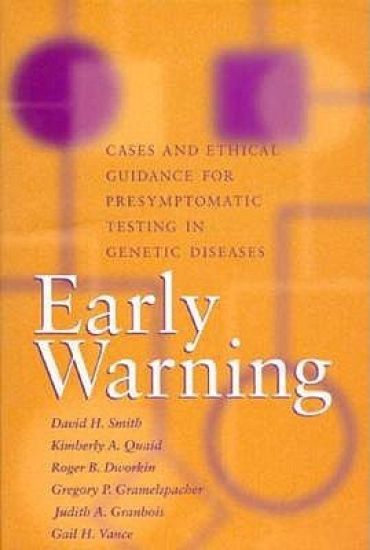
Early Warning

Early Warning

David H. Smith; Kimberly A. Quaid; Roger B. Dworkin; Gregory P. Gramelspacher

Indiana University Press
1998
sidottu
"This timely, well-written book brings together the collective experience of experts from the fields of medicine, psychiatry, religious studies, bioethics, and molecular genetics in an effort to develop coherent guidelines for the counseling of potential sufferers from genetic diseases." —Journal of Religion and Health This book presents 29 case studies that identify the most important ethical issues that are likely to emerge from new technologies of genetic testing and develops a series of guidelines based on those case studies. By providing the clinical origins and rationale behind each of its recommendations, the book will help readers think through the ethical issues and will assist them in the development of additional guidelines.
Entrusted

Entrusted

David H. Smith

Indiana University Press
1995
sidottu
"Entrusted provides a much needed contribution to the literature on ethics in the healthcare arena." —Health Progress "A splendid and invaluable book, one every trustee with an active conscience would want to read and one every trustee with a dormant conscience ought to read." —Richard Chait, Center for Higher Education Governance and Leadership " . . . thoughtful essays on the morality, obligations, practice, and virtues of trusteeship. . . . Smith presents intriguing arguments for governance grounded in a broader sense of organizational and public stewardship." —ARNOVA News "[Smith's] contribution breaks some new and difficult ground by helping us to think beyond the routine and mundane dimensions of trusteeship." —Academe " . . . essential reading for trustees." —Ethics "Entrusted should be required reading for trustees of any not-for-profit." —Advancing Philanthropy
The Work of the Future

The Work of the Future

David H. Autor; David A. Mindell

MIT PRESS LTD
2022
sidottu
Why the United States lags behind other industrialized countries in sharing the benefits of innovation with workers and how we can remedy the problem.The United States has too many low-quality, low-wage jobs. Every country has its share, but those in the United States are especially poorly paid and often without benefits. Meanwhile, overall productivity increases steadily and new technology has transformed large parts of the economy, enhancing the skills and paychecks of higher paid knowledge workers. What’s wrong with this picture? Why have so many workers benefited so little from decades of growth? The Work of the Future shows that technology is neither the problem nor the solution. We can build better jobs if we create institutions that leverage technological innovation and also support workers though long cycles of technological transformation. Building on findings from the multiyear MIT Task Force on the Work of the Future, the book argues that we must foster institutional innovations that complement technological change. Skills programs that emphasize work-based and hybrid learning (in person and online), for example, empower workers to become and remain productive in a continuously evolving workplace. Industries fueled by new technology that augments workers can supply good jobs, and federal investment in R&D can help make these industries worker-friendly. We must act to ensure that the labor market of the future offers benefits, opportunity, and a measure of economic security to all.
Healing Psychiatry

Healing Psychiatry

David H Brendel

MIT Press
2009
pokkari
A new patient-centered approach to psychiatry that aims to resolve the field's conceptual tension between science and humanism by drawing on classical American pragmatism and contemporary pragmatic bioethics.Psychiatry today is torn by opposing sensibilities. Is it primarily a science of brain functioning or primarily an art of understanding the human mind in its social and cultural context? Competing conceptions of mental illness as amenable to scientific explanation or as deeply complex and beyond the reach of empirical study have left the field conceptually divided between science and humanism. In Healing Psychiatry David Brendel takes a novel approach to this stubborn problem. Drawing on the classical American pragmatism of Charles Sanders Peirce, William James, and John Dewey, as well as contemporary work of pragmatic bioethicists, Brendel proposes a "clinical pragmatism" that synthesizes scientific and humanistic approaches to mental health care. Psychiatry, he argues, must integrate scientific and humanistic models by emphasizing the practical, pluralistic, participatory, and provisional aspects of clinical diagnosis and treatment. Psychiatrists need to have the skill and flexibility to use scientific and humanistic approaches in a collaborative, open-ended clinical process; they must recognize the complexity of human suffering even as they strive for scientific rigor. This is the only way, he writes, that psychiatry can heal its conceptual rift and the emotional wounds of its patients.Healing Psychiatry explores these issues from both clinical and theoretical standpoints and uses case histories to support its basic argument. Brendel calls for an open-minded and flexible yet scientifically informed approach to understanding, diagnosing, and treating mental disorders. And he considers the future of psychiatry, applying the principles of clinical pragmatism to a broad range of ethical concerns in psychiatric training and research.
The Work of the Future

The Work of the Future

David H. Autor; David A. Mindell

MIT PRESS LTD
2023
nidottu
Why the United States lags behind other industrialized countries in sharing the benefits of innovation with workers and how we can remedy the problem.The United States has too many low-quality, low-wage jobs. Every country has its share, but those in the United States are especially poorly paid and often without benefits. Meanwhile, overall productivity increases steadily and new technology has transformed large parts of the economy, enhancing the skills and paychecks of higher paid knowledge workers. What’s wrong with this picture? Why have so many workers benefited so little from decades of growth? The Work of the Future shows that technology is neither the problem nor the solution. We can build better jobs if we create institutions that leverage technological innovation and also support workers though long cycles of technological transformation.Building on findings from the multiyear MIT Task Force on the Work of the Future, the book argues that we must foster institutional innovations that complement technological change. Skills programs that emphasize work-based and hybrid learning (in person and online), for example, empower workers to become and remain productive in a continuously evolving workplace. Industries fueled by new technology that augments workers can supply good jobs, and federal investment in R&D can help make these industries worker-friendly. We must act to ensure that the labor market of the future offers benefits, opportunity, and a measure of economic security to all.
From the Laboratory to the Moon

From the Laboratory to the Moon

David H. Devorkin

MIT PRESS LTD
2025
nidottu
The reserved genius and celebrated Black scientist, who built the first astronomical observatory on the moon and worked to inspire underserved students to pursue science and engineering.In April 1972, as George Carruthers closely monitored the operation from the Manned Spacecraft Center in Houston, astronauts conducting the Apollo 16 mission positioned a gold-plated far ultraviolet electrographic camera on the moon. The camera, Carruthers's invention, was the first astronomical observatory on the lunar surface, where it stands to this day. While Carruthers's achievements earned many accolades, including the President's Medal for Technology and Invention, surprisingly little is known about this remarkable man. In From the Laboratory to the Moon, David DeVorkin explores Carruthers's life and work, for the first time telling the full story of how a deeply reserved African American farm boy rose to become one of our most celebrated aerospace scientists.DeVorkin follows Carruthers from his childhood in Ohio and then Chicago to his career at the US Naval Research Laboratory in Washington, DC. In the highly competitive world of space science in the 1960s and 1970s, Carruthers's genius for experimentation and exploration transcended the racial stereotyping and discrimination of his day, and he achieved world-class recognition for his studies of the Earth and deep space. A leading expert in the history of astronomy and space science, DeVorkin gives a deft account of these achievements and of how Carruthers used the fame they brought him, along with his notoriety as a Black man in science, to become a tireless advocate for underserved young people in science and engineering.