Kirjojen hintavertailu. Mukana 11 342 296 kirjaa ja 12 kauppaa.

Kirjahaku

Etsi kirjoja tekijän nimen, kirjan nimen tai ISBN:n perusteella.

1000 tulosta hakusanalla David N Alderman

Tibetan and Zen Buddhism in Britain
This book analyses the transplantation, development and adaptation of the two largest Tibetan and Zen Buddhist organizations currently active on the British religious landscape: the New Kadampa Tradition (NKT) and the Order of Buddhist Contemplatives (OBC). The key contributions of recent scholarship are evaluated and organised thematically to provide a framework for analysis, and the history and current landscape of contemporary Tibetan and Zen Buddhist practice in Britain are also mapped out. A number of patterns and processes identified elsewhere are exemplified, although certain assumptions made about the nature of 'British Buddhism' are subjected to critical scrutiny and challenged.
The Nubian Past

The Nubian Past

David N. Edwards

Routledge
2004
sidottu
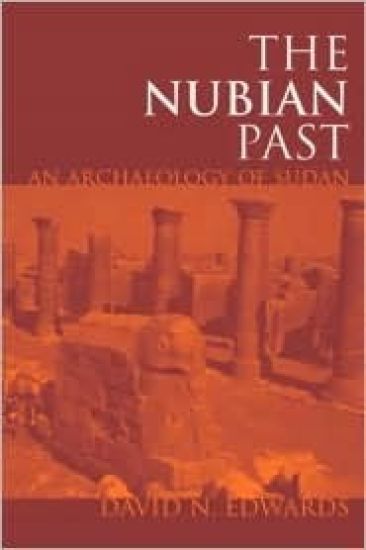
This cutting-edge synthesis of the archaeology of Nubia and Sudan from prehistory to the nineteenth century AD is the first major work on this area for over three decades. Drawing on results of the latest research and developing new interpretive frameworks, the area which has produced the most spectacular archaeology in sub-Saharan Africa is examined here by an author with extensive experience in this field.The geographical range of the book extends through the Nubian north, the Middle Nile Basin, and includes what has become the modern Sudan. Using period-based chapters, the region's long-term history is traced and a potential for a more broadly framed and inclusive 'historical archaeology' of Sudan's more recent past is explored.This text breaks new ground in its move beyond the Egyptocentric and more traditional culture-histories of Nubia, often isolated in Africanist research, and it relocates the early civilizations and their archaeology within their Sudanic Africa context. This is a captivating study of the area's history, and will inform and enthral all students and researchers of Archaeology and Egyptology.
The Nubian Past

The Nubian Past

David N. Edwards

Routledge
2004
nidottu
This cutting-edge synthesis of the archaeology of Nubia and Sudan from prehistory to the nineteenth century AD is the first major work on this area for over three decades. Drawing on results of the latest research and developing new interpretive frameworks, the area which has produced the most spectacular archaeology in sub-Saharan Africa is examined here by an author with extensive experience in this field.The geographical range of the book extends through the Nubian north, the Middle Nile Basin, and includes what has become the modern Sudan. Using period-based chapters, the region's long-term history is traced and a potential for a more broadly framed and inclusive 'historical archaeology' of Sudan's more recent past is explored.This text breaks new ground in its move beyond the Egyptocentric and more traditional culture-histories of Nubia, often isolated in Africanist research, and it relocates the early civilizations and their archaeology within their Sudanic Africa context. This is a captivating study of the area's history, and will inform and enthral all students and researchers of Archaeology and Egyptology.
Russian Views of Japan, 1792-1913

Russian Views of Japan, 1792-1913

David N. Wells

Routledge
2009
nidottu
Before Japan was 'opened up' in the 1850s, contact with Russia as well as other western maritime nations was extremely limited. Yet from the early eighteenth century onwards, as a result of their expanding commercial interests in East Asia and the North Pacific, Russians had begun to encounter Japanese and were increasingly eager to establish diplomatic and trading relations with Japan. This book presents rare narratives written by Russians, including official envoys, scholars and, later, tourists, who visited Japan between 1792 and 1913. The introduction and notes set these narratives in the context of the history of Russo-Japanese relations and the genre of European travel writing, showing how the Russian writers combined ethnographic interests with the assertion of Russian and European values, simultaneously inscribing power relations and negotiating cultural difference.

Tibetan and Zen Buddhism in Britain
This book analyses the transplantation, development and adaptation of the two largest Tibetan and Zen Buddhist organizations currently active on the British religious landscape: the New Kadampa Tradition (NKT) and the Order of Buddhist Contemplatives (OBC). The key contributions of recent scholarship are evaluated and organised thematically to provide a framework for analysis, and the history and current landscape of contemporary Tibetan and Zen Buddhist practice in Britain are also mapped out. A number of patterns and processes identified elsewhere are exemplified, although certain assumptions made about the nature of 'British Buddhism' are subjected to critical scrutiny and challenged.
The Russian Discovery of Japan, 1670–1800
During the period of the Tokugawa shogunate’s seclusion policy from about 1630 onwards there was very little European interaction with the Japanese except through the restricted Dutch presence at Nagasaki. During this period, however, Russians exploring Siberia and the Russian Far East came into contact with Japan, and further exploration and information collecting was encouraged by the Russian government, culminating in the first official Russian Embassy to Japan in 1792. This book examines the Russian discourse on Japan in the period, tracing the gradual accumulation of knowledge, and the development of Russian views, sometimes distorted, about Japan. The book includes key historical documents, some translated into English for the first time. The book is a prequel to the author’s previous book, Russian Views of Japan, 1792–1913: An Anthology of Early Travel Writing.
Responding to Chaos

Responding to Chaos

David N Buck

Spon Press
2000
nidottu
A celebration of a unique culture and its experience of design, this sensitive text is a timely examination of Japanese design at the start of a new century. The country's economic boom in the 1980s produced a surge of interest in land and building, and consequently in design in all its forms. From restaurant interiors to products, from private housing to recreational spaces, design received an unprecedented degree of attention. However the bursting in the early 1990s of this so-called 'bubble' economy has prompted a re-examination of design and its role in urban society.
The Last Man Who Knew Everything

The Last Man Who Knew Everything

David N. Schwartz

Basic Books
2017
sidottu
In 1942, a team at the University of Chicago achieved what no one had before: a nuclear chain reaction. At the forefront of this breakthrough stood Enrico Fermi. Straddling the ages of classical physics and quantum mechanics, equally at ease with theory and experiment, Fermi truly was the last man who knew everything-at least about physics. But he was also a complex figure who was a part of both the Italian Fascist Party and the Manhattan Project, and a less-than-ideal father and husband who nevertheless remained one of history's greatest mentors. Based on new archival material and exclusive interviews, The Last Man Who Knew Everything lays bare the enigmatic life of a colossus of twentieth century physics.
The Human Microbiota

The Human Microbiota

David N. Fredricks

John Wiley Sons Inc
2013
sidottu
The Human Microbiota offers a comprehensive review of all human-associated microbial niches in a single volume, focusing on what modern tools in molecular microbiology are revealing about human microbiota, and how specific microbial communities can be associated with either beneficial effects or diseases. An excellent resource for microbiologists, physicians, infectious disease specialists, and others in the field, the book describes the latest research findings and evaluates the most innovative research approaches and technologies. Perspectives from pioneers in human microbial ecology are provided throughout.
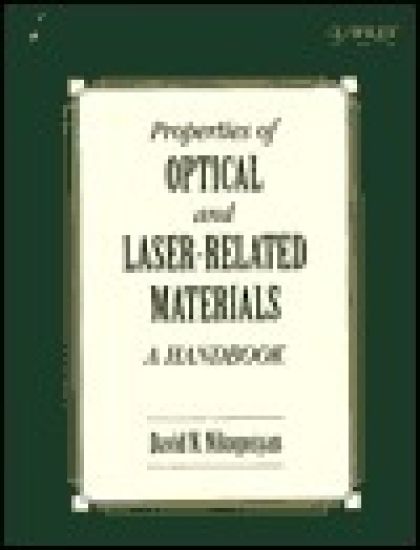
Properties of Optical and Laser-Related Materials

Properties of Optical and Laser-Related Materials

David N. Nikogosyan

JOHN WILEY SONS INC
1997
sidottu
Properties of Optical and Laser-Related Materials—A Handbook offers the reader a self-contained, concise and up-to-date collection of the key properties of 125 of the most common and important optical materials used in modern optics, laser physics and technology, spectroscopy and laser spectroscopy, nonlinear optics, quantum electronics and laser applications. This comprehensive volume presents not only the classical properties but also those that have appeared in the three decades since the invention of the laser. The presentation of the material is given in a clear tabular form with more than 1000 references. A wide variety of readers, ranging from workers in both industry and academia, to lecturers and students at postgraduate and undergraduate levels, will find Properties of Optical and Laser-Related Materials—A Handbook an invaluable resource.
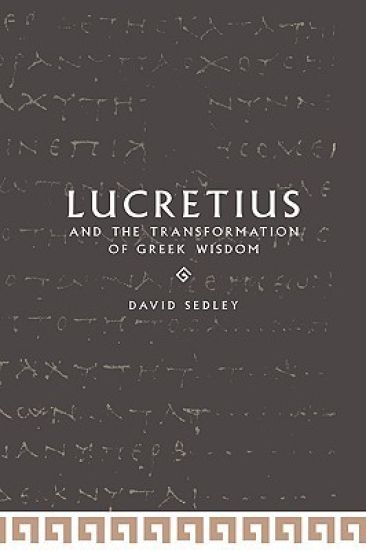
Lucretius and the Transformation of Greek Wisdom

Lucretius and the Transformation of Greek Wisdom

David N. Sedley

Cambridge University Press
2003
pokkari
This book is designed to appeal both to those interested in Roman poetry and to specialists in ancient philosophy. In it David Sedley explores Lucretius' complex relationship with Greek culture, in particular with Empedocles, whose poetry was the model for his own, with Epicurus, the source of his philosophical inspiration, and with the Greek language itself. He includes a detailed reconstruction of Epicurus' great treatise On Nature, and seeks to show how Lucretius worked with this as his sole philosophical source, but gradually emancipated himself from its structure, transforming its raw contents into something radically new. By pursuing these themes, the book uncovers many unrecognised aspects of Lucretius' methods and achievements as a poetic craftsman.
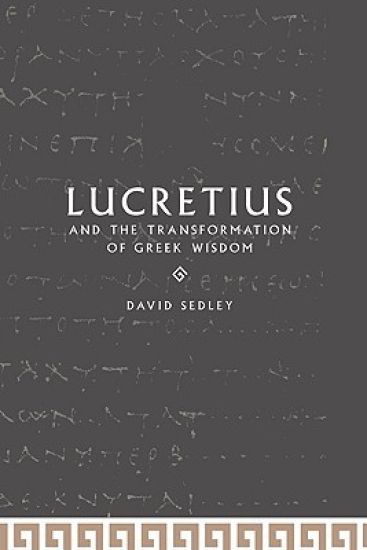
Lucretius and the Transformation of Greek Wisdom

Lucretius and the Transformation of Greek Wisdom

David N. Sedley

Cambridge University Press
1998
sidottu
This book is designed to appeal both to those interested in Roman poetry and to specialists in ancient philosophy. In it David Sedley explores Lucretius’ complex relationship with Greek culture, in particular with Empedocles, whose poetry was the model for his own, with Epicurus, the source of his philosophical inspiration, and with the Greek language itself. He includes a detailed reconstruction of Epicurus’ great treatise On Nature, and seeks to show how Lucretius worked with this as his sole philosophical source, but gradually emancipated himself from its structure, transforming its raw contents into something radically new. By pursuing these themes, the book uncovers many unrecognised aspects of Lucretius’ methods and achievements as a poetic craftsman.
Leading Learning that Matters

Leading Learning that Matters

David N Perkins; Daniel G Wilson; Flossie S G Chua

Chua, Perkins Wilson
2021
pokkari
How can school learning be expanded to matter more in learners' lives? How can school leaders shape an institution to stay true to its core commitments and thrive as a center of contemporary learning? Leading Learning that Matters offers a flexible process to help school leaders and their communities construct a vision of what learning really matters for the lives their learners are likely to live and then make that vision a daily reality in classrooms. This book, with ideas informed by research and tested in practice, will: - guide you through the four key dimensions of the Leading Learning that Matters (LLtM) process - creating shared vision, developing collaborative structures, supporting individual development, and sustaining progress - provide tips and tools for building and refining a vision of learning that matters for your students, and for organizing and tracking the progress of the LLtM process - show what Leading Learning that Matters looks like through pictures of practice from schools that have embarked on the LLtM process Leading Learning that Matters is for any school leader who wants to ensure that their school is preparing students to thrive in the contemporary world and is ready to explore what that looks like through a collaborative process.
Maps of the Imagination

Maps of the Imagination

David N Collins

Writers Club Press
2001
pokkari
Maps Of The Imagination offers a phantasmagorical journey through the "psychedelic sixties" by a young poet/writer who offered a titillating rendition of the "next generation" beat poetry. A vivid and surreal trip to places your parents always warned you about.
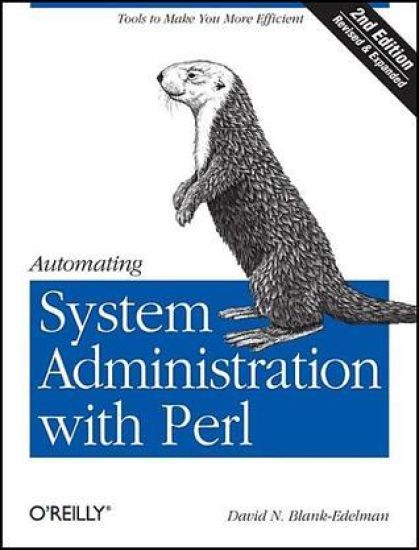
Automating System Administration with Perl 2e

Automating System Administration with Perl 2e

David N Blank?edelman

O'Reilly Media, Inc, USA
2009
nidottu
If you do systems administration work of any sort, you have no choice: you have to deal with increasing demands on your time and the growing complexity of your environment. "Automating System Administration with Perl", the second edition of O'Reilly's popular "Otter Book", not only offers you the right tools for your job, but also suggests the best way to approach particular problems and securely automate pressing tasks. With this book in hand and Perl in your toolbox, you can do more with less - less effort, fewer resources, and less hassle. Thoroughly updated and expanded to cover the latest operating systems, technologies, and Perl modules, "Automating System Administration with Perl" will help you: manage user accounts; monitor filesystems and processes; work with configuration files in important formats such as XML and YAML; administer databases, including MySQL, MS-SQL, and Oracle with DBI; work with directory services like LDAP and Active Directory; script email protocols and spam control; effectively create, handle, and analyze log files; administer network name and configuration services, including NIS, DNS and DHCP; maintain, monitor, and map network services, using technologies and tools such as SNMP, nmap, libpcap, GraphViz and RRDtool; and, improve filesystem, process, and network security. To get you up to speed on technologies like XML/XPath, LDAP, SNMP, and SQL, this edition also features additional appendices, which readers found particularly helpful in the first edition. Packed with advice, "Automating System Administration with Perl" explains both why and how to manage your system administration challenges with Perl.