Kirjojen hintavertailu. Mukana 12 390 323 kirjaa ja 12 kauppaa.

Kirjahaku

Etsi kirjoja tekijän nimen, kirjan nimen tai ISBN:n perusteella.

1000 tulosta hakusanalla David P. Silcox

The Constitution in Congress: Democrats and Whigs, 1829-1861

The Constitution in Congress: Democrats and Whigs, 1829-1861

David P. Currie

University of Chicago Press
2013
nidottu
The Constitution in Congress series has been called nothing less than a biography of the US Constitution for its in-depth examination of the role that the legislative and executive branches have played in the development of constitutional interpretation. This third volume in the series, the early installments of which dealt with the Federalist and Jeffersonian eras, continues this examination with the Jacksonian revolution of 1829 and subsequent efforts by Democrats to dismantle Henry Clay's celebrated "American System" of nationalist economics. David P. Currie covers the political events of the period leading up to the start of the Civil War, showing how the slavery question, although seldom overtly discussed in the debates included in this volume, underlies the Southern insistence on strict interpretation of federal powers. Like its predecessors, The Constitution in Congress: Democrats and Whigs will be an invaluable reference for legal scholars and constitutional historians alike.
The Constitution of the United States

The Constitution of the United States

David P. Currie

University of Chicago Press
2000
nidottu
A masterly introduction to the United States Constitution, this slim book leads the reader through a concise overview of the document's individual articles and amendments. With clear and accessible language, Currie then examines each of the three branches of the federal government and explains the relation between the federal and state governments. He analyzes those constitutional provisions that are designed to protect citizens from governmental interference, such as the due process and equal protection clauses and the confusing first amendment provisions respecting the separation of church and state, and includes discussions of judicial review and freedom of speech and of the press. A sympathetic yet critical guide, Currie's book enables students and laypersons to understand one of the cornerstones of the Western political tradition. The second edition, along with an updated chronology and bibliography, incorporates the Supreme Court decisions over the past decade that have affected constitutional interpretation. "Superb . . . highly recommended for those seeking a reliable, understandable, and useful introduction to our constitution."—Appellate Practice Journal and Update
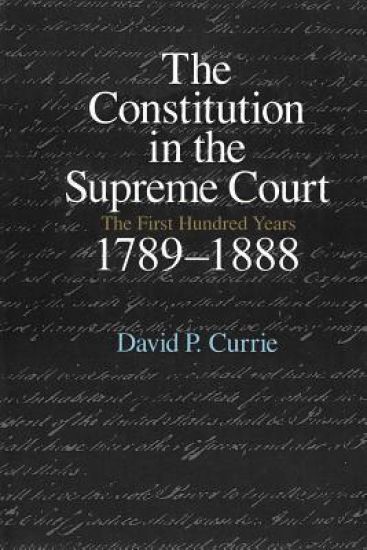
The Constitution in the Supreme Court

The Constitution in the Supreme Court

David P. Currie

University of Chicago Press
1992
nidottu
Currie's masterful synthesis of legal analysis and narrative history, gives us a sophisticated and much-needed evaluation of the Supreme Court's first hundred years. "A thorough, systematic, and careful assessment...As a reference work for constitutional teachers, it is a gold mine."--Charles A. Lofgren, Constitutional Commentary
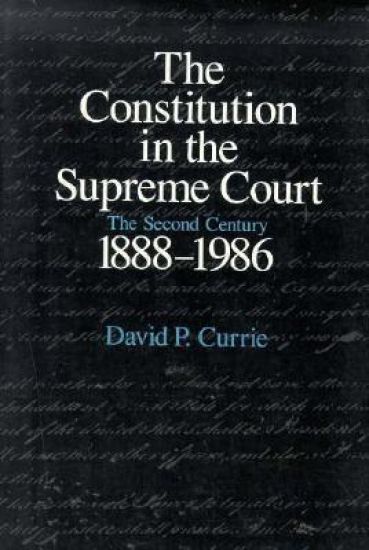
The Constitution in the Supreme Court

The Constitution in the Supreme Court

David P. Currie

University of Chicago Press
1994
nidottu
The Constitution in the Supreme Court: The Second Century traces the development of the Supreme Court from Chief Justice Fuller (1888-1910) to the retirement of Chief Justice Burger (1969-1986). Currie argues that the Court's work in its second century revolved around two issues: the constitutionality of the regulatory and spending programs adopted to ameliorate the hardships caused by the Industrial Revolution and the need to protect civil rights and liberties. Organizing the cases around the tenure of specific chief justices, Currie distinguishes among the different methods of constitutional exegesis, analyzes the various techniques of opinion writing, and evaluates the legal performance of different Courts. "Elegant and readable. Whether you are in favor of judicial restraint or judicial activism, whatever your feelings about the Warren Court, or the Renquist Court, this is a book that justifies serious study."--Robert Stevens, New York Times Book Review
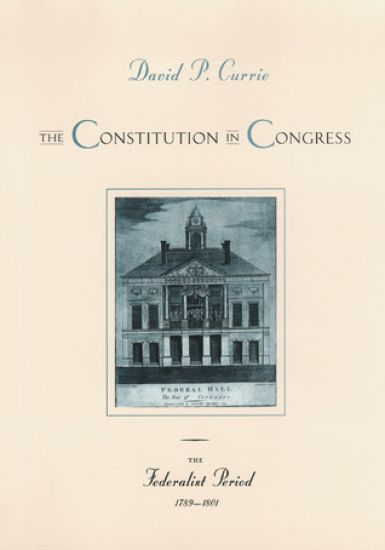
The Constitution in Congress: The Federalist Period, 1789-1801

The Constitution in Congress: The Federalist Period, 1789-1801

David P. Currie

University of Chicago Press
1999
nidottu
This is an examination of the US constitution, providing an analysis from a legal perspective of the first six congresses constituting the federalist period. The book aims to establish that the Constitution was forged, not in the courts, but in the legislative and executive branches of government. The first half of the book is devoted to the work of the First Congress, which was virtually a continuation of the Constitutional Convention, setting up the executive cabinet departments, the judiciary, a taxation system, and a host of other institutions. The second part of the book examines the Second to the Sixth Congresses, where partisan battles arose over such controversial initiatives as the Alien and Sedition Acts.
The Constitution in Congress: The Jeffersonians, 1801-1829

The Constitution in Congress: The Jeffersonians, 1801-1829

David P. Currie

University of Chicago Press
2001
sidottu
Because of the judicial branch's tremendous success in reviewing legislative and executive action in the United States, legal scholars have traditionally looked only to the courts for guidance in interpreting the Constitution. This, the second book in David P. Currie's multivolume series, looks to the legislative and executive branches for insights into the development of constitutional interpretation.Currie examines the period of Republican hegemony from the inauguration of Thomas Jefferson in 1801 to the election of Andrew Jackson in 1829. During this time of great leadership and controversy, many benchmark issues—the abolition of the new Circuit Courts, the Louisiana Purchase, the Burr conspiracy, the War of 1812, the Monroe Doctrine, and the Missouri Compromise, among others—were debated and decided almost exclusively in the legislative and executive arenas. With its uniquely legal perspective and comprehensive coverage, The Constitution in Congressillustrates how the executive and legislative branches matched the Supreme Court in putting flesh and blood onto the skeleton of the Constitution.
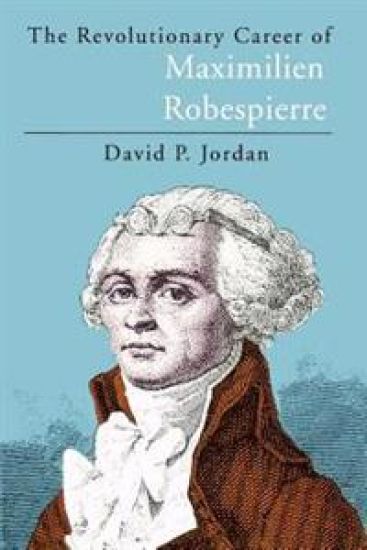
The Revolutionary Career of Maximilien Robespierre

The Revolutionary Career of Maximilien Robespierre

David P. Jordan

University of Chicago Press
1989
pokkari
As it changed forever the political landscape of the modern world, the French Revolution was driven by a new type of personality: the confirmed, self-aware revolutionary. Maximilien Robespierre originated the role and embodied its ideological essence and extremes; the self that he projected to the people was equated with the ideals for which he strove. In creating this intellectual biography of so enigmatic a figure, David Jordan has stressed the words of the man about himself. With great imagination and insight, Jordan places Robespierre's self-conceptualization within the context of events and explains how Robespierre "The Incorruptible" a man seen by contemporaries as virtuous could not only equate justice with vengeance and demand it of the people, but also stand as its symbol before the world."
Why Iowa?

Why Iowa?

David P. Redlawsk; Caroline J. Tolbert; Todd Donovan

University of Chicago Press
2010
nidottu
If Barack Obama had not won in Iowa, most commentators believe that he would not have been able to go on to capture the Democratic nomination for president. "Why Iowa?" offers the definitive account of those early weeks of the campaign season: from how the Iowa caucuses work and what motivates the candidates' campaigns, to participation and turnout, as well as the lingering effects that the campaigning had on Iowa voters. Demonstrating how 'what happens in Iowa' truly reverberates throughout the country, five-time Iowa precinct caucus chair David P. Redlawsk and his coauthors take us on an inside tour of one of the most media-saturated and speculated-about campaign events in American politics. Considering whether a sequential primary system, in which early, smaller states such as Iowa and New Hampshire have such a tremendous impact, is fair or beneficial to the country as a whole, the authors here demonstrate that not only is the impact warranted, but it also reveals a great deal about informational elements of the campaigns. Contrary to conventional wisdom, this sequential system does confer huge benefits on the nominating process, while Iowa's particularly well-designed caucus system - extensively explored here for the first time - brings candidates' arguments, strengths, and weaknesses into the open and under the media's lens.
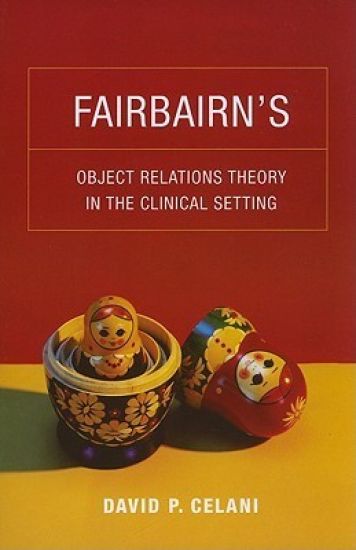
Fairbairn’s Object Relations Theory in the Clinical Setting

Fairbairn’s Object Relations Theory in the Clinical Setting

David P. Celani

Columbia University Press
2010
sidottu
W. R. D. Fairbairn (1889-1964) challenged the dominance of Freud's drive theory with a psychoanalytic theory based on the internalization of human relationships. Fairbairn assumed that the unconscious develops in childhood and contains dissociated memories of parental neglect, insensitivity, and outright abuse that are impossible the children to tolerate consciously. In Fairbairn's model, these dissociated memories protect developing children from recognizing how badly they are being treated and allow them to remain attached even to physically abusive parents. Attachment is paramount in Fairbairn's model, as he recognized that children are absolutely and unconditionally dependent on their parents. Kidnapped children who remain attached to their abusive captors despite opportunities to escape illustrate this intense dependency, even into adolescence. At the heart of Fairbairn's model is a structural theory that organizes actual relational events into three self-and-object pairs: one conscious pair (the central ego, which relates exclusively to the ideal object in the external world) and two mostly unconscious pairs (the child's antilibidinal ego, which relates exclusively to the rejecting parts of the object, and the child's libidinal ego, which relates exclusively to the exciting parts of the object). The two dissociated self-and-object pairs remain in the unconscious but can emerge and suddenly take over the individual's central ego. When they emerge, the "other" is misperceived as either an exciting or a rejecting object, thus turning these internal structures into a source of transferences and reenactments. Fairbairn's central defense mechanism, splitting, is the fast shift from central ego dominance to either the libidinal ego or the antilibidinal ego-a near perfect model of the borderline personality disorder. In this book, David Celani reviews Fairbairn's five foundational papers and outlines their application in the clinical setting. He discusses the four unconscious structures and offers the clinician concrete suggestions on how to recognize and respond to them effectively in the heat of the clinical interview. Incorporating decades of experience into his analysis, Celani emphasizes the internalization of the therapist as a new "good" object and devotes entire sections to the treatment of histrionic, obsessive, and borderline personality disorders.
Fairbairn’s Object Relations Theory in the Clinical Setting

Fairbairn’s Object Relations Theory in the Clinical Setting

David P. Celani

Columbia University Press
2010
pokkari
W. R. D. Fairbairn (1889-1964) challenged the dominance of Freud's drive theory with a psychoanalytic theory based on the internalization of human relationships. Fairbairn assumed that the unconscious develops in childhood and contains dissociated memories of parental neglect, insensitivity, and outright abuse that are impossible the children to tolerate consciously. In Fairbairn's model, these dissociated memories protect developing children from recognizing how badly they are being treated and allow them to remain attached even to physically abusive parents. Attachment is paramount in Fairbairn's model, as he recognized that children are absolutely and unconditionally dependent on their parents. Kidnapped children who remain attached to their abusive captors despite opportunities to escape illustrate this intense dependency, even into adolescence. At the heart of Fairbairn's model is a structural theory that organizes actual relational events into three self-and-object pairs: one conscious pair (the central ego, which relates exclusively to the ideal object in the external world) and two mostly unconscious pairs (the child's antilibidinal ego, which relates exclusively to the rejecting parts of the object, and the child's libidinal ego, which relates exclusively to the exciting parts of the object). The two dissociated self-and-object pairs remain in the unconscious but can emerge and suddenly take over the individual's central ego. When they emerge, the "other" is misperceived as either an exciting or a rejecting object, thus turning these internal structures into a source of transferences and reenactments. Fairbairn's central defense mechanism, splitting, is the fast shift from central ego dominance to either the libidinal ego or the antilibidinal ego-a near perfect model of the borderline personality disorder. In this book, David Celani reviews Fairbairn's five foundational papers and outlines their application in the clinical setting. He discusses the four unconscious structures and offers the clinician concrete suggestions on how to recognize and respond to them effectively in the heat of the clinical interview. Incorporating decades of experience into his analysis, Celani emphasizes the internalization of the therapist as a new "good" object and devotes entire sections to the treatment of histrionic, obsessive, and borderline personality disorders.
As the Crow Flies: 2,500 miles on a homemade bicycle
If you were the kind of person who can't stop making things and you'd made your own bicycle in your shed from unsuitable off-the-shelf industrial steel box section, the obvious thing to do next would be to embark on a solo, unsupported ride round the country to the first place under each letter in the index of your 1998 AA road atlas. Lightly equipped and with a crow as guide Dave Ramsden reaches the parts other touring cyclists do not, including the heights of euphoria and the pit of despair. Along the way he is inspired to poetry, exposed to adversity and experiments with porridge.'Tony Benn meets Alan Bennett, meets Bill Bryson, with none of the subtlety or style. Highly recommended.'Lesley Sadsack, Pigeon Fancier.'Part travelogue, part political polemic, Dave Ramsden drags himself and his heavy home-made bike around beleaguered Britain.'Colin Outcast, Fartown Bugle
I Know You Are There

I Know You Are There

David P Matheson

Lulu.com
2018
pokkari
A captivating story, describing events that could happen to anyone trying to make a life in our unpredictable world. The hand of fate verses the tide of what we want and hope for ourselves, and those we love. It could have happened to anybody. It Happened to Maryanne McGee
Meaning and Interpretation of Music in Cinema

Meaning and Interpretation of Music in Cinema

David P. Neumeyer

Indiana University Press
2015
sidottu
By exploring the relationship between music and the moving image in film narrative, David Neumeyer shows that film music is not conceptually separate from sound or dialogue, but that all three are manipulated and continually interact in the larger acoustical world of the sound track. In a medium in which the image has traditionally trumped sound, Neumeyer turns our attention to the voice as the mechanism through which narrative (dialog, speech) and sound (sound effects, music) come together. Complemented by music examples, illustrations, and contributions by James Buhler, Meaning and Interpretation of Music in Cinema is the capstone of Neumeyer's 25-year project in the analysis and interpretation of music in film.
Meaning and Interpretation of Music in Cinema

Meaning and Interpretation of Music in Cinema

David P. Neumeyer

Indiana University Press
2015
pokkari
By exploring the relationship between music and the moving image in film narrative, David Neumeyer shows that film music is not conceptually separate from sound or dialogue, but that all three are manipulated and continually interact in the larger acoustical world of the sound track. In a medium in which the image has traditionally trumped sound, Neumeyer turns our attention to the voice as the mechanism through which narrative (dialog, speech) and sound (sound effects, music) come together. Complemented by music examples, illustrations, and contributions by James Buhler, Meaning and Interpretation of Music in Cinema is the capstone of Neumeyer's 25-year project in the analysis and interpretation of music in film.
From Insight to Innovation

From Insight to Innovation

David P. Billington

MIT Press
2020
sidottu
Technology is essential to modern life, yet few of us are technology-literate enough to know much about the engineering that underpins it. In this book, David P. Billington, Jr., offers accessible accounts of the key twentieth-century engineering innovations that brought us into the twenty-first century. Billington examines a series of engineering advances-from Hoover Dam and jet engines to the transistor, the microchip, the computer, and the internet-and explains how they came about and how they work.Each of these innovations tells a unique story. The great dams of the New Deal brought huge rivers under control, and a national highway system interconnected the nation, as did jet air travel. The transistor and the microchip originated in the private sector and found a mass market after early government support. The computer and the internet began as government projects and found a mass market later in the private sector. Billington finds that engineers with unconventional insights could succeed in a bureaucratic age; what mattered were independent vision and a society that welcomed innovation.This book completes the story of American engineering begun with the earlier volumes The Innovators (by the author's father) and Power, Speed, and Form (by the author and his father).