
Kirjahaku
Etsi kirjoja tekijän nimen, kirjan nimen tai ISBN:n perusteella.
1000 tulosta hakusanalla David Porter

A Voyage In The South Seas: In The Years 1812-14, With Particular Details Of The Galapagos And Washington Islands (1823)
David Porter
KESSINGER PUBLISHING, LLC
2008
nidottu




FIVE MINUTES TO LIVE by author David Porter is full of suspense and adventure. This christian fiction is the first book of the Matt Davenport Chronicles and is based on true Biblical events that will prove to keep you wanting more. Matt Davenport is an everyday good guy, happy to support his friend and secret crush, Jessica. So when she asks him to be her plus-one at a dinner where she'll be giving a talk about ground-breaking new science, Matt is expecting a fun-but normal-night.But their night on the town is anything but normal. Their ride is interrupted by a car collision-and a kidnapping-as Jessica is torn from the wreck and dragged away.Suddenly, Matt finds himself in a race to save his friend and protect her scientific discovery, alongside a stranger with mysterious ties to Israel's Mossad. The chase takes Matt from the U.S. to Tel Aviv, facing mercenaries and enemies at every turn. As he struggles to decipher clues that will lead him to his friend, it becomes clear that Jessica's scientific discovery poses a threat to Israel's security, one that dangerous people want to exploit.To rescue his friend and prevent the science from falling into the wrong hands, Matt has to figure out who to trust...especially the small voice inside him that's trying to guide him to Jessica and safety...before it's too late.

Thought This Might Help Someone is a journey to the next great version of yourself. It follows the dailies - David Porter's continuing series of daily seeds he scatters to the universe. Through personal introspection, the author has created a true transformation in his life from disconnected to powerful. As you read the book, you'll learn how to: trust yourself as you reach for your dreams; find connection and fulfillment with others; seek opportunities to look at the world differently. After each daily reflection, the author poses questions that will allow you to craft your own "dailies." Your answers will become the raw material that creates each greater version of you. By taking the time and making the effort, you can create your own personal scripture as a product of your mind, heart, and soul. And from there, your trajectory is squarely in your hands. Slow down, take time to reflect, and find the greatest version of you with the insights and wisdom in this book.

Thought This Might Help Someone is a journey to the next great version of yourself. It follows the dailies - David Porter's continuing series of daily seeds he scatters to the universe. Through personal introspection, the author has created a true transformation in his life from disconnected to powerful. As you read the book, you'll learn how to: trust yourself as you reach for your dreams; find connection and fulfillment with others; seek opportunities to look at the world differently. After each daily reflection, the author poses questions that will allow you to craft your own "dailies." Your answers will become the raw material that creates each greater version of you. By taking the time and making the effort, you can create your own personal scripture as a product of your mind, heart, and soul. And from there, your trajectory is squarely in your hands. Slow down, take time to reflect, and find the greatest version of you with the insights and wisdom in this book.
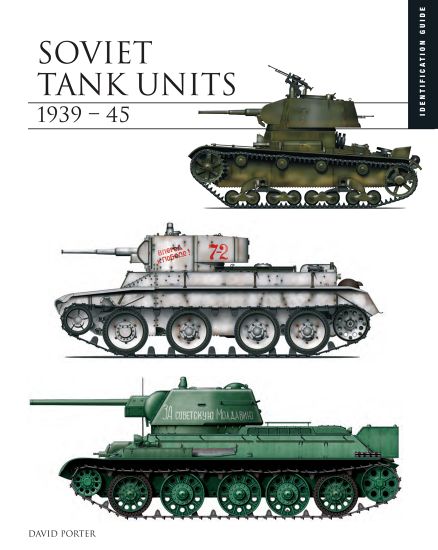
Soviet Tank Units 1939–45 offers an highly-illustrated guide to the main armoured fighting vehicles used by the Red Army during World War II. This compact volume includes sample unit structures and orders of battle from company up to corps level, providing an organizational context for key campaigns throughout the war. Organised chronologically, the book offers a comprehensive survey of Soviet-employed armoured fighting vehicles by campaign, including the German invasion of 1941, the defence of Moscow, the Stalingrad counter-offensive, the battles of Kharkov and Kursk, Operation ‘Bagration’, and the final defeat of Axis forces in Berlin, Vienna and Budapest in May 1945. All the major and many minor tank that saw action on the Eastern Front is featured. The guide also includes numerous Lend-Lease Armoured fighting vehicles well as many examples of Soviet light vehicles, self-propelled guns, tractors and trucks. Packed with 250 full-colour artworks and photographs with exhaustive specifications, Soviet Tank Units 1939–45: Identification Guide is a key reference source for military modellers and World War II enthusiasts.

Illustrated with detailed artworks of American, British, Canadian, Australian, French, Polish and other Western Allied nations tanks and their markings with exhaustive captions and specifications, World War II Tanks: Western Allies 1939–45: Identification Guide offers an highly-illustrated guide to the main armoured fighting vehicles used by the Western Allies during World War II. This compact volume includes sample unit structures and orders of battle from company up to corps level. Organised by division, the book offers a comprehensive survey of Western Allied armoured fighting vehicles by campaign, including the fall of Poland, the defence of the Low Countries and France, desert warfare in North Africa, the push through Italy, the Normandy landings, the Battle of the Bulge and the final defeat of Germany. All the major and many minor tanks are featured, with variations of the M4 Sherman, Churchill and Matilda, as well as mat-laying, engineering and mine-clearing versions. Lesser known models from the early years of the war, armoured cars, halftracks, trucks and amphibious vehicles make this a rounded compendium of Western Allied armoured fighting vehicles. Packed with more than 200 full-colour artworks and photographs with exhaustive specifications, World War II Tanks: Western Allies 1939–45 is a key reference guide for military modellers and World War II enthusiasts.
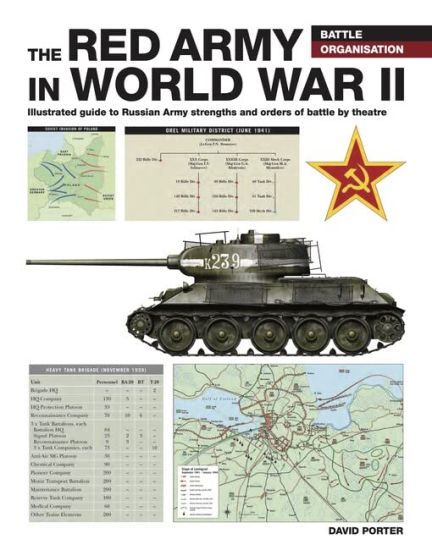
Without the Red (or Soviet) Army, it is likely that the Western Allies would have taken much longer to defeat the Third Reich – they may even have lost altogether. However even decades after the war’s end, little is widely known about this giant organization that numbered millions of soldiers. Broken down by key battles or campaigns within each theatre of war, The Red Army in World War II shows the strengths and organizational structures of the Red Army’s ground forces campaign by campaign, building into a detailed compendium of information. With extensive organizational diagrams and full-colour campaign maps showing the disposition of units, The Red Army in World War II is an easy-to-use guide to the Russian, Polish, Czech and units of other nationalities that served as part of Stalin’s army, their strengths during key campaigns and battles, and details of where they served throughout the war. The book will be an essential reference guide for any serious enthusiast of World War II.

In Britain, most of us take electricity for granted. When there are power cuts, we are shocked by the gloom and the silence and how dependent on electricity we have become. Critics predicted that the privatisation of electricity supply in 1990 would lead to power shortages. Elsewhere in Europe it was sometimes dismissed contemptuously as 'The British Experiment'. But the plan worked. Private investment flowed and customers reaped the benefits. Then it began to go wrong. Governments wanted more and more say, but their policies were often confusing and sometimes merely vote-catching The confidence of investors was damaged. Power stations closed faster than they were replaced. The risk of power shortages increased. In 1987, David Porter found himself at the centre of the energy supply revolution when he helped to form a new body created to fight for the UK's independent electricity producers. Soon he was also speaking for the companies that had once been state-owned. Battles were fought and often won, but government intervention grew relentlessly. The ideals of the privatisation were forgotten. Politics, rather than the paying customers, drove the industry.This book is David's story of those eventful years.

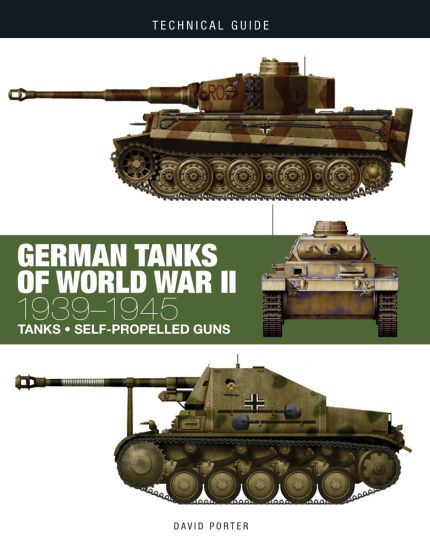
Organised chronologically by type, German Tanks of World War II offers a highly illustrated guide to the main types of armoured fighting vehicles used by the German armed forces during the conflict. Ranging from heavy tanks to self-propelled guns, from light tanks to captured foreign tanks used by Germany, the book is an expert examination of the armoured fighting vehicles that were put into action in the invasions of Poland (Fall Weiss) in 1939, in France and the Low Countries (Fall Gelb) in 1940, in Fall Blau (Operation Braunschweig) on the Eastern Front, at Stalingrad in 1942-43, at the battles of Kursk and Kharkov in 1943, as well as in North Africa under Field Marshall Rommel, the Normandy campaign of 1944, and at the Battle of the Bulge in the Ardennes in 1944– 45. Tanks featured include light tanks such as Panzerkampfwagen I and II, medium tanks like Panzerkampfwagen III and IV Ausf E – the staples of the German war effort – and the Panzerkampfwagen KV – a captured Soviet KV-1. Of course, the Panther, possibly the best all-round tank of the conflict, features, as do the variants of the mighty Tiger I and Tiger II heavy tanks. In addition, the book covers flame-throwing half-tracks, tank destroyers, Marder III self-propelled guns, and Hummel self- propelled howitzers. Each featured artwork includes authentic markings and colour schemes, while every separate model is accompanied by exhaustive specifications. Packed with 120 full-colour artworks with detailed specifications, German Tanks of World War II is a key reference guide for military modellers and World War II enthusiasts.

Integral Equations: A Practical Treatment, from Spectral Theory to Applications
David Porter; David S. G. Stirling
Cambridge University Press
1990
pokkari
This book gives a rigorous and practical treatment of integral equations. These are significant because they occur in many problems in mathematics, physics and engineering and they offer a powerful (sometimes the only) technique for solving these problems. The book aims to tackle the solution of integral equations using a blend of abstract ‘structural’ results and more direct, down-to-earth mathematics. The interplay between these two approaches is a central feature of the text and it allows a thorough account to be given of many of the types of integral equation which arise in application areas. Since it is not always possible to find explicit solutions of the problems posed, much attention is devoted to obtaining qualitative information and approximations to the solutions, with the associated error estimates. This treatment is intended for final year mathematics undergraduates, postgraduates and research workers in application areas such as numerical analysis and fluid mechanics.


Es este un ensayo dedicado a profundizar de forma humana y racional, como no podr a ser de otro modo siendo como digo un ensayo, en los problemas hacia los que nos puede conducir una conducta y unas elecciones vitales err neas. Cada una de las decisiones que tomemos en un momento tan b sico en la evoluci n de toda persona, como sin duda lo es la adolescencia, nos van a llevar tal vez, hacia unas consecuencias que pueden llegar a ser desastrosas a la hora de enfocar nuestro posterior ciclo vital. Pese a no tener pretensiones educativas, s posee este escrito la intenci n de poder ayudar por un lado, a alumnos con falta de expectativas o de motivaci n, y por otro, a profesores a los cuales queda ya demasiado lejos la adolescencia. Trata de forma sencilla e impersonal, de intentar hacer comprender que existen muchos y variados motivos por los que llegar a un fracaso escolar y laboral total, no solo los que se esperan seg n un manual de psicolog a educativa o pedag gica al uso. Se pretende insistir en el hecho, de que en una enorme cantidad de ocasiones, el problema no es la falta de motivaci n o deseo de aprendizaje, incluso tampoco de capacidades. Simplemente es una incomprensi n del funcionamiento vital, debido a la desconocida evidencia por parte de los alumnos, de que poseen un cerebro en pleno desarrollo neuronal, que les impide f sicamente, comprender qu est ocurriendo tanto en su ser interior, como en su exterior social, al tiempo que los profesores han perdido la capacidad de asimilar o tratar en la parte de responsabilidad que les corresponda, este problema, ya sea por el olvido que produce el paso del tiempo, o por simple dejadez. Respecto al ensayo en s , un personaje an nimo y desesperado, tratar de encontrar al amor de su vida, perdido entre la vor gine de un aeropuerto internacional, al tiempo que intenta descifrar, o al menos comprender, los errores que le llevaron a su actual situaci n laboral y por tanto vital. Entre los recuerdos del pasado, se entremezclar n los problemas del presente, buscando ese amor descubierto apenas unos minutos antes entre el gent o. La dura b squeda de un rojo y des rtico grano de arena, entre una infinita playa de blancas orillas.

For many centuries, visual art, music, literary arts, and drama were closely linked with the people of God. Consider that paintings and sculptures of biblical characters and events are featured in most art museums and play an essential role in art history. Some of the most famous pieces of music are religious, even directly quoting Scripture. Handel's Messiah is just one example. Authors from Mark Twain to William Blake to Flannery O'Connor have religious themes in their work. Many dramas, especially medieval plays, depict the lives of saints and biblical figures. Decades ago, Jesus Christ Superstar and Godspell were huge stage hits.Moreover, the Bible itself addresses creative expression. The tabernacle, a work of art made up of hundreds of smaller pieces, was designed by God and crafted by inspired humans. Our first session looks at the tabernacle and the artisans God called to built it in Exodus 31:1-11. Musical arts play a large role in Scripture as well, as evidenced by the Psalms. Young David began his court life as a lyre-player asked to soothe a tormented King Saul (1 Sam 16:14-23). The Bible itself is the word of God and contains hundreds of stories. In our third lesson, we recall Nathan's use of story to confront King David in 2 Samuel 12:1-9. The Bible also considers the use of dramatic arts in acting out a message from God-a kind of "performance art." Ezekiel uses drama and symbol in Ezekiel 37:15-28 to restore hope and imagination to the devastated exiles.God has used artistic expression throughout the centuries to convey truth, offer blessing, and urge believers to deeper faithfulness. In modern life, artistic expression flourishes, from movies to books to music to paintings and photographs. Sometimes artists are intentional about trying to portray God's truths. Other times, perhaps God is working even when the artist is unaware of it. As believers, we may hear and see God at work in many art forms.
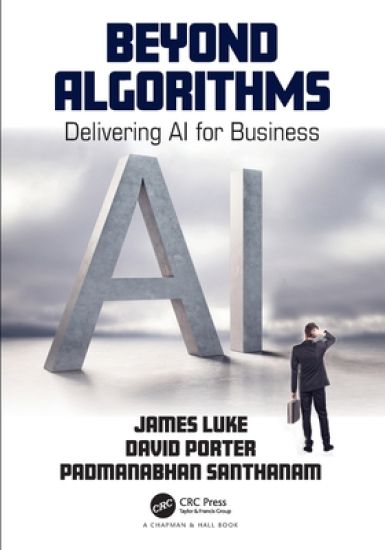
With so much artificial intelligence (AI) in the headlines, it is no surprise that businesses are scrambling to exploit this exciting and transformative technology. Clearly, those who are the first to deliver business-relevant AI will gain significant advantage.However, there is a problem! Our perception of AI success in society is primarily based on our experiences with consumer applications from the big web companies. The adoption of AI in the enterprise has been slow due to various challenges. Business applications address far more complex problems and the data needed to address them is less plentiful. There is also the critical need for alignment of AI with relevant business processes. In addition, the use of AI requires new engineering practices for application maintenance and trust.So, how do you deliver working AI applications in the enterprise?Beyond Algorithms: Delivering AI for Business answers this question. Written by three engineers with decades of experience in AI (and all the scars that come with that), this book explains what it takes to define, manage, engineer, and deliver end-to-end AI applications that work. This book presents:Core conceptual differences between AI and traditional business applicationsA new methodology that helps to prioritise AI projects and manage risksPractical case studies and examples with a focus on business impact and solution deliveryTechnical Deep Dives and Thought Experiments designed to challenge your brain and destroy your weekends