Kirjojen hintavertailu. Mukana 11 244 527 kirjaa ja 12 kauppaa.

Kirjahaku

Etsi kirjoja tekijän nimen, kirjan nimen tai ISBN:n perusteella.

1000 tulosta hakusanalla Debora Pol

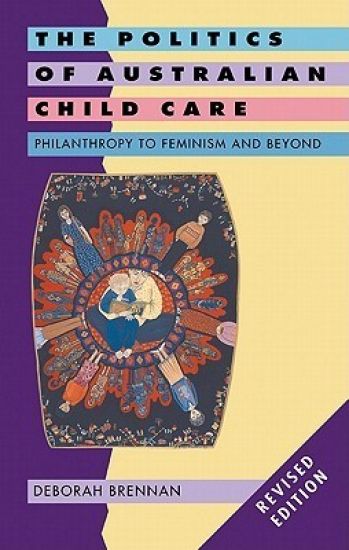
The Politics of Australian Child Care

The Politics of Australian Child Care

Deborah Brennan

Cambridge University Press
1998
pokkari
This book, now in a revised edition, is a political history of child care in Australia from the 1890s to the 1990s. Once provided by philanthropic groups and available only to those deemed underprivileged, child care has now become part of the mainstream political agenda. Deborah Brennan provides an in-depth analysis of policy developments in this significant area since the Commonwealth became involved in 1972. The revised edition provides a detailed analysis of the shifts in policy under Labor as well as an up-to-date account of developments under the Howard government since 1996.
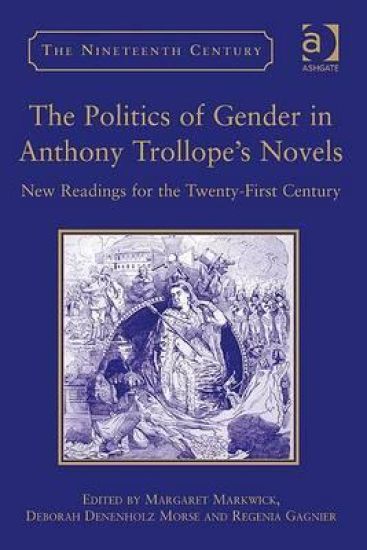
The Politics of Gender in Anthony Trollope's Novels

The Politics of Gender in Anthony Trollope's Novels

Deborah Denenholz Morse

Ashgate Publishing Limited
2009
sidottu
Bringing together established critics and exciting new voices, The Politics of Gender in Anthony Trollope's Novels offers original readings of Trollope that recognize and repay his importance as source material for scholars working in diverse fields of literary and cultural studies. As the editors observe in their provocative introduction, Trollope more than any of his contemporaries is studied by scholars from disciplines outside literary studies. The contributors here draw together work from economics, colonialism and ethnicity, gender studies, new historicism, liberalism, legal studies, and politics that convincingly argues for the eminence of Trollope's writings as a vehicle for the theoretical explorations of Victorian culture that currently predominate. The essays variously examine imperial and postcolonial themes in the context of economic, cultural, aesthetic, and demographic influences; show how gender-sensitive readings expose Trollope's critique of capitalism's influence; address Trollope and sexuality in the context of queer studies, the law, archetypal constructions, and classical feminism; and offer new approaches to narrative theory through examination of Victorian understandings of male and female psychology. Regenia Gagnier's concluding chapter revisits the collection's critical strands and reflects on the implications for future studies of Trollope.
New Policies for New Residents

New Policies for New Residents

Deborah J. Milly

Cornell University Press
2014
sidottu
In recent decades, many countries have experienced both a rapid increase of in-migration of foreign nationals and a large-scale devolution of governance to the local level. The result has been new government policies to promote the social inclusion of recently arrived residents. In New Policies for New Residents, Deborah J. Milly focuses on the intersection of these trends in Japan. Despite the country's history of restrictive immigration policies, some Japanese favor a more accepting approach to immigrants. Policies supportive of foreign residents could help attract immigrants as the country adjusts to labor market conditions and a looming demographic crisis. As well, local citizen engagement is producing more inclusive approaches to community. Milly compares the policy discussions and outcomes in Japan with those in South Korea and in two similarly challenged Mediterranean nations, Italy and Spain. All four are recent countries of immigration, and all undertook major policy innovations for immigrants by the 2000s. In Japan and Spain, local NGO–local government collaboration has influenced national policy through the advocacy of local governments. South Korea and Italy included NGO advocates as policy actors and partners at the national level far earlier as they responded to new immigration, producing policy changes that fueled local networks of governance and advocacy. In all these cases, Milly finds, nongovernmental advocacy groups have the power to shape local governance and affect national policy, though in different ways.
Jackson Pollock

Jackson Pollock

Deborah Solomon

Cooper Square Publishers Inc.,U.S.
2001
pokkari
Deborah Solomon's biography sets Jackson Pollock in his time and portrays him as a shy, often withdrawn person, full of insecurities and self-doubts, and frequently unable to express himself about his art or its meaning. Solomon interviewed two hundred people who knew Pollock and his work and she has drawn extensively on Pollock's own writings and other personal papers. She examines the artist's relationships with his family; his wife and fellow artist Lee Krasner; art patron Peggy Guggenheim; the painters Willem de Kooning, Mark Rothko, and many more.
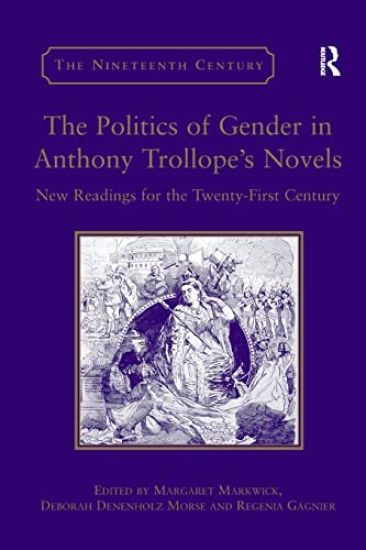
The Politics of Gender in Anthony Trollope's Novels
Bringing together established critics and exciting new voices, The Politics of Gender in Anthony Trollope's Novels offers original readings of Trollope that recognize and repay his importance as source material for scholars working in diverse fields of literary and cultural studies. As the editors observe in their provocative introduction, Trollope more than any of his contemporaries is studied by scholars from disciplines outside literary studies. The contributors here draw together work from economics, colonialism and ethnicity, gender studies, new historicism, liberalism, legal studies, and politics that convincingly argues for the eminence of Trollope's writings as a vehicle for the theoretical explorations of Victorian culture that currently predominate. The essays variously examine imperial and postcolonial themes in the context of economic, cultural, aesthetic, and demographic influences; show how gender-sensitive readings expose Trollope's critique of capitalism's influence; address Trollope and sexuality in the context of queer studies, the law, archetypal constructions, and classical feminism; and offer new approaches to narrative theory through examination of Victorian understandings of male and female psychology. Regenia Gagnier's concluding chapter revisits the collection's critical strands and reflects on the implications for future studies of Trollope.
The Polyvagal Path to Joyful Learning

The Polyvagal Path to Joyful Learning

Debra Em Wilson

WW NORTON CO
2023
nidottu
Every student and teacher is different but there’s one thing each has in common: a responsive nervous system ready for action. Whether it’s a fight breaking out in the playground, a difficult conversation with a parent or an impromptu fire drill, understanding how the nervous system responds can help keep teachers and students on an even keel. Polyvagal Theory (PVT) has had a tremendous impact on the mental health field, shedding light on how the nervous system predictably moves between different states in response to changing situations. School consultant Debra Em Wilson introduces PVT to educators and shows how using PVT-guided strategies can help create optimal learning environments. When school staff understand the role of the nervous system in learning, they can better help students develop the skills leading to increased resilience, adaptability and flexibility: essential qualities for social, emotional and academic success.
The Polyvagal Backpack

The Polyvagal Backpack

Debra Em Wilson

WW NORTON CO
2023
nidottu
In The Polyvagal Path to Joyful Learning, Debra Em Wilson introduced educators to Polyvagal Theory (PVT) and explained how human nervous systems move between different states in response to changing situations. Teachers who can recognise the oscillating states of students’ (and their own) nervous systems—“safe and engaged”, “fight-or-flight”, or “shutdown”—are better prepared to create an optimal learning environment. The Polyvagal Backpack picks up where Wilson’s first book left off by providing a plethora of classroom activities demonstrating how to implement PVT. The ease with which the principles of PVT can be applied becomes clear as Wilson draws one activity after another from her metaphorical backpack and shows how to help students co-regulate a classroom, for example, or repair a relationship. The opening true or false quiz, final FAQ section and clear descriptions throughout make this an ideal book for teacher teams to read and use together.
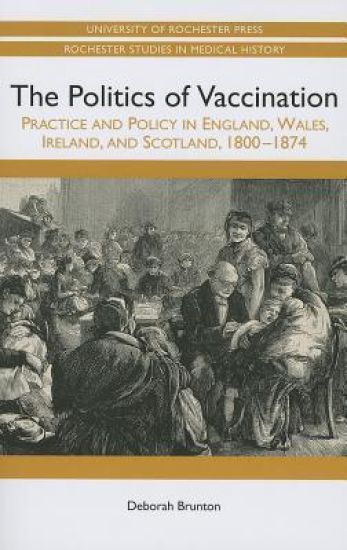
The Politics of Vaccination

The Politics of Vaccination

Deborah Brunton

University of Rochester Press
2013
pokkari
A detailed examination of the political forces and events that shaped smallpox vaccination policy in England, Wales, Ireland, and Scotland during the nineteenth century. The introduction of public vaccination was among the greatest of public health triumphs. By the end of the nineteenth century, legislation framed and implemented by medical experts in Britain's government brought smallpox under control for the first time. The Politics of Vaccination: Practice and Policy in England, Wales, Ireland, and Scotland, 1800-1874, by historian Deborah Brunton, reveals the conflict that accompanied this success, and highlights how power differentials among government officials, medical experts, and general practitioners influenced vaccination policy across Great Britain. Brunton challenges the assumption that expert supervision was crucial, showing instead that local organization was pivotal to successful public vaccination. Throughout Britain, ordinary practitioners -- eager to enhance their professional status -- demanded the right to shape and supervise public vaccination. But their achievement depended on wider political considerations, and varied from country to country. In England and Wales, for instance, practitioners were defeated by a new band of medical experts who had established apower base within government. In Scotland, medical professionals contrived to keep most vaccination within the private sector, but local enthusiasm ensured very high levels of participation. Public vaccination was most successfulin Ireland, where practitioners had limited influence over dispensary provision and smallpox was nearly eradicated, if briefly, in the 1860s. In The Politics of Vaccination, Brunton demonstrates that public vaccination was not simply a medical matter: it was a divisive political issue, with outcomes strongly influenced by competing partisan interests. Deborah Brunton is senior lecturer in History of Medicine at the Open University.
Polish-American Folklore

Polish-American Folklore

Deborah Silverman

University of Illinois Press
2000
sidottu
Integrating vivid photographs, firsthand observations, and interviews against a rich backdrop of ethnic practices and traditions, Deborah Anders Silverman explores how Polish Americans are creatively adapting the rural peasant folklore of the old country to life in multicultural, urban America. Silverman surveys rituals of courtship, marriage, coming of age, and funerals, also noting those customs that have been rediscovered after falling into disuse. She follows the trail of folk stories and delves into folk music and dance, particularly the polka, providing a detailed discussion of texts, contexts, and performance practices. She also describes birthing practices, home remedies, superstitions, folk blessings, and miracle cures. In addition, she offers a wealth of information on foodways and on the origins and celebration of holy days, from Christmas Eve vigils to the Dyngus Day festivals of the Easter season. Polish-American Folklore reveals a community that preserves distinctive traditions even though geographically dispersed in a new homeland. Polish Americans retain ties to their ethnicity though ethnic media, social clubs, churches, group events, and the Internet. This "Polonia without walls" is united by a resilient, dynamic, family-oriented culture that attracts not only Polish immigrants and their descendants but also newcomers from other ethnic and racial groups. By including first-person commentary from a wide range of Polish American individuals and families, from first-generation immigrants to non-Polish in-laws who embrace Polish foods, music, and traditions, Silverman brings to life a thriving ethnic subculture that values equally its Polish roots and its American harvest.
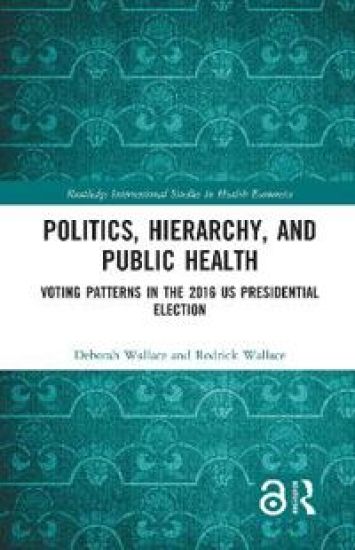
Politics, Hierarchy, and Public Health

Politics, Hierarchy, and Public Health

Deborah Wallace; Rodrick Wallace

Routledge
2019
sidottu
Steep socioeconomic hierarchy in post-industrial Western society threatens public health because of the physiological consequences of material and psychosocial insecurities and deprivations. Following on from their previous books, the authors continue their exploration of the geography of early mortality from age-related chronic conditions, of risk behaviors and their health outcomes, and of infant and child mortality, all due to rigid hierarchy. They divide the 50 states into those that gave their electoral college votes to Trump and those that gave theirs to Clinton in the 2016 presidential election and compare the two sets for socioeconomic and public health profiles. They deliberately apply only simple standard statistical methods in the public health analyses: t-test, Mann-Whitney test, bivariate regression, and backward stepwise multivariate regression. The book assumes familiarity with basic statistics.The authors argue that the unequal power relations that result in eroding public health in the nation and, in particular, in the Trump-voting states, largely cascade from the collapse of American industry, and they analyze the Cold War roots of that collapse. In two largely independent chapters on economics, they explore both the suppression of countervailing forces, such as organized labor, and the diversion of technical resources to the military as essential foundations to the population-level suffering that expressed itself in the 2016 presidential election.This interdisciplinary book has several primary audiences: creators of public policies, such as legislators and governmental staff, public health professionals and social epidemiologists, economists, labor union professionals, civil rights advocates, political scientists, historians, and students of these disciplines from public health through the social sciences.The Open Access version of this book, available at http://www.taylorfrancis.com, has been made available under a Creative Commons Attribution-Non Commercial-No Derivatives 4.0 license.
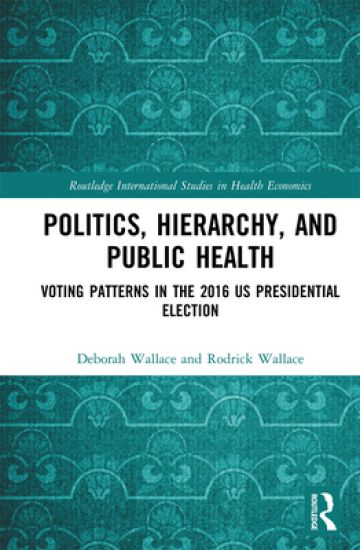
Politics, Hierarchy, and Public Health

Politics, Hierarchy, and Public Health

Deborah Wallace; Rodrick Wallace

Routledge
2021
nidottu
Steep socioeconomic hierarchy in post-industrial Western society threatens public health because of the physiological consequences of material and psychosocial insecurities and deprivations. Following on from their previous books, the authors continue their exploration of the geography of early mortality from age-related chronic conditions, of risk behaviors and their health outcomes, and of infant and child mortality, all due to rigid hierarchy. They divide the 50 states into those that gave their electoral college votes to Trump and those that gave theirs to Clinton in the 2016 presidential election and compare the two sets for socioeconomic and public health profiles. They deliberately apply only simple standard statistical methods in the public health analyses: t-test, Mann-Whitney test, bivariate regression, and backward stepwise multivariate regression. The book assumes familiarity with basic statistics.The authors argue that the unequal power relations that result in eroding public health in the nation and, in particular, in the Trump-voting states, largely cascade from the collapse of American industry, and they analyze the Cold War roots of that collapse. In two largely independent chapters on economics, they explore both the suppression of countervailing forces, such as organized labor, and the diversion of technical resources to the military as essential foundations to the population-level suffering that expressed itself in the 2016 presidential election.This interdisciplinary book has several primary audiences: creators of public policies, such as legislators and governmental staff, public health professionals and social epidemiologists, economists, labor union professionals, civil rights advocates, political scientists, historians, and students of these disciplines from public health through the social sciences.
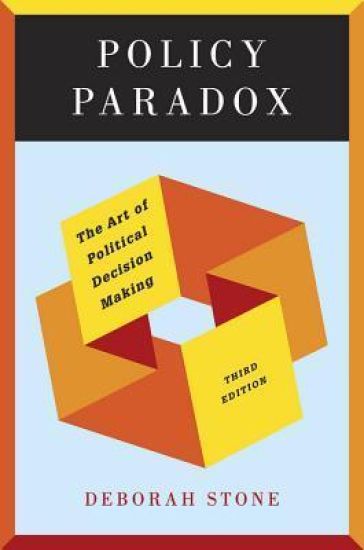
Policy Paradox

Policy Paradox

Deborah Stone

WW Norton Co
2012
nidottu
Policy making is a political struggle over values and ideas. By exposing the paradoxes that underlie even seemingly straightforward policy decisions, Policy Paradox shows students that politics cannot be cleansed from the process in favor of “rationality.” Author Deborah Stone has fully revised and updated this popular text, which now includes many paradoxes that have arisen since September 11. Examples throughout the book have been updated, and the prose has been streamlined to make a great read even better.
Contesting the Politics of Genocidal Rape

Contesting the Politics of Genocidal Rape

Debra B. Bergoffen

Routledge
2013
nidottu
Rape, traditionally a spoil of war, became a weapon of war in the ethnic cleansing campaign in Bosnia. The ICTY Kunarac court responded by transforming wartime rape from an ignored crime into a crime against humanity. In its judgment, the court argued that the rapists violated the Muslim women’s right to sexual self-determination. Announcing this right to sexual integrity, the court transformed women’s vulnerability from an invitation to abuse into a mark of human dignity. This close reading of the trial, guided by the phenomenological themes of the lived body and ambiguity, feminist critiques of the autonomous subject and the liberal sexual/social contract, critical legal theory assessments of human rights law and institutions, and psychoanalytic analyses of the politics of desire, argues that the court, by validating women’s epistemic authority (their right to establish the meaning of their experience of rape) and affirming the dignity of the vulnerable body (thereby dethroning the autonomous body as the embodiment of dignity), shows us that human rights instruments can be used to combat the epidemic of wartime rape if they are read as de-legitimating the authority of the masculine autonomous subject and the gender codes it anchors.
Contesting the Politics of Genocidal Rape

Contesting the Politics of Genocidal Rape

Debra B. Bergoffen

Routledge
2011
sidottu
Rape, traditionally a spoil of war, became a weapon of war in the ethnic cleansing campaign in Bosnia. The ICTY Kunarac court responded by transforming wartime rape from an ignored crime into a crime against humanity. In its judgment, the court argued that the rapists violated the Muslim women’s right to sexual self-determination. Announcing this right to sexual integrity, the court transformed women’s vulnerability from an invitation to abuse into a mark of human dignity. This close reading of the trial, guided by the phenomenological themes of the lived body and ambiguity, feminist critiques of the autonomous subject and the liberal sexual/social contract, critical legal theory assessments of human rights law and institutions, and psychoanalytic analyses of the politics of desire, argues that the court, by validating women’s epistemic authority (their right to establish the meaning of their experience of rape) and affirming the dignity of the vulnerable body (thereby dethroning the autonomous body as the embodiment of dignity), shows us that human rights instruments can be used to combat the epidemic of wartime rape if they are read as de-legitimating the authority of the masculine autonomous subject and the gender codes it anchors.
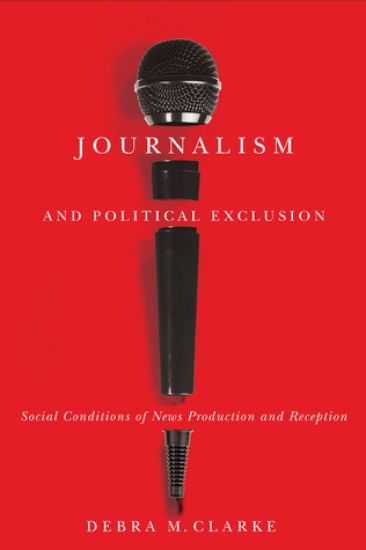
Journalism and Political Exclusion

Journalism and Political Exclusion

Debra M. Clarke

McGill-Queen's University Press
2014
sidottu
The constraints of news production and the consequent limitations of news result directly in dissatisfaction throughout news audiences. News stories are frequently found to be inadequately informative to the extent that journalism is more inclined to generate political disenchantment, rather than prompt its audiences to pursue a fully engaged level of political participation in their societies. Journalism and Political Exclusion provides a multi-method, integrated analysis of news production and news audiences, including a long-term study of community activists in a central Canadian city. During the seven-year fieldwork period, different groups of research participants completed questionnaires, wrote news diaries, and were interviewed in their homes while viewing network television newscasts. Clarke shows that frustrations with the informational limitations of television and other news media are accelerated among women and the working-class often lack opportunities to access alternative information sources. The critical contribution of journalism to the production and reproduction of ideas about social reality is frequently acknowledged and assumed yet rarely investigated and demonstrated. Through an examination of the everyday realities of both news production and news reception, Journalism and Political Exclusion also shows how the current "crises" of professional journalism heighten the level of political exclusion experienced by various social groups.
Journalism and Political Exclusion

Journalism and Political Exclusion

Debra M. Clarke

McGill-Queen's University Press
2014
nidottu
The constraints of news production and the consequent limitations of news result directly in dissatisfaction throughout news audiences. News stories are frequently found to be inadequately informative to the extent that journalism is more inclined to generate political disenchantment, rather than prompt its audiences to pursue a fully engaged level of political participation in their societies. Journalism and Political Exclusion provides a multi-method, integrated analysis of news production and news audiences, including a long-term study of community activists in a central Canadian city. During the seven-year fieldwork period, different groups of research participants completed questionnaires, wrote news diaries, and were interviewed in their homes while viewing network television newscasts. Clarke shows that frustrations with the informational limitations of television and other news media are accelerated among women and the working-class often lack opportunities to access alternative information sources. The critical contribution of journalism to the production and reproduction of ideas about social reality is frequently acknowledged and assumed yet rarely investigated and demonstrated. Through an examination of the everyday realities of both news production and news reception, Journalism and Political Exclusion also shows how the current "crises" of professional journalism heighten the level of political exclusion experienced by various social groups.